High-roller volatility is not a fringe event. It is a structural feature of iGaming revenue — and your negative carryover policy is the primary lever you control to manage it. Here is the operator-first framework for getting that policy right.
TL;DR
Negative carryover is an affiliate marketing policy where an affiliate’s negative earnings — resulting from players winning more than they lost in a given period — are carried into the following month. The affiliate must generate enough positive revenue to offset this balance before receiving new commissions. While “No Negative Carryover” is a powerful recruitment tool, a standard NCO policy is the primary mechanism operators use to hedge against high-roller volatility.
The Mechanics: How NCO Actually Hits Your Bottom Line
The theory is straightforward. The financial impact is not. Understanding exactly how a single player event propagates through your affiliate commission structure is the prerequisite for any policy decision.
The Math of a High-Roller Loss Event
Take a mid-tier affiliate — call them Affiliate A — running a 35% NGR RevShare deal. Their player cohort performs as follows in a single calendar month:
- Total cohort GGR (player losses): $10,000
- Bonus cost deduction (25%): −$2,500
- NGR before high-roller event: $7,500
- One player wins: $15,000
- Revised month-end NGR: −$7,500
- Affiliate’s 35% commission on −$7,500: −$2,625
Nobody pays a negative commission. But that −$2,625 deficit has to go somewhere. Under Standard NCO, it rolls into Month 2. The affiliate’s cohort must generate more than $2,625 in net commission before they see a single dollar paid out. Under No NCO, the deficit resets on the first of the month, and the operator absorbs the full $2,625 loss.
One affiliate. One player. One month. $2,625.
Now run that scenario across a portfolio of 300 active RevShare affiliates during a progressive jackpot cycle, and you understand why NCO policy is a financial architecture decision, not an affiliate relations nicety.
How Negative Carryover Affects RevShare Calculation
Negative carryover directly impacts RevShare calculation by introducing an NGR deficit that must be cleared before new commissions are generated. This is one of the most common triggers of affiliate commission disputes, particularly when affiliates expect a monthly commission reset but operate under a standard carryover model.
Because player net revenue fluctuates, the way NCO is applied determines how predictable affiliate earnings appear — and whether partners perceive your program as transparent or punitive.
High-Roller Quarantine: The Advanced Tactic Most Operators Don’t Use
Standard NCO calculates the affiliate’s balance across their entire player cohort. Every player’s activity — high-rollers, casual depositors, bonus hunters — aggregates into a single NGR figure. One outlier event drags the whole cohort underwater.
High-Roller Quarantine is a structural alternative. Under this model, players who exceed a defined single-session win threshold — say, $10,000 or $20,000 — are flagged and isolated from the affiliate’s standard cohort NGR calculation for that period. Their win event is treated as an operator-absorbed exceptional variance rather than a commission-base deduction.
The mechanics require platform support: your tracking system must be able to tag individual player events by win magnitude and apply different calculation rules to flagged events. This is not a feature available in generic performance marketing trackers. It requires iGaming-specific commission plan logic — the kind that Scaleo’s commission architecture is built to handle at the deal-template level.
Why does quarantine matter from a recruitment standpoint? Because it allows you to offer Standard NCO as your default policy while providing meaningful protection to affiliates who drive genuinely high-quality traffic but happen to have one VIP player capable of distorting a month’s numbers. It’s a policy that sophisticated affiliates respect — because it demonstrates you understand the statistical reality of a small cohort.
Scaleo internal data, 2025: In our analysis of $100M+ in iGaming affiliate transactions, operators who implement flexible per-affiliate NCO policies — rather than a single site-wide setting — see a 14% higher retention rate among top-performing affiliates over a 12-month period. The difference is not the policy itself. It’s the ability to tailor it.
Per-Player vs Aggregate NCO Calculation
Most affiliate programs calculate negative carryover on an aggregate basis — combining all player net revenue into a single NGR figure per affiliate. This means one high-roller can create a full cohort-level NGR deficit.
Per-player NCO calculation isolates each player’s contribution individually. A single player’s negative balance does not offset the entire cohort, reducing distortion but increasing calculation complexity.
Operators running high-value VIP traffic or hybrid RevShare models increasingly prefer per-player logic to reduce affiliate commission disputes and improve transparency.
The Policy Comparison Matrix: Four Models, Four Risk Profiles
When structuring your risk-mitigation strategy, the choice between NCO models is not a binary one. Each variant carries a distinct margin profile, affiliate sentiment outcome, and operational use case. Here is the full decision matrix.
| Policy Type | Impact on Operator Margin | Affiliate Sentiment | Best For |
|---|---|---|---|
| Standard NCO | High Protection | Low / Negative | Standard traffic volume, lower-tier or unproven partners, early-stage program with limited jackpot reserve |
| No NCO (Monthly Reset) | High Risk — operator absorbs all losses | Very High | Elite SEO affiliates with large diversified cohorts; treat as a variable acquisition cost, not a free benefit |
| Threshold Reset | Moderate — operator caps exposure | High | Most mid-market programs; a defined cap (e.g., −$500 resets to zero) balances both sides without full operator exposure |
| Quarantine Policy | Balanced — isolates outlier events | Moderate / Positive | Programs with VIP or high-roller traffic; protects affiliate cohort data from single-event distortion |
One policy does not fit all partners. The operators who treat this as a single toggle — either NCO is on or it’s off, program-wide — are leaving both margin and top-affiliate relationships on the table simultaneously.
How to Choose the Right Negative Carryover Policy
If your program has fewer than 100 active RevShare affiliates and limited jackpot reserve → use Standard NCO.
If you are recruiting SEO-driven affiliates with diversified cohorts → offer No NCO selectively.
If you operate across multiple brands or verticals → implement Threshold Reset or Bundling.
If your traffic includes VIP or high-roller segments → implement Quarantine logic.
The Operator’s Dilemma: Using NCO as a Negotiation Lever
NCO policy is negotiation currency. Used correctly, it lets you close deals with top-tier affiliates without restructuring your base commission rates — which affects your entire program — and without absorbing unlimited jackpot exposure on every partner.
Sample Negative Carryover Clause (Affiliate Agreement)
“If the Net Gaming Revenue (NGR) generated by an affiliate’s referred players is negative in any given calendar month, the negative balance shall be carried forward and offset against future positive NGR generated by the same affiliate until such balance is cleared. The Company reserves the right to apply negative carryover on a per-brand or aggregated basis across all products operated under the same license.”
When to Offer No NCO — and Who Actually Earns It
No Negative Carryover should be treated as a premium program feature, not a default. The affiliates who justify it share three characteristics: a large, diversified player cohort (200+ active players), proven first-party SEO traffic with organic search attribution, and a documented track record of generating positive NGR across at minimum two consecutive quarters.
Why does cohort size matter?
Because statistical variance is a function of sample size. An affiliate with 20 players has a meaningful probability of one high-roller event wiping out the entire cohort NGR in a single month. An affiliate with 500 players has that same event absorbed across a far larger base — the distortion is proportionally smaller and the operator’s expected loss on a monthly reset is bounded.
When structuring your risk-mitigation strategy, consider No NCO as a variable acquisition cost in your partner budget rather than a pure liability. If an elite SEO affiliate with a 500-player cohort generates an average of $28,000 NGR per month and requires No NCO to join your program, your expected monthly reset exposure — assuming one $15,000 jackpot event every six months — is approximately $2,500 amortized. Against a $28,000 average monthly NGR, that is a 9% acquisition premium. You would pay significantly more than that in CPA for equivalent traffic quality.
The Per-Affiliate NCO Toggle: Why Platform Architecture Matters
Most affiliate software treats NCO as a site-wide setting. It is on or it is off. Every partner operates under the same policy. That limitation forces a false choice: either you protect your margins across the board and lose top-tier affiliate recruitment leverage, or you offer No NCO to everyone and absorb disproportionate exposure from your riskiest partners.
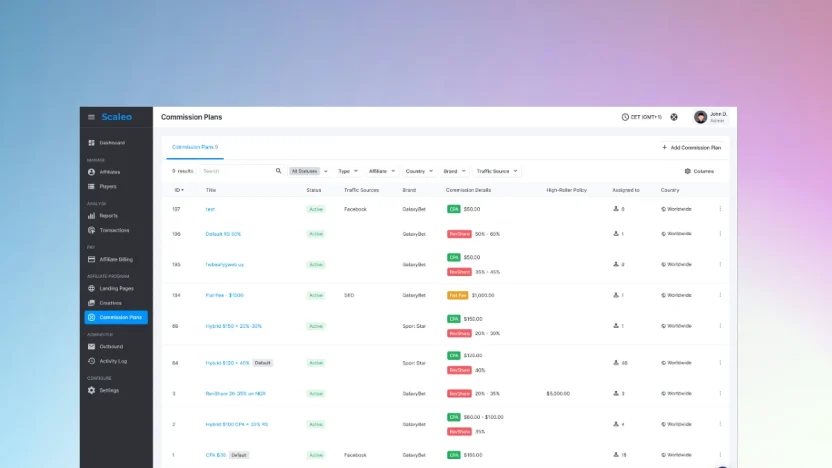
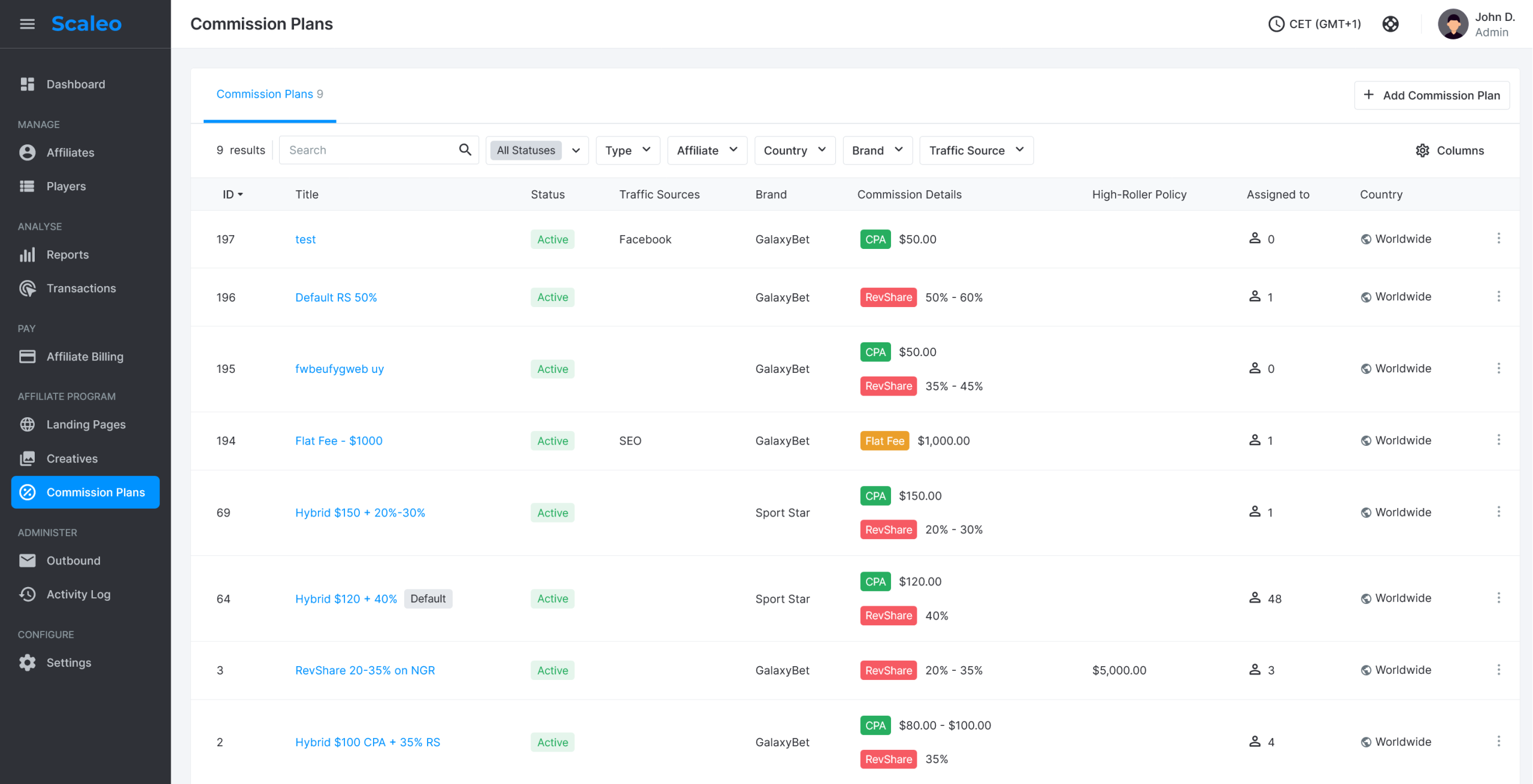
In Scaleo, NCO policy is assigned at the commission plan level — which means per affiliate, per deal. An operator can run Standard NCO for 90% of their partner portfolio and No NCO for three specific VIP affiliate relationships, simultaneously, with no manual tracking required. The platform calculates, applies, and logs the correct policy for each affiliate automatically at every commission cycle.
This is not a minor operational convenience. It is the structural prerequisite for using NCO as a negotiation lever at all. Without per-affiliate configuration, you are not negotiating — you are choosing a single policy for everyone and hoping it works.
⚠️ Regulatory note: In jurisdictions regulated by the UKGC and MGA, operators are required to maintain auditable records of all affiliate commission calculations. A per-affiliate NCO policy that exists as an informal arrangement — “we agreed verbally to reset their balance” — does not satisfy this requirement. Every NCO policy variant must be documented in the affiliate agreement and enforced through automated platform logic with a full audit trail. Manual overrides tracked in a spreadsheet are not a compliance-grade solution.
Why Manual NCO Tracking Fails — and What Breaks First
The operational complexity of NCO scales with every variable you introduce: multiple currencies, sub-affiliate tiers, hybrid CPA-plus-RevShare deals, and per-affiliate policy variants. At small program sizes — under 30 active RevShare partners — manual tracking in a spreadsheet is painful but survivable. At 100 partners, it has already generated errors. At 300 partners, it is generating disputes.
Multi-Currency NCO: The Calculation Layer Most Operators Underestimate
An affiliate operating across EUR, GBP, and CAD markets generates NGR in three currencies.
The negative balance from a GBP high-roller event needs to be carried forward and applied against future GBP-denominated NGR — not converted to EUR at a point-in-time FX rate and aggregated. Currency isolation in NCO calculation is a specific technical requirement that generic trackers handle poorly.
The rounding error alone across a multi-currency program running 12 monthly commission cycles is material.
Scaleo’s commission plan architecture handles currency-isolated NGR calculation natively — the negative balance is tracked in its originating currency and only converted to payout currency at the final commission calculation stage.
That distinction prevents a class of reconciliation dispute that operators running manual or generic-tracker NCO management encounter regularly.
Sub-Affiliate Tiers and NCO Bundling
Bundling is the practice of aggregating NGR across multiple brands or sub-affiliate tiers within the same operator group when calculating NCO balances. In a multi-brand operation — say, a casino brand and a sportsbook brand under the same license — a loss event on the casino side can be offset against positive NGR on the sportsbook side before the affiliate’s commission balance is calculated.
Whether bundling benefits the operator or the affiliate depends entirely on which brand is generating the surplus. Operators who run bundled NCO calculations on multi-brand programs can smooth out single-brand variance events. Affiliates whose traffic skews toward one brand heavily may find bundling reduces their visible commission during periods when their primary brand runs a loss.
The policy must be explicit in the affiliate agreement — “negative balances may be calculated across all brands operated by [Company]” — otherwise it is a retroactive policy change, which destroys partner trust faster than almost any other dispute type.
NCO Configuration in Practice: The Implementation Checklist
Before you publish your affiliate program terms, each of these questions needs a written answer — and a corresponding platform configuration.
- What is your default NCO policy? Standard carry, threshold reset, or monthly reset? This applies to every affiliate not on a custom deal.
- What is your threshold figure if you use a threshold reset model? State a specific number — not “a reasonable amount.”
- Does your platform support per-affiliate NCO assignment? If not, you cannot offer premium partners a different policy without a manual workaround that will eventually fail.
- Does your platform track carryover balances in originating currency or convert at calculation time? For multi-currency programs, this is a material distinction.
- Do you operate a multi-brand program? If so, is NCO calculated per-brand or bundled? Must be stated explicitly in your agreement.
- Do you have a Quarantine policy for exceptional win events? If so, what is the win threshold that triggers quarantine, and how is it applied?
- Is your NCO calculation automated and logged? Manual overrides tracked outside the platform are not audit-ready.
Every unanswered question on this list is a future dispute. Operators who work through these before launching their program have significantly fewer commission reconciliation conversations than those who set a commission rate and figure out the rest later.
NCO Policy Is Only Flexible If Your Platform Supports Flexibility
A program-wide NCO toggle is a blunt instrument. The operators running per-affiliate NCO policy — Standard carry for the portfolio, No NCO for three master affiliates, Quarantine logic for VIP-traffic partners — are running a more sophisticated risk management operation than their competitors. That sophistication requires a platform that handles it automatically, logs it auditably, and surfaces it transparently to each affiliate in their portal.
See how Scaleo’s commission plan architecture handles per-affiliate NCO configuration, multi-currency balance tracking, and the anti-fraud layer that ensures the players driving your NCO events are being properly identified before they distort another month’s numbers.
Frequently Asked Questions
Does negative carryover affect CPA deals?
No. Negative carryover only applies to Revenue Share and hybrid RevShare-plus-CPA deals. A pure CPA commission is paid on a qualifying event — a first deposit, a verified registration — and that event either qualifies or it doesn’t. There is no running balance to carry forward. In a hybrid deal, the CPA component continues paying on qualifying FTDs regardless of the RevShare balance. Only the RevShare portion of the commission is affected by NCO. This is worth stating clearly in your agreement, because affiliates on hybrid deals sometimes assume NCO freezes all payouts — including the CPA component — which is not correct under a properly structured hybrid deal.
Can I implement negative carryover retroactively on existing affiliates?
Technically, yes. In practice, do not. Retroactive policy changes — applying NCO to an affiliate who joined under a No NCO agreement, or changing a threshold figure mid-relationship — destroy partner trust faster than almost any other action in affiliate management. The financial gain from a retroactive policy change is almost always smaller than the cost of the affiliate relationship, the potential forum complaints, and the signal it sends to every other partner in your program watching how you treat existing partners. If you need to change NCO policy for an affiliate, negotiate it explicitly at renewal with appropriate notice, document it in a written amendment, and give the affiliate time to adjust their traffic strategy.
What is NCO “bundling” and how does it work?
Bundling refers to aggregating NGR across multiple brands or products within the same operator group when calculating an affiliate’s monthly commission balance. If an operator runs both a casino and a sportsbook under the same affiliate program, a negative NGR month on the casino side can be offset against positive NGR on the sportsbook side before the affiliate’s commission is calculated. Bundling can benefit the operator by smoothing single-brand variance events, or benefit the affiliate if one underperforming brand offsets a positive balance elsewhere. It must be defined explicitly in the affiliate agreement — retroactive bundling is the kind of policy surprise that generates public complaints on affiliate forums and GPWA threads.
How does NCO interact with sub-affiliate commission structures?
Sub-affiliate tiers — where a master affiliate earns an override on the NGR produced by affiliates they’ve recruited — add a calculation layer. The sub-affiliate’s own negative balance should not propagate upward to affect the master affiliate’s override calculation unless your agreement explicitly states otherwise. In most well-structured programs, NCO is calculated independently at each tier level. If your platform aggregates sub-affiliate NGR into the master affiliate’s balance before applying NCO, you need to disclose that clearly — and verify that your platform actually handles tiered NCO calculation correctly, because many do not.
What happens to an affiliate’s negative balance if I close their account?
If an affiliate’s account is closed while carrying a negative NCO balance, the standard position—the one that should be stated in your terms— is that the balance is written off. You cannot pursue an affiliate for a negative commission balance; that is not how revenue-share agreements work. What you can do is delay account closure until the end of a billing cycle and apply any positive NGR generated in the final period against the outstanding balance before settlement. The key is having this written into your termination clause so the process is not improvised at the point of closure.