The affiliate software question most operators ask too late: “Can I keep my tracking platform if I change casino backends?” If your affiliate software came bundled with your platform provider, the answer is almost certainly no — and by then, you already know what that costs.
⚡ Standalone vs Bundled iGaming Affiliate Software
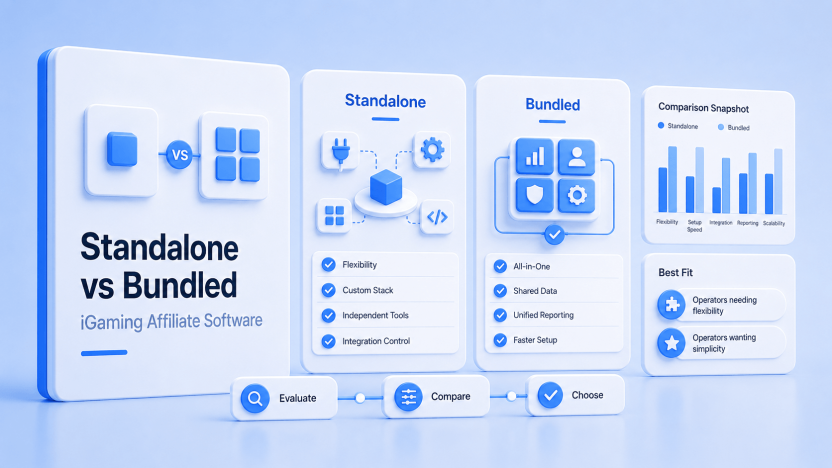
Standalone iGaming affiliate software connects to your casino or sportsbook backend via API, operating independently of whichever Player Account Management (PAM) system or game aggregator you run. Bundled affiliate software is a module within a casino platform ecosystem—functionally integrated but architecturally tied. Operators who build affiliate programs on bundled software own their commission rates and their creatives. They do not own their affiliate data in any portable, platform-independent sense. That distinction is invisible until you need to migrate — and then it becomes the most expensive line item in the project.
The Architecture Difference: What “Standalone” Actually Means
The word “standalone” gets used loosely in iGaming software sales conversations, so let’s define it precisely in technical terms.
A standalone affiliate platform connects to your casino or sportsbook backend through a documented API layer. It receives player events — registrations, KYC completions, deposits, wagers, withdrawals — as structured data from your PAM, processes them according to its own commission logic, and operates its own affiliate portal, tracking infrastructure, and reporting stack. It does not care which PAM sent the data. Change the PAM, update the API integration, and the affiliate platform continues operating. Your affiliate relationships, commission history, tracking links, and performance data stay in the affiliate platform.
A bundled affiliate module is a different architecture.
It is not a separate product that integrates with the casino platform — it is a component of the casino platform. Player data does not flow to the affiliate module via API; it is already inside the same system. The affiliate module reads directly from the platform’s internal data structures. This makes the initial integration seamless and the ongoing maintenance minimal. It also makes the affiliate module inseparable from the platform in any practical sense.
When you leave the casino platform, you leave the affiliate module. The data model, the historical records, the affiliate account structure — these are stored in the platform’s proprietary format. There is no standardized export. There is no affiliate data portability spec that bundled providers are obligated to honor. What you get at the end of a bundled relationship is whatever the contract says you get — and most operators don’t read that clause until they need it.
The PAM-Agnostic Standard: What to Verify Before Signing
A genuinely PAM-agnostic affiliate tracking platform should satisfy four technical criteria without conditions:
- Open postback schema: The platform accepts player events from any source via a documented S2S postback or API endpoint. No proprietary event format required from the sending system.
- Portable affiliate data: Affiliate accounts, tracking links, commission history, and NGR records are exportable in a standard format (CSV, JSON) at any time, without restriction, without requiring vendor cooperation.
- Independent tracking infrastructure: Tracking domains, click logs, and conversion records are hosted within the affiliate platform, not within the casino backend. They persist independently of the casino platform’s operational status.
- Multi-backend support: The platform has documented integrations with more than one casino backend provider and can connect to custom or proprietary PAM systems via its postback API without requiring a pre-built connector.
Ask these four questions before signing any affiliate software agreement. If the answer to any of them is conditional — “yes, as long as you stay on our platform” — you are evaluating a bundled module, not a standalone product, regardless of how it is marketed.
The Real Cost of Platform Lock-In: Beyond the Invoice
The license fee for a bundled affiliate module is often lower than a standalone SaaS platform — sometimes significantly so, because it is priced as an add-on rather than a primary product. That price difference is real. So is the cost structure it obscures.
Cost 1: Affiliate Data That Belongs to the Platform, Not to You
Your affiliate program’s data — the click-to-FTD attribution history, the NGR records per affiliate per period, the fraud event logs, the commission calculation audit trail — is the institutional memory of your acquisition program. It tells you which affiliates generate high-LTV players. It tells you which traffic sources perform in which markets. It is the foundation on which you negotiate future deals, identify fraud patterns, and defend commission calculations in disputes.
In a bundled architecture, this data exists inside the casino platform’s database. You access it through the affiliate module’s reporting interface. The data itself is not yours to extract, transform, and take elsewhere in any complete sense. When you migrate casino platforms, you lose continuous access to that history. You may receive a data export — the completeness and format of which varies by provider and contract — but you lose the live, queryable relationship between that historical data and your new platform’s attribution model.
Practically: affiliates who join your program after a platform migration have a clean record in the new system. Affiliates who predate the migration have historical records in a format that does not natively integrate with the new platform. Your affiliate team spends months reconciling two data sets. Your top affiliates spend months getting inaccurate commission statements while the reconciliation runs. Some of them leave.
Cost 2: Tracking Link Continuity
Every affiliate in your program has tracking links embedded across their content — review pages, comparison tables, banner placements, deep links to specific game lobbies. These links contain your tracking domain and the affiliate’s unique identifiers. In a bundled system, the tracking domain is typically a subdomain of the casino platform or a domain managed by the platform provider.
When you migrate platforms, those tracking links break or redirect to an undefined destination — unless you have negotiated a specific link migration arrangement with both the outgoing and incoming providers. In practice, this negotiation is complex, time-consuming, and often incomplete. The result is a period during migration — typically four to twelve weeks — where affiliate tracking is degraded or non-functional. Affiliates are sending traffic. Conversions are occurring. None of it is being attributed. Commission disputes follow.
A standalone affiliate platform owns its own tracking infrastructure. The tracking domains, the click logs, the redirect logic — these sit within the affiliate platform, not within the casino backend. A casino platform migration leaves the affiliate tracking layer completely unaffected. Affiliates keep their links. Attribution continues without interruption. The migration is invisible to your affiliate program.
Cost 3: Negotiating Leverage You No Longer Have
Platform providers know that affiliate data lock-in reduces operator switching behavior.
An operator who has built a three-year affiliate program on a bundled module faces a non-trivial migration cost every time they consider changing casino platforms — even if the platform is underperforming, overcharging, or failing to release product features on schedule.
This is not a hypothetical commercial dynamic. It is the explicit business rationale behind bundled ecosystem strategies. The affiliate module is not primarily a revenue line for these providers — it is a retention mechanism. The cost of that retention is paid by the operator, in the form of reduced leverage in every platform contract negotiation they conduct for the duration of the relationship.
An operator running a standalone, PAM-agnostic affiliate platform can change casino backends without touching their affiliate program. That option — the credible threat of migration — is worth more in contract negotiations than most operators account for when they price the “savings” of a bundled module.
Scaleo internal data, 2025: Operators who migrated to Scaleo from bundled affiliate modules reported an average of 11 weeks of degraded affiliate attribution during the transition period from their previous platform — time during which commissions were calculated manually or estimated. Post-migration, the same operators reported a 34% reduction in affiliate commission disputes within the first six months, attributed to automated NGR calculation replacing manual reconciliation processes inherited from the bundled system.
When Bundled Works Fine — and When It Doesn’t
Bundled affiliate software is not always the wrong choice. There are specific operator profiles for which it is the rational decision. There are others for which it is a structural mistake that compounds over time. The distinction matters, because the bundled module sales pitch is persuasive precisely because it is genuinely true for some operators.
Scenarios Where Bundled Is Defensible
Single-platform operators with no migration horizon. If you have launched on a specific casino platform, you have no intention of changing it, and your affiliate program is a secondary acquisition channel rather than a primary revenue driver, the bundled module’s lower cost and zero integration overhead is a reasonable trade. You are not building negotiating leverage you have no intention of using, and the data portability risk is theoretical rather than practical.
Startups validating the affiliate channel. An operator in the first 12 months of operation, testing whether affiliate traffic is worth investing in at scale, does not need a standalone affiliate platform with full PAM-agnostic API architecture. The bundled module gets you to market faster with lower upfront cost. The caveat: treat this as a temporary arrangement and plan the migration to standalone before your affiliate program grows large enough that migration becomes painful.
Operators fully committed to a vertically integrated stack. Some operators deliberately choose a fully integrated stack — casino platform, game aggregator, payments, affiliate module — and treat integration simplicity as a strategic asset. This is a coherent position. Its cost is platform dependency, and that cost is acceptable if the integrated stack continues to perform competitively. The moment it doesn’t, the exit cost becomes material.
Scenarios Where Standalone Is Non-Negotiable
Multi-platform operators. Any operator running more than one casino or sportsbook brand across different casino backends cannot use a single bundled affiliate module because each backend has its own module. Running two bundled modules means running two affiliate programs — two sets of affiliate accounts, two tracking domains, two commission histories, and two reporting stacks. There is no unified view of affiliate performance across brands. Scaleo’s multi-brand architecture handles this as a native feature: one platform, one affiliate portal, multiple brand tracking configurations, unified reporting.
Operators planning a platform migration. If you are currently evaluating casino platform providers, or if your current platform relationship has any commercial tension, you are a platform migration risk. Build your affiliate program on a standalone platform before you migrate, not after. The cost of migrating affiliate software and casino platform simultaneously is significantly higher than migrating them independently — and the affiliate relationship damage during a combined migration can take 12–18 months to repair.
Operators with large, high-value affiliate portfolios. The 20 affiliates who drive 80% of your NGR are not interchangeable. They have institutional relationships with your program, historical commission records, custom deal structures, and specific technical integrations. Losing affiliate data continuity on these relationships during a platform migration is not an inconvenience — it is a commercial risk with a quantifiable dollar value. Standalone platforms protect that relationship continuity regardless of what happens at the casino backend layer.
Operators in regulated multi-jurisdiction markets. The MGA and UKGC require operators to maintain auditable records of affiliate commission calculations. A bundled affiliate module whose data is not independently exportable creates a compliance risk: if the platform provider experiences downtime, insolvency, or a contractual dispute, your access to historical commission records may be interrupted at the moment a regulator requests them. Standalone platforms with independent data hosting eliminate that dependency.
What You Actually Give Up: A Factual Assessment
This section covers two of the most common bundled affiliate module situations operators ask about. The assessment is factual, not adversarial — both platforms have genuine strengths within their ecosystems. The question is what happens outside those ecosystems.
If You Leave the SoftSwiss Ecosystem
SoftSwiss’s affiliate module is natively integrated with the SoftSwiss Game Aggregator and back-office. Within that ecosystem, the integration is seamless — NGR data flows directly without postback configuration, and the affiliate module inherits the platform’s player data model automatically.
If you migrate away from SoftSwiss to a different game aggregator or PAM, the affiliate module loses its data source. The native integration that made it valuable becomes the reason it cannot follow you. You will need to either migrate to a new affiliate platform simultaneously with your casino platform migration — compounding the complexity and the affiliate relationship risk — or attempt to maintain the old affiliate module in a degraded state while the new casino platform is built out, which creates a split-brain attribution problem.
Operators searching for a SoftSwiss alternative who want to preserve affiliate program continuity through the migration need a PAM-agnostic platform that can be integrated with the new backend before the SoftSwiss relationship ends, running in parallel during a transition period, and then taking over cleanly when the cutover occurs. That parallel-run capability requires a platform with an open postback schema and multi-backend integration support — the defining characteristics of a standalone platform.
If You Leave the EveryMatrix Ecosystem
EveryMatrix’s affiliate module operates within the EveryMatrix platform stack in a comparable architectural pattern. The integration with the EveryMatrix casino engine means player events are available to the affiliate module without external API configuration. The affiliate module is a component of the platform contract, not a separately licensed product.
Operators evaluating EveryMatrix alternatives face the same structural question: the affiliate program you built on EveryMatrix’s module is not portable. The historical NGR data, the affiliate account records, the tracking link infrastructure — these are within the EveryMatrix environment. A migration away from EveryMatrix requires a decision about the affiliate program: rebuild it on a new platform from scratch, or find a standalone platform that can be integrated with the new backend and accept a data migration with whatever completeness the EveryMatrix export provides.
The answer to “can I use something other than the bundled module while staying on EveryMatrix or SoftSwiss?” is technically yes in some cases — both platforms have varying degrees of API openness.
But the commercial and contractual reality is that using a third-party affiliate platform alongside a bundled module provider requires explicit agreement, creates data flow complexity, and may not be supported at all tiers of those providers’ commercial arrangements. Verify the specific terms with both parties before assuming this is straightforward.
The Migration Playbook: Switching to a Standalone Platform Without Destroying Your Affiliate Program
The operators who migrate successfully — keeping affiliate relationships intact and attribution continuous — do it in a specific sequence. The operators who damage their affiliate programs during migration typically invert that sequence.
- Stand up the standalone platform first, before cutting over. Configure Scaleo — or whichever standalone platform you are moving to — against your existing casino backend simultaneously with the old affiliate module. Run both systems in parallel for a minimum of one full commission cycle. Verify that player events are flowing correctly, that NGR calculations match between systems, and that tracking attribution is consistent. Do not cut over until you have a verified parallel run.
- Migrate affiliate accounts before migrating tracking links. Import affiliate account data into the new platform. Issue new tracking links to all active affiliates — ideally in a single communication with a clear cutover date and a 30-day overlap period during which both old and new links are valid. This is the step most operators rush and most regret. Give affiliates time to update their links before deprecating the old ones.
- Export all historical data from the bundled system before your contract ends. Request the most complete export available — affiliate accounts, commission history, player-to-affiliate attribution records, fraud event logs — and verify that the export is complete before terminating the contract. Once the contract ends, your leverage to request additional data disappears.
- Notify affiliates before the cutover, not after. Affiliates who discover that their tracking links have changed by noticing a drop in attributed conversions are affiliates who are already composing a forum post about your program. A proactive communication — here is what is changing, here is your new link, here is what happens to your historical commission records — converts a potential relationship crisis into a routine administrative update.
- Run commission reconciliation across both periods at the first post-migration payment run. The payment cycle that spans the migration date will have attribution split between two systems. Reconcile it manually, document it explicitly in affiliate statements, and communicate any anomalies before affiliates ask about them.
Scaleo as a PAM-Agnostic Option: What the Independence Actually Delivers
Scaleo is built as casino affiliate software that is independent of any specific casino backend. The platform connects to any PAM — proprietary, white-label, or custom-built — via its S2S postback API. There is no pre-built connector requirement. If your casino backend can fire an HTTP postback when a player event occurs, Scaleo can receive it, attribute it, and process it through its commission logic.
The practical consequences of that architecture are specific:
Your affiliate data is yours. Affiliate accounts, tracking links, commission history, and NGR records are stored within Scaleo’s platform — not within your casino backend. They are exportable on demand in standard formats. If you change casino platforms, your Scaleo instance continues operating without interruption. Your affiliates keep their links. Your commission history is continuous. Your fraud scoring records are intact.
Multi-backend operations are a native use case. Running a casino brand on one backend and a sportsbook brand on another — or migrating from one backend to another while keeping the second brand live — is a standard Scaleo deployment pattern. The platform’s multi-brand architecture handles separate tracking configurations, commission plans, and reporting instances for each backend within a single operator account. Affiliates see a unified portal. The operator sees unified cross-brand reporting. The backends are operationally independent.
Migration support is built into the integration model. Because Scaleo connects via open postback API rather than proprietary data connectors, it can run in parallel with a bundled module during a migration period. Both systems receive player events from the casino backend simultaneously. Commission calculations can be compared between systems before cutover. When you are ready to switch, you disable the old module’s postback and Scaleo becomes the sole attribution system — without a gap in tracking.
We, the team behind Scaleo, have onboarded operators in the middle of casino platform migrations — where the existing affiliate module was bundled with a departing platform and could not migrate. The consistent finding is that the affiliate program damage from a bundled migration is not primarily technical. It is relational: affiliates who experience unexplained drops in attributed conversions, delayed commission statements, or commission recalculations during a migration are affiliates who update their mental model of your program’s reliability. Recovering that trust takes longer than fixing the technical integration.
Build the standalone infrastructure before you need it.
⚠️ Contract checklist before signing any affiliate software agreement: Confirm in writing that you own all affiliate data and can export it in full at any time. Confirm that tracking domains can be migrated or redirected if you change providers. Confirm that the affiliate module operates independently of any other product in the vendor’s stack. If any of these confirmations require conditions or caveats, get them in writing before signing — not as a comfort measure, but because these terms determine your exit cost from the relationship.
Frequently Asked Questions
Can I use a standalone affiliate platform while staying on SoftSwiss or EveryMatrix?
Technically possible in some configurations, but not straightforward. Both platform ecosystems have varying degrees of API openness at different contract tiers. Using a third-party standalone affiliate platform alongside a bundled module provider requires explicit commercial agreement with the platform provider, a data flow architecture that avoids double-attribution, and clarity on which system is the commission-of-record. Verify the specific terms with your platform provider before assuming this is a supported configuration. For operators who want to migrate to a standalone platform, the cleaner approach is a planned cutover with a parallel-run period rather than running both systems indefinitely.
What happens to my affiliate data when I migrate casino platforms?
If your affiliate software is bundled with your casino platform, your affiliate data — commission history, player-to-affiliate attribution records, tracking link infrastructure — is stored within the casino platform’s environment.
At migration, you receive whatever data export your contract entitles you to. The completeness and format of this export varies by provider. In most cases it is sufficient for historical reference but insufficient for direct import into a new platform’s live attribution model. If your affiliate software is standalone and PAM-agnostic, a casino platform migration leaves your affiliate data completely unaffected — it stays in the affiliate platform, which continues operating against the new casino backend via its API integration.
What is affiliate data portability and why does it matter?
Affiliate data portability is the ability to export your affiliate program’s complete historical records — affiliate accounts, tracking link attribution history, commission calculations, NGR records, fraud event logs — in a standard format, at any time, without requiring vendor cooperation or paying a migration fee. It matters because affiliate program data is the institutional memory of your acquisition channel. Operators who cannot port their affiliate data when changing platforms are forced to either stay on an underperforming platform or rebuild their affiliate program’s historical record from scratch on the new one.
- Standalone platforms with open data export are the baseline for portability.
- Bundled modules are not designed with portability as a priority.
How long does migrating from a bundled to a standalone affiliate platform take?
For a program with under 100 active affiliates, a well-planned migration from a bundled module to a standalone platform takes four to eight weeks from integration start to full cutover — assuming the casino backend API is documented and accessible.
The majority of that time is parallel-run validation: verifying that player events are being attributed correctly, that NGR calculations match between systems, and that tracking links have been updated by active affiliates. For larger programs — 200-plus active affiliates, multi-currency, multi-brand — plan for eight to sixteen weeks and budget for a dedicated migration resource on your affiliate team.
The technical integration is rarely the bottleneck. Affiliate communication and link migration are.
Does Scaleo integrate with any casino backend or PAM?
Yes! Scaleo connects to any casino or sportsbook backend that can fire S2S postback events — which covers every major PAM and game aggregator in the market, as well as custom-built proprietary systems.
There is no pre-built connector requirement. The integration requires configuring your casino backend to fire postback events to Scaleo’s endpoint when defined player events occur (registration, KYC, deposit, wager, withdrawal). Scaleo’s postback documentation covers the event schema and parameter structure. For operators migrating from a bundled system, Scaleo can run in parallel with the existing module during a transition period, receiving the same postback events simultaneously until the cutover is confirmed and the old module is decommissioned.
Your Affiliate Program Should Survive Any Platform Decision You Make
The casino platform you run today is not necessarily the one you will run in three years. Market conditions change. Platform performance diverges from sales promises. Better technology emerges. Your affiliate program — the affiliate relationships, the commission history, the attribution data — should not be held hostage to that uncertainty. A PAM-agnostic affiliate platform is not a hedge against a decision you plan to make. It is the baseline infrastructure for an operator who intends to stay in control of their acquisition channel regardless of what happens at the backend layer.
See how Scaleo’s PAM-agnostic architecture handles multi-backend deployments, parallel migration runs, and affiliate data portability — or explore the anti-fraud engine that runs independently of your casino backend from the first click.
FAQ
What is the difference between standalone and bundled iGaming affiliate software?
Standalone iGaming affiliate software connects to any casino or sportsbook backend via a documented API layer and operates independently — it has its own tracking infrastructure, affiliate portal, and commission logic that persist regardless of which PAM or game aggregator the operator uses. Bundled affiliate software is a module within a casino platform ecosystem, reading player data directly from the platform’s internal database. The functional difference is that standalone software survives a casino platform migration intact, while bundled software is architecturally inseparable from the platform — when the operator leaves the casino platform, they leave the affiliate module and lose portable access to their affiliate program data.
What happens to affiliate tracking links when an operator migrates away from a bundled platform?
In a bundled architecture, tracking domains are typically subdomains of the casino platform or managed by the platform provider. When the operator migrates to a new platform, those tracking links either break or redirect to an undefined destination unless a specific link migration arrangement is negotiated with both the outgoing and incoming providers. This negotiation is complex and frequently incomplete. During migration — typically four to twelve weeks — affiliate tracking is degraded or non-functional: affiliates are sending traffic, conversions are occurring, and none of it is being attributed correctly. Commission disputes follow, and the best-performing affiliates, who monitor their tracking most closely, are usually the first to notice and the first to reduce traffic or leave the program.
How can operators verify whether affiliate software is truly PAM-agnostic before signing?
Ask four specific technical questions before signing: Does the platform accept player events from any source via a documented S2S postback or API endpoint with no proprietary format required from the sending system? Are affiliate accounts, tracking links, commission history, and NGR records exportable in a standard format (CSV, JSON) at any time without restriction? Does the tracking infrastructure — domains, click logs, redirect logic — sit within the affiliate platform independently of the casino backend’s operational status? Does the platform have documented integrations with more than one casino backend provider? If any answer is conditional — “yes, as long as you remain on our platform” — the software being evaluated is a bundled module regardless of how it is marketed.
What affiliate data is at risk when an operator is locked into a bundled platform?
The data at risk includes the complete click-to-FTD attribution history, NGR records per affiliate per period, fraud event logs, commission calculation audit trails, and affiliate account structures. This data is the institutional memory of the acquisition program — it determines which affiliates receive tier upgrades, supports commission dispute resolution, and provides the historical baseline for fraud pattern analysis. In a bundled architecture, this data exists inside the casino platform’s proprietary database. At contract end, operators typically receive a partial export in a format that does not natively integrate with the new platform’s attribution model, requiring months of reconciliation and frequently resulting in commission statements that do not match affiliates’ own records during the transition period.
Is bundled iGaming affiliate software always cheaper than standalone alternatives?
The license fee for a bundled module is often lower because it is priced as an add-on rather than a primary product. However, the total cost of ownership is higher for most operators over a three-to-five year horizon when factoring in: the cost of affiliate team overhead during any platform migration; the commission disputes and affiliate churn that result from tracking degradation during migration, the reduced negotiating leverage with the platform provider due to data lock-in, and the opportunity cost of affiliate program features that a dedicated standalone platform ships on its own roadmap versus a bundled module that is deprioritized in the platform provider’s development queue. Operators who have migrated from bundled to standalone solutions consistently report that the migration costs more than they anticipated — because the affiliate data portability gap only becomes visible when the migration is already in progress.