When an iGaming affiliate postback fails, conversions go unrecorded, affiliates stop trusting reports, and finance teams cannot reconcile payouts. Most postback failures in casino and sportsbook affiliate programs are not caused by broken infrastructure — they are caused by misconfigured click ID handling, endpoint timeouts, or parameter mismatches between the operator’s backend and the affiliate tracking platform.
This guide walks operators through the most common postback failure patterns in iGaming, how to diagnose each one, and how to fix it before it damages partner relationships or distorts your marketing data.
TL;DR — Key Takeaways for Casino and Sportsbook Operators
- Postback failures in iGaming affiliate programs most commonly originate from click ID loss during session handoffs—not from network or server errors, and the symptoms typically surface days or weeks after the misconfiguration occurs.
- Server-to-server (S2S) postback tracking eliminates browser dependency from attribution, but introduces strict requirements for click ID persistence, endpoint availability, and parameter formatting that operators must validate on both sides of the integration.
- The five most common iGaming postback failure modes are click ID truncation, endpoint timeout, duplicate event firing, parameter mismatch between operator and platform, and delayed postback execution that falls outside the attribution window.
- A systematic diagnostic workflow — starting with click ID verification, then endpoint response validation, then event-level log comparison — resolves 90% of postback issues within hours rather than the weeks of email-based troubleshooting that most programs default to.
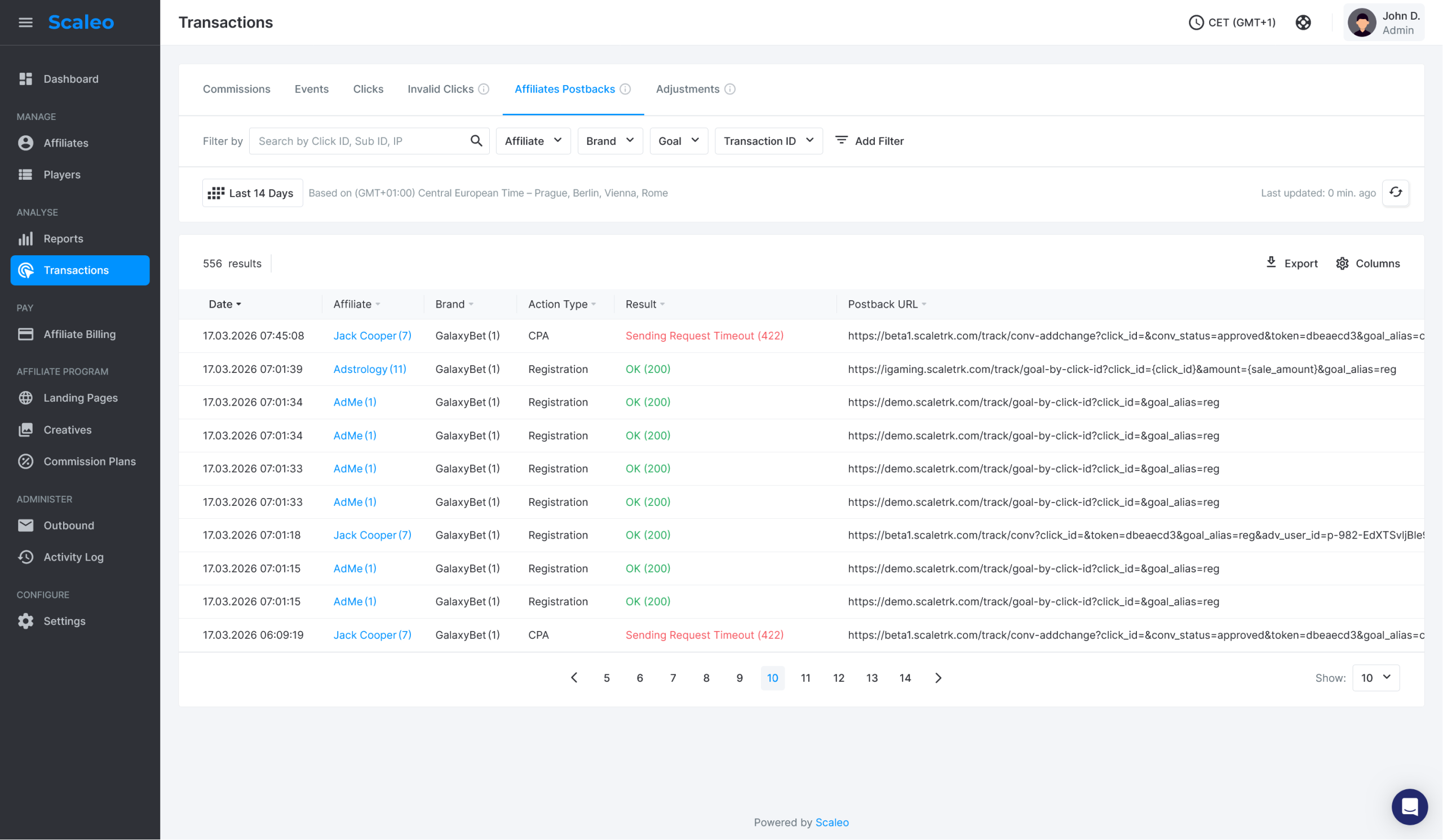
- iGaming-native affiliate platforms like Scaleo provide built-in postback debugging tools including real-time postback logs with HTTP response codes, click ID lifecycle tracing, and configurable retry logic for failed delivery — features that generic tracking solutions typically lack.
Why Postback Failures Are More Expensive in iGaming Than Other Verticals
In iGaming affiliate programs, a failed postback does not just mean a missed data point. It means an affiliate sent a player who deposited, played, and generated revenue — and the affiliate was never credited. That affiliate now suspects shaving. If it happens more than once, they reduce traffic or leave the program entirely.
The financial stakes compound because iGaming affiliate payouts are frequently structured on RevShare, where the commission is calculated against the player’s lifetime net gaming revenue.
A single unrecorded first-time deposit (FTD) does not just lose one CPA payout — it disconnects that player from the affiliate permanently. Every subsequent deposit, every bet, every month of activity generates revenue that the affiliate never sees and the operator never pays. The data mismatch grows silently over time.
The secondary damage is to reporting confidence. Marketing teams that optimize acquisition spend based on affiliate-attributed conversions are making decisions on incomplete data. If 5–10% of postbacks fail silently, every cost-per-acquisition figure in the program is wrong. The operator either overpays on channels with intact tracking or underpays affiliates who are actually delivering the highest-value players.
This is why postback reliability in iGaming is not a technical nice-to-have. It is the infrastructure layer that holds together partner trust, financial accuracy, and marketing intelligence.
How S2S Postback Tracking Works in Casino Affiliate Programs
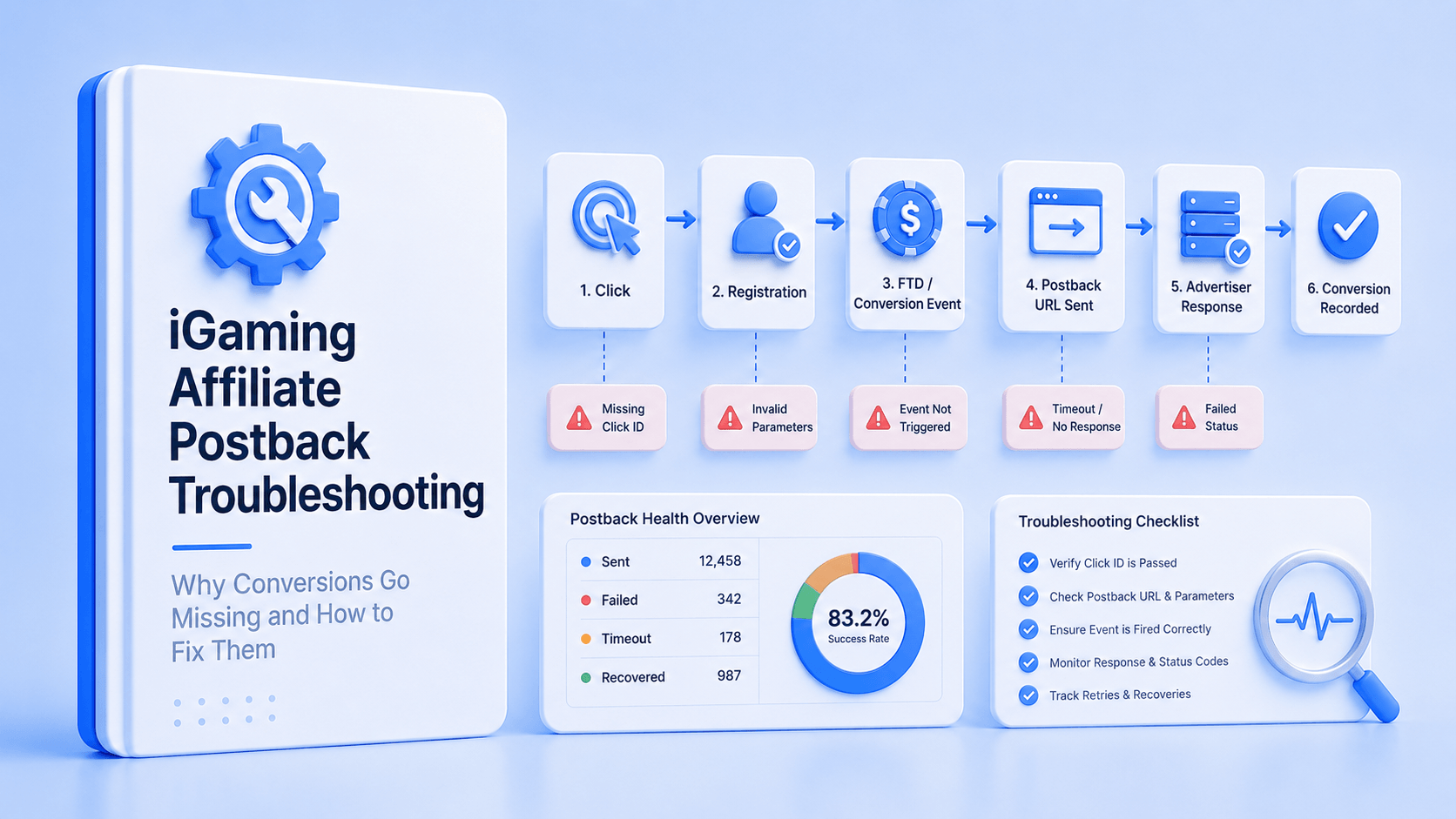
Server-to-server postback tracking in iGaming follows a specific sequence. Understanding where in this sequence failures occur is essential to diagnosing them efficiently. As of Q1 2026, S2S is the standard for regulated casino and sportsbook affiliate programs because it removes the browser from the attribution decision entirely.
The flow has four stages.
- First, a potential player clicks an affiliate tracking link. The affiliate platform generates a unique click ID and appends it to the redirect URL, sending the player to the operator’s website or app.
- Second, the operator’s backend must capture that click ID and persist it — typically by storing it in the user’s session, writing it to a database field tied to the registration, or passing it through the signup form as a hidden parameter.
- Third, when a qualifying event occurs — registration, FTD, qualifying deposit, or any other configured conversion event — the operator’s server fires an HTTP GET or POST request to the affiliate platform’s postback endpoint, including the original click ID and event-specific parameters like transaction amount and event type.
- Fourth, the affiliate platform receives the postback, validates the click ID against its click log, applies attribution rules, and records the conversion.
Every failure described in this guide occurs at one of these four stages. Most failures cluster at stage two (click ID persistence) and stage three (postback execution), which is why those stages receive the most detailed diagnostic attention below.
The Five Most Common Postback Failure Modes in iGaming
After supporting hundreds of casino and sportsbook affiliate integrations, the same five failure modes account for the vast majority of postback issues. Here is each one, what causes it, how to identify it, and exactly how to fix it.
Failure Mode 1: Click ID Loss During Session Handoff
This is the single most common postback failure in iGaming, and the hardest to detect because it produces no error messages.
What happens: The click ID is generated correctly at the affiliate platform and appended to the redirect URL. The player arrives at the operator’s landing page with the click ID in the URL query string. But the operator’s registration flow does not capture or persist the click ID, so by the time the player completes a deposit, the backend has no click ID to include in the postback.
Common causes in iGaming environments:
- The registration form strips query parameters when the player moves from the landing page to the signup page, especially in single-page applications (SPAs) that rewrite URLs on navigation.
- The player clicks through on mobile, opens the app store, installs the app, and returns to complete registration inside the native app — the click ID never crosses from the mobile browser into the app environment. This is the classic deferred deep link gap.
- The operator uses a third-party registration widget or iframe that does not forward query parameters from the parent page.
- The click ID parameter name in the tracking link does not match what the operator’s backend expects. The affiliate platform sends
?click_id=abc123but the operator’s system reads?clickid=abc123or?subid=abc123.
How to diagnose: Open the affiliate platform’s click log. Find a known test click. Confirm the click ID was generated. Now check the operator’s backend: was that click ID stored against the user record that registered? If the click ID is present in the click log but absent from the operator’s database for the corresponding user, the loss happened at stage two.
How to fix: Ensure the operator’s landing page captures the click ID from the URL immediately on page load — typically via JavaScript that reads the query parameter and writes it to a first-party cookie, a session storage value, and a hidden form field simultaneously. All three provide redundancy. For app-based flows, implement deferred deep linking via a service like AppsFlyer or Adjust, or a custom solution that stores the click ID server-side before the app store redirect and retrieves it on first app open. For iframe-based registration, pass the click ID to the iframe via the src attribute’s query string.
Failure Mode 2: Endpoint Timeout or HTTP Error
This failure is the easiest to detect because it produces a visible HTTP status code in the postback log — but only if the operator or platform is actually logging postback responses.
What happens: The operator’s server fires the postback request to the affiliate platform’s endpoint. The endpoint does not respond within the timeout window (typically 5–30 seconds), or it returns a 4xx or 5xx error. The conversion is never recorded.
Common causes in iGaming environments:
- The affiliate platform’s postback endpoint is rate-limited and the operator is sending a burst of postbacks during a peak signup period (common during major sporting events or promotional campaigns).
- The operator’s server-side postback call is synchronous and blocks the user’s registration flow. If the platform takes too long to respond, the operator’s code times out and silently drops the postback to avoid degrading the user experience.
- DNS resolution failures — the operator’s server cannot resolve the affiliate platform’s domain at the moment the postback fires, typically due to DNS caching issues or a CDN misconfiguration on the platform side.
- The affiliate platform’s IP has been blocked by the operator’s firewall or WAF, or vice versa. This is surprisingly common when operators use aggressive bot-protection services like Cloudflare in “I’m Under Attack” mode.
How to diagnose: Check the postback log on both sides. On the operator side, look for the HTTP response code returned by the affiliate platform’s endpoint. A 200 means the request was received. A 408 or socket timeout means the platform did not respond in time. A 403 means the request was blocked. A 500 means the platform had an internal error. On the platform side, check if the request was received at all — if it was not, the issue is network-level (DNS, firewall, WAF).
How to fix: Make all postback calls asynchronous on the operator side. The postback should fire in the background — never in the critical path of the user’s registration or deposit flow. Implement retry logic: if the first attempt fails, queue the postback and retry at 30 seconds, 5 minutes, and 30 minutes. Log every attempt and response. Whitelist the affiliate platform’s IP range in your WAF. If using Cloudflare or a similar service, create a firewall rule that allows requests to and from the platform’s known IP ranges without challenge.
Failure Mode 3: Duplicate Event Firing
Duplicate postbacks do not cause lost conversions — they cause inflated conversion counts, which leads to overpayment and destroys reporting accuracy in the opposite direction.
What happens: The operator’s backend fires the same postback multiple times for a single conversion event. The affiliate platform records duplicate conversions, inflating the affiliate’s earnings and skewing the operator’s cost reporting.
Common causes in iGaming environments:
- The operator’s event trigger is attached to a webhook that fires on every database write related to the user record, not just on the first qualifying event. A player who makes three deposits triggers three FTD postbacks.
- The operator’s retry logic re-fires a postback that was already successfully received. This happens when the operator’s system does not check the platform’s response code before retrying, or when the retry queue does not deduplicate against already-confirmed deliveries.
- Multiple services on the operator’s backend are each independently configured to fire postbacks for the same event — for example, both the payment processor’s webhook and the CRM’s event trigger fire a postback on deposit.
How to diagnose: Pull a report of all postbacks fired in the last 7 days. Group by click ID and event type. Any click ID with more than one postback for the same event type (FTD, registration) is a duplicate. Cross-reference the timestamps — if the same click ID fires twice within seconds, it is a trigger duplication issue. If the second fire comes minutes or hours later, it is a retry logic issue.
How to fix: Implement a deduplication check on the operator side before firing any postback. Before sending, query your local log: “Have I already fired a postback for this click ID and this event type?” If yes, do not fire again. On the platform side, most iGaming-native affiliate platforms (including Scaleo) also apply server-side deduplication — rejecting a second conversion for the same click ID within a configurable window. However, relying solely on platform-side deduplication is insufficient because the duplicate postback still consumes network resources and creates noise in logs.
Failure Mode 4: Parameter Mismatch Between Operator and Platform
This failure mode produces postbacks that technically fire and receive a 200 response — but record incorrect or incomplete data. The conversion appears to work but the attribution data is wrong.
What happens: The operator sends a postback with parameters that do not match the affiliate platform’s expected format. The platform either ignores the malformed parameters, assigns default values, or records the conversion without the data needed for accurate commission calculation.
Common causes in iGaming environments:
- The operator sends the deposit amount in a different currency than the platform expects. The postback says
amount=100and the platform records it as 100 USD, but the deposit was actually 100 CZK. This causes RevShare calculations to be off by an order of magnitude. - The event type parameter uses different values. The operator sends
event=depositbut the platform expectsevent=ftdfor first-time deposits andevent=rdfor repeat deposits. All deposits get classified as the same event type, breaking tiered commission logic. - The click ID is URL-encoded on the operator side but the platform does not decode it before matching, or the operator double-encodes special characters. A click ID like
abc%3D123does not matchabc=123in the platform’s click log. - The operator passes GGR (Gross Gaming Revenue) in the amount field, but the platform’s commission structure is configured against NGR (Net Gaming Revenue). The RevShare calculation is then applied to the wrong revenue base.
How to diagnose: Compare the raw postback URL or payload (as logged on the operator side) against the platform’s postback documentation. Check every parameter name and value format. Then compare against what the platform actually recorded — most platforms expose the raw inbound postback data in their admin interface or via API. The mismatch will be immediately visible.
How to fix: Build a postback parameter mapping document during integration setup. For every parameter the platform expects, document the exact parameter name, data type, format, currency, and any enumerated values. Before going live, fire test postbacks with known values and verify that the platform records exactly what you sent. In iGaming, the most critical parameters to validate are: click ID format, event type enumeration, amount currency and precision (does the platform expect cents or whole currency units?), and the revenue type (GGR vs. NGR vs. deposits).
Failure Mode 5: Attribution Window Expiry
This failure is unique to iGaming because the player journey from first click to first deposit can span days or even weeks — far longer than in most affiliate verticals.
What happens: The player clicks an affiliate link on day 1 and registers. They do not make a deposit until day 14. The operator fires the FTD postback on day 14, but the affiliate platform’s attribution window was configured for 7 days. The platform rejects the postback because the click ID has expired.
Common causes in iGaming environments:
- The attribution window on the affiliate platform is set to a generic default (7 or 14 days) that does not reflect the actual player conversion cycle for casino or sportsbook products, which often runs 21–45 days from first click to first deposit.
- The operator fires the postback correctly, but the platform was recently reconfigured and the attribution window was inadvertently shortened.
- The click ID was generated by a campaign that has since been paused or deleted on the platform side, making the click ID invalid even if it is within the time window.
How to diagnose: In the affiliate platform’s postback response log, look for rejection reasons. Most platforms return a specific error code or message for expired click IDs — for example, “click_id expired” or “conversion outside attribution window.” Cross-reference the original click timestamp with the postback timestamp. If the gap exceeds the configured attribution window, this is the cause.
How to fix: Set the attribution window to match the actual player conversion cycle for your product. For casino products with bonus-driven onboarding, 30 days is a reasonable minimum. For sportsbook products tied to seasonal events, 45–60 days may be appropriate. Review your platform’s attribution window setting quarterly and adjust based on your actual click-to-conversion distribution data. In Scaleo, the attribution window is configurable per campaign and per partner — so high-value affiliates who drive longer consideration cycles can be given extended windows without changing the global default.
The Diagnostic Workflow: A Step-by-Step Troubleshooting Process
When an affiliate reports missing conversions — or when your internal reconciliation surfaces discrepancies between platform-reported conversions and your backend data — follow this sequence. It is designed to isolate the failure stage within minutes, not days.
Step 1: Confirm the click was recorded. Go to the affiliate platform’s click log. Search by the affiliate’s tracking link or partner ID. Confirm that clicks are being recorded with valid click IDs. If no clicks appear, the issue is upstream of the postback — the tracking link itself is broken, misconfigured, or not being used by the affiliate.
Step 2: Verify click ID persistence on the operator side. Take a known click ID from step 1. Check the operator’s user database: is that click ID stored against the user record that registered through that affiliate link? If not, the click ID was lost during session handoff (Failure Mode 1). Stop here and fix the capture mechanism.
Step 3: Check whether the postback was fired. On the operator side, check your postback fire log. Was an HTTP request sent to the affiliate platform’s endpoint for this user’s conversion event? If no request was fired, the issue is in the operator’s event trigger logic — the conversion event occurred but the postback trigger did not execute. Common cause: the trigger is attached to the wrong event, or conditional logic (such as “only fire on first deposit”) is filtering out valid events.
Step 4: Verify the platform received the postback. Check the affiliate platform’s inbound postback log. Filter by click ID or timestamp. If the operator fired the request but the platform has no record of receiving it, the issue is network-level — DNS failure, firewall block, or endpoint unavailability (Failure Mode 2).
Step 5: Check the platform’s postback processing result. If the platform received the postback, what was the processing result? Did it record the conversion successfully, or did it reject the postback? If rejected, the rejection reason will point directly to the failure mode: expired click ID (Failure Mode 5), duplicate click ID (Failure Mode 3), or parameter validation failure (Failure Mode 4).
Step 6: Compare the recorded data. If the conversion was recorded, verify that the data matches. Does the recorded amount match the actual deposit? Does the event type match? Is the correct affiliate credited? If the data is wrong, the issue is a parameter mismatch (Failure Mode 4), and the raw postback payload will show exactly which parameter is misformatted.
Preventive Measures: Building a Postback Setup That Does Not Break
Troubleshooting is reactive. The better approach is to design the integration so that failures are either prevented or immediately visible. Here are the engineering practices that separate reliable postback setups from fragile ones.
Always fire postbacks asynchronously. The postback request must never be in the critical path of the player’s user journey. Use a message queue (RabbitMQ, SQS, or equivalent) to decouple the conversion event from the postback delivery. This prevents platform endpoint latency from affecting the player experience and enables built-in retry logic.
Implement a postback delivery ledger. Maintain a local log of every postback fired, including the full request URL or payload, the timestamp, the HTTP response code, and whether a retry was triggered. This ledger is the single source of truth during disputes. Without it, troubleshooting involves emailing the affiliate platform and waiting days for log extracts.
Use HMAC-signed postbacks. Append a cryptographic signature to each postback request so the affiliate platform can verify that the request genuinely originated from the operator’s server and was not spoofed or tampered with. This is increasingly standard in regulated markets where commission payouts must be auditable. Rotate signing keys quarterly.
Run end-to-end test conversions before launching any affiliate. Before activating a new affiliate partner, generate a test click, complete a test registration and deposit, and verify that the postback fires, is received, and records correctly on the platform side. Do not rely on “it should work” — validate the full chain with real data. In Scaleo, the postback testing interface allows operators to fire test postbacks with arbitrary parameters and immediately see how the platform processes them, without affecting production data.
Monitor postback success rates daily. Set an alert that fires when the postback success rate (200 responses / total postbacks fired) drops below 95%. A sudden drop usually indicates a platform-side endpoint issue or a WAF rule change. A gradual decline usually indicates a growing population of sessions where the click ID is being lost — typically caused by a frontend code change that affected the landing page or registration flow.
Document the integration specification. For every affiliate platform integration, maintain a written specification that lists: the postback endpoint URL, the HTTP method (GET or POST), every required and optional parameter with its name, format, and example value, the attribution window configuration, the deduplication rules, and the expected response codes. Update this document whenever either side changes their configuration. Most postback failures that take weeks to resolve could have been diagnosed in minutes if a current specification existed.
How Scaleo Handles Postback Reliability for iGaming Operators
For operators evaluating affiliate platforms specifically on postback reliability, iGaming-native platforms offer capabilities that generic tracking solutions do not. Scaleo is built for this environment, but the criteria below apply regardless of which platform you choose — any serious iGaming affiliate platform should offer these.
Scaleo’s postback architecture includes real-time postback logging with full HTTP request and response details visible in the admin interface, so operators and affiliate managers can diagnose failures without requesting log extracts from a support team. The click ID lifecycle is traceable end-to-end: from the moment the click is generated, through the redirect, to the postback receipt and conversion recording. If a click ID is rejected, the rejection reason is visible immediately.
Configurable retry logic means that if a postback delivery fails (timeout, 5xx error), Scaleo automatically re-attempts delivery on a configurable schedule — typically at 30 seconds, 5 minutes, and 30 minutes — before marking the delivery as permanently failed. The attribution window is configurable per campaign and per partner, which is essential for iGaming where different affiliate types (content sites, paid media buyers, comparison portals) have fundamentally different click-to-conversion timelines.
For operators who are not using Scaleo, the diagnostic workflow and preventive measures in this guide apply to any S2S postback integration. The failure modes are universal. What differs between platforms is the quality of the debugging tools you have access to when something goes wrong — and in iGaming, something always eventually goes wrong.
When Postback Issues Indicate a Deeper Integration Problem
Sometimes, persistent postback failures are symptoms of a more fundamental architecture issue. If you are experiencing the same failure mode repeatedly despite fixing the immediate cause, consider whether the underlying integration design is sound.
Signs that the problem is architectural, not configurational: postback failures correlate with specific player registration paths (e.g., mobile app but not desktop web); click IDs are lost only for players who register through a specific third-party payment provider’s hosted checkout; the operator’s backend fires postbacks from multiple services that are not coordinated; or the operator is running two affiliate platforms simultaneously with no clear delineation of which platform handles which traffic source.
In these cases, the fix is not another patch to the postback trigger. It is a review of the operator’s data flow architecture — mapping every path a player can take from click to conversion and verifying that the click ID is persisted and accessible at every step. For operators running multi-brand programs or multiple registration flows (sportsbook, casino, poker from a single platform), this mapping exercise is not optional. It is the only way to guarantee postback reliability at scale.
Frequently Asked Questions
What is an iGaming affiliate postback and how does it work?
An iGaming affiliate postback is a server-to-server (S2S) HTTP request that the operator’s backend sends to the affiliate tracking platform when a qualifying player event occurs — such as a first-time deposit (FTD) or registration. When a player clicks an affiliate tracking link, the platform generates a unique click ID and appends it to the redirect URL. The operator’s backend must capture and store that click ID, then include it in the postback when a conversion event fires. This allows the affiliate platform to match the player back to the originating affiliate and record the commission.
Why do affiliate postbacks fail in iGaming?
The five most common causes of postback failure in iGaming are: click ID loss during session handoff (the most frequent), endpoint timeout or HTTP error, duplicate event firing, parameter mismatch between the operator’s backend and the affiliate platform, and delayed postback execution that falls outside the attribution window. Most failures happen at the click ID persistence stage — the click ID is generated correctly but never captured or stored by the operator’s registration flow, so there is nothing to include in the postback when a conversion fires.
How do I diagnose a missing conversion in an affiliate postback integration?
Start with the affiliate platform’s click log. Confirm the click ID was generated for the session in question. Then check the operator’s backend: was that click ID stored against the user record that completed the conversion? If the click ID exists in the click log but is absent from the operator’s database for the corresponding user, the loss occurred at the click ID persistence stage. If the click ID is present in both, check the postback log for HTTP response codes — a 200 indicates successful delivery, a 408 indicates timeout, a 403 indicates the request was blocked. Work through the four-stage S2S flow systematically rather than starting with network diagnostics.
What is the difference between S2S postback tracking and cookie-based tracking in iGaming?
Cookie-based tracking stores attribution data in the player’s browser. It is unreliable in iGaming because browser privacy updates — particularly Apple’s Intelligent Tracking Prevention (ITP) on Safari — delete third-party cookies within 24 hours, and many iGaming sessions span multiple devices or move from browser to native app. Server-to-server (S2S) postback tracking removes the browser from the attribution decision entirely: the click ID is stored on the operator’s server and sent directly from server to server when a conversion fires. S2S is the current industry standard for regulated casino and sportsbook affiliate programs precisely because it is not subject to browser-level interference.
How can I prevent duplicate postbacks from inflating affiliate commission counts?
Duplicate postbacks occur when the operator’s event trigger fires multiple times for a single conversion, when retry logic re-fires an already-confirmed postback, or when multiple services (payment processor webhook and CRM trigger, for example) independently fire postbacks for the same event. To prevent duplicates: implement idempotent postback logic that checks for a confirmed delivery receipt before retrying; configure a single authoritative event source rather than multiple services monitoring the same trigger; and use the affiliate platform’s deduplication rules to reject postbacks carrying a click ID that has already been attributed. Platforms like Scaleo provide real-time postback logs with HTTP response codes so operators can verify whether a postback was received before any retry fires.
How long should an affiliate postback retry for if the first attempt fails?
The standard retry pattern is three attempts with increasing intervals: retry at 30 seconds, then 5 minutes, then 30 minutes from the initial failure. Beyond three retries, the risk of creating duplicate records on the platform side increases if the original delivery was received but the response was lost in transit. All retry attempts should be logged with timestamp and HTTP response code. Postback calls should always be asynchronous — fired in the background, never in the critical path of the player’s registration or deposit flow — so that a failed delivery does not degrade the player experience.