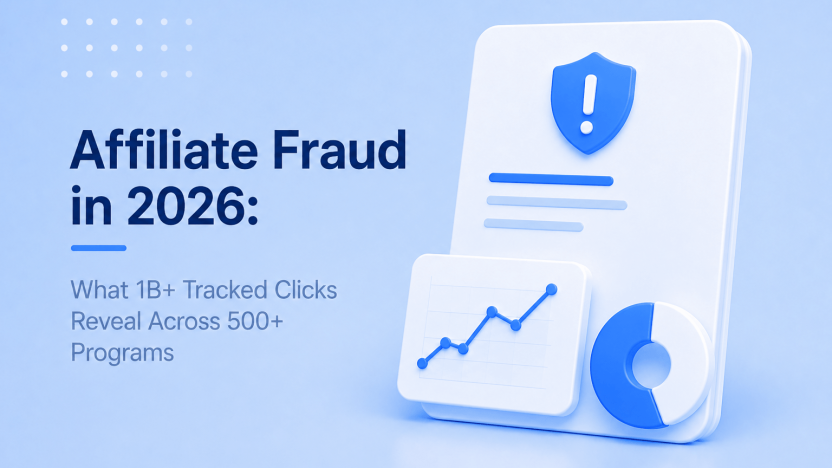
Affiliate fraud is no longer a line item in the risk register. It’s the second business model running inside your program.
Across more than 500 affiliate programs tracked through Scaleo’s platform — spanning finance, eCommerce, SaaS, lead generation, and iGaming — the fraud patterns we see have shifted from opportunistic to systematic. Fraudsters aren’t gaming commission thresholds one click at a time. They’re building infrastructure: emulator farms, synthetic identity pipelines, traffic laundering networks, and coordinated multi-accounting rings that look clean in top-of-funnel reports and crater your NGR at reconciliation.
This report combines Scaleo platform signals with the best publicly available industry data to give program managers and affiliate ops teams a real picture of where fraud sits in 2026, what’s changing, and what the numbers mean for how you run your program.

Running a program on software built before AI-era fraud existed? Scaleo’s anti-fraud logic operates at the click, session, and conversion layer — in real time. Start your free trial →
The Scale of the Problem: Industry Benchmarks
Before the platform-specific signals, the macro context matters.
Digital ad fraud is projected to exceed $100 billion in global losses by the end of 2026, up from roughly $88 billion in 2025. That figure spans all channels, but affiliate is disproportionately exposed because the payment model creates a direct financial incentive at every conversion point. Click fraud in paid search runs between 14% and 22% of all traffic depending on vertical and geo. Across affiliate channels specifically, roughly 17% of all traffic has been shown to be non-human — a figure that’s been stable for several years, which means it’s not improving despite better tooling at the platform level.
The lead quality problem is worse. An estimated 25% of leads generated through affiliate campaigns are fake or of demonstrably poor quality. If you’re running a CPA program at $100 per acquisition and a quarter of your signups are synthetic, you already know what that does to unit economics at scale: for every 10,000 signups, $250,000 in commission paid to no one for nothing.
Cookie stuffing still affects between 5% and 10% of affiliate transactions. Sub-ID manipulation — where fraudulent traffic is laundered through clean sub-publisher IDs to avoid detection — accounts for approximately 8%–12% of affiliate fraud incidents. Mobile affiliate fraud rates run up to 50% higher than desktop, because mobile tracking infrastructure is more fragmented and easier to spoof.
Bot traffic contributes to roughly 24% of all affiliate clicks globally. That number alone explains why programs that rely on click volume as a health signal are working from broken data.
What Scaleo’s Platform Data Shows
Across programs running on Scaleo, several patterns appear consistently enough to be treated as operational baselines rather than outliers.
Conversion rate as a fraud proxy. Programs without real-time fraud filtering show conversion rate variance that is statistically inconsistent with organic traffic behavior. Specifically: high-volume affiliates that produce click-to-registration ratios well above program average — but deposit or purchase rates far below average — are the single most reliable indicator of incentivized or synthetic traffic. The gap between registration and monetization is where fraud hides.
Geo-clustering in suspicious traffic. A concentration of clicks from specific IP ranges within narrow time windows, particularly from regions flagged as high-IVT (Asia-Pacific leads at 27.85% IVT; the US runs at 23.69%; Europe is cleanest at 7.80%), correlates strongly with bot farm activity. Programs using geo-based commission caps or geo-level quality scoring substantially reduce exposure to this pattern.
Sub-ID laundering. Among programs running 50+ active affiliates, sub-ID manipulation is the most common fraud vector Scaleo’s system flags. The mechanism is consistent: a top-level affiliate account passes clean traffic through verified sub-publisher IDs, while routing bot or incentivized traffic through unmonitored sub-IDs. The aggregate reporting looks clean because the dirty sub-IDs are diluted by legitimate volume.
Post-conversion churn velocity. In programs where Scaleo tracks post-conversion behavior (particularly in finance and SaaS), users generated by flagged affiliates churn at a rate 3–4x higher within the first 30 days than organic or direct traffic. This is not a coincidence. Incentivized users, fake leads, and bot-triggered registrations don’t engage — they exist to trigger a payout and nothing else.
Legacy OS and browser fingerprints. Consistent with Fraudlogix’s 2025 dataset of 105.7 billion impressions, Scaleo affiliate tracking data shows that traffic from Windows 8 and legacy Android environments carries IVT rates dramatically above program average. Windows 8 traffic shows IVT rates of 76.26% in aggregate industry data. These fingerprints are a reliable heuristic for bot farm infrastructure.
How Fraud Tactics Have Evolved in 2025–2026
The headline shift is automation sophistication. What used to require click farms with human labor has been partially replaced by AI-assisted bots capable of mimicking realistic user journeys — session depth, scroll behavior, reading time, mouse trajectory variation. Standard detection methods now catch less than 40% of sophisticated bot traffic, according to ClickFortify’s 2026 analysis.
Generative AI has accelerated the problem along a separate axis. AI-enabled fraud schemes rose 456% between 2024 and 2025. General Invalid Traffic (GIVT) increased 86% in H2 2024, driven in part by AI crawler activity. General Invalid Traffic rates grew 70% in December 2024 compared to the prior year — a spike attributable to the proliferation of AI agent frameworks that generate page interactions as a byproduct of scraping.
Click injection has become more targeted. Rather than firing fake clicks broadly, sophisticated actors fire a click just before a confirmed conversion — intercepting attribution from a legitimate user action and stealing the commission. This requires access to install or conversion event data, which is more available than it should be given the fragmented state of mobile tracking.
Postback manipulation is the server-side equivalent: injecting fake conversion signals directly into tracking postback URLs. Programs without cryptographic event validation are vulnerable. The conversion appears in reporting, the commission fires, and the payout leaves before anyone runs a quality check.
Traffic laundering through sub-networks has professionalized. Fraudsters buy cheap traffic, run it through multiple redirect hops across legitimate-looking publisher domains, and deliver it to an affiliate tracking link looking like organic referral traffic. By the time attribution is assessed, the traffic has been washed.
Fraud by Vertical: Where Risk Concentrates
Not all verticals are equally exposed. The relationship between commission size and fraud incentive is almost perfectly linear.
Financial services and fintech run the highest fraud rates of any non-gambling vertical. Lead generation programs in insurance, loans, and credit cards are frequently targeted with synthetic identity submissions — fake leads built from real personal data fragments, submitted through affiliate forms to trigger CPL payouts. These leads pass basic validation (real names, real address formats, real-looking emails) but never convert.
eCommerce and retail face coupon fraud, return fraud loops, and affiliate commission stacking — where the same purchase is attributed across multiple affiliate touch points through cookie manipulation. Cookie stuffing remains an active vector here; the incentive is strong because the commissions on high-ticket items are significant.
SaaS and B2B lead gen deal primarily with form fill fraud and fake trial registrations. The conversion event (a form submission or free trial activation) is easy to spoof. Programs that don’t track engagement past the conversion trigger — product login, feature activation, billing — are systematically overpaying for dead leads.
Travel and insurance face some of the highest CPC fraud rates in the industry. High keyword competition drives aggressive click fraud from competitors, and affiliate programs in these verticals see proportionally higher rates of fraudulent click injection targeting high-commission conversion paths.
Across all verticals, programs without post-conversion quality tracking are running blind past the conversion event — which is exactly where the economic damage is.
The Attribution Problem Underneath Everything
A finding that doesn’t get enough attention in fraud reporting: most affiliate fraud succeeds not because detection tools are absent, but because attribution models are broken.
Last-click attribution — still the default in the majority of affiliate programs — creates a structural vulnerability. It rewards whoever touches a user last before conversion, regardless of who drove genuine intent. This is the economic foundation of click injection, cookie stuffing, and forced redirect schemes. They’re all attacks on the attribution model, not on traffic quality per se.
Programs that have moved to multi-touch or assisted-conversion attribution models report materially lower fraud losses — not because fraud attempts decrease, but because the payout logic no longer rewards the specific behavior fraudsters exploit.
The secondary problem is time lag. Most affiliate programs run quality audits on a monthly or quarterly cycle. By the time a fraudulent affiliate is identified and clawbacks are attempted, the damage is done, the commission is paid, and the affiliate has already rotated to a new account or program. Real-time detection isn’t a luxury feature — it’s the minimum viable operating model for a program above a few hundred affiliates.
AI and the Next Fraud Cycle
The AI-driven evolution of fraud deserves specific attention because it changes the baseline for what “good detection” looks like.
Mouse movement spoofing is no longer detectable by simple trajectory analysis. MMBT (Mouse Movement Behavioral Testing) achieves roughly 94.7% accuracy with 2.3% false positives in controlled conditions, but adversarial AI systems are already generating variable scroll speeds and realistic reading time distributions that bypass pattern matching.
Synthetic identity generation has been dramatically accelerated by generative models. A fraud operation that previously required weeks of manual work to build convincing fake user profiles can now produce thousands of synthetic identities in hours — complete with consistent behavioral histories, device fingerprints, and browsing patterns that pass standard scoring systems.
The practical implication for affiliate program managers: detection tools calibrated on 2023 fraud patterns are already outdated. The signal-to-noise ratio in click and conversion data is getting worse, not better, which makes real-time multi-layer scoring — rather than periodic batch auditing — the only defensible approach.
Regulatory Pressure Is Catching Up
Compliance risk has historically been the operator’s problem. That’s changing.
In 2023, the UK Gambling Commission issued over £214 million in fines, with a significant portion tied to inadequate oversight of third-party affiliates. A UK law taking effect in 2025 makes operators legally liable for fraud committed by any affiliate partner — meaning the program manager is now on the hook for what their affiliates do, not just what they do themselves.
GDPR enforcement related to affiliate tracking has intensified. Programs using third-party cookie-based tracking without explicit consent documentation are exposed to regulatory action independently of any fraud consideration.
The direction of travel is clear: affiliate programs will be held to a higher standard of partner oversight, traffic quality verification, and post-conversion monitoring. That’s not a prediction — it’s already in the regulatory text.
iGaming: A Separate Category of Risk
iGaming affiliate fraud operates on a different scale and with different mechanics than general affiliate fraud. The commission structures are larger, the regulatory scrutiny is heavier, and the fraud tactics are more sophisticated. It warrants its own section.
Spotlight: iGaming Affiliate Fraud in 2026
The iGaming affiliate market is growing fast. Industry revenue is projected to reach US$87.9 billion with an annual growth rate above 9%, and affiliate-driven acquisition is the primary channel for most online casino and sportsbook operators. That scale, combined with CPA commissions that regularly exceed €200–€400 per depositing player, makes iGaming the single highest-fraud-density vertical in affiliate marketing.
The numbers are specific and severe. In many programs, up to one-third of affiliate-driven registrations are flagged or declined due to fraud indicators. Bonus abuse alone costs the iGaming sector an estimated 15% of annual gross revenue. Total losses from mobile casino and sportsbook fraud exceeded $1.2 billion, with affiliate fraud listed among the top five contributing schemes alongside money laundering and account takeover.
Fraud typology in iGaming is more layered than in other verticals.
CPA abuse is the entry-level attack: affiliates flood programs with incentivized or bot-generated signups to trigger cost-per-acquisition payouts. These accounts deposit nothing, or deposit the minimum required to unlock the CPA payment, then immediately churn. The conversion metric looks healthy. The cohort LTV is zero.
Bonus cycling is more organized: coordinated multi-accounting rings — sometimes run through Telegram channels — exploit welcome bonuses, deposit matches, and free spin offers across hundreds of synthetic accounts. A documented case from a UK-based operator in 2022 saw a fraud ring distribute referral codes through Telegram, cycle funds through prepaid cards, and extract more than £50,000 from a single campaign before detection. Multiply that across a program with 200+ affiliates and no real-time multi-accounting detection, and the math is not subtle.
Stealth arbitrage is the cleanest-looking attack: an affiliate buys low-quality traffic — incentivized, geo-mismatched, or sourced from PTC networks — and routes it through cloaked funnels that present it as organic search or direct referral traffic. The traffic passes geo-checks because the affiliate has specifically sourced it from program-approved regions. It fails on LTV, but by the time that’s clear, the affiliate has been paid.
Brand bidding is a compliance issue that bleeds into fraud: affiliates bid on the operator’s branded keywords in paid search, intercept users who were already converting, and claim CPA commissions for acquisition they didn’t drive. It inflates acquisition costs without adding volume, and it distorts paid search performance data for the operator’s own campaigns simultaneously.
Regulatory consequences for iGaming operators are not theoretical. The UK Gambling Commission’s £214 million in 2023 fines included cases directly traceable to weak affiliate partner oversight. Beyond financial penalties, there’s license risk — regulators have suspended operating licenses for operators found to be systematically non-compliant with affiliate monitoring requirements. A fraudulent affiliate who sends traffic from a prohibited jurisdiction can trigger a compliance failure that threatens the entire operation.
The fraud detection gap in iGaming is particularly wide because the standard metrics — CTR, registration rate, deposit rate — can all be gamed within a single player journey. A well-constructed fake player will register, make a minimum deposit, claim the bonus, complete the wagering requirement on low-variance games, and withdraw. Each step looks legitimate in isolation. The fraud only becomes visible at the cohort level, over time, when LTV data is clean enough to analyze — which requires the operator to track beyond the CPA event into post-bonus NGR.
Programs that don’t close that loop are paying commissions on players who were never players.
What Scaleo Does About It
Scaleo’s anti-fraud architecture is built on the premise that click-level filtering is a starting point, not a solution.
Multi-layer scoring at the click layer. Every click that enters a Scaleo-tracked program is scored against IP reputation data, device fingerprint signals, geo-risk profiles, and behavioral patterns before it reaches the landing page. Traffic from legacy OS/browser combinations flagged as bot-associated is scored accordingly. High-velocity click patterns from narrow IP ranges trigger real-time suppression, not end-of-month audits.
Sub-ID level fraud isolation. Scaleo tracks fraud signals at the sub-publisher level, not just the top-level affiliate account. This is the specific capability that catches sub-ID laundering — the most common fraud vector in large programs. A top-level affiliate account with clean aggregate metrics can still have sub-IDs generating entirely fraudulent traffic; Scaleo flags the sub-ID, not just the affiliate.
Conversion quality tracking. For programs that enable post-conversion event passing, Scaleo correlates conversion signals with post-conversion behavior — login activity, product engagement, purchase history — to flag low-quality cohorts before commission cycles close. This is the mechanism that catches CPA abuse, fake lead submissions, and incentivized traffic that clears conversion thresholds but never engages with the product.
Configurable fraud rule engine. Program-specific risk thresholds, commission caps by geo, traffic source restrictions, and time-delay conversion validation are all configurable at the program level. There is no single fraud profile that fits every vertical; the rule engine reflects that.
Real-time alerting. When fraud scoring exceeds configured thresholds, Scaleo surfaces alerts immediately — not in the next reporting cycle. The time between a fraud pattern emerging and an operator acting on it is where the financial damage accumulates.
The platform was built for programs where fraud is a real operational cost, not a theoretical one. Try Scaleo free →
What the Data Tells Program Managers to Do Right Now
The research, platform signals, and regulatory direction all point toward the same operational changes.
Move quality scoring past the conversion event. If the only data you’re using to evaluate affiliate quality is click volume, registration rate, and conversion rate, you’re missing the entire second half of the picture. Post-conversion LTV, churn velocity, and product engagement are where fraud surfaces — and they’re the metrics that determine whether a CPA payout was money well spent or money wasted.
Score at the sub-ID level. Aggregate affiliate reporting hides fraud that’s isolated to specific sub-publishers. A program with 10 clean affiliates and 2 fraudulent ones will look healthy in top-line reporting. It won’t look healthy in the finance review.
Implement time-delay conversion validation. A conversion event that fires within seconds of a click — particularly for products that have meaningful registration or onboarding steps — is a red flag. Legitimate users take time. Bot-triggered conversions don’t.
Review geo-risk exposure. Asia-Pacific IVT rates run nearly 4x higher than European rates. Programs with significant APAC traffic that aren’t applying geo-level quality scoring are accepting unnecessary fraud exposure. That’s not a reason to block APAC traffic — it’s a reason to score it differently.
Audit sub-IDs, not just affiliates. Schedule sub-ID level audits quarterly at minimum. Look for sub-IDs with high click volume, above-average conversion rates, and below-average post-conversion engagement. That pattern is the fingerprint of laundered traffic.
Final Note on Methodology
The platform-specific data in this report reflects aggregated, anonymized signals from affiliate programs running on Scaleo across multiple verticals and geographies. No individual program data is disclosed. Industry statistics are drawn from Fraudlogix’s 2025 IVT Report (105.7 billion impressions), TrafficGuard’s State of Affiliate Fraud, ClickFortify’s 2026 Click Fraud Statistics, Bluepear’s iGaming Affiliate Fraud analysis, and PartnerMatrix’s 2025 affiliate fraud research. Where figures represent ranges or estimates, they are presented as such.
Fraud rates and typologies shift with detection capability, regulatory environment, and vertical-specific commission structures. The figures in this report reflect conditions as of Q1 2026. Programs operating at scale should treat these as directional benchmarks, not precise forecasts for their specific traffic mix.
Scaleo is an affiliate management software platform built for performance marketing programs that operate at scale. The platform includes real-time fraud detection, sub-ID level tracking, and configurable anti-fraud logic across click, session, and conversion layers. Learn more at scaleo.io