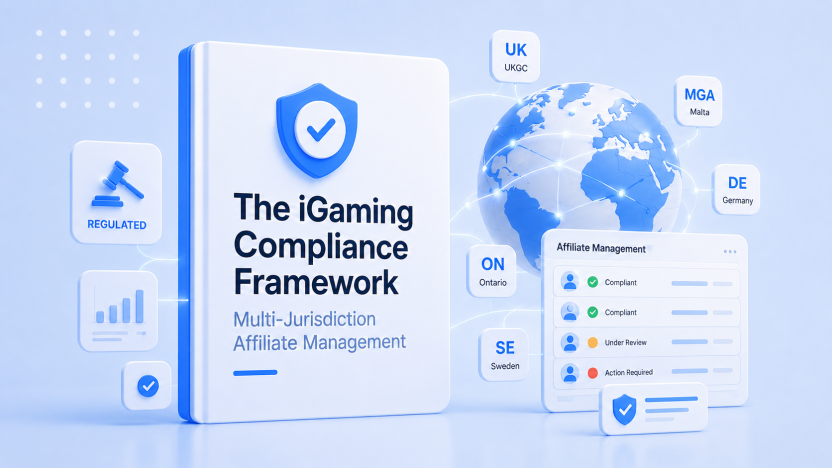
Every operator expanding into a second regulated market learns the same thing: the compliance framework that worked for one jurisdiction does not scale to two. By the third jurisdiction, the gap between what your affiliate contracts say and what your affiliates are actually doing in the market becomes the most expensive oversight in your program.
⚡ SHORT ANSWER
An iGaming affiliate compliance framework is a structured, repeatable system that categorizes markets by regulatory risk, maintains a centralized repository of jurisdiction-specific marketing rules, enforces those rules through affiliate agreement terms and creative auditing processes, and automates the distribution, acknowledgment, and audit trail of compliance requirements across the affiliate portfolio. Without a framework, compliance is a manual effort that fails to scale. With one, it becomes an operational system that grows with the program rather than breaking under it.
Why Ad-Hoc Compliance Fails — and When It Fails
Most iGaming affiliate programs start with a single market and a single license. Compliance at that stage is manageable by feel — the affiliate manager knows the rules, reviews new creative when they remember to, and updates the affiliate agreement when something changes. It works until it doesn’t, and the failure mode is always the same: the program grows faster than the compliance process.
New markets bring new regulatory requirements. A UKGC-licensed operation adding a MGA license for European traffic is not adding a second version of the same rules — it is adding a distinct regulatory regime with different advertising standards, different responsible gambling messaging requirements, different data residency obligations, and different enforcement postures.
New affiliates bring new traffic sources, new creative formats, and new promotional approaches that may not have existed when the affiliate agreement was last reviewed. New staff inherit compliance processes that live in someone’s memory rather than in documented, enforced systems.
The regulatory consequences of ad-hoc compliance failures are not theoretical. The UKGC’s published enforcement actions consistently include operators penalized specifically for failures in third-party affiliate oversight — non-compliant bonus advertising, undisclosed wagering requirements, promotional materials targeting vulnerable audiences. The penalty is not reduced because the violation originated with an affiliate rather than the operator directly. The operator issued the license. The operator carries the consequence.
A framework does not eliminate compliance risk. It does convert compliance from a reactive, ad-hoc process that generates surprises into a proactive, systematic one that surfaces problems before they become regulatory events.
Step 1: Categorize Markets by Regulatory Risk Level
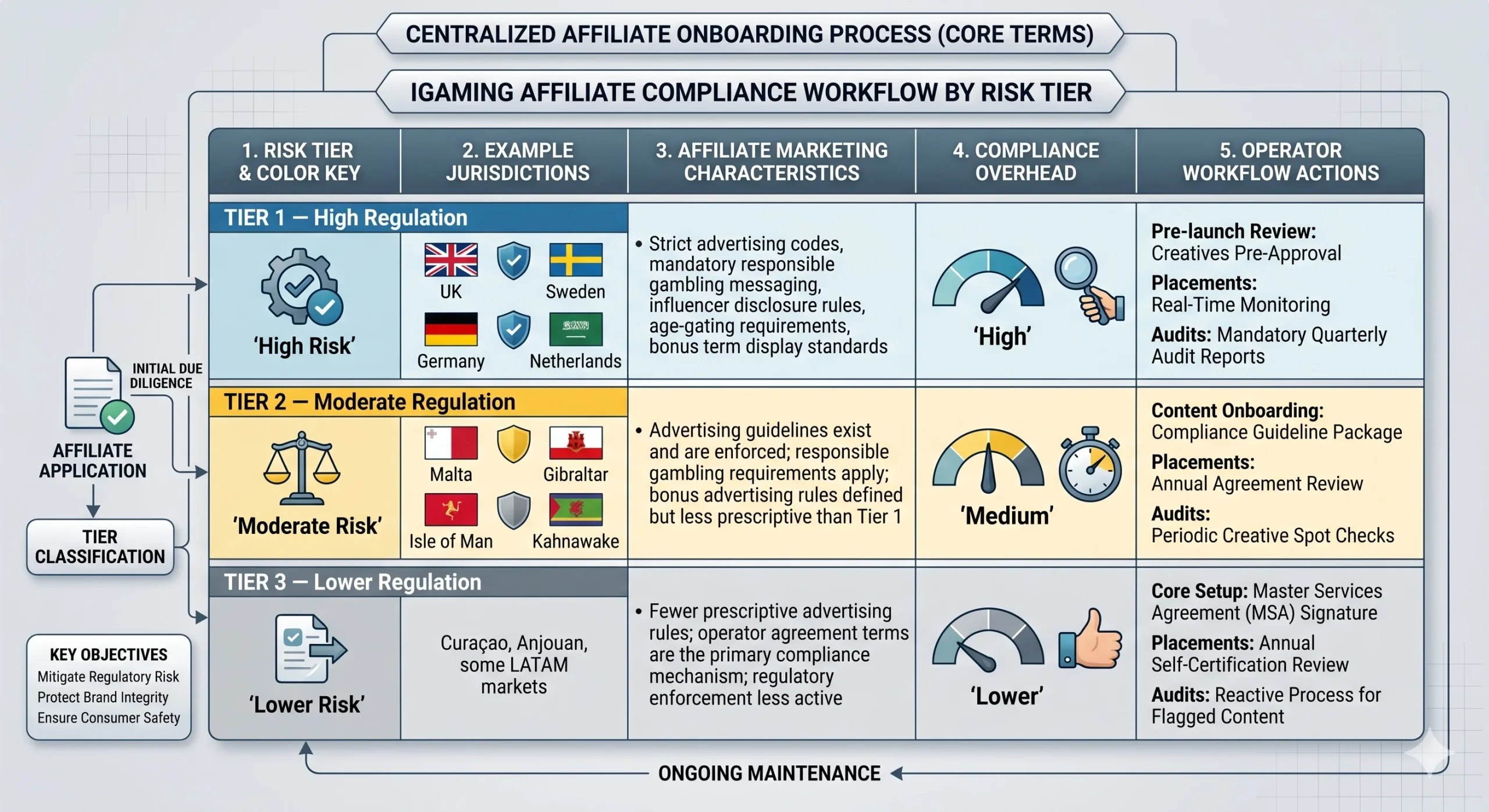
The foundation of a scalable compliance framework is a market risk classification. Not all markets impose the same compliance obligations on affiliate marketing, and treating them as equivalent produces one of two failure modes: over-investing in compliance overhead for low-risk markets, or under-investing in compliance rigor for high-risk ones.
A practical three-tier classification covers the operating range of most multi-jurisdiction programs:
| Risk Tier | Example Jurisdictions | Affiliate Marketing Characteristics | Compliance Overhead |
|---|---|---|---|
| Tier 1 — High Regulation | UK (UKGC), Sweden (Spelinspektionen), Germany (GGL), Netherlands (KSA) | Strict advertising codes, mandatory responsible gambling messaging, influencer disclosure rules, age-gating requirements, bonus term display standards | High — pre-approval of affiliate creatives recommended; real-time monitoring of live placements; quarterly audits minimum |
| Tier 2 — Moderate Regulation | Malta (MGA), Gibraltar, Isle of Man, Kahnawake | Advertising guidelines exist and are enforced; responsible gambling requirements apply; bonus advertising rules defined but less prescriptive than Tier 1 | Medium — annual agreement review; periodic creative audits; incident-based reactive review process |
| Tier 3 — Lower Regulation | Curaçao, Anjouan, some LATAM markets | Fewer prescriptive advertising rules; operator agreement terms are the primary compliance mechanism; regulatory enforcement less active | Lower — agreement-based compliance; annual review; reactive process for flagged content |
This classification is not static. Markets move between tiers as regulatory regimes develop. Germany moved from Tier 3 to Tier 1 over three years as its interstate treaty framework came into force and the GGL began active enforcement. Brazil is currently in transition. Ontario introduced a distinct regulatory framework in 2022 that sits structurally between Tier 1 and Tier 2 in terms of affiliate marketing obligation. Your market classification must be reviewed at least annually, and any enforcement action or regulatory guidance published in a market you operate in should trigger an immediate classification review for that market.
The practical output of Step 1 is a market registry — a document that lists every jurisdiction your affiliate program generates traffic from, its current tier classification, the primary regulatory body, the key advertising rules that affect affiliate content, and the last review date. This registry is the source of truth that drives the rest of the framework. It should live in a shared, version-controlled location — not in an email thread or an affiliate manager’s personal drive.
Step 2: Build a Central Compliance Repository
Once markets are classified, the compliance requirements for each tier need to be translated into affiliate-actionable rules — specific, plain-language guidance on what affiliates can and cannot do when promoting your brand in each market. The central repository is where those rules live, where they are updated when regulations change, and where affiliates and affiliate managers can reference the current requirements without having to interpret primary regulatory sources.
What the Repository Must Contain
Per-market marketing rules. For each market in your registry, a specific set of affiliate-facing rules: what claims can be made about bonuses (minimum deposit, wagering requirements, game restrictions must be displayed), what responsible gambling messaging is required and in what format, what age-gating or age verification statements are required on pages promoting your brand, and what creative formats or channels are prohibited (e.g., direct advertising to under-18 demographics, undisclosed influencer partnerships).
Approved creative assets and brand guidelines. Affiliates cannot produce compliant content without compliant source material. The repository must include approved banner sets, logo usage guidelines, approved bonus claim language (exact wording that satisfies the bonus display requirements in each tier), and responsible gambling badge assets. When regulatory requirements change — a new UKGC social responsibility code takes effect, for instance — the approved asset library updates and affiliates are notified through the distribution process covered in Step 4.
Prohibited content examples. Rules are easier to follow when accompanied by examples of violations. The repository should include annotated examples of non-compliant content: a bonus advertisement missing the wagering requirement disclosure, a promotional headline that implies guaranteed winnings, a landing page without the required responsible gambling footer. These examples reduce the “I didn’t know that was a violation” argument and establish a documented standard against which affiliate conduct can be measured.
Version history and change log. Every update to the repository — a new market added, a regulatory change incorporated, an approved asset updated — must be logged with a date and a description of what changed. This version history is the audit trail that demonstrates your compliance program is active and maintained, not a static document created at launch and never revisited.
Scaleo internal data, 2025: Operators who maintain a centralized, versioned compliance repository and distribute updates through their affiliate platform — rather than via email — report a 3.4x higher rate of affiliate acknowledgment of compliance updates within 30 days of issuance. The difference is not affiliate willingness — it is delivery mechanism. Updates distributed through a platform where affiliates log in to access their commission data are seen. Updates distributed by email to a list that may include outdated contact addresses are not reliably received.
Step 3: Establish an Affiliate Creative Audit Process
A compliance repository sets the standard. The audit process enforces it. Without a defined, repeatable audit process, the repository is documentation that affiliates can claim they read and ignored without consequence. With one, compliance is a condition of program participation that is actively verified.
Audit Scope and Frequency by Tier
Audit frequency should be proportional to regulatory risk tier and affiliate volume. A blanket “audit every affiliate annually” approach is neither operationally feasible nor risk-calibrated — a Tier 1 affiliate driving 40,000 monthly sessions in a UKGC-regulated market poses significantly more regulatory exposure than a Tier 3 affiliate generating 200 monthly sessions in a Curaçao-licensed market.
A risk-calibrated audit schedule:
- Tier 1 markets, top 20% of affiliates by traffic volume: Quarterly audit of live promotional pages, bonus claim language, responsible gambling messaging, and social content where applicable. Pre-approval process for new creative formats before they go live.
- Tier 1 markets, remaining affiliates: Semi-annual audit with incident-triggered reviews. Any complaint, regulatory inquiry, or player report related to an affiliate’s content triggers an immediate out-of-cycle audit.
- Tier 2 markets, all affiliates: Annual audit. Incident-triggered reviews for any flagged content.
- Tier 3 markets, all affiliates: Reactive monitoring — review triggered by specific flags (player complaints, competitive intelligence, random sampling). Full audit at agreement renewal.
What an Audit Covers
Bonus and promotion advertising accuracy. Does every bonus claim on the affiliate’s site display the minimum deposit, wagering requirement, game restrictions, and expiry period in the format required by the relevant regulatory jurisdiction? This is the most frequently cited violation category in operator enforcement actions related to affiliate marketing.
Responsible gambling messaging. Is the required responsible gambling footer, badge, or messaging present on pages promoting gambling products? Is the messaging compliant with the specific format requirements of the relevant jurisdiction — some regulators specify font size, placement, and wording, not just presence?
Age-gating and audience targeting. Is the promotional content positioned in a context that could expose it to under-18 audiences? For Tier 1 markets, this includes reviewing the broader site context — a casino affiliate banner appearing in a sports content article that attracts a significant youth audience is a compliance issue regardless of whether the banner itself is technically compliant.
Disclosure of commercial relationship. Does the affiliate’s content disclose the commercial affiliate relationship in a manner consistent with the jurisdiction’s advertising disclosure standards? In UKGC-regulated markets and across the EU under the Unfair Commercial Practices Directive, non-disclosure of commercial intent in promotional content is a regulatory violation independent of the gambling advertising rules.
Tracking link and brand representation accuracy. Is the affiliate using current, approved tracking links? Are they representing the operator’s brand, bonus terms, and product features accurately and using current approved assets rather than outdated creative?
Audit Documentation
Every audit — whether it results in a finding or a clean pass — must produce a documented record: date of audit, affiliate account reviewed, pages or assets reviewed, findings (if any), and action required or taken. This documentation is the evidence base that an operator presents to a regulator to demonstrate active third-party oversight. An operator who can show a regulator three years of quarterly audit records for their Tier 1 affiliate cohort is in a fundamentally different position than one who can show that the affiliate agreement was signed and then nothing was checked until a complaint arrived.
Step 4: Automate Distribution, Acknowledgment, and Audit Trail
The first three steps produce the compliance system. This step is where that system either scales or collapses under its own weight. Manual distribution of compliance updates — emailing revised terms to 200 affiliates, tracking who responded, following up with those who didn’t, logging the acknowledgments somewhere — is a process that works at 20 affiliates and fails at 100. The automation layer is not optional for programs of meaningful size.
T&C Distribution and Versioned Acknowledgment
When your compliance repository is updated — a regulatory change in a Tier 1 market requires a new bonus display format, a new jurisdiction is added to your license coverage, an approved asset library is refreshed — the updated terms need to reach all affected affiliates with a mechanism that records their acknowledgment.
“Sending an email” is not a mechanism that records acknowledgment. An email may be received, may be read, and may be acted on. It may also be filtered to spam, received at an outdated address, or acknowledged with a reply that is not recorded in any auditable system. A platform-based update distribution — where affiliates are presented with a compliance update notification at next login, required to confirm acknowledgment before accessing their dashboard, and the acknowledgment is timestamped and logged at the account level — is the only mechanism that produces a genuine audit trail.
We, the team behind Scaleo, built the compliance notification and acknowledgment tooling because operators were repeatedly describing the same gap: they had updated their terms, they believed their affiliates knew, and when a regulatory inquiry arrived they could not demonstrate that any specific affiliate had actually received and acknowledged the update. The platform closes that gap by making acknowledgment a logged event rather than an assumed behavior.
Audit Trail Architecture: What Needs to Be Logged
A compliance audit trail in an iGaming affiliate program needs to capture five categories of events at the affiliate account level:
- Agreement version history: Which version of the affiliate agreement was in effect at every point in the relationship — not just the current version. If a compliance violation occurred six months ago under an older version of the terms, the audit trail must show what those terms required at the time.
- Compliance update acknowledgments: Every compliance notification issued, the date it was issued, the date the affiliate acknowledged it, and the version of the document acknowledged. Unacknowledged updates must generate a visible flag in the affiliate account, not disappear into a sent-items folder.
- Audit records: Every creative audit conducted, findings recorded, actions taken, and date of completion.
- Enforcement actions taken: Any commission clawback, account suspension, or content removal request made in relation to a compliance issue, with the supporting documentation that justified the action.
- Traffic and creative change events: New tracking links issued, new landing pages created, new promotional formats activated. These events create a record of when new affiliate activity began — which is the relevant starting date if a new placement generates a compliance complaint.
Automating Compliance Checks Within the Affiliate Platform
Beyond acknowledgment tracking, a well-configured affiliate platform reduces compliance friction by making compliant behavior the path of least resistance. Scaleo’s platform architecture supports several specific configurations that serve compliance objectives:
Geo-restricted tracking links. Tracking links can be configured to serve compliant landing pages based on the player’s detected jurisdiction — a player in the UK receives a landing page with UKGC-compliant bonus display, a player in Germany receives the GGL-compliant variant. The affiliate does not need to manage geo-specific links manually. The platform routes to the compliant destination automatically.
Affiliate account status gates. Affiliates whose compliance acknowledgments are overdue — an updated T&C has been issued and not acknowledged within the defined window — can have their account status set to a restricted state automatically. New tracking link requests are blocked. Commission payments are held pending acknowledgment. The gate converts a passive compliance requirement into an active one with a financial consequence for non-response.
Custom fields for compliance documentation. Affiliate accounts can carry custom fields for compliance-relevant attributes — license jurisdiction coverage, approved promotional formats, audit status, last audit date. These fields make the compliance status of every affiliate visible in the platform dashboard without a separate compliance tracking spreadsheet.
⚠️ The spreadsheet compliance failure mode: Operators who manage compliance acknowledgments, audit records, and agreement versions in spreadsheets outside their affiliate platform consistently encounter the same problem: the compliance record and the commercial record are in different systems, maintained by different people, and out of sync with each other. When a regulatory inquiry arrives asking for the complete compliance history of a specific affiliate account — every version of terms they operated under, every audit conducted, every update acknowledged — the answer assembled from disconnected spreadsheets and email archives is never as complete as the one assembled from a single platform with a unified audit log. Build the audit trail in the same system where the affiliate relationship is managed. Anything else produces gaps.
Applying the Framework by Jurisdiction: MGA, UKGC, and Curaçao
The framework above is jurisdiction-agnostic by design. Here is how it applies specifically to the three most common license structures in iGaming affiliate programs.
UKGC — Tier 1, Highest Compliance Intensity
The UKGC’s third-party arrangement requirements place explicit compliance obligations on operators for the marketing activities of their affiliates. The operator must ensure affiliates comply with the UK Advertising Codes (CAP and BCAP), display bonus terms prominently and accurately, use compliant responsible gambling messaging, and do not target vulnerable groups. The UKGC can and does hold operators accountable for affiliate violations — “the affiliate did it, not us” has not historically been a successful defense.
For UKGC programs: market tier is 1, audit frequency is quarterly for high-volume affiliates, pre-approval of new creative formats is recommended, and the compliance repository must include the current CAP Code interpretation guidance for gambling advertisements alongside operator-specific bonus display templates. Every affiliate agreement must contain explicit representation that the affiliate will comply with UK advertising codes and the operator’s program terms, with a clawback clause for compliance violations.
MGA — Tier 2, Structured but Less Prescriptive
The MGA’s advertising guidelines apply to operators and to third parties acting on their behalf — which includes affiliates. The guidelines cover responsible gambling messaging, prohibited claims (guarantees of winnings, misleading comparative statements), and age-verification requirements for promotional content. MGA enforcement is active but less prescriptive in format requirements than the UKGC — there is more operator discretion in how compliance is demonstrated as long as the underlying obligations are met.
For MGA programs: market tier is 2, annual affiliate audits are the baseline with incident-triggered reviews, and the compliance repository should include MGA-specific responsible gambling asset requirements. The audit trail requirement is real — the MGA can request compliance documentation during a license review, and operators who cannot demonstrate systematic affiliate oversight are at risk of license conditions being imposed.
Curaçao — Tier 3, Agreement-Driven
Curaçao’s licensing regime imposes fewer prescriptive affiliate marketing obligations than Tier 1 or Tier 2 regulators. The primary compliance mechanism for Curaçao-licensed operators is the affiliate agreement itself — the contractual terms the operator sets are the standard against which affiliate conduct is measured, because regulatory enforcement of specific advertising standards is limited.
This does not mean compliance is irrelevant for Curaçao-licensed programs. It means the operator’s agreement must be more comprehensive, not less — because the regulatory backstop that exists in Tier 1 and Tier 2 markets is largely absent.
Curaçao is currently undergoing regulatory reform, with the new Gaming Control Board framework increasing compliance obligations for licensed operators. Programs operating under Curaçao licenses should treat their tier classification as subject to revision within the next 12–18 months as the new framework takes effect.
Frequently Asked Questions
What is iGaming affiliate compliance?
iGaming affiliate compliance is the set of processes and controls an operator uses to ensure that affiliates promoting their casino, sportsbook, or other gambling product do so in accordance with applicable advertising regulations, the operator’s own program terms, and responsible gambling standards in each jurisdiction where the affiliate’s content is accessible. Compliance obligations vary significantly by jurisdiction — from prescriptive format requirements in UKGC-regulated markets to agreement-driven standards in less regulated markets — and the operator carries the primary regulatory liability for affiliate conduct regardless of what the affiliate agreement says.
Who is responsible for affiliate compliance violations — the operator or the affiliate?
Regulatorily, the operator. Contractually, the affiliate (if the agreement is written correctly). The distinction matters because they are not the same question. A well-drafted affiliate agreement with explicit compliance obligations and clawback clauses gives the operator contractual recourse against the affiliate for a violation — but it does not transfer the operator’s regulatory liability to the affiliate. The regulator’s enforcement action targets the licensed operator. The operator’s contractual clawback is a separate, private commercial remedy that may or may not be financially recoverable. Building the compliance framework to prevent violations is materially more effective than building it to recover damages after they occur.
How often should I audit my affiliates for compliance?
Frequency should be calibrated to regulatory risk tier and affiliate traffic volume. Tier 1 market affiliates generating significant traffic warrant quarterly audits at minimum, with pre-approval of new creative formats for the highest-volume partners. Tier 2 market affiliates should be audited annually with incident-triggered out-of-cycle reviews. Tier 3 market affiliates can be managed reactively with full audits at agreement renewal. The audit schedule should be documented in the compliance framework and applied consistently — an inconsistent audit schedule that happens to have missed the affiliate whose content triggered a regulatory inquiry is harder to defend than a documented schedule that was followed.
How do I demonstrate affiliate compliance oversight to a regulator?
Through documented evidence of a systematic process: the current version of every affiliate agreement (and previous versions with their effective dates), records of every compliance update issued and acknowledged, audit records with findings and actions taken, and any enforcement actions taken against affiliates for compliance violations. This evidence is most credible when it lives in a single system — ideally the affiliate platform itself — rather than assembled from multiple disconnected sources. Regulators assess not just whether individual violations occurred but whether the operator had a functioning compliance oversight system. A complete, timestamped audit trail in a unified platform is the most effective demonstration of systematic oversight.
What should a compliant iGaming affiliate agreement include?
At minimum: explicit representation that the affiliate will comply with applicable advertising regulations in all jurisdictions where they promote the operator’s brand; specific bonus and promotion display requirements matching the operator’s licensed markets; responsible gambling messaging obligations; age-gating requirements; disclosure of commercial relationship requirements; a prohibition on targeting prohibited demographics; an operator right to audit affiliate content; an operator right to require removal of non-compliant content with a defined response window; and a commission clawback clause for compliance violations with a defined evidence standard and lookback period. Agreements covering Tier 1 markets should additionally include jurisdiction-specific advertising code compliance obligations referenced by name, not just by general description.
A Compliance Framework Without an Audit Trail Is a Document, Not a System
The market classification, the compliance repository, the audit process — these are the architecture. The audit trail is what makes the architecture defensible when a regulator asks for evidence. If your compliance acknowledgments are in an email sent-items folder and your audit records are in a spreadsheet that three different people have edited, you do not have a compliance system. You have compliance intent. The gap between the two is where regulatory exposure lives.
See how Scaleo’s affiliate management platform handles versioned T&C distribution, acknowledgment logging, geo-aware tracking link routing, and affiliate account compliance gating — or explore how the anti-fraud engine adds a behavioral monitoring layer to the compliance framework for operators who need to identify problematic traffic patterns before they become regulatory events.