The operators who struggle at 200 partners are almost never struggling with the wrong affiliates. They are struggling with infrastructure that was designed for 20. The spreadsheet that worked fine at the start is now a 14-tab monster that somebody forgot to update. The manual reconciliation that took two hours at 30 partners takes three days at 150. The fraud that was a minor nuisance at 50 partners is a five-figure monthly payout drain at 300. The scale ceiling is not a partner quality problem. It is a systems problem — and it announces itself through predictable symptoms at predictable thresholds.
⚡ DIRECT ANSWER
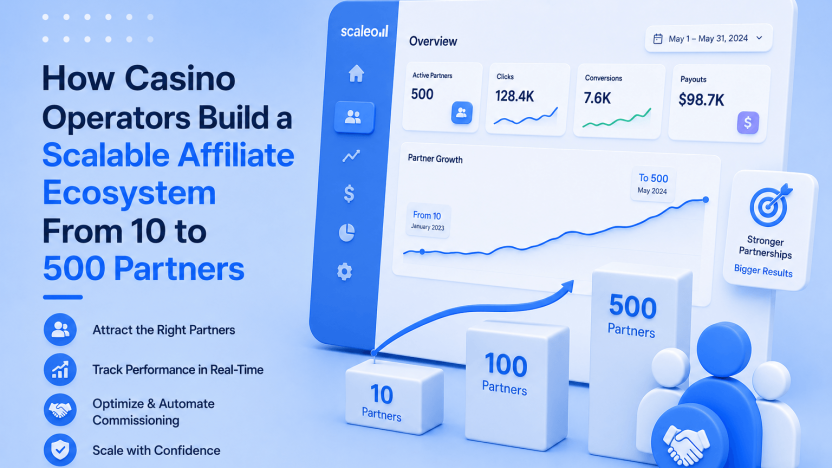
Scaling an iGaming affiliate program from 10 to 500 partners requires a transition from manual relationship management to automated technical infrastructure at three distinct thresholds. At 10 partners, spreadsheets and manual calculation are workable. At 50, automated S2S postback and commission plan templates become necessary. At 200+, behavioral anti-fraud systems and real-time NGR calculation are not optional — they are the difference between a profitable program and a managed payout drain. Each threshold demands a specific infrastructure response. Operators who treat 500 partners like “10 partners, but bigger” do not scale. They collapse under the weight of manual debt they built at the start and never replaced.
The Scale Ceiling: Where Programs Break and Why
Before mapping the three phases of the scaling journey, it is worth being specific about what the scale ceiling actually looks like from the inside — because operators experiencing it rarely recognize it for what it is.
The first symptom is commission calculation taking longer than it should. What was a two-hour monthly task at 30 partners becomes a three-day process at 150, because the NGR formula that was manageable in a spreadsheet now requires reconciling player-level data from multiple sources, applying different deduction rates per deal tier, tracking NCO balances across periods, and manually verifying that the figures match what the affiliate platform recorded. Nobody built the automation layer because at the time, it seemed like a lot of engineering effort for a problem that did not yet feel urgent. Now it is urgent.
The second symptom is affiliate disputes increasing disproportionately to affiliate count. At 10 partners, a missing FTD attribution is a quick email resolution. At 200 partners, three disputes per month is a background hum. At 500 partners, with no systematic audit trail, it is a weekly workload that occupies your affiliate manager and erodes partner trust. The disputes are not increasing because your partners are getting worse. They are increasing because the attribution infrastructure was not built to be auditable at scale.
The third symptom is the realization — usually on a monthly NGR report, usually three months after the fact — that a significant percentage of CPA payouts were made on fraudulent or incentivized traffic. At 10 partners, you know every affiliate personally. At 500, you are trusting a traffic quality filter that was configured when your program was a fraction of its current size. The filter has not been updated. The fraud has evolved. The payout drain has been running for months.
These are not individual problems. They are the same problem — infrastructure debt — expressed through three different operational failure modes. The solution is not working harder at the current scale. It is rebuilding the infrastructure layer before each ceiling is hit, not after.
Phase 1: The Trust Foundation (10–50 Partners)
The first phase of affiliate program scaling is the one most operators get right — and the one whose technical decisions have the most long-term consequence. What you build at 10 partners is either the foundation of a program that scales to 500, or the technical debt that prevents it.
The Infrastructure Priority at This Phase: S2S From Day One
The single most consequential infrastructure decision at the 10-partner stage is the tracking architecture. Operators who launch with pixel-based tracking because it is faster to set up than S2S postback are building attribution infrastructure that will generate disputes, drop conversions under load, and fail progressively as browser privacy enforcement tightens. At 10 partners with modest traffic, pixel tracking works well enough to feel acceptable. At 150 partners during a major sports event, it drops 15–25% of conversions silently and generates a dispute backlog that takes weeks to clear.
S2S postback costs slightly more setup time at the beginning. It costs zero additional setup time at every subsequent growth phase because it continues working regardless of traffic volume, browser environment, or event spike magnitude. The engineering investment is front-loaded once. The dividend compounds across every partner and every billing cycle that follows.
The parallel requirement at this phase is affiliate portal quality. Top-tier SEO affiliates — the partners who generate high-LTV organic traffic and whose program decisions have an outsized impact on your revenue — evaluate program credibility through the affiliate portal experience as part of their due diligence. A portal that loads slowly, displays commission data without NGR deduction transparency, or requires a support ticket to interpret a statement is a portal that fails the credibility check. At 10 partners you do not have the portfolio history to compensate for a poor portal experience. The portal is part of the pitch.
What Success Looks Like at Phase 1
By the time you have 50 active partners, the foundation should include: S2S postback with retry logic and a complete delivery log; a minimum of three commission plan templates (CPA, RevShare, hybrid) with the NGR formula explicitly configured in the platform rather than calculated externally; a documented onboarding sequence that new affiliates complete without requiring affiliate manager intervention at each step; and a fraud baseline established — what does normal conversion behavior look like for your specific player demographic and market, so that deviations become detectable when they emerge.
The Phase 1 infrastructure decision that matters most at Phase 3: Operators who configure their NGR formula inside their affiliate platform at the 10-partner stage — rather than calculating externally and pushing pre-processed values — arrive at the 200-partner stage with a commission history that is fully auditable at the deduction level. Operators who calculate externally arrive at 200 partners with a commission history that exists in spreadsheets, is not natively queryable, and must be manually reconstructed whenever a partner disputes a historical statement. The data quality decision made at Phase 1 determines the reconciliation workload at Phase 3.
Phase 2: The Automation Pivot (50–200 Partners)
The 50-partner threshold is where manual processes that felt manageable begin generating measurable operational debt. The transition from Phase 1 to Phase 2 is not about adding more tools — it is about eliminating the manual intervention points that were acceptable at small scale and become program-threatening at medium scale.
Eliminating “Calculation Day” — The Monthly Reconciliation Burden
“Calculation Day” is the informal name affiliate managers use for the annual ritual that precedes every payment run: pulling player data from the casino back-office, applying NGR deductions in a spreadsheet, reconciling the output against what the affiliate platform recorded, investigating discrepancies, and producing the final commission figures that will be paid. At 30 partners this takes a few hours. At 100 partners it takes several days. At 200 partners it is a full-time task that occupies the entire affiliate team for a week before every payment cycle.
The elimination of Calculation Day requires one architectural change: the NGR formula must live inside the affiliate platform, applied to raw player event data received via API or postback, not outside it in a spreadsheet that someone updates before each payment run. When the platform calculates NGR natively — receiving GGR events, applying configured deduction rates, maintaining running per-affiliate balances — the “calculation” is continuous rather than periodic. Payment run day is a review and approval exercise, not a calculation exercise. The workload per payment cycle drops from days to hours.
Scaleo’s commission architecture performs this calculation natively. Player events — deposit, wager, withdrawal — arrive via postback carrying raw event data. The configured deduction formula runs at calculation time, not at reconciliation time. The affiliate sees an itemized statement in their portal. The operator reviews a pre-calculated commission ledger rather than building one from source data each month. At 150 partners across multiple commission plan types and currencies, this architecture difference represents approximately 22 staff-hours per month recovered from manual reconciliation — consistently with what Scaleo has measured across operator migrations from legacy systems.
Commission Plan Architecture at Scale
The 50–200 partner range is also where the “one-size-fits-all commission” model breaks down. At 10 partners, having every affiliate on the same RevShare rate is operationally simple and commercially acceptable. At 150 partners, you have SEO content sites that justify 35% NGR RevShare because of their high-LTV organic traffic, media buyers who need CPA and net-15 payment terms, streamers who need hybrid with a guaranteed floor, and new affiliates who should be on a 30-day probationary CPA before earning a full rate. All of these deal types running simultaneously require per-affiliate commission plan assignment — which requires a platform that treats commission plans as configurable objects rather than global settings.
The tiered reward structure that emerges at this phase also serves a retention function. An affiliate on a flat 28% RevShare rate has no financial incentive to grow their NGR contribution to your program. An affiliate who knows that at €15,000 monthly NGR they move to 33%, and at €40,000 they reach 38%, has a program-specific reason to invest in your brand over a competitor’s. The tier structure converts your commission plan from a cost center into a retention mechanism built directly into the financial relationship.
Sub-Affiliate Network Management Emerges at This Phase
By 100–150 partners, some of your top affiliates will be operating their own sub-affiliate networks — sending traffic through multiple publisher sources under a single affiliate account. If you have not configured SubID tracking by this point, you have an attribution black hole: the parent affiliate’s performance metrics are an aggregate that masks quality differences between sub-affiliate sources, fraud originating from specific sub-sources is invisible at the parent level, and your fraud scoring is operating on blended data that dilutes the signals it needs to detect. SubID tracking at the Phase 2 stage is not a nice-to-have. It is the prerequisite for meaningful fraud detection at Phase 3.
Phase 3: The Enterprise Ecosystem (200–500+ Partners)
The 200-partner threshold marks the transition from “growing affiliate program” to “affiliate program as a material revenue channel.” At this scale, the technical infrastructure is no longer a support function — it is a competitive asset. The operators who have built the right infrastructure in Phases 1 and 2 manage 500 partners with a team of three. The operators who did not are hiring their seventh affiliate manager and still falling behind.
Behavioral Anti-Fraud: Non-Optional at This Scale
At 500 partners, manual traffic auditing is not a viable fraud prevention strategy. There is no affiliate manager with the bandwidth to review 500 affiliate accounts’ traffic patterns each month alongside their normal program management responsibilities. The fraud detection layer must be automated, and it must operate at the player behavioral level — not the traffic signal level.
The fraud patterns that emerge specifically at high partner count are the ones that exploit the anonymity of scale. A bonus abuse ring operating through one of your 500 partners generates a behavioral signature that is statistically significant at the sub-affiliate source level, statistically invisible at the program aggregate level. Synthetic identity clusters generating high QFTD counts from one affiliate segment look like normal performance metrics when viewed alongside the 499 other affiliate accounts. The detection requires SubID-level fraud scoring applied in real time — not a monthly manual review of aggregated affiliate reports.
Scaleo’s Anti-Fraud Logic™ scores each click and conversion event against a behavioral baseline built from the program’s own legitimate traffic history. At 500 partners, this baseline is statistically strong — the engine has enough genuine traffic data to identify deviations with high confidence and low false positive rates. The composite scoring model flags anomalies before the payout run, not after. At a program generating 3,000 QFTDs per month at an average CPA of €90, the difference between detecting fraud before payout and detecting it after represents approximately €270,000 per month in potential unrecoverable payout exposure for a 10% fraudulent traffic rate.
Multi-Brand Operations: The Architecture Requirement
Operators who have reached 500 total partners across multiple brands — a casino and a sportsbook, or two casino brands in different license jurisdictions — face a specific infrastructure challenge that ecosystem-bound platforms cannot address: the need for unified affiliate management across brands without running separate platform instances.
Running separate affiliate platform instances per brand means separate affiliate portals, separate commission histories, separate tracking domains, and no unified view of an affiliate’s total contribution across the program portfolio. Affiliates who promote multiple brands must log into multiple portals, interpret multiple commission statements, and reconcile separate payment streams. The operational overhead on both the operator side and the affiliate side is significant — and it disproportionately affects the program’s ability to attract and retain tier-1 affiliates who manage multiple program relationships simultaneously.
Scaleo’s multi-brand architecture handles per-brand tracking domains, commission plans, and reporting instances within a single operator account. Affiliates promoting multiple brands see a unified portal with brand-specific performance breakdowns. The operator sees cross-brand aggregate reporting alongside per-brand detail. The casino backends are operationally independent — each fires its own postbacks to brand-specific endpoints — but the affiliate management layer is unified.
Data Portability: The Growth Insurance Policy
At 500 partners, your affiliate program represents years of commission history, hundreds of carefully negotiated deal structures, and thousands of tracking links embedded across the internet in locations you may not fully map. That institutional value — the history of which affiliates generate high-LTV players, which traffic sources perform in which markets, which deal structures produce sustainable long-term relationships — is the most valuable asset in your acquisition function.
An affiliate program built on an ecosystem-bound platform — Affilka within SoftSwiss, PartnerMatrix within EveryMatrix — holds that value inside the casino platform’s data environment. The day you evaluate changing your casino backend, that value becomes a negotiating hostage. The migration cost includes not just the technical work of changing platforms but the affiliate data continuity risk that comes with it. At 500 partners, that risk is material enough to keep operators on underperforming casino platforms longer than they should stay.
Scaleo operates independently of any casino backend. The affiliate program data — commission history, player attribution records, NCO balances, fraud scoring history, tracking link infrastructure — lives inside the Scaleo platform, not inside the casino backend. Change your game provider. Change your PAM. Change your casino platform entirely. None of those decisions touch your affiliate program. Your 500 partners keep their links. Your commission history is continuous. Your institutional knowledge survives the backend change intact.
The Scaling Friction Matrix: Legacy Experience vs Modern Infrastructure
| Scaling Hurdle | The Legacy Experience | The Scaleo Solution | Phase Where This Becomes Critical |
|---|---|---|---|
| Partner onboarding | Manual email chains, setup instructions sent per-affiliate, no self-service flow | Automated onboarding with custom vetting workflows; affiliates self-complete setup without affiliate manager at each step | Phase 2 (50+ partners) |
| NGR reconciliation | 3–5 day manual audit before each payment run; spreadsheet calculation, manual discrepancy investigation | Real-time NGR calculation via API; payment run is review and approval, not calculation | Phase 2 (100+ partners) |
| Fraud detection | Post-payout realization of fraudulent traffic patterns; manual audit of monthly reports | Anti-Fraud Logic™ flags suspicious FTD clusters, CPA chasing, and bonus abuse rings before payout | Phase 3 (200+ partners) |
| Commission plan diversity | Global settings force all affiliates onto same plan; different deal types managed manually outside platform | Per-affiliate commission plan assignment; CPA, RevShare, hybrid, tiered running simultaneously from same account | Phase 2 (50+ partners) |
| Sub-affiliate visibility | Parent affiliate metrics aggregate sub-sources; fraud from one sub-affiliate invisible in parent-level data | SubID-level tracking, fraud scoring, and NGR reporting natively; sub-affiliate source quality independently measurable | Phase 2–3 (100+ partners) |
| Multi-brand management | Separate platform instances per brand; no unified cross-brand affiliate view; affiliate logs into multiple portals | Multi-brand architecture in single account; unified affiliate portal with brand-specific breakdowns; cross-brand reporting native | Phase 3 (200+ partners) |
| Data portability | Commission history locked to casino backend; platform change creates affiliate data continuity risk | Standalone architecture; all affiliate data exportable on demand; casino backend change is invisible to affiliate program | Phase 3 (200+ partners) |
| Affiliate portal performance | Legacy PHP rendering; full-page reload on dashboard filter changes; 5–8 second load times frustrate active affiliates | Sub-1.4 second average dashboard load; real-time conversion events via WebSocket; mobile-responsive affiliate portal | Phase 1 (10+ partners) |
| Compliance and T&C management | Manual email distribution; no acknowledgment logging; audit trail lives in email threads | Versioned T&C distribution with timestamped acknowledgment logging; compliance audit trail in platform | Phase 2–3 (regulated markets) |
NGR Accuracy at Scale: Why a 2% Discrepancy Is Not a Rounding Error
At 10 partners with modest monthly NGR, a 2% calculation discrepancy is negligible in dollar terms. At 500 partners generating combined affiliate-attributed NGR of €2 million per month, a 2% calculation discrepancy is €40,000 per month — either overpaid to affiliates because the deduction formula was not applied correctly, or underpaid and generating disputes because affiliates calculated a different figure from the same source data.
The sources of NGR discrepancy in high-volume programs are consistent across operators: postback events that fired but were not processed before the calculation period closed (typically due to the queue saturation that occurs during peak traffic events), currency conversion timing differences in multi-currency programs where the FX rate applied at the operator and platform sides differs, and deduction rate changes that were applied at different points in the calculation chain between the casino backend and the affiliate platform.
Scaleo’s infrastructure maintains 99.9% S2S postback processing reliability — meaning that in a 10,000-event-per-hour peak window, fewer than 10 events will fail to process within the billing period. The retry queue with exponential backoff ensures that transient failures are recovered before period close. The full postback delivery log with HTTP timestamps means that when a discrepancy does occur, it can be traced to the specific event that caused it and resolved at the HTTP request level — not through a multi-day spreadsheet comparison between operator and affiliate records.
For regulated operators under MGA or UKGC licensing, the audit trail requirement adds an additional dimension to NGR accuracy: regulators can and do request evidence of how affiliate commissions were calculated. A platform that produces a timestamped, event-level NGR calculation record for any affiliate in any period satisfies this requirement by default. A platform that stores only the final commission figure — not the underlying events and deductions that produced it — requires manual reconstruction to respond to a regulatory request. At 500 partners with years of commission history, that reconstruction is not a minor administrative task.
The Infrastructure Decision Timeline: When to Build Each Layer
The most expensive infrastructure decisions are the ones made late — after the scale ceiling has been hit rather than before. The timeline below maps the specific infrastructure decisions to the partner count thresholds where they need to be in place, based on where Scaleo observes programs experiencing the consequences of delayed implementation.
| Partner Count | Infrastructure Decision | Cost of Delaying Beyond This Threshold |
|---|---|---|
| Program launch | S2S postback architecture, native NGR formula in platform, three commission plan templates | Attribution debt compounds with every additional partner; rebuilding later requires affiliate link migration and data gap acceptance |
| 25–30 partners | SubID tracking enabled, fraud behavioral baseline established, affiliate portal load time verified | Sub-affiliate fraud invisible without SubID; no baseline means no anomaly detection when fraud scales up |
| 50–75 partners | Automated onboarding workflow, tiered commission plan structure, NCO policy per-affiliate assignment | Manual onboarding at 100+ partners becomes full-time work for affiliate manager; flat commission rates inhibit retention of high performers |
| 100–150 partners | Automated fraud alert thresholds configured, 30-day and 60-day retention tracking by affiliate | Fraud operating at this scale for 3+ months before manual detection generates 5-figure unrecoverable payout exposure |
| 200 partners | Multi-brand architecture if applicable, compliance T&C versioning and acknowledgment logging | Retroactive brand separation from a single-instance setup requires tracking link migration; compliance gaps in regulated markets generate license risk |
| 300–500 partners | Full behavioral scoring at SubID level, data portability audit, postback load test at peak traffic volume | At 500 partners, an undiscovered ecosystem lock-in or data portability constraint becomes a negotiating position that casino platform vendors exploit |
Frequently Asked Questions
How do I manage 500 affiliates without a large team?
The ratio of affiliate manager headcount to active partner count in well-automated programs runs approximately 1:100 to 1:150 — meaning a team of three to four can manage 400–500 partners when the right automation infrastructure is in place. The key automation layers that make this ratio achievable: automated onboarding that brings new affiliates through setup without affiliate manager intervention at each step; native NGR calculation that eliminates Calculation Day labor; automated fraud scoring that flags anomalies before they require human review rather than after they require dispute resolution; and automated compliance notification and acknowledgment workflows. The affiliate manager’s role in an automated program is relationship management, deal negotiation, and exception handling — not data entry and reconciliation. That shift requires the automation infrastructure to exist first.
Can Scaleo handle multi-currency payouts for a global partner base?
Yes, natively. Scaleo’s commission architecture tracks NGR in the player’s originating currency and converts to the affiliate’s payout currency at the commission calculation stage, not at the deposit event stage. This matters because currency conversion at the wrong point in the calculation chain creates rounding errors that compound across high-volume programs. The distinction: an affiliate whose cohort generates player activity in EUR, GBP, and CAD receives a commission statement showing NGR calculated in each originating currency with a documented conversion rate applied at period close — not a single aggregate figure that cannot be verified against source data. NCO balances are also tracked per currency, preventing the cross-currency balance distortion that creates reconciliation problems in programs that aggregate currencies prematurely.
What is affiliate churn rate on legacy vs modern platforms?
Affiliate program churn — partners who reduce or stop sending traffic within 12 months of joining — is measurably higher on programs running legacy PHP-based portals with 5–8 second dashboard load times than on programs running modern affiliate portals with sub-2-second load times. The mechanism is not aesthetic. It is behavioral: a portal that loads slowly is a portal that active affiliates check less frequently, which means they catch discrepancies later, make optimization decisions on stale data, and develop less engagement with your program’s performance metrics. The affiliates who churn first from slow portals are typically the most active ones — because they are the ones logging in frequently enough to experience the friction. Based on Scaleo’s operator data, programs that migrated from legacy portals to Scaleo’s Instant UI reported affiliate portal login frequency increases of 34% on average within 60 days of migration, with a corresponding increase in affiliate-initiated optimization conversations with affiliate managers.
When should an operator switch from spreadsheet tracking to a dedicated affiliate platform?
The answer most operators want is a partner count threshold. The more accurate answer is a workload threshold: when the monthly time investment in manual reconciliation, commission calculation, and dispute resolution exceeds 15 hours per billing cycle, the ROI on a dedicated platform is positive within the first quarter regardless of partner count. At 15+ hours of manual work per month, the staff cost of that work exceeds the platform license cost of most mid-market affiliate software options. The switch to a dedicated platform recovers those hours and redeploys them into activities that generate program revenue rather than administrative maintenance. Most operators hit this threshold between 15 and 30 partners — far earlier than they expect.
How does affiliate program fraud scale with partner count?
Fraud scales non-linearly with partner count because the anonymity and complexity of a larger program are themselves fraud enablers. At 10 partners, the operator knows each affiliate personally and can identify anomalous behavior through direct observation. At 500 partners, direct observation is impossible — fraud detection depends entirely on automated behavioral scoring. The fraud patterns that emerge at scale are specifically designed to exploit this transition: bonus abuse rings and synthetic identity operations target programs large enough that their activity is statistically invisible in aggregate metrics, but too large for manual review to catch them. The fraud rate in an unmonitored 500-partner program is not simply 50 times the fraud rate in an unmonitored 10-partner program — it is orders of magnitude higher because the fraud operators specifically target scale-stage programs that have outgrown manual oversight without yet deploying automated detection.
The Infrastructure You Build at 10 Partners Determines Whether You Reach 500
Every operator who has hit a scale ceiling did so because an infrastructure decision made at small scale was not revisited before it became a constraint. S2S postback built at launch. NGR formula owned by the platform, not the spreadsheet. Fraud scoring enabled before the fraud scales up. Data portability confirmed before the casino backend conversation happens. None of these are large decisions when made proactively. All of them are expensive decisions when made reactively — after the payout drain is already running, after the disputes are already queued, after the fraud has already been paid.
See how Scaleo’s platform architecture is designed to scale with your program from the first affiliate to the five-hundredth — or explore how the Anti-Fraud Logic™ protects your margins at the phase where manual monitoring stops being viable.
Related reading: What Is an FTD? Definition and Qualification Logic · Negative Carryover in iGaming: The Operator’s Complete Policy Guide · The Real Cost of Affiliate Platform Migration: TCO Analysis