Choosing iGaming affiliate software is no longer a simple feature comparison. For operators, the real question is whether the platform can protect margin, calculate commissionable revenue correctly, and hold up under regulatory and affiliate scrutiny when volume spikes.
A tracker that works for e-commerce or lead gen will often fail in gambling because it cannot reconcile NGR logic, support settlement-driven revenue events, or surface fraud patterns before a payout run.
This comparison focuses on the 10 platforms most often considered by casino and sportsbook operators, with emphasis on commission integrity, postback reliability, fraud controls, and multi-jurisdiction readiness.
⚡ Key Takeaways
iGaming Affiliate Software is a purpose-built tracking and commission management platform that connects operators with affiliate partners by attributing player activity — FTDs, deposits, NGR — back to the originating traffic source. Unlike generic performance marketing tools, it must handle revenue-share models, real-time GGR/NGR calculations, and regulatory-grade data integrity across multiple jurisdictions.
Three attributes separate a genuinely capable platform from a repurposed SaaS tracker dressed up for gambling:
- NGR Accuracy: The platform must apply operator-defined bonus cost, rake deductions, and jackpot contributions at the transaction level — not as an end-of-month spreadsheet adjustment.
- S2S Postback Reliability: Server-to-server event delivery with retry logic and real-time FTD matching. Cookie-based attribution fails at 30–40% in iOS 17+ environments.
- Behavioral Anti-Fraud: Static IP blacklists catch perhaps 12% of bonus-abuse attempts. Pattern-recognition engines that flag velocity, device-fingerprint anomalies, and deposit/withdrawal timing anomalies catch the rest.
Platform Comparison at a Glance
| Platform | Best For (Use Case) | Tracking Method | Key iGaming Feature | Pricing Model |
|---|---|---|---|---|
| Scaleo | Mid-market & enterprise operators, white-label sportsbooks | S2S + Cookie hybrid | Real-time NGR/GGR, multi-currency, fraud score engine | Monthly SaaS (tiered by clicks) |
| Affilka by SoftSwiss | Operators running on the SoftSwiss Game Aggregator | S2S | Native NGR integration with SoftSwiss back-office | Included in SoftSwiss licensing |
| IREV | Casino operators needing a CRM-affiliate hybrid | S2S | Player lifetime value segmentation, GGR dashboards | Revenue share + platform fee |
| NetRefer | Large casino brands with established affiliate networks | S2S | AI CoPilot layer, GraphQL API, multi-brand management | Enterprise contract |
| Cellxpert | Regulated European sportsbooks (UKGC, MGA) | S2S | Compliance-first reporting, GDPR data residency controls | Enterprise contract |
| Income Access (Paysafe) | Large lottery & land-based operators going digital | Cookie + S2S | Offline/online attribution bridge | Enterprise contract |
| MyAffiliates | Poker networks, multi-brand operators | Cookie + S2S | Complex tiered commission plans, deal group logic | Monthly SaaS |
| PartnerMatrix (EveryMatrix) | Operators running on the EveryMatrix gaming platform | S2S | Multi-brand dashboard, DeepCI traffic analysis | Custom enterprise pricing |
| Optimove | Operators prioritizing retention analytics + affiliate ROI | API | ML-driven player segmentation, affiliate cohort reporting | Enterprise contract |
| BetConstruct Affiliate | Operators running the full BetConstruct gaming stack | S2S | Integrated affiliate tracking within BetConstruct ecosystem | Bundled with BetConstruct platform |
The Critical Importance of NGR Logic — Where Legacy Platforms Break
Here is where most comparisons go shallow, so let’s go deep.
A standard affiliate platform measures a conversion. A player clicks, deposits £100, and the platform records a “conversion event” worth £100. That’s it. That’s all it knows. For e-commerce, that’s fine. For iGaming, that number is almost meaningless from a commission-calculation standpoint.
Net Gaming Revenue is not a single number. It’s a formula that varies by operator, by jurisdiction, and sometimes by game vertical:
NGR = GGR − Bonuses − Payment Processing Fees − Jackpot Contributions − ChargebacksMany platforms — including some that have been in the iGaming space for two decades — expect you to push a pre-calculated revenue figure via postback and treat it as truth. That means your back-office team is manually calculating NGR in a spreadsheet, then reconciling it against affiliate commission reports. At 50 affiliates, that’s painful. At 500, it’s a compliance risk.
Scaleo’s approach is architecturally different. The platform accepts multi-parameter postbacks that carry both the gross gaming revenue event and the deduction components as separate fields. The NGR formula is then configured inside Scaleo’s commission plan builder, applied at calculation time — not at reporting time. Change your bonus cost structure in January? The recalculation propagates automatically across all active commission plans without manual intervention.
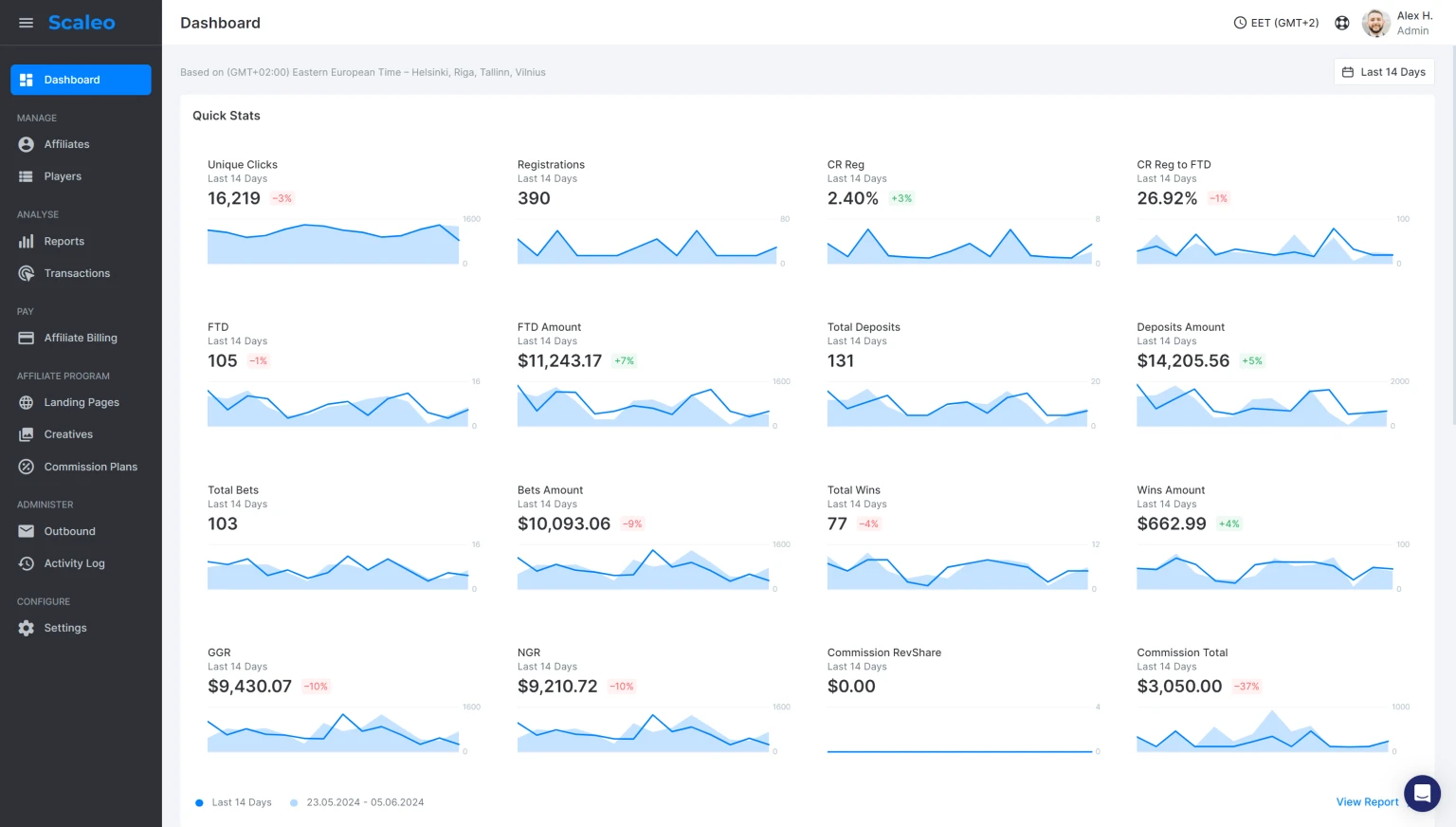
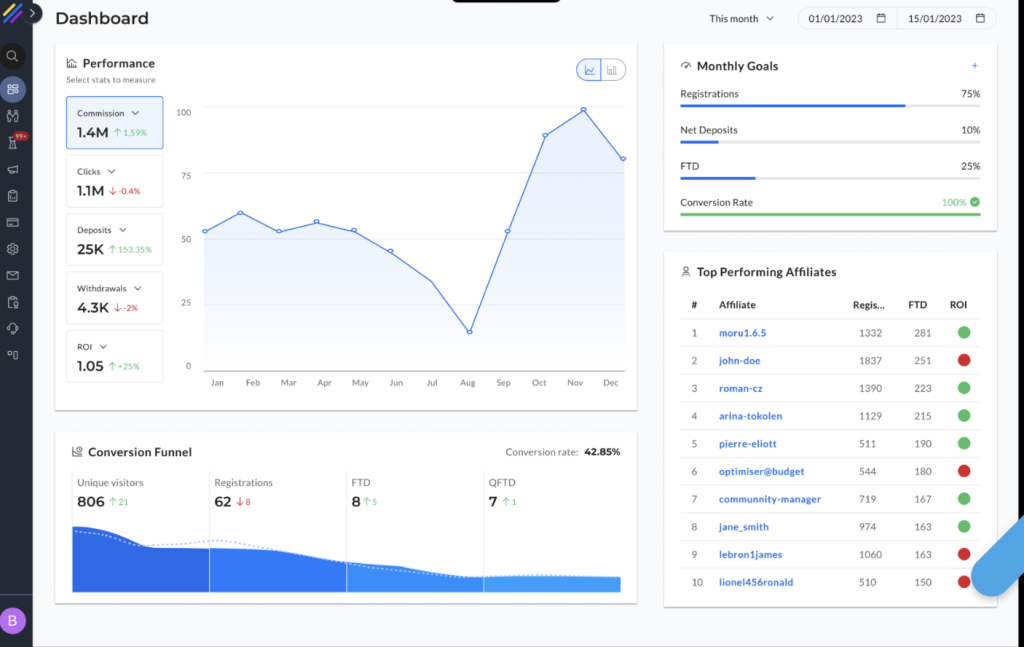
Fig. 1 — Scaleo’s real-time NGR dashboard: per-affiliate GGR, bonus deductions, and net revenue calculated at the transaction level, not end-of-month.
This matters enormously for revenue-share affiliates. An affiliate earning 35% NGR on a player cohort needs to trust the number. If they can’t audit it field-by-field, you lose them to a competitor who offers transparency. Scaleo’s affiliate-facing portal exposes the NGR breakdown — GGR line, deduction line, net line — so there’s no black box. That transparency is a retention mechanism, not just a reporting feature.
For sportsbook operators, the equivalent is margin-adjusted revenue: you need to strip the void bets, adjust for in-play settlement errors, and apply the promotional free-bet liability before any commission is owed. The same postback architecture supports this. Most platforms can’t. Full stop.
Behavioral Anti-Fraud — Why IP Blocking Is Dead and What Actually Works
IP blacklisting was the industry standard in 2019. It’s largely theater in 2026.
Residential proxy networks now rotate through legitimate IP pools at sub-second intervals. A motivated bonus abuser — someone systematically creating duplicate accounts to claim welcome offers — is not going to show up on a static DNSBL list. They’re coming in from a Virgin Media IP in Manchester, a Vodafone IP in Munich, and a Comcast IP in Florida, all within the same session chain. Your blacklist doesn’t see them. Your bank account does.
The actual attack surface in iGaming affiliate fraud looks like this: an affiliate drives traffic from incentivized sources — click farms, self-referrals, or purchased player lists — that generate high FTD counts but zero long-term NGR. The players deposit, claim the bonus, and immediately withdraw or churn. The affiliate collects a CPA commission on every FTD. The operator absorbs the full bonus cost plus processing fees. Losses of €10,000–€50,000 per month from a single bad actor affiliate are not uncommon at mid-sized operators.
Behavioral detection changes the detection vector entirely. Instead of asking “is this IP address known-bad?”, a behavioral engine asks:
- Does this player’s deposit-to-withdrawal timing fall outside the 95th percentile of legitimate player behavior?
- Does the device fingerprint share hardware entropy with other accounts registered in the last 72 hours?
- Is the registration-to-FTD interval under 4 minutes? (A legitimate player takes 12–18 minutes on average.)
- Does the session have consistent mouse movement patterns, or does it look like automated form fill?
Scaleo’s anti-fraud engine scores every click and conversion event in real time against a rule set that operators configure. You can set automated hard-blocks — affiliate account freezes triggered at a fraud score above a defined threshold — or soft alerts that flag for manual review. Critically, the fraud score is visible to the operator in the affiliate dashboard, so your affiliate compliance team can act before a commission run, not after.
One operator running a multi-brand casino network reduced fraudulent FTD payouts by 67% in the first 90 days after switching from a legacy IP-block-only system to Scaleo’s behavioral scoring. That’s not a marketing claim — that’s a function of catching registration velocity patterns that an IP list simply cannot see.
Platform Deep Dives — The Honest Assessment
1. Scaleo
We, the team behind Scaleo, built this platform specifically for performance-driven iGaming operators who need more than a generic tracking layer.

The dashboard loads in under 1.4 seconds on average — roughly 3x faster than legacy PHP-based tracker interfaces that still render full-page reloads on filter changes. The “Instant UI” design philosophy isn’t cosmetic. When an affiliate logs in and sees their NGR, FTDs, and commission balance in under two seconds, they stay engaged. That’s an affiliate retention mechanism with a measurable impact on partner loyalty.
Unlike platforms built in the mid-2000s and incrementally patched over two decades, Scaleo was architected from the ground up on a modern API-first stack — meaning postback infrastructure, commission calculation, and fraud scoring are native functions rather than add-on modules bolted onto an aging core. The practical consequence: configuring a new NGR deduction rule, rolling out a multi-currency commission plan, or updating fraud thresholds takes minutes, not a support ticket and a waiting queue.
✅ Pros
- Real-time NGR/GGR calculation with configurable deduction formulas
- Behavioral anti-fraud engine with automated threshold-based blocking
- Multi-currency commission plans with dynamic FX conversion
- S2S + cookie hybrid tracking with retry logic and postback logging
- White-label affiliate portal with Instant UI (sub-1.4s load times)
- Modern API-first architecture — no legacy technical debt
- Dedicated iGaming onboarding and compliance support
❌ Cons
- No native CRM module — requires integration with third-party player retention tools
- Entry-level plan caps can feel restrictive for very high-volume click networks
- Not ideal for operators who need offline/land-based attribution bridging
2. Affilka by SoftSwiss
If your entire operation runs on the SoftSwiss stack, Affilka is the obvious choice — and a genuinely good one.
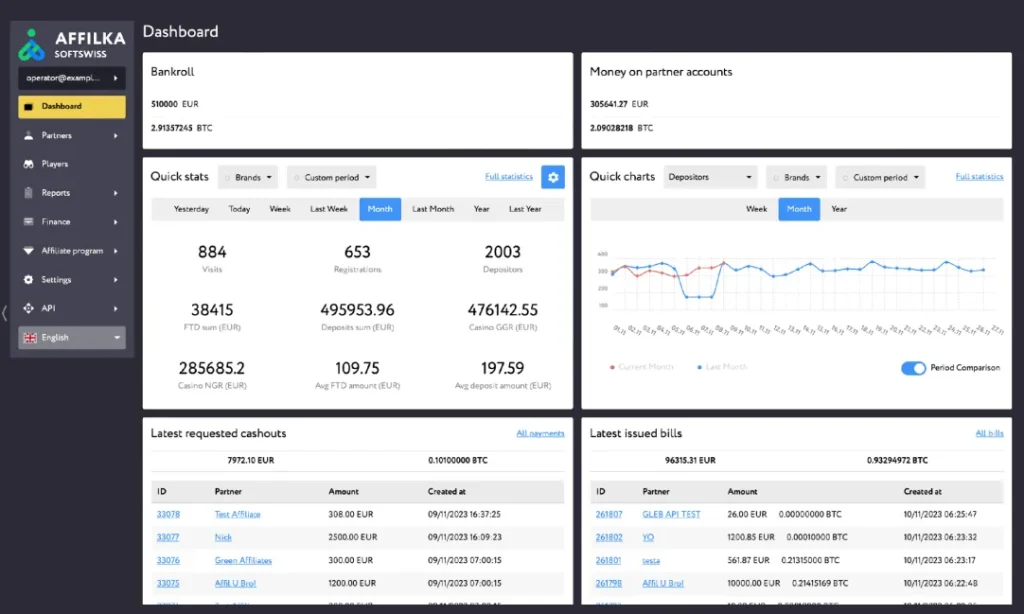
The native back-office integration means NGR data flows directly without postback engineering. That’s a genuine operational advantage — until you look at the pricing structure. Affilka starts at approximately €2,500/month, creating a meaningful cost barrier for mid-tier operators who don’t need the full SoftSwiss ecosystem bundled in. Outside the SoftSwiss environment, Affilka loses much of its advantage. Integration with third-party PAMs or game aggregators is technically possible but requires significant engineering overhead that negates the “plug-and-play” value proposition. If you’re evaluating Affilka and your tech stack isn’t SoftSwiss-native, the total integration cost will likely exceed the license savings.
✅ Pros
- Seamless NGR integration within SOFTSWISS environment
- No postback configuration needed for SoftSwiss-native operators
- Near real-time analytics and strong UI/UX for affiliates
❌ Cons
- Effectively locked to the SoftSwiss ecosystem — third-party integration is heavy
- High starting cost (~€2,500/month) creates a barrier for mid-tier operators
- Not suitable for multi-platform or custom PAM operators
3. IREV
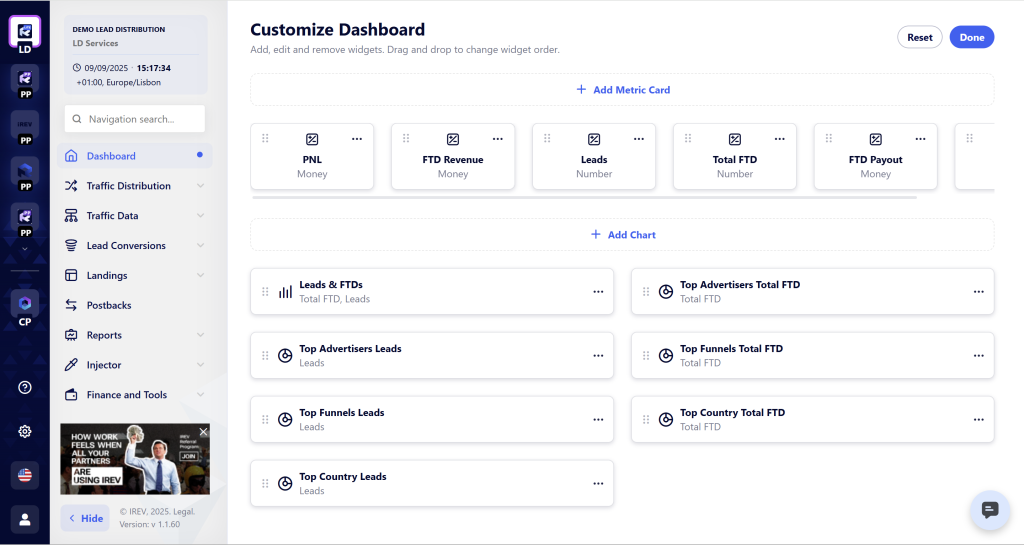
IREV positions itself at the intersection of affiliate tracking and player lifecycle management. If you need a platform that bridges affiliate attribution with CRM segmentation — understanding which affiliate-sourced player cohorts have the highest 90-day LTV — IREV is worth serious evaluation. It’s not a pure tracking tool. It’s closer to a customer intelligence platform with affiliate capabilities. That depth comes with complexity and a pricing structure that favors established operators with significant monthly GGR. For operators primarily focused on affiliate program management rather than deep player analytics, the CRM overhead is a cost without a corresponding payoff.
✅ Pros
- Deep player LTV segmentation by acquisition source
- GGR dashboards with cohort analysis
- Strong for operators who want affiliate ROI tied to long-term player value
❌ Cons
- Higher implementation complexity and cost
- Overkill for operators with under 200 active affiliates
- Less intuitive affiliate-facing portal UX compared to dedicated affiliate platforms
4. NetRefer
NetRefer has been one of the most recognized names in iGaming affiliate management since 2004, and that longevity is both its greatest asset and its most significant liability. Many of the industry’s largest casino brands run on NetRefer — which means many operators encounter it when inheriting an affiliate program that predates their tenure.
The platform has evolved over two decades, and the recent addition of an AI CoPilot layer and GraphQL APIs reflects genuine investment in keeping pace with modern expectations. However, these features sit on top of a PHP-based architecture that was designed before server-to-server postbacks were the standard, before behavioral fraud scoring was a concept, and before multi-jurisdiction compliance requirements demanded per-brand data segregation at the infrastructure level. The consequence isn’t just cosmetic: advanced reporting — the kind operators actually need to reconcile NGR with affiliates — is not included in the base contract. Pricing for reporting modules is additive, which creates a recurring friction point in what should be a straightforward cost-benefit calculation.
For operators inheriting a NetRefer installation with an established affiliate base, migration risk is the primary reason to stay. For operators evaluating from scratch, the architecture debt and opaque total cost of ownership are meaningful objections.
✅ Pros
- Strong brand recognition — affiliates are familiar with the interface
- Recent GraphQL API additions improve integration flexibility
- AI CoPilot layer provides useful multi-brand performance summaries
❌ Cons
- Legacy PHP architecture — modern features bolted on rather than natively built
- Advanced reporting tools priced separately from the base platform
- Complex UI that requires significant onboarding time for new affiliate managers
- Enterprise contract pricing with limited flexibility for mid-market operators
5. Cellxpert
Cellxpert’s main argument is compliance.
For operators holding UKGC or MGA licenses, the platform’s GDPR data residency controls and audit-trail features meaningfully reduce regulatory exposure. If your primary concern is passing a compliance audit rather than affiliate acquisition velocity, Cellxpert belongs on your shortlist. It is not optimized for rapid affiliate onboarding or high-volume click processing — that’s a deliberate trade-off for compliance depth.
✅ Pros
- Best-in-class regulatory compliance tooling for UKGC/MGA markets
- GDPR data residency and audit trail out of the box
- Enterprise-grade SLA and support for regulated sportsbooks
❌ Cons
- Affiliate onboarding flow is slow and bureaucratic by design
- Not optimized for high-volume affiliate networks
- Enterprise contract pricing with significant minimum commitments
Scaleo vs. NetRefer: The Modern Stack vs. the Legacy Incumbent
The Scaleo vs. NetRefer comparison is the one that comes up most often when mid-to-large operators are evaluating whether to stay on legacy infrastructure or migrate to a purpose-built modern platform. Both are iGaming-native, both support S2S, and both have significant install bases. The decision turns on three technical realities.
Architecture age and what it costs you. NetRefer was built in 2004. That’s not a criticism of the team — it’s a statement about what was technically possible at the time. NGR formula ownership, behavioral fraud scoring, and per-brand data residency weren’t engineering priorities in 2004 because the industry didn’t need them at scale. Scaleo was built after these became table stakes. The result is that what takes a Scaleo operator 15 minutes to configure — a new deduction rule, a fraud threshold, a per-jurisdiction commission plan — requires a support ticket and a deployment queue in a legacy system. At operational velocity, that difference compounds.
NGR formula ownership. Scaleo holds the NGR formula inside the platform. NetRefer, like most legacy trackers, delegates the deduction logic to your back-office team. If you have a robust in-house tech function already maintaining an NGR calculation service, that works — at the cost of a permanent reconciliation overhead between your back-office and your affiliate reporting. If you want the tracker to be the single source of truth for commissions, Scaleo wins this point clearly and with no workaround required.
Total cost transparency. Scaleo’s tiered SaaS pricing is published and predictable. NetRefer operates on enterprise contracts where advanced reporting — the reports your affiliate compliance team needs to run a clean payout cycle — are priced as add-ons. Operators migrating off NetRefer consistently report that the effective monthly cost, once reporting modules and support tiers are factored in, was significantly higher than the headline contract suggested.
A Technical Note on S2S Reliability in Regulated Markets
Server-to-server postback tracking fundamentally rewrites how we capture conversion data, bypassing the fragile client-side dependence that has plagued marketers since Safari’s ITP and Firefox’s Enhanced Tracking Protection began quietly gutting cookie-based attribution. It just works — until it doesn’t.
The failure mode most operators underestimate is postback queue saturation during high-traffic events: a major sports fixture, a slots tournament, a jackpot drop. At peak load, a poorly architected S2S system drops postbacks silently. No error. No retry. The FTD simply never registers. The affiliate doesn’t get commission credit. The operator has a dispute.
Scaleo’s postback infrastructure includes a retry queue with exponential backoff and a full postback log visible to the operator’s technical team. Every event — delivered, failed, retried — is logged with timestamps and HTTP response codes. When an affiliate questions a missing FTD, you have an auditable record at the HTTP request level. That’s not a feature for the affiliate manager — that’s a feature for your legal team.
For operators in regulated markets, this audit trail also satisfies the technical documentation requirements that bodies like the MGA increasingly expect to see during compliance reviews. Legacy platforms built before these requirements crystallized rarely log at this granularity. Plan accordingly.
Ready to Replace Your Spreadsheet Reconciliation With a Real NGR Engine?

If your affiliate compliance team is still manually deducting bonus costs from GGR at month-end, you’re one bad actor away from a six-figure commission dispute. Explore how Scaleo’s platform features, anti-fraud engine, and iGaming-specific commission architecture close that gap — before your next payment run.
Frequently Asked Questions
How do S2S postbacks handle FTD tracking in regulated markets?
S2S postbacks fire from your back-office server directly to the affiliate platform’s endpoint when a qualifying deposit event occurs, carrying identifiers like the click ID, player ID, and deposit amount. In regulated markets — particularly those under MGA or UKGC oversight — the postback must also carry a jurisdiction-compliant timestamp and, in some implementations, a hashed player identifier to satisfy GDPR pseudonymization requirements. A platform like Scaleo logs the full HTTP exchange, making the postback delivery auditable at the request level. This matters because regulators can — and do — request evidence of how affiliate commission events were recorded and attributed.
What is the difference between NGR and GGR in affiliate commission calculations?
Gross Gaming Revenue (GGR) is total player losses before any operator cost deductions: the raw spread between total bets and total wins. Net Gaming Revenue deducts from GGR the costs the operator incurs in generating that revenue — primarily bonus costs, payment processing fees, jackpot contributions, and any applicable taxes or levies. Most revenue-share affiliate agreements pay on NGR because it more accurately reflects the operator’s actual profit margin. Paying affiliates on GGR without deducting bonus costs is one of the fastest ways to make an acquisition channel unprofitable.
Why does behavioral anti-fraud outperform IP blacklisting for bonus abuse detection?
IP blacklisting assumes fraudulent actors use identifiable, static IP addresses. Residential proxy networks, mobile carrier IP rotation, and VPN infrastructure mean that in 2026, a motivated bonus abuser rarely shows up on a DNSBL. Behavioral detection instead looks at the signature of how a player interacts with your platform: registration-to-deposit timing, session mouse-movement entropy, device hardware fingerprint overlap with recently registered accounts, and deposit/withdrawal velocity relative to cohort norms. These behavioral signals are significantly harder to spoof at scale. An operator running Scaleo’s fraud scoring reduced fraudulent CPA payouts by 67% within 90 days—behavioral patterns that IP-block rules had completely missed were exposed.
Can affiliate management software for sportsbooks handle in-play bet settlement adjustments?
Yes, but only if the platform supports multi-event postback sequences rather than single-event conversion tracking. For sportsbooks, the revenue value of a bet isn’t finalized at placement — it’s finalized at settlement, which may be minutes, hours, or days later. A properly architected S2S implementation sends an initial postback at bet placement and a settlement postback when the outcome is confirmed, with void and amendment events handled as additional postback types. Scaleo’s postback schema supports this multi-event model, allowing sportsbook operators to structure revenue-share commissions on settled NGR rather than gross stakes, which is the only model that accurately reflects actual margin.
How should operators evaluate affiliate software when expanding into multiple regulated jurisdictions?
Multi-jurisdiction operation introduces three specific requirements for your affiliate platform. First, data residency: some regulators (particularly in Germany and Sweden) require player data to be stored within the EU. Check whether the platform offers region-specific server deployments. Second, currency isolation: commission plans must calculate NGR in the player’s native currency before converting to affiliate payout currency — rounding at the wrong stage creates reconciliation errors at scale. Third, license-aware traffic routing: your platform needs to segregate affiliate tracking by license entity so that MGA-licensed player traffic doesn’t contaminate UKGC reporting. Scaleo’s multi-brand architecture handles this at the account level, with per-brand tracking domains, commission plans, and reporting instances.
What is iGaming affiliate software and what makes it different from generic affiliate tracking tools?
iGaming affiliate software is a purpose-built tracking and commission management platform that attributes player activity — FTDs, deposits, net gaming revenue — back to the originating affiliate traffic source. It differs from generic affiliate trackers in three critical ways: it must calculate Net Gaming Revenue (NGR) accurately by applying operator-defined bonus costs, jackpot contributions, and processing fee deductions at the transaction level; it must support server-to-server postback tracking reliable enough for settlement-grade attribution; and it must include behavioral anti-fraud logic capable of detecting bonus-abuse patterns that IP blacklisting cannot identify. Generic performance marketing tools that work for e-commerce fail in iGaming because they treat a deposit event as a terminal conversion rather than the start of a revenue-share calculation.
What is NGR and why does it matter for iGaming affiliate commission calculation?
NGR stands for Net Gaming Revenue — the revenue figure on which most iGaming RevShare commissions are calculated. It is not a single number; it is a formula: NGR = GGR (Gross Gaming Revenue) minus bonus costs, minus payment processing fees, minus jackpot contributions, minus chargebacks. The formula varies by operator, jurisdiction, and sometimes by game vertical. This matters for affiliate software selection because a platform that only accepts a single revenue value via postback forces the operator’s back-office team to calculate NGR manually in a spreadsheet before the commission run. At 50 affiliates that is painful; at 500 it is a compliance risk. Platforms that accept multi-parameter postbacks carrying both GGR and individual deduction components — and apply the NGR formula inside the commission plan builder — eliminate that reconciliation overhead entirely.
Is cookie-based tracking still viable for iGaming affiliate programs in 2026?
Cookie-based tracking has become unreliable for iGaming attribution as of 2026. Apple’s Intelligent Tracking Prevention (ITP) deletes third-party cookies within 24 hours on Safari, which commands a significant share of mobile casino traffic. Cookie-based attribution fails at 30–40% of sessions in iOS 17+ environments. Additionally, iGaming sessions frequently span multiple devices or move from mobile browser to native app, breaking cookie-based attribution chains entirely. Server-to-server (S2S) postback tracking is the current standard for regulated casino and sportsbook programs because it stores attribution data server-side and is not subject to browser-level interference.
What should operators evaluate when choosing between standalone and platform-bundled iGaming affiliate software?
The primary evaluation criteria are data portability, tracking link continuity, and migration independence. Standalone affiliate SaaS platforms connect to any PAM (Player Account Management) system via API and operate independently — if the operator changes casino backends, the affiliate program continues unaffected. Bundled affiliate modules are components of the casino platform, with player data stored in the platform’s proprietary format. Switching casino platforms means losing continuous access to affiliate data and potentially breaking all existing tracking links during migration. Operators should also verify whether the platform supports native NGR calculation, behavioral fraud detection, and per-affiliate NCO configuration — capabilities that generic bundled modules frequently lack.