Commission Fundamentals · Revenue Calculation · Operator Reference
⚡ DIRECT ANSWER
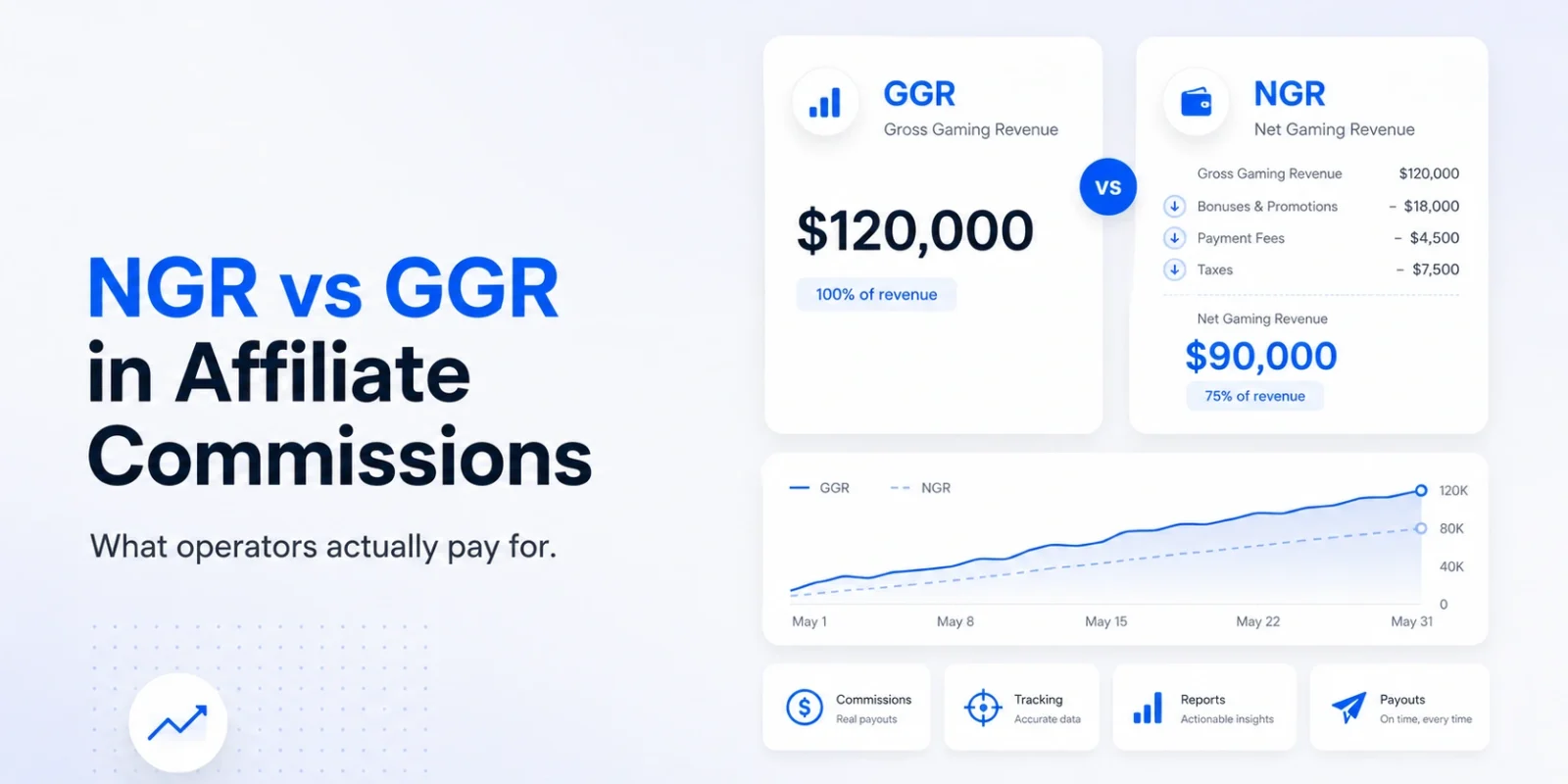
GGR (Gross Gaming Revenue) is the total monetary difference between the amount players wagered and the amount they won — the raw revenue retained by the operator before any cost deductions. NGR (Net Gaming Revenue) deducts from GGR the operator’s direct costs of generating that revenue: bonus costs, payment processing fees, jackpot contributions, game provider royalties, and applicable taxes or levies. In iGaming affiliate programs, the choice between GGR and NGR as the commission base is one of the most consequential decisions an operator makes — it determines who actually bears the cost of player acquisition, what the affiliate’s effective commission rate is regardless of the headline percentage, and whether the operator’s program is commercially sustainable at scale.
Most iGaming affiliate agreements specify a RevShare rate. Almost none of them adequately define what that rate is applied to. “35% RevShare” written on a term sheet is not a commission structure. It is a percentage without a base. The base — GGR or NGR, and which specific deductions are applied to arrive at it — determines the real economics of the deal for both operator and affiliate. Two programs offering identical RevShare rates on different bases can produce commission payments that differ by 40% or more for the same player activity.
This guide defines both metrics precisely, maps the full deduction chain from GGR to NGR, works through the mathematics with real numbers, explains the jurisdiction-specific variations that affect what qualifies as an allowable deduction, and covers how to present the formula to affiliates in a way that builds program trust rather than generating disputes. This is the post that your affiliate agreement’s commission section should be able to reference.
GGR: The Starting Point
Gross Gaming Revenue is the simplest metric in iGaming finance to define and the most commonly misunderstood in affiliate contexts. It is not the total amount wagered. It is the amount retained.
The formula:
GGR = Total Player Wagers − Total Player Winnings
A casino table handles €1,000,000 in total wagers in a month. The house pays out €960,000 in winnings. GGR for that table in that month is €40,000 — the house’s 4% theoretical margin retained as gross revenue. The €1,000,000 in wagers is not GGR. The €40,000 retained is GGR.
For sportsbooks, the calculation is structurally identical: total stakes minus total winnings paid equals GGR. The practical complexity is that sportsbook GGR fluctuates more dramatically than casino GGR because individual events with large staking — a major championship final, a boxing match — can produce outcomes that swing the GGR substantially above or below the theoretical margin in any given period.
GGR as a commission base means the affiliate earns a percentage of the raw retained revenue before any operator costs are deducted. For affiliates, GGR-based commission is the most predictable and most favorable structure: the operator’s bonus costs, provider fees, and processing expenses are entirely the operator’s problem. For operators, GGR-based commission means paying affiliate commission on revenue that may be substantially consumed by costs — in some markets and product configurations, an operator paying 35% commission on GGR while absorbing 30% bonus costs, 5% processing fees, and 10% game provider royalties is paying commission on revenue that does not exist at the net level.
The Deduction Chain: From GGR to NGR
NGR is not a single fixed formula. It is a class of formulas that share a common structure — starting from GGR and subtracting defined costs — but differ in which costs are included, in what order, and at what rates. The deduction chain below represents the comprehensive version; most operators apply a subset of these deductions depending on their product mix, jurisdiction, and deal structure.
Deduction 1: Bonus Costs
Bonus costs represent the monetary value of promotional incentives paid to players during the period — welcome match bonuses, free spins with real-money conversion, reload bonuses, cashback offers, and loyalty rewards. They are the largest single deduction in most casino NGR formulas and the one with the most operator configuration options.
The calculation approach varies. Some operators deduct the full nominal value of bonuses issued. Others deduct only the bonus costs actually utilized and converted by players (since a portion of issued bonuses expire unused). The most common approach in regulated markets is to deduct the net bonus cost — the total bonus amount cleared through wagering requirements, which is lower than the nominal issued amount because wagering requirements consume some of the bonus value before it reaches the player’s real-money balance.
In practice: a €25 welcome match bonus carries a nominal value of €25, but if the wagering requirement is 30x and the casino’s house edge on eligible games averages 3%, the expected bonus cost to the operator at clearance is approximately €25 − (30 × €25 × 0.03) = €25 − €22.50 = €2.50 expected net transfer. The operator can use the full €25 as the deduction (conservative for affiliates) or the expected net clearance cost of €2.50 (conservative for operators). Most affiliate agreements specify “bonus costs” without defining which calculation applies — a significant source of commission disputes.
Deduction 2: Payment Processing Fees
Payment processing fees cover the cost of accepting deposits and processing withdrawals — card scheme fees, payment processor margins, e-wallet transaction costs, and bank transfer charges. These typically run 1.5–3.5% of deposit volume in regulated markets, with significant variation by payment method: credit card processing runs higher (2–3%), e-wallets vary by provider (1–2.5%), and bank transfers run lower (0.5–1.5%) but with higher minimum transaction fees.
The deduction is typically expressed as a percentage of GGR rather than a percentage of deposit volume, because applying it to deposit volume would require sharing gross transaction data with affiliates who have no business need for that figure. Standard rates in affiliate agreements run 2–3% of GGR as a processing fee deduction — a simplification that approximates the real cost without exposing transaction-level data.
Deduction 3: Jackpot Contributions
Progressive jackpot contributions are a fixed percentage of each wager on jackpot-eligible games that is set aside for the jackpot pool. The contribution rate is set by the game provider (typically 1–3% of each eligible wager) and represents a real cost to the operator — revenue that passes through GGR but is held in reserve for jackpot payouts rather than being available as operational revenue.
The jackpot contribution deduction is controversial in affiliate agreements because its impact is asymmetric: in months when no major jackpot is hit, the deduction reduces the affiliate’s commission base without a corresponding benefit to the operator (the contributions accumulate in the pool). In months when a jackpot is hit, the large payout creates a negative NGR event that is already captured by the GGR calculation — meaning the jackpot contribution deduction effectively double-counts the jackpot cost from the operator’s perspective.
The cleanest approach: deduct jackpot contributions from the NGR formula on product lines where jackpot exposure is a genuine material cost (high-volatility progressive slots), and exclude the deduction for product lines where jackpot exposure is minimal (table games, live casino). This requires per-product-line NGR calculation, which most affiliate platforms support natively but which requires explicit configuration.
Deduction 4: Game Provider Royalties and Licensing Fees
This is the NGR deduction that most affiliate agreements omit and most affiliate managers do not mention. Game provider royalties — the percentage of GGR paid to software providers like Evolution, NetEnt, Pragmatic Play, and others for the right to offer their content — are a real and material cost that the operator incurs directly from the same player activity that generates the affiliate’s commission.
Typical game provider royalty rates run 15–25% of GGR for third-party content, with wide variation by provider and product type: live casino games from Evolution carry higher royalty rates than standard video slots from smaller providers. An operator whose player mix skews heavily toward live casino content may be paying 20–25% of GGR in provider royalties — a deduction that, if applied to the NGR formula, significantly affects the commission base.
Whether game provider royalties are included in the NGR deduction is a deal-specific negotiation point. Most operators do not include them in standard affiliate agreements — the royalty rate is commercially sensitive and varies by game, making it difficult to disclose and verify.
Operators who include provider royalties in their NGR formula should either express the deduction as a blended flat-rate approximation (e.g., “provider costs: 12% of GGR”) or provide per-game-type breakdowns that allow affiliates to verify the calculation. An unexplained reduction that cannot be traced to a defined formula generates disputes regardless of whether it is commercially justified.
Deduction 5: Taxes and Regulatory Levies
Tax treatment varies dramatically by jurisdiction and has significant implications for the effective NGR commission base. Three approaches exist across regulated iGaming markets:
GGR-based tax (UK, Malta, Sweden, Germany): The regulator taxes a percentage of GGR before any other deductions. In the UK, Remote Gaming Duty runs at 21% of GGR for remote gaming revenue from UK customers. If an operator is paying 21% of GGR in RGD, and then paying 35% RevShare on NGR after deductions, the actual affiliate commission as a percentage of GGR is significantly lower than the headline 35% NGR rate suggests — because the tax deduction reduces the NGR base before the commission percentage is applied.
Turnover-based tax (some LATAM markets, Australia): Tax is levied on total player stakes rather than on GGR or NGR. This creates a different cost structure that does not map directly to the GGR-to-NGR deduction chain and typically requires a separate line item in the NGR formula rather than a percentage of GGR deduction.
NGR-based tax (some emerging markets): Tax is applied to NGR itself, creating a situation where the tax deduction and the commission base are both functions of the same underlying metric. Whether the tax is deducted before or after the affiliate commission is calculated is a materially important detail that must be specified explicitly in the affiliate agreement.
Deduction 6: Chargebacks and Payment Reversals
Chargebacks — disputed payment reversals processed through the player’s bank or card scheme — represent money that was counted in GGR when the deposit was processed but subsequently returned to the player’s account by the payment provider.
Including chargebacks in the NGR deduction is standard and defensible: the operator did not ultimately retain the disputed amount, so it should not serve as a commission base. The deduction is typically expressed as the net chargeback amount (total chargebacks minus any recovered amounts) in the commission period.
The NGR Formula: Written Out Completely
Combining the deductions above, a comprehensive NGR formula for a typical regulated casino affiliate program reads:
NGR = GGR
− Bonus costs (net of expired unused bonuses)
− Payment processing fees (expressed as % of GGR)
− Jackpot contributions (where applicable by product line)
− Provider royalties (if included — typically as blended % of GGR)
− Applicable taxes and regulatory levies (jurisdiction-specific)
− Net chargebacks (total reversals minus recovered amounts)
The affiliate’s RevShare commission is then calculated as:
Commission = NGR × RevShare rate
Which deductions are included in your NGR formula must be stated explicitly in the affiliate agreement — not referenced generically. “NGR calculated in accordance with standard industry practice” is not a formula. It is an invitation to dispute.
The Mathematics: A Worked Example
The same player activity, the same RevShare rate, and different NGR formula definitions produce materially different commission payments. The example below uses a single affiliate’s monthly player cohort to show exactly how large that difference can be.
| Metric | Value | Notes |
|---|---|---|
| Total player wagers (cohort) | €820,000 | All eligible games in the month |
| Total player winnings paid | €787,200 | Based on ~96% average RTP across game mix |
| GGR | €32,800 | €820,000 − €787,200 |
| Bonus costs | −€8,200 | 25% of GGR (typical for casino with active bonus program) |
| Payment processing fees | −€984 | 3% of GGR |
| Jackpot contributions | −€656 | 2% of GGR (slots portion of game mix) |
| Provider royalties | −€3,936 | 12% of GGR (blended rate across game mix) |
| Regulatory levy (UK RGD at 21%) | −€6,888 | 21% of GGR for UK-registered players |
| Net chargebacks | −€328 | 1% of GGR |
| NGR (all deductions) | €11,808 | GGR after all six deduction categories |
| NGR (bonus + processing only) | €23,616 | GGR after the two most commonly included deductions |
Now apply a 35% RevShare rate to each base:
| Commission Base | 35% Commission | As % of GGR (effective rate) |
|---|---|---|
| GGR commission (35% of €32,800) | €11,480 | 35.0% |
| NGR commission — bonus + processing only (35% of €23,616) | €8,266 | 25.2% |
| NGR commission — all deductions (35% of €11,808) | €4,133 | 12.6% |
The range between a 35% GGR commission and a 35% NGR commission with all deductions included is a factor of 2.8 — the affiliate receives €11,480 in the first case and €4,133 in the third, for the exact same player activity. Both deals are described as “35% RevShare.” Neither description is wrong. The base definition is everything.
⚠️ The comparison trap: Affiliates who compare RevShare rates across programs without verifying the commission base are comparing numbers that may not be comparable. A 40% RevShare on a GGR base may pay less than a 30% RevShare on an NGR base with moderate deductions, depending on the operator’s bonus cost rate and regulatory levy exposure. Any affiliate program comparison that cites RevShare percentages without specifying the deduction methodology is providing information that is true but potentially misleading. Operators who present their commission formula transparently — rate plus base definition plus deduction schedule — win the trust of affiliates who understand their business and lose only the affiliates who were comparing headline rates without reading the terms.
GGR vs NGR Commission: What Each Model Signals About Program Design
The choice between GGR and NGR as a commission base is not purely mathematical. It signals something about the program’s commercial architecture and the risk-sharing arrangement between operator and affiliate.
| Dimension | GGR Commission | NGR Commission |
|---|---|---|
| Who bears bonus cost risk | Operator — bonus costs reduce operator margin but not affiliate commission | Shared — bonus costs reduce the commission base before the affiliate’s percentage is applied |
| Who bears regulatory levy risk | Operator — tax increases reduce operator margin with no effect on affiliate | Shared — tax deduction reduces commission base |
| Affiliate predictability | Higher — commission tracks GGR which is more stable than NGR | Lower — commission fluctuates with bonus spend, processing costs, and levy changes |
| Operator margin protection | Lower — operator absorbs all cost increases without commission adjustment | Higher — cost increases are partially passed through to affiliate via reduced NGR base |
| Fraud incentive alignment | Weaker — affiliate earns commission on GGR regardless of bonus abuse in cohort | Stronger — bonus abuse in affiliate’s cohort generates negative NGR, reducing their commission |
| Appropriate for high-bonus markets | Risky — high bonus spend may consume all GGR margin while affiliate still earns | Suitable — bonus costs are factored into commission base |
| Affiliate preference | Higher — simpler, more predictable, no deduction disputes | Lower — requires trust in operator’s deduction calculation |
The fraud incentive alignment row deserves specific attention. On a GGR commission, an affiliate whose cohort includes a bonus abuse ring earns commission on the GGR those players generate — which may be positive, since they wager real money through the wagering requirement. The operator absorbs the net negative NGR event while still paying commission. On an NGR commission, the bonus abuse in the affiliate’s cohort reduces their commission base directly — the negative NGR event reduces the commission they earn. This creates a natural alignment: an affiliate on NGR commission has a direct financial incentive to ensure their traffic quality is sufficient to generate positive NGR, because their earnings depend on it. This is one of the structural arguments for NGR commission structures that goes beyond the operator’s margin protection interest.
Jurisdiction-Specific Variations That Affect the NGR Formula
The NGR formula is not universal. Regulatory frameworks in different markets impose specific requirements on how gaming revenue is calculated, which costs are deductible, and how taxable revenue is defined. These regulatory definitions do not automatically apply to affiliate commission calculations — but they create the framework within which operators calibrate their NGR formulas.
United Kingdom (UKGC): Remote Gaming Duty applies at 21% of GGR generated from UK-connected customers. This levy is a hard cost that significantly affects the NGR available for affiliate commission in UK-facing programs. Operators who include the 21% RGD deduction in their NGR formula are sharing a real and verifiable cost with affiliates. The deduction should be stated as a separate line item in commission statements rather than blended into a general “taxes” category — affiliates can verify the RGD rate independently and should be able to confirm that the deduction rate matches the published levy.
Malta (MGA): Malta Gaming Tax is a tiered levy based on gaming revenue and player location, with B2C operations paying a minimum monthly tax and a GGR percentage. The tax structure is more complex than UK RGD and produces variable effective rates depending on monthly GGR volume. Operators including Malta tax in the NGR formula should use the actual effective rate for the period rather than a flat approximation — the variability is real and should be reflected in commission calculations.
Germany (GGL): Germany’s interstate treaty introduced a 5.3% virtual slot tax on each virtual slot spin’s stake, plus a 5% sports betting tax on stakes. The stake-based taxation model does not map cleanly to a GGR percentage deduction, which creates complexity in NGR formula design for operators with significant German traffic. Most operators convert the stake-based levy to an effective GGR percentage based on their game mix and average margin, then apply that blended rate as the NGR tax deduction.
Curacao and offshore jurisdictions: Lower or zero gaming-specific revenue taxes mean the NGR formula typically includes only operational cost deductions (bonus, processing, provider royalties) without a regulatory levy line. This produces higher NGR-to-GGR ratios than Tier 1 regulated markets and correspondingly higher effective commission payments for the same RevShare rate — a factor that sometimes makes offshore programs more affiliate-attractive despite other program quality differences.
Configuring NGR Commission in Scaleo
The difference between calculating NGR in a spreadsheet and calculating it inside an affiliate platform is not just operational efficiency — it is the difference between a commission calculation that affiliates can audit and one they have to take on trust. We, the team behind Scaleo, built the commission plan architecture specifically to own the NGR formula inside the platform, applied to raw player event data, producing an itemized statement that affiliates can verify component by component.
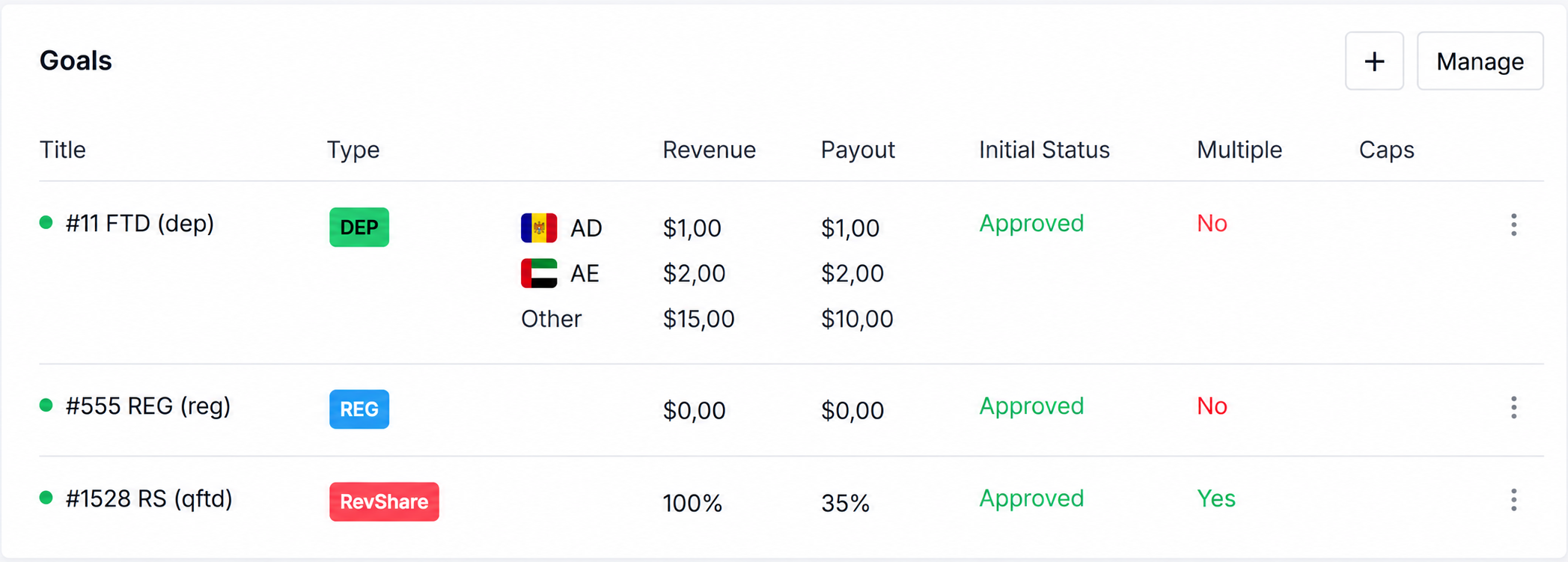
Scaleo’s commission plan builder supports the following NGR deduction configuration options:
Per-deduction-category configuration: Each deduction component — bonus cost, processing fee, jackpot contribution, provider royalty, tax levy — is configured as a separate field with its own rate or calculation method. Operators can include or exclude any deduction category per commission plan, meaning affiliates on different deal tiers can operate under different NGR deduction schedules simultaneously. A standard affiliate on a 30% RevShare might see bonus and processing deductions only. A VIP affiliate negotiating custom terms might see a formula that excludes provider royalties as a trade-off for a lower headline rate.
Per-affiliate deduction assignment: The deduction schedule is assigned at the commission plan level, which is assigned per affiliate. Different affiliates in the same program can legitimately operate under different NGR formulas if their deal structures justify it. The platform tracks and applies each affiliate’s formula independently, producing commission statements that reflect the specific terms of each deal rather than a program-wide average.
Affiliate-facing deduction transparency: Each affiliate’s commission statement in the Scaleo portal shows the NGR calculation itemized: GGR line, each deduction with its amount and the rate applied, net NGR, and the commission calculated on that NGR. The affiliate does not need to trust a single black-box commission figure — they can verify each deduction against their agreed terms and their own player data. This transparency is not just an affiliate relations benefit. It eliminates the category of commission dispute that originates from an affiliate not being able to reconcile the figure they received against the formula they agreed to.
Scaleo internal data, 2025: Operators who migrated from pre-calculated NGR postback models (where a single commission-ready figure was pushed to the platform) to native NGR calculation inside Scaleo reported a 44% reduction in affiliate commission disputes within six months of migration. The reduction was not attributable to commission amounts changing — the same deductions were applied. It was attributable to affiliates being able to see the calculation rather than being presented with a conclusion they could not verify. Transparency resolves more disputes than renegotiation.
Presenting the NGR Formula to Affiliates: What to Include and How to Write It
The NGR formula in your affiliate agreement needs to be written in a way that is simultaneously legally precise and operationally understandable to an affiliate manager who will need to explain it to their publisher partners. These two requirements are in tension but not mutually exclusive.
A formula clause that satisfies both requirements:
“Net Gaming Revenue (NGR) is calculated as follows: NGR = GGR − Bonus Costs − Processing Fees − Jackpot Contributions − Applicable Tax. For the purposes of this agreement: (i) Bonus Costs means the net monetary value of promotional bonuses issued to referred players and converted to real-money balance through the applicable wagering requirement, calculated as [specific method]; (ii) Processing Fees means [X]% of GGR, representing the blended payment processing cost across deposit and withdrawal methods; (iii) Jackpot Contributions means [Y]% of GGR generated from jackpot-eligible game categories, representing the jackpot pool contribution rate applied by the game provider; (iv) Applicable Tax means the gaming-specific regulatory levy imposed by [jurisdiction] at the rate of [Z]% of GGR applicable to revenue generated from players registered in [territory]. All deduction components will be itemized in each monthly commission statement accessible in the Partner Portal.”
Three elements make this clause defensible and clear: each deduction is named, defined, and either given a specific rate or a specific calculation method. “Processing fees” without a rate is not a deduction — it is a variable that can expand without bound. “Processing fees: 2.5% of GGR” is a deduction that can be verified. The final sentence — committing to itemized deduction statements — converts the contractual formula into an operational promise that the platform must support. If Scaleo is the affiliate platform, it does support it. If a legacy tracker is the platform, that commitment may require manual statement preparation, which is itself a reason to evaluate whether the platform is operationally suited to NGR-based commission structures.
Frequently Asked Questions
What is the difference between GGR and NGR in iGaming?
GGR (Gross Gaming Revenue) is total player wagers minus total player winnings — the raw revenue retained by the operator before any cost deductions. NGR (Net Gaming Revenue) deducts from GGR the direct costs of generating that revenue: bonus costs, payment processing fees, jackpot contributions, game provider royalties, applicable taxes and levies, and net chargebacks. GGR is always higher than NGR for the same player activity. The gap between them depends on the operator’s cost structure, bonus strategy, and jurisdiction — it typically runs 30–65% of GGR in regulated markets with active bonus programs and high processing costs.
Is it better for affiliates to be paid on GGR or NGR?
GGR commission is generally more favorable to affiliates — the base is larger, the calculation is simpler, and the affiliate is insulated from the operator’s cost structure changes. NGR commission is more commercially sustainable for operators in high-cost markets (regulated Tier 1 jurisdictions with significant tax levies and high bonus spend rates). For the affiliate, the practical question is not GGR vs NGR in isolation — it is the effective commission rate, which depends on both the headline percentage and the deduction methodology. A 40% GGR commission on a UK-licensed program with 21% RGD applied to GGR may produce a lower effective payment than a 30% NGR commission on a Malta-licensed program with moderate bonus costs and no significant regulatory levy. Always compare on the same effective base, not on headline rates.
What deductions are standard in an iGaming NGR formula?
The most commonly included deductions in standard iGaming affiliate NGR formulas are bonus costs and payment processing fees — these appear in the majority of NGR-based affiliate agreements. Jackpot contributions are included in many casino programs, particularly those with significant progressive slot content. Game provider royalties are included less frequently, typically in agreements with more sophisticated affiliates or at higher commission tiers where the operator needs more deductions to sustain the rate. Regulatory tax levies are included in programs licensed in high-levy jurisdictions (UK, Sweden, Germany) and generally excluded in low-tax or offshore-licensed programs. The definition of “standard” varies enough by jurisdiction and product mix that any affiliate agreement should specify explicitly which deductions apply rather than referencing industry standards.
How do I calculate effective affiliate commission rate from an NGR deal?
To calculate your effective commission rate as a percentage of GGR from an NGR deal: (1) identify all deduction categories in the NGR formula and their rates as percentages of GGR; (2) sum the deduction percentages to get the total deduction rate; (3) subtract from 100% to get the NGR-to-GGR ratio; (4) multiply your RevShare rate by that ratio. Example: 35% RevShare on NGR where deductions total 40% of GGR → NGR is 60% of GGR → effective commission is 35% × 60% = 21% of GGR. The effective commission rate is the comparable figure across programs with different base definitions. Most affiliate agreements do not present this calculation explicitly, which is why rate-only comparisons between programs frequently mislead.
Can the NGR formula change after an affiliate agreement is signed?
The NGR formula should be treated as a material term of the affiliate agreement, not an operational parameter the operator can adjust unilaterally. Any change to the deduction methodology — adding a new deduction category, changing a deduction rate, or modifying the calculation method for an existing deduction — should require written notice to the affiliate and, for significant changes, a formal amendment to the agreement. Operators who adjust NGR deduction rates without notice create both a dispute risk and, in some jurisdictions, a potential breach of contract claim. Best practice: fix deduction rates in the agreement for a defined term (typically 12 months), with a mechanism for adjustment at renewal with prior written notice. This gives operators the flexibility to update formulas as regulatory costs change while giving affiliates the predictability they need to model their expected earnings.
A Commission Structure Is Only as Good as Its Definition
Every commission dispute in an affiliate program traces back to a gap between what the operator believes the NGR formula says and what the affiliate believes it says — and the reason those beliefs differ is almost always that the formula was not written with sufficient specificity in the first place. The deduction methodology that seems self-evident to an operator who lives with their cost structure every day is not self-evident to an affiliate who sees a commission figure and a percentage rate and tries to reconstruct the calculation from those two numbers alone. Write the formula completely. Configure it in your platform natively. Surface the calculation in every statement. Disputes resolved by transparency cost nothing. Disputes resolved by negotiation after the fact cost relationships.
See how Scaleo’s commission plan architecture configures NGR deductions per category, per affiliate, with itemized statement output — or explore how the Negative Carryover guide covers what happens when the NGR formula produces a negative balance in a given period.