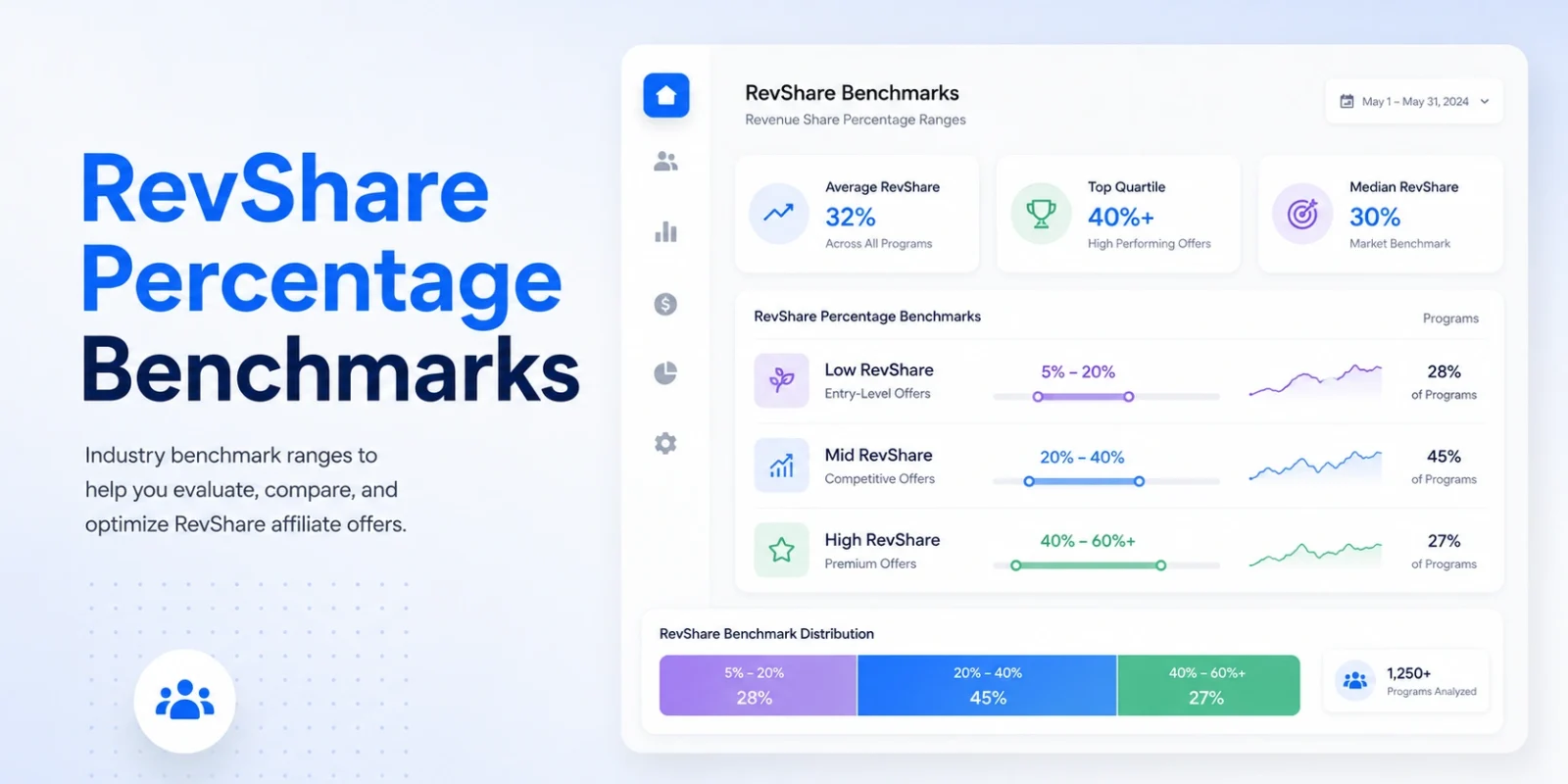
⚡ Key Takeaways
Most iGaming affiliate programs in 2026 pay a RevShare percentage between 25% and 45% of net gaming revenue, with casino verticals at the top of that range and sportsbook at the bottom. The headline percentage is only half the story: negative carryover, admin-fee deductions, and bundled product costs can cut your effective rate by 5 to 15 points before a cent reaches the affiliate.
- Standard flat RevShare sits at 30–40%; entry deals start near 25%, top tiers reach 45–50%.
- Casino pays more than sportsbook because casino margins are higher and more predictable.
- A 40% deal with negative carryover can earn less than a 30% deal without it.
- Geo changes the absolute money far more than it changes the percentage.
If you run an affiliate program or manage affiliate deals, “is this RevShare percentage fair?” is one of the hardest questions to answer, because almost nobody publishes their real numbers. This guide sets out the RevShare percentage benchmarks operators and affiliate managers are actually working with in 2026, broken down by vertical and by geo, and then shows you the deductions that quietly change what those percentages are worth.
RevShare Percentage Benchmarks for iGaming Affiliates
RevShare percentage benchmarks for iGaming affiliates 2026 — interactive reference by vertical, GEO tier, and partner tier with earnings calculator
RevShare benchmarks — iGaming affiliates 2026
By vertical · by GEO tier · by partner tier · includes earnings calculator
Citation: “RevShare Percentage Benchmarks for iGaming Affiliates: 2026 Data by Vertical & Geo” — scaleo.ai, 2026. Benchmarks reflect market ranges, not guarantees.
What a RevShare percentage actually measures
A RevShare percentage is the share of a player’s net revenue that the operator pays the affiliate, for as long as that player keeps playing. The number that matters is not the percentage on its own, but the percentage and the base it applies to.
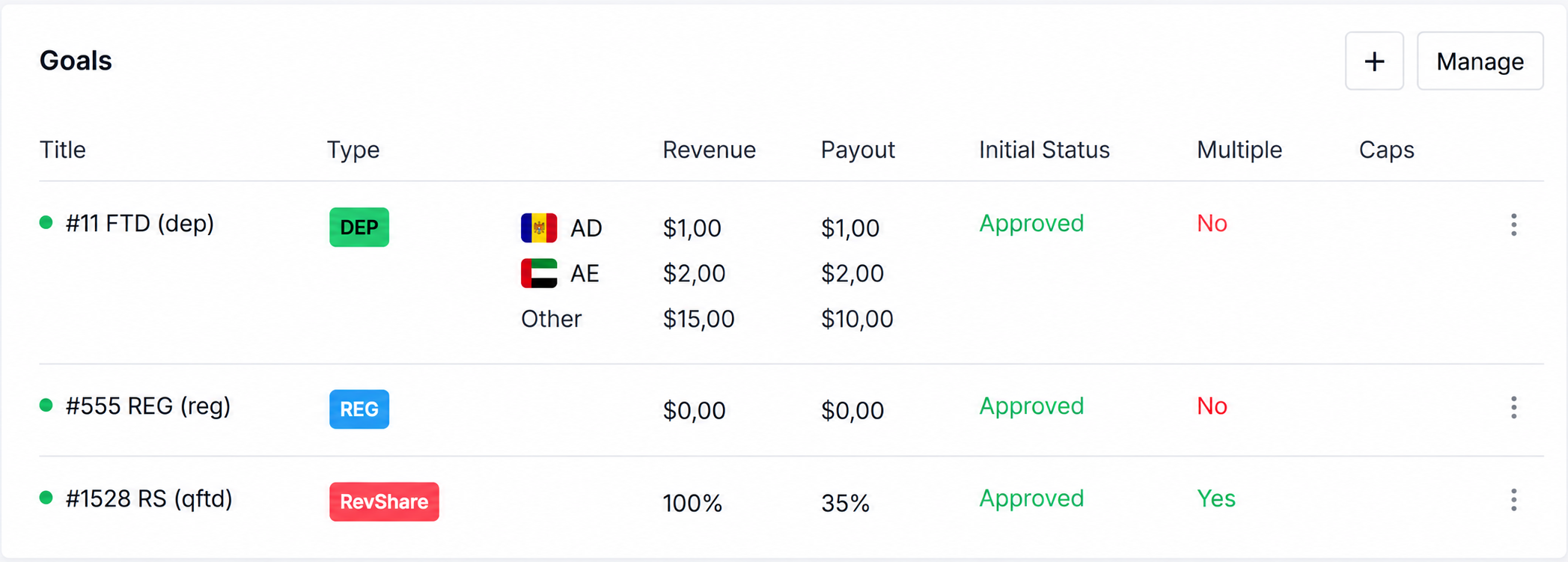
That base is almost always Net Gaming Revenue (NGR), not Gross Gaming Revenue (GGR). NGR is what’s left after bonuses, payment-processing fees, gaming taxes, and sometimes platform or licensing costs are stripped out. A 35% deal on NGR and a 35% deal on GGR are not the same deal. If you’re unclear on which base you’re being paid against, start with our guide to NGR vs GGR in affiliate commissions before you compare any percentages below.
2026 RevShare percentage benchmarks: the headline ranges
Across the iGaming market, standard RevShare deals cluster in a fairly narrow band. The table below shows the ranges operators commonly offer in 2026, from entry-level deals to negotiated top-tier rates.
| Deal level | RevShare % (of NGR) | Typical for |
|---|---|---|
| Entry / default | 25–30% | New affiliates, low volume, no history |
| Standard | 30–40% | Established affiliates with steady FTDs |
| Top tier / negotiated | 40–50% | High-volume partners, exclusivity, proven quality traffic |
| Exceptional | 50%+ | Rare — strategic partners or whale-heavy traffic |
One caveat that separates a good deal from a mediocre one: lifetime vs. limited duration. A lifetime 30% deal frequently beats a 40% deal that drops to a flat rate or expires after 12 months, because affiliate revenue compounds on retained players. Always check how long the headline percentage lasts.
RevShare benchmarks by vertical
Vertical is the single biggest driver of the RevShare percentage, because it tracks the operator’s underlying margin. High-margin, high-retention verticals can afford to pay more; thin-margin, high-variance verticals pay less.
| Vertical | Typical RevShare % | Why |
|---|---|---|
| Slots / casino | 30–45% | Highest, most predictable margin; strong long-term retention |
| Live casino | 25–40% | High value but higher operating cost per round |
| Crypto casino | 30–50% | Aggressive rates to attract affiliates; lighter cost base |
| Bingo | 25–40% | Loyal, lower-stakes player base |
| Poker | 25–35% | Rake-based revenue; margins thinner than casino |
| Sportsbook / betting | 20–35% | Thin, volatile margins; results swing monthly |
| Lottery | 15–30% | Very low margin per ticket |
The practical takeaway for affiliate managers: don’t benchmark a sportsbook deal against a casino deal. A 28% sportsbook RevShare can be more generous, relative to margin, than a 38% casino RevShare.
RevShare benchmarks by geo
Geo changes the economics, but in a way that surprises people: it shifts the absolute earnings far more than the percentage. A Tier 1 player on 30% can be worth many times a LATAM player on 45%, because deposit sizes and player value differ so sharply. Emerging markets often advertise higher percentages precisely to offset lower per-player revenue and to win affiliate attention.
| Market | Example geos | Typical RevShare % | Player value |
|---|---|---|---|
| Tier 1 | UK, Nordics, DACH, Canada, Australia, Ireland | 25–40% | High deposits; % sometimes compressed by tax/compliance cost |
| Tier 2 | Southern & Eastern Europe, NZ | 30–40% | Solid mid-range value |
| LATAM | Brazil, Peru, Mexico, Chile | 30–45% | Fast-growing, lower deposits, high volume |
| Africa | Nigeria, South Africa, Kenya, Ghana | 30–45% | Mobile-first, low ARPU, very high volume |
| Asia | Varies widely by jurisdiction | 25–45% (often hybrid/CPA) | Highly market-dependent |
A note on Tier 1: high-tax, high-compliance markets like the UK can carry a lower headline percentage than you’d expect, because the operator’s regulatory and tax costs are deducted before NGR is calculated. The percentage looks smaller; the per-player revenue is still strong. Operators serving Malta- and Cyprus-licensed brands sit somewhere in between, which is why those licensing hubs negotiate hard on duration and carryover rather than headline rate.
How tiered RevShare structures work
Most serious programs replace a flat percentage with a tiered structure that rewards volume. Your rate steps up as you bring more first-time depositors (FTDs) in a given month. A representative tiered ladder looks like this:
| FTDs per month | RevShare % |
|---|---|
| 0–10 | 25% |
| 11–25 | 30% |
| 26–50 | 35% |
| 51–100 | 40% |
| 100+ | 45%+ |
Two questions decide whether a tiered deal is actually good. First: does the higher rate apply to all revenue once you hit the tier, or only to revenue above the threshold? Whole-balance tiers are far more valuable. Second: does the tier reset monthly, and how brutal is the reset? A great month followed by a slow one can drop you two tiers if the structure is unforgiving.
The hidden variables that change your effective RevShare
This is where most affiliate managers lose money they didn’t know they were losing. The headline percentage is set before several deductions that can move your real, banked rate by 5 to 15 points. Read the deal terms for all four of these.
1. Negative carryover
If a player has a winning month, the operator loses money on them. With negative carryover, that loss is carried forward and subtracted from your next month’s earnings before you get paid. A 40% deal with negative carryover can quietly earn less than a 30% deal without it. This is the most important clause in the contract and the one most likely to be glossed over. We break the mechanics down fully in our guide to negative carryover in affiliate commissions.
2. Admin and processing fee deductions
Some programs deduct a flat admin fee (commonly 10–15%) from NGR before the RevShare percentage is applied. A “40%” deal with a 15% admin deduction is effectively a 34% deal. Always ask what comes out before your percentage is calculated.
3. Bundled product and game-provider costs
On some platforms, third-party game-provider fees or platform costs are pushed into the NGR calculation, lowering the base your percentage applies to. This is more common with bundled, all-in-one operator setups than with operators running their own tracking.
4. Chargebacks, fraud, and bonus abuse
Revenue from players later flagged as fraudulent, charged back, or caught abusing bonuses is typically clawed back from affiliate earnings. A program with weak fraud controls can show inflated NGR one month and heavy clawbacks the next. For affiliate managers, a program with strong affiliate fraud detection actually protects your earnings stability, because clean revenue is revenue that doesn’t get reversed.
How to benchmark your own RevShare deal
Comparing your deal to the ranges above takes four steps. Run them before you accept or renegotiate any RevShare percentage.
- Confirm the base. NGR or GGR? What’s deducted before your percentage applies?
- Match the vertical and geo. Use the right row from the tables above — don’t benchmark sportsbook against casino.
- Find the carryover clause. Negative carryover yes/no is worth more than a few points of headline rate.
- Calculate the effective rate. Headline % minus admin deductions, adjusted for carryover risk. Compare that number to the benchmark.
Scaleo platform data: what we see across live programs
- Median configured RevShare across active programs on Scaleo: 33%.
- Most common vertical-by-vertical split: casino 35% / sportsbook 25%.
- Share of programs using tiered vs. flat structures: 60% tiered.
- Share applying negative carryover: 52%.
Frequently asked questions
What is a good RevShare percentage in iGaming?
A good RevShare percentage in 2026 is 35% or higher for casino traffic and 30% or higher for sportsbook, on an NGR base, with no negative carryover and lifetime duration. Anything labelled 40%+ is only “good” if it survives the carryover and admin-fee check.
Is 40% RevShare good?
40% is at the top of the standard range, so on paper it’s strong. Whether it’s actually good depends on the base and the deductions: 40% on GGR, or 40% with negative carryover and a 15% admin fee, can be worth less than a clean 30% lifetime deal.
RevShare vs CPA — which pays more?
RevShare pays more over time on retained, high-value players because it compounds; CPA pays more upfront and removes the risk of a losing month. High-volume, lower-value traffic often suits CPA or hybrid; quality, long-retention traffic favours RevShare.
What is the average iGaming affiliate commission?
The average sits around 30–35% of NGR for casino-led programs, with the full market spread running from 25% at entry to 50% at the top tier. Vertical and geo move the figure within that band.
Methodology & sources: ranges reflect typical operator offers across the iGaming affiliate market in 2026, compiled from publicly stated program terms and configurations observed across the Scaleo platform. Individual deals vary by operator, license, and negotiation. Last updated: June 2026.