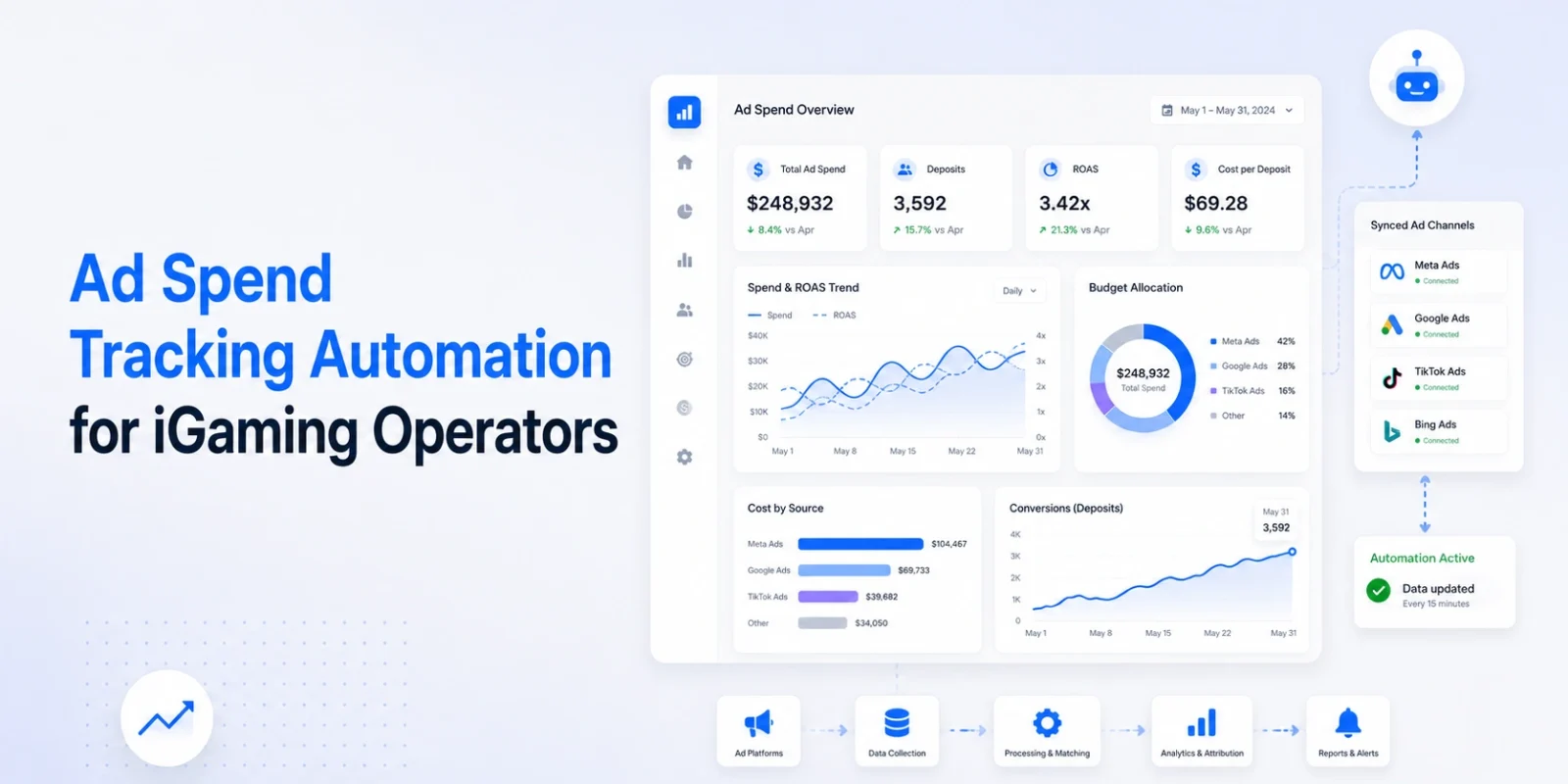
Quick answer: Ad spend tracking automation for iGaming connects media spend, affiliate clicks, registrations, FTDs, deposits, NGR, commission cost and fraud validation in one reporting workflow. The goal is not only to see how much was spent, but to identify which campaigns, affiliates, GEOs and sub-sources produce eligible, profitable players after bonuses, reversals, compliance exclusions and payout rules are applied.
Ad spend tracking automation for iGaming is not just about seeing how much was spent on ads. It is about connecting media spend, affiliate traffic, registrations, FTDs, deposits, player value, commission cost and fraud validation in one acquisition-performance workflow.
For casino and sportsbook operators, a normal ad dashboard is not enough. Meta, Google, programmatic platforms and affiliate networks can show clicks, impressions and platform-attributed conversions, but they rarely show the full commercial truth: whether those conversions became approved players, made qualified first deposits, passed fraud checks, generated NGR and stayed profitable after CPA payouts, RevShare liability, bonus cost and reversals.
That is where ad spend tracking automation becomes an operator-level control system. Instead of manually comparing campaign spend, affiliate reports, backend player events, finance spreadsheets and fraud notes, operators can automate the data flow from click to qualified player value.
This guide explains how iGaming operators can automate ad spend tracking, why generic ROAS reporting fails in casino and sportsbook acquisition, which metrics matter, how server-side postbacks improve reliability, and how Scaleo helps operators connect partner performance, player events, commissions and acquisition ROI in one place.
What Is Ad Spend Tracking Automation in iGaming?
Ad spend tracking automation is the process of automatically collecting, matching and reporting acquisition data from multiple sources. In a basic marketing setup, this may mean pulling spend, clicks, conversions and revenue into one dashboard. In iGaming, the requirement is more advanced.
An iGaming acquisition dashboard needs to connect:
- paid media spend;
- affiliate and partner traffic;
- click IDs, UTMs, partner IDs and sub-IDs;
- registrations and approved registrations;
- first-time deposits;
- qualified FTDs;
- redeposits and early retention signals;
- GGR and NGR;
- CPA, RevShare, hybrid and tiered commission cost;
- bonus cost and promotional liability;
- chargebacks, reversals and rejected events;
- fraud flags and compliance exclusions;
- budget caps and payout eligibility.
The purpose is not simply to ask, “Did this ad campaign produce conversions?” The more useful question is: did this acquisition source produce real, eligible, profitable players?
Why Generic Ad Dashboards Fail for Casino and Sportsbook Operators
Generic ad dashboards are designed for simpler funnels. They usually track impressions, clicks, cost, conversions and revenue. That may work for ecommerce or a basic lead-generation funnel. It is not enough for iGaming because the commercial event chain is longer and the quality gap between a click and a profitable player is much wider.
| Metric | Generic ad dashboard | iGaming acquisition dashboard |
|---|---|---|
| Spend | Total campaign spend. | Spend by channel, GEO, brand, affiliate, sub-ID and campaign. |
| Conversion | Form submit, checkout or app install. | Registration, approved registration, FTD, qualified FTD and redeposit. |
| Revenue | Checkout revenue or lead value. | GGR, NGR, player value, redeposit value and lifetime value signals. |
| Cost | Media spend only. | Media spend + CPA + RevShare liability + bonus cost + adjustments. |
| Quality | Conversion count. | KYC status, fraud flags, reversals, chargebacks, player retention and source quality. |
| Decision | Increase or decrease budget. | Scale, pause, cap, investigate, adjust commission terms or audit traffic source. |
A campaign can look profitable in an ad platform and still lose money for the operator once invalid signups, bonus abuse, failed KYC, high commission liability, low redeposit rate, or reversals are included. This is why operators need acquisition reporting that goes beyond ad platform ROAS.
What iGaming Operators Actually Need to Track
Clicks and registrations matter, but they are early signals. Serious iGaming acquisition teams need to track the full path from paid or partner-driven traffic to approved player value.
| Metric | What it shows | Why it matters |
|---|---|---|
| Spend by channel | How much was spent on each paid source. | Controls paid acquisition budget. |
| Clicks | Traffic volume from ads, affiliates or sub-sources. | Useful for diagnosing reach and landing-page performance. |
| Registrations | How many players created accounts. | Early funnel signal, but not enough for payout decisions. |
| Approved registrations | Accounts that pass basic validation. | Filters out some low-quality signups. |
| FTDs | First-time deposits. | Core commercial acquisition event. |
| Qualified FTDs | FTDs that meet payout and compliance rules. | Prevents paying for invalid, duplicate or excluded events. |
| Cost per FTD | Spend divided by FTDs. | Shows acquisition efficiency. |
| Cost per qualified FTD | Total acquisition cost divided by eligible FTDs. | More useful than raw cost per registration. |
| NDCs | New depositing customers. | Common iGaming acquisition KPI. |
| Redeposits | Whether players deposit again. | Shows early retention and traffic quality. |
| GGR | Gross gaming revenue. | Top-level player revenue before key deductions. |
| NGR | Net gaming revenue after agreed deductions. | More useful for partner ROI and RevShare analysis. |
| CPA commission cost | Fixed payout owed for qualified actions. | Shows immediate partner cost. |
| RevShare liability | Ongoing partner share of player revenue. | Shows future commission cost. |
| Bonus cost | Promotional cost tied to acquisition. | Prevents inflated ROI analysis. |
| Chargebacks and reversals | Invalid or reversed player value. | Protects operators from false profitability. |
| Fraud flags | Suspicious behaviour by source, affiliate or player. | Prevents scaling low-quality traffic. |
| Partner ROI | Value generated after acquisition and commission cost. | Shows which affiliates deserve more budget or better terms. |
The key is not more metrics for their own sake. The key is connecting each metric to a decision: scale, pause, cap, investigate, renegotiate, or optimize.
Paid Media Spend vs Affiliate Commission Cost
Many acquisition reports separate paid media spend from affiliate commission cost. That can be useful for channel management, but it can also hide the true cost of acquiring players.
In iGaming, acquisition cost may include more than media spend:
True Acquisition Cost =
Media Spend
+ Affiliate Commission
+ Bonus Cost
+ Payment Cost
+ Fraud / Reversal Adjustments
+ Operational Adjustments
That matters because ad platform ROAS and operator net ROAS are not the same thing. An ad platform may optimise toward a reported conversion, while the operator needs to understand whether the conversion became a qualified player and whether the cost of acquiring that player fits the commercial model.
Platform ROAS = Platform-Attributed Revenue / Media Spend

Operator Net ROAS = Net Gaming Revenue / True Acquisition Cost
The second formula is harder to build, but more useful. It includes the real economics of paid media, affiliates, player quality and commissions.
Clicks, Registrations, FTDs and Qualified FTDs Are Not the Same Thing
One of the biggest mistakes in ad spend tracking is treating every conversion event as equally valuable. In iGaming, the distance between a click and a payout-grade event is large.
| Event | Tracking value | Payout-grade? |
|---|---|---|
| Click | Shows traffic and source interest. | No. |
| Registration started | Shows early intent. | No. |
| Registration submitted | Shows account creation attempt. | Usually no. |
| Registration approved | Shows a validated user account. | Sometimes, depending on the program. |
| First deposit initiated | Shows payment intent. | No, because the payment may fail or be reversed. |
| First deposit approved | Shows a confirmed first deposit. | Yes, if it meets program rules. |
| Qualified FTD | Shows a commercially valid first-time depositor. | Yes. |
| Redeposit | Shows early player value and retention. | Yes. |
| NGR update | Supports RevShare and partner ROI reporting. | Yes. |
| Fraud rejection | Removes an invalid event or player. | Yes, as an adjustment. |
| Chargeback or reversal | Corrects value after payment or player issues. | Yes, as an adjustment. |
The operator should define which events are informational and which are payout-grade. This prevents finance, affiliate managers and partners from arguing over raw conversion numbers that were never meant to control commissions.
Why ROAS Alone Is Not Enough in iGaming
ROAS is useful, but it can be misleading if the definitions of revenue and cost are overly simplistic. A campaign may show strong ROAS if it generates many first deposits, but still be unattractive if those players are bonus-led, low-retention, high-risk or expensive under the commission model.
Operators should look beyond basic ROAS and include:
- cost per registration;
- cost per approved registration;
- cost per FTD;
- cost per qualified FTD;
- NGR per FTD;
- redeposit rate;
- early player value by cohort;
- bonus cost per player;
- fraud rate by affiliate or sub-ID;
- commission cost by partner;
- payback window;
- net margin after partner payouts.
Basic ROAS asks, “Did revenue exceed spend?” iGaming acquisition reporting must ask, “Did this traffic produce eligible player value after all acquisition costs, commission rules and quality controls?”
For a channel-level reference point, compare these decisions with our iGaming affiliate ROAS benchmarks.
The Data Architecture for Automated Ad Spend Tracking
An iGaming ad spend tracking workflow should connect paid media, affiliate tracking, operator backend events and finance logic. The architecture can vary by operator, but the core pattern is consistent.
Ad platforms + affiliate sources
↓
Click IDs, UTMs, partner IDs, sub-IDs, creative IDs, GEOs
↓
Scaleo tracking links, postbacks, API or webhook integrations
↓
Operator registration, KYC, deposit and revenue events
↓
Fraud checks, validation status and compliance exclusions
↓
Commission logic: CPA, RevShare, Hybrid, tiered and sub-affiliate
↓
Dashboard: spend, FTDs, NGR, ROAS, partner ROI and payout liability
↓
Alerts: overspend, fraud spike, attribution gap and commission mismatch
The goal is to create one acquisition source of truth. Ad platforms can still be used for media buying and optimization. BI tools can still be used for executive reporting. But operators need an internal performance layer that understands iGaming events and commission economics.
Client-Side Pixels vs Server-Side Postbacks
Client-side pixels are browser-based. They fire when a page loads or a browser event occurs. They are useful for many marketing and analytics use cases, but they are not always reliable enough for payout-critical iGaming events.
Server-side postbacks are sent from the operator’s backend, platform or tracking system after a verified event occurs. For iGaming, this is especially important because a confirmed FTD, rejected player, chargeback, NGR update or fraud adjustment should come from a trusted server-side source, not only from a browser page view.
| Tracking method | Strengths | Limitations | Best use |
|---|---|---|---|
| Client-side pixel | Easy to deploy, useful for ad platforms and website events. | Can be affected by browsers, blockers, consent choices, page errors and duplicate firing. | Page views, early funnel events, platform optimisation signals. |
| Server-side postback | More controlled, backend-confirmed and better for payout-grade events. | Requires integration and clean event logic. | Approved registration, FTD, qualified FTD, NGR, reversals, fraud rejection. |
| API/webhook integration | Flexible and suitable for custom data flows. | Requires technical configuration and monitoring. | Player events, finance updates, partner dashboards, BI exports. |
| Hybrid tracking | Combines early browser signals with backend-confirmed outcomes. | Requires deduplication and event governance. | Serious iGaming acquisition programs. |
The strongest setup usually uses hybrid tracking: client-side signals for early journey visibility and server-side events for confirmed commercial outcomes.
How to Connect Ad Spend, Player Events and Partner Payouts
Automated ad spend tracking works when every important event can be tied back to a campaign, source, affiliate, sub-affiliate or creative. That requires consistent identifiers across the journey.
A practical setup usually includes:
- Campaign identifiers: UTM source, medium, campaign, content and term.
- Partner identifiers: affiliate ID, partner ID, sub-affiliate ID and sub-ID parameters.
- Click identifiers: click ID or transaction ID stored at click time.
- Brand and GEO identifiers: brand, market, language and regulatory region.
- Player-event mapping: registration, KYC, deposit, FTD, redeposit and revenue events.
- Validation rules: approved, pending, rejected, duplicate, fraudulent or reversed status.
- Commission rules: CPA, RevShare, hybrid, tiered, country-specific or player-level terms.
- Reporting dimensions: date, week, campaign, affiliate, channel, sub-ID, creative and device.
Without consistent IDs, automated reporting becomes a guessing exercise. With consistent IDs, operators can see which sources produce real value and which only produce activity.
Metrics Every iGaming Ad Spend Dashboard Should Include
A useful dashboard should help teams act. It should not just display numbers. For iGaming acquisition, this means grouping metrics by spend, funnel, player quality, commission cost, fraud and action.
| Dashboard section | Metrics to include | Decision it supports |
|---|---|---|
| Spend | Media spend, partner cost, commission liability, bonus cost. | Budget pacing and true acquisition cost. |
| Traffic | Clicks, CTR, CPC, source, GEO, device, creative. | Creative and source performance. |
| Registration funnel | Registrations, approval rate, KYC failure rate. | Landing page, onboarding and market fit. |
| Deposit funnel | FTDs, qualified FTDs, deposit approval rate, cost per FTD. | Commercial acquisition quality. |
| Player value | NGR, redeposits, early retention, cohort value. | Whether traffic has long-term potential. |
| Partner economics | CPA payout, RevShare, hybrid cost, tier progress, payout status. | Commission control and partner negotiation. |
| Fraud and compliance | Duplicate accounts, bonus abuse, excluded GEOs, reversals, chargebacks. | Traffic quality and risk control. |
| Action | Scale, cap, pause, investigate, audit tracking, renegotiate. | Operational next step. |
For affiliate managers, the most useful dashboards are often partner-level. For acquisition managers, the most useful dashboards are often campaign and GEO-level. For finance teams, payout liability and adjustment visibility matter most. A good tracking system should support all three views.
Budget Pacing and Automated Spend Alerts
Tracking is only useful if it leads to action. Ad spend tracking automation should help operators control budget before spend becomes waste.
Useful budget pacing rules include:
| Rule | Why it matters | Example alert |
|---|---|---|
| Daily spend cap | Prevents sudden overspend. | Campaign has used 85% of daily budget by midday. |
| FTD cap | Prevents overbuying unqualified or unprofitable players. | Affiliate reached weekly FTD cap. |
| GEO cap | Controls spend in restricted or lower-margin markets. | Spend in a specific GEO exceeds approved threshold. |
| Partner cap | Limits risk from one affiliate or sub-source. | Partner traffic spike exceeds normal range. |
| CPA threshold | Stops campaigns that exceed target acquisition cost. | Cost per qualified FTD exceeds target by 25%. |
| NGR threshold | Keeps focus on player value, not volume. | NGR per FTD below target for two consecutive cohorts. |
| Fraud-rate threshold | Prevents scaling bad sources. | Fraud flags exceed source baseline. |
| Conversion-delay window | Avoids pausing campaigns before deposits mature. | Wait 72 hours before judging FTD value for slower GEOs. |
| Attribution mismatch | Detects tracking gaps. | Ad platform shows conversions, but backend FTDs do not match. |
Automated alerts should not create noise. They should highlight the problems that require action: overspend, tracking gaps, suspicious traffic, poor FTD quality, budget underdelivery, payout anomalies and source-level performance changes.
Fraud, Reversals and Compliance Exclusions
iGaming acquisition performance cannot be judged until invalid or risky events are removed. This is where many generic dashboards fail. They count conversions, but they do not understand which conversions should be excluded from payout or budget scaling decisions.
Operators should track and report:
- duplicate accounts;
- self-excluded players;
- restricted GEOs;
- KYC failures;
- payment reversals;
- chargebacks;
- bonus abuse;
- fake registrations;
- incentivized low-quality traffic;
- multi-accounting patterns;
- sub-affiliate anomalies;
- CPA manipulation;
- fraud rejection reason;
- commission clawbacks.
The dashboard should distinguish between gross conversions and approved payable conversions. This protects operator margin and reduces disputes with partners.
Common Tracking Mistakes That Waste iGaming Ad Spend
Most ad spend tracking problems are not caused by a lack of data. They are caused by disconnected data, weak event definitions and unclear ownership.
Counting registrations as success
Registrations are useful, but they are not the final commercial outcome. A source that produces cheap registrations but few qualified FTDs may be wasting budget.
Using ad platform ROAS as the only source of truth
Ad platforms are useful for campaign optimization, but they do not always include backend validation, rejected players, commission cost, or operator-specific NGR logic.
Mixing pending and approved events
A pending deposit or registration should not be treated the same as an approved, qualified player event. Dashboards should show status clearly.
Ignoring commission cost
A campaign can look profitable before CPA and RevShare cost are included. Partner payouts are not a side note; they are an acquisition cost.
No event deduplication
If the same FTD can be recorded by a pixel, postback and API without deduplication, reporting will inflate performance and create payout disputes.
No sub-ID visibility
Affiliate traffic quality can vary dramatically by sub-source. Without sub-ID reporting, operators may punish or reward the wrong partner activity.
Scaling before the payback window is clear
Some campaigns need time before FTDs, redeposits and NGR mature. Scaling too early can overfund weak traffic; pausing too early can kill sources that convert more slowly.
No fraud feedback loop
Fraud teams should not operate separately from acquisition reporting. Fraud rejections and suspicious patterns should feed back into partner, GEO and campaign decisions.
A Better Decision Framework: Scale, Cap, Pause or Investigate
Automated ad spend tracking should recommend smarter actions than “increase spend” or “reduce spend.” In iGaming, the right action depends on source quality, FTD maturity, fraud signals, payout rules and margin.
| Condition | Suggested action |
|---|---|
| CPA below target and qualified FTD quality is strong. | Increase budget gradually. |
| FTD volume high but approval rate low. | Investigate fraud, KYC issues or source quality. |
| ROAS positive but RevShare liability is high. | Review net margin, not just gross revenue. |
| Clicks high but registrations low. | Audit landing page, offer, GEO targeting and tracking. |
| Registrations high but FTDs low. | Audit onboarding, payment methods, KYC flow and bonus terms. |
| FTDs strong but redeposits weak. | Review retention quality and source expectations. |
| Fraud flags rising. | Pause source, cap partner or tighten validation. |
| Ad platform and backend data mismatch. | Audit tracking, deduplication, postbacks and consent settings. |
| Source performs in one GEO but not another. | Split budgets and commission rules by GEO. |
| Sub-ID produces repeated invalid activity. | Block sub-source or exclude it from payable traffic. |
This is where automation becomes operationally useful. It does not replace the affiliate manager or acquisition lead. It gives them cleaner signals and faster reasons to act.
How Scaleo Helps Operators Track Acquisition ROI
Scaleo helps operators manage the affiliate and partner-performance layer of acquisition. Paid media platforms can show campaign spend and platform-attributed actions, but operators still need a performance source of truth for partner traffic, player events, commissions, fraud validation and payout eligibility.
With Scaleo, operators can centralize the performance data that matters to affiliate and partner programs:
- affiliate and partner tracking links;
- campaign, brand, GEO and sub-ID reporting;
- server-side postback tracking;
- API and webhook integrations;
- multi-goal conversion tracking;
- CPA, RevShare, hybrid, tiered and country-based commission logic;
- player-level event reporting;
- fraud controls and validation rules;
- multi-brand attribution visibility;
- partner performance dashboards;
- payout and commission visibility;
- real-time reporting for acquisition decisions.
The value is not only seeing that a conversion happened. The value is seeing whether the conversion is valid, payable and commercially useful.
Example: From Paid Click to Qualified FTD in Scaleo
A simplified acquisition flow may look like this:
1. Player clicks a paid or affiliate campaign link.
2. The click is recorded with campaign, partner, GEO and sub-ID parameters.
3. The player lands on the operator brand.
4. Registration event is sent back to the tracking system.
5. KYC or account validation updates player status.
6. First deposit is initiated.
7. Approved FTD is confirmed server-side.
8. Fraud and compliance checks validate the event.
9. Commission rules calculate CPA, RevShare or hybrid payout.
10. Dashboard shows source ROI, qualified FTDs, NGR and payout liability.
That is a very different workflow from simply counting a browser conversion. It gives acquisition, affiliate, fraud and finance teams a shared view of what happened.
What to Automate First
Operators do not need to automate everything on day one. The best starting point is usually the part of reporting that creates the most manual reconciliation or the most expensive mistakes.
A practical implementation sequence:
- Define payout-grade events. Agree which events are informational and which control commission.
- Standardise IDs. Use consistent campaign, affiliate, sub-ID, GEO and brand parameters.
- Implement server-side postbacks. Send backend-confirmed registration, FTD and revenue events.
- Add validation statuses. Mark events as pending, approved, rejected, reversed or fraud-flagged.
- Map commission rules. Apply CPA, RevShare, hybrid, tiered and country-specific logic.
- Build source-level reporting. Show performance by partner, campaign, GEO, brand and sub-source.
- Create budget and cap alerts. Detect overspend, fraud spikes and underperforming sources.
- Connect finance workflows. Make payout visibility part of acquisition reporting.
- Review weekly cohorts. Compare FTD quality, redeposits and early NGR by source.
- Optimize continuously. Adjust budgets, caps, offers and commission terms based on real value.
Final Checklist for iGaming Ad Spend Tracking Automation
Use this checklist before scaling acquisition spend across paid media and affiliates.
- Are campaign, partner, sub-ID, brand and GEO identifiers consistent?
- Are browser events separated from backend-confirmed events?
- Is FTD clearly defined?
- Is qualified FTD clearly defined?
- Are pending, approved, rejected and reversed events separated?
- Are CPA, RevShare and hybrid commission rules mapped correctly?
- Is NGR available for partner ROI reporting?
- Are bonus costs included in acquisition economics?
- Are fraud flags visible by source and sub-source?
- Are chargebacks and reversals reflected in reporting?
- Are ad platform conversions deduplicated against postbacks?
- Are consent and privacy settings respected?
- Are budget caps and FTD caps monitored?
- Can affiliate managers see partner-level profitability?
- Can finance teams see payout liability?
- Can acquisition teams act on alerts without manual spreadsheet work?
Final Verdict: Track Spend Against Real Player Value, Not Just Conversions
Ad spend tracking automation is valuable only when it connects spend to the right outcomes. For iGaming operators, that means moving beyond clicks, registrations and ad platform conversions. The real performance question is whether each campaign, affiliate, GEO and sub-source produces eligible, depositing, revenue-generating players after fraud, bonuses, reversals, compliance exclusions and commission rules are applied.
Generic ad dashboards can show activity. Operator-grade acquisition tracking shows value.
Scaleo helps operators build that acquisition-performance layer by connecting partner tracking, server-side events, commission models, fraud controls and real-time reporting. When paid media and affiliate acquisition are measured against qualified FTDs, NGR and true acquisition cost, teams can scale good sources faster and stop funding traffic that only looks good on the surface.
Want to see how Scaleo can help your team track affiliate performance, qualified FTDs, partner ROI and payout liability in one platform? Book a demo and see how operator-grade tracking changes acquisition decisions.
Ad Spend Tracking Automation FAQ
What is ad spend tracking automation in iGaming?
Ad spend tracking automation in iGaming connects paid media spend, affiliate traffic, registrations, FTDs, deposits, NGR, commission cost, fraud validation and payout eligibility in one reporting workflow. It helps operators identify which campaigns, partners and GEOs produce profitable players.
How is iGaming ad spend tracking different from normal ROAS reporting?
Normal ROAS reporting often compares campaign spend with platform-attributed revenue. iGaming ad spend tracking must also account for FTD quality, NGR, CPA payouts, RevShare liability, bonus cost, fraud flags, chargebacks, reversals, compliance exclusions and partner payout rules.
What is cost per FTD?
Cost per FTD is the acquisition cost divided by the number of first-time depositors. A more useful version is cost per qualified FTD, which counts only approved first-time deposits that meet the operator’s payout, compliance and traffic-quality rules.
What is the difference between FTD and qualified FTD?
An FTD is a first-time deposit. A qualified FTD is a first-time deposit that meets the operator’s rules for validity, such as approved payment, allowed GEO, passed fraud checks, non-duplicate account status and any agreed minimum deposit or wagering conditions.
Why are server-side postbacks important for ad spend tracking?
Server-side postbacks are important because payout-grade events such as approved FTDs, NGR updates, reversals and fraud rejections should come from a trusted backend source. Browser pixels are useful for early journey signals, but server-side events are more reliable for commission and partner ROI reporting.
Should operators track media spend and affiliate commission together?
Yes. Media spend and affiliate commission are both acquisition costs. Operators should understand true acquisition cost by combining media spend, CPA payouts, RevShare liability, bonus cost, payment adjustments and fraud or reversal corrections where relevant.
How do fraud checks affect ad spend ROI?
Fraud checks affect ROI because fake registrations, duplicate accounts, bonus abuse, restricted GEO traffic, chargebacks and rejected deposits can make a source look profitable before validation. Fraud-adjusted reporting prevents operators from scaling traffic that should not be paid or trusted.
What metrics should an iGaming acquisition dashboard include?
An iGaming acquisition dashboard should include spend, clicks, registrations, approved registrations, FTDs, qualified FTDs, cost per FTD, NGR, redeposits, CPA cost, RevShare liability, bonus cost, fraud flags, chargebacks, reversals, GEO, partner, campaign and sub-ID performance.
Can Scaleo replace ad platform reporting?
Scaleo does not replace ad platforms for media buying. Instead, it gives operators a partner-performance and affiliate-tracking layer where traffic, player events, commissions, fraud checks, payout eligibility and acquisition ROI can be measured against operator-defined rules.
How does Scaleo help operators understand affiliate ROI?
Scaleo helps operators understand affiliate ROI by connecting partner traffic, tracking links, postbacks, player events, commission models, fraud controls and reporting. This allows teams to compare affiliates by qualified FTDs, NGR, payout liability, source quality and long-term partner value.