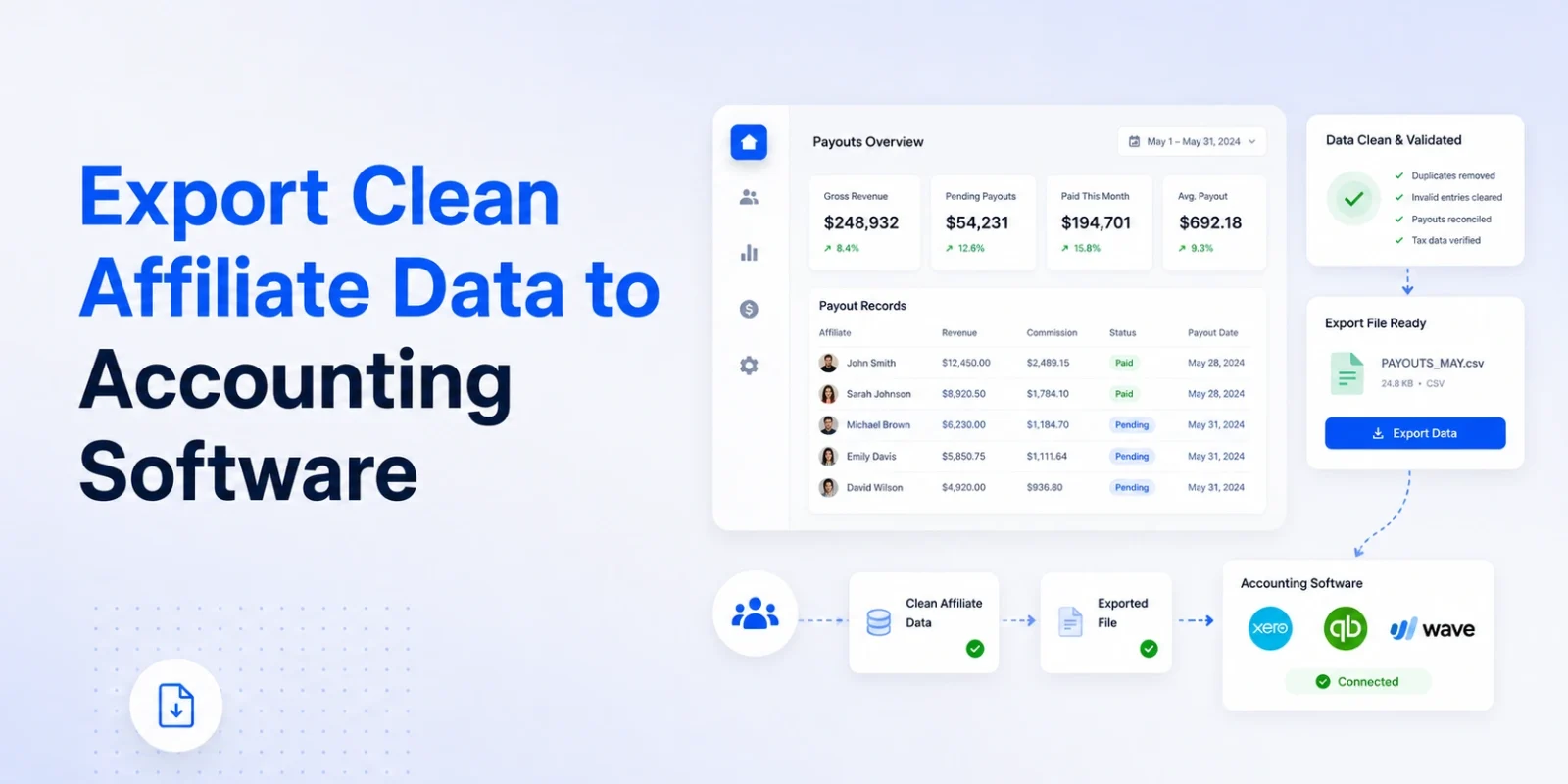
TL;DR — Exporting Affiliate Data for Accounting Reconciliation
→ “Can you export the data” is the wrong question. Almost every affiliate platform can produce a CSV. The right question is whether that CSV contains what a finance team needs to close the books without manually rebuilding your commission logic in a spreadsheet every month.
→ A reconciliation-ready export needs five things a basic transaction dump usually doesn’t have: commission line items broken out by affiliate, the GGR or NGR basis used for each calculation, currency with the FX rate applied at the time of the transaction, a full deduction breakdown, and clearly marked payout period boundaries.
→ Platform-reported totals and accounting-recorded totals disagree for predictable reasons — accrual-versus-cash timing, FX rate snapshots taken at different moments, retroactive adjustments that never propagate backward, and rounding that compounds across thousands of line items into a discrepancy that looks systemic because it is.
→ None of this holds up without an audit trail. If a finance team — or a regulator — asks how a specific commission figure was calculated six months after the fact, “we’re not sure, the export doesn’t say” is not an acceptable answer in a regulated vertical.
Every affiliate platform vendor answers “yes” when an operator asks whether the platform exports data to accounting software. It’s a checkbox on a feature comparison sheet, and every vendor checks it, because a CSV export is trivial to build. What almost none of them answer honestly is the follow-up question that actually matters: does that export contain what a finance team needs to reconcile it against the general ledger, or does it hand finance a pile of transaction rows and leave them to reconstruct the commission logic themselves, from scratch, every close cycle?
We’ve watched this gap surface at nearly every operator who migrates onto a platform built with tracking in mind and reconciliation as an afterthought. The tracking data is accurate. The postback delivery is reliable — assuming you’ve already solved the failure modes we cover in our postback troubleshooting guide, where we note directly that finance teams cannot reconcile payouts against tracking data they don’t trust in the first place. But accurate tracking data and reconciliation-ready data are not the same deliverable. One tells you what happened. The other tells you what happened, why the number came out the way it did, and how to prove it to someone asking six months later.
What Does “Clean” Actually Mean for an Affiliate Data Export?
“Clean data” is one of those phrases that sounds precise and means almost nothing until someone defines it. For an affiliate export headed into accounting software, clean means exactly one thing: a finance team can take the file, reconcile it against the platform’s own reported payout totals and against the general ledger, and close that period without opening a support ticket or rebuilding commission math in a spreadsheet to figure out where a number came from.
That’s a specific, testable bar. Most exports fail it not because the underlying numbers are wrong, but because the file doesn’t carry enough context for someone outside the platform to independently verify how those numbers were derived. A total commission figure with no basis, no currency context, and no deduction detail is not clean data. It’s a number finance has to trust blindly, and finance teams — correctly — don’t trust numbers they can’t independently verify.
The Five Fields Finance Cannot Reconcile Without
Strip away platform-specific formatting and every reconciliation-ready affiliate export needs the same five elements. Missing any one of them turns an export from a finance deliverable into a starting point for a manual investigation.
Commission line items broken out by affiliate. Not a single aggregated total per period — individual line items, tied to a specific affiliate ID, a specific transaction or transaction batch, and a specific calculation date. Aggregation can always be built up from line-item detail. It can never be reliably broken back down from a single summary figure.
The GGR or NGR basis used for each calculation. Hybrid CPA+RevShare structures, and RevShare deals generally, depend entirely on which revenue basis the commission was calculated against. A line item that states a commission amount without stating whether it was calculated on Gross Gaming Revenue or Net Gaming Revenue is not verifiable — it’s an assertion. Finance needs the basis stated per line item, not once in a footnote or a contract PDF nobody attaches to the export.
Currency and the exchange rate applied at the time of the transaction. Multi-currency operators — which is most operators running international programs — generate a specific, predictable reconciliation failure when the export states only a converted total in the operator’s base currency without the original currency and the FX rate used. Reconstructing that rate after the fact, weeks later, against a market that’s moved, is close to impossible with any precision.
A full deduction breakdown. Chargebacks, bonus abuse write-offs, negative carryover adjustments, processing fees, and any manual corrections all need to appear as distinct, labeled line items — not netted invisibly into a final payout figure. A commission line that’s been quietly reduced by a negative carryover adjustment, with no visible record of the adjustment itself, is exactly the kind of number that triggers a dispute with the affiliate and a support escalation with finance in the same week.
Clearly marked payout period boundaries. Every line item needs an unambiguous period tag — which billing cycle it belongs to, and whether it reflects the original calculation or a retroactive adjustment applied after that period closed. Without this, a correction applied in March for a February transaction shows up as a mystery variance in March’s numbers instead of a traceable adjustment to February’s.
Why Platform-Reported Totals and Accounting-Recorded Totals Don’t Match
Almost every operator finance team has, at some point, stared at a variance between what the affiliate platform reports as total commission liability and what’s sitting in the general ledger, with no obvious explanation for the gap. The gap is rarely a bug. It’s almost always one of four predictable, mechanical causes.
Accrual versus cash-basis timing. The platform typically records a commission the moment it’s calculated — on an accrual basis. Accounting software, depending on how the operator’s books are kept, may record the corresponding expense on a cash basis, at the moment payment actually clears. Between those two events sits a payout cycle, sometimes weeks long, during which the two systems are correctly, legitimately out of sync. This isn’t an error. It’s a timing difference that needs to be understood and bridged, not chased as a discrepancy.
FX conversion snapshot timing. If the platform converts currency at the moment of the original transaction and the accounting system converts at the moment of payout — or worse, at a period-end rate applied uniformly regardless of when each individual transaction occurred — the two totals will diverge by an amount that’s entirely explainable and entirely invisible unless both systems expose which rate, and which timestamp, they used.
Retroactive adjustments that don’t propagate backward. A chargeback discovered in April against a February transaction needs to adjust February’s commission record, not simply appear as an unexplained deduction in April’s export. Platforms that apply adjustments only forward, at the point of discovery, without linking them back to the original period, generate exactly this kind of variance — and generate it repeatedly, every time a late chargeback or fraud reversal comes in.
Rounding and aggregation drift. A rounding difference of a fraction of a cent, applied consistently across ten thousand individual transactions, does not stay a fraction of a cent. It compounds into a total that’s visibly, sometimes significantly, off — and because each individual instance looks trivial, it’s the variance category most likely to get dismissed instead of traced.
A one-cent rounding discrepancy, repeated across ten thousand transactions, is not a rounding error. It’s a systemic mismatch wearing a rounding error’s costume.
The Audit-Trail Requirement: What “Complete and Auditable” Actually Means
We’ve written elsewhere, in our breakdown of RevShare, CPA, and hybrid commission models, that operators need to be able to produce complete, auditable records of exactly how every commission figure was calculated. That requirement isn’t a compliance nicety. In a regulated vertical, it’s the difference between a routine finance question and a regulatory finding — and it only holds up if the export itself carries the audit trail, rather than requiring someone to reconstruct it after the fact from memory or from a system that’s since changed its own commission rules.
In practice, “complete and auditable” means three specific things at the export level. First, an immutable calculation record — once a commission line item is calculated and recorded, the original calculation is preserved even if a later adjustment changes the payable amount, so the history isn’t overwritten, only appended to. Second, commission rule versioning — if the RevShare percentage or CPA structure for an affiliate changed mid-period, the export needs to reflect which rule version applied to which specific transactions, not just the rule in effect on the day someone happens to pull the report. Third, a timestamped basis declaration on every line — the GGR/NGR basis, the currency, and the FX rate all need their own timestamp, tied to the transaction, not to whenever the export was generated.
Regulatory reporting obligations for MGA- and UKGC-licensed operators assume this level of traceability exists. We cover the broader compliance framework in our iGaming affiliate compliance guide, but the specific, practical version of the requirement is this: if a regulator or an internal auditor asks how a commission figure from four months ago was derived, the honest answer needs to be a query against the export’s own audit fields — not a reconstruction project involving three people and a shared spreadsheet.
Structuring the Export: A Practical Field List
Translated into an actual export schema, a reconciliation-ready file needs the following columns at minimum, at the line-item level:
- Affiliate ID and affiliate name
- Transaction ID and transaction timestamp
- Commission basis (GGR or NGR) with the specific revenue figure it was calculated against
- Commission model applied (CPA, RevShare, hybrid) and the specific rate or rule version in effect
- Original currency, converted currency, and the FX rate applied with its timestamp
- Gross commission amount before deductions
- Deduction line items, each individually labeled — chargeback, negative carryover, bonus write-off, processing fee, manual correction
- Net payable commission amount
- Payout period assignment, with a separate flag distinguishing an original calculation from a retroactive adjustment
- Calculation timestamp and, where applicable, adjustment timestamp
Every column on that list exists to answer one specific reconciliation question finance will eventually ask. Strip any of them out and that question turns into a manual investigation instead of a lookup.
Building a Recurring Reconciliation Workflow, Not a One-Time Cleanup
A clean export solves the data problem once. It doesn’t solve the reconciliation problem, which recurs every single close cycle regardless of how good the underlying export is. The workflow around it matters as much as the file itself.
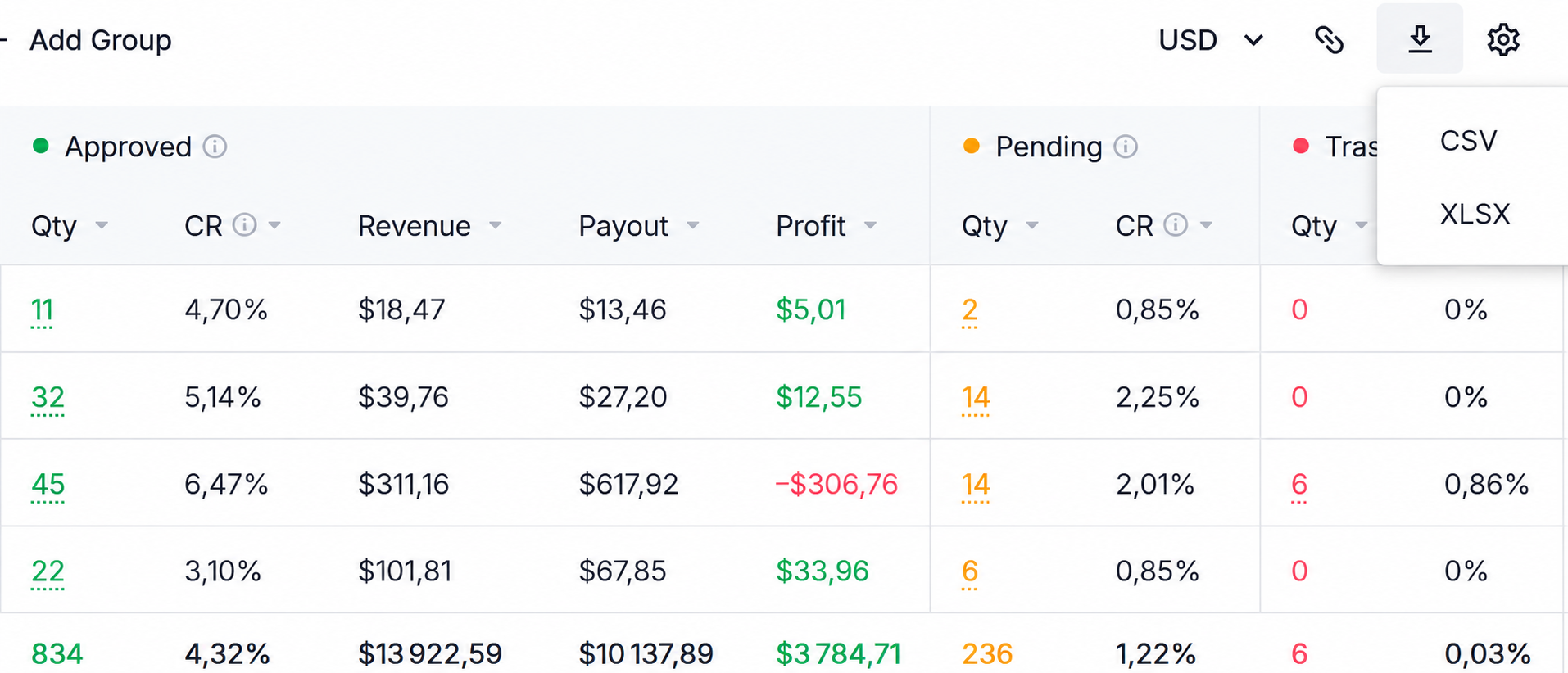
Across the finance teams we’ve supported through this, the pattern that holds up is a standing monthly reconciliation pass rather than a scramble at period close: export the period’s affiliate data on a fixed schedule, run an automated variance check against the general ledger total, and set a variance threshold — a small percentage, tuned to transaction volume — above which a discrepancy gets investigated line by line rather than written off as noise. Discrepancies under that threshold, consistently traceable to known FX or timing effects, get documented once and treated as expected variance going forward, not re-investigated from zero every month.
The alternative — reconciling ad hoc, only when a number looks obviously wrong — guarantees that small, explainable variances accumulate silently for months before anyone notices the accumulation is no longer small.
Checkbox Export vs. Reconciliation-Ready Export
| What It Provides | What’s Missing | Downstream Consequence |
|---|---|---|
| A single aggregated commission total per affiliate per period | Line-item detail, transaction-level traceability | Any variance requires rebuilding the calculation from scratch to find its source |
| A converted total in the operator’s base currency | Original currency and the FX rate applied at transaction time | FX-driven variance becomes unexplainable weeks after the fact |
| A net payable figure after deductions | Itemized deduction breakdown (chargebacks, carryover, fees) | Disputes with affiliates over payout amounts with no visible basis to resolve them |
| A commission amount with no basis stated | GGR/NGR basis and commission rule version per line item | Commission figures cannot be independently verified during an audit or a regulatory review |
| A snapshot of current-period totals only | Retroactive adjustment linkage back to the original period | Late chargebacks and corrections appear as unexplained variance instead of traceable adjustments |
“A commission total with no basis, no currency context, and no deduction detail isn’t clean data. It’s a number finance has to trust without being able to check it — and finance teams, correctly, don’t extend that trust for free.”
What a Bad Export Actually Costs
The immediate cost is time. A finance team reconstructing commission logic from a bare transaction dump every close cycle is spending hours — sometimes days, at scale — doing work that a properly structured export would have made unnecessary. That cost repeats every single month, indefinitely, for as long as the export stays unfixed.
The second cost shows up in the affiliate relationship. An affiliate disputing a payout figure, with no itemized deduction breakdown available to either side, turns into a negotiation about trust rather than a lookup against a shared, verifiable record. We, the team behind Scaleo, treat this as the same underlying problem the industry hasn’t solved at an infrastructural level: operators and affiliates rarely have a shared source of truth for how a commission figure was actually derived, and every unresolved payout dispute is a small, cumulative tax on that relationship.
The third cost is regulatory, and it’s the one operators underweight until an audit forces the issue. An inability to produce a clean, auditable calculation record on request, during a licensing review, is not a paperwork inconvenience. In an MGA- or UKGC-licensed program, it’s a finding — and findings tied to commission calculation opacity are exactly the kind of issue that turns a routine review into a longer, more expensive one.
Still Rebuilding Commission Logic in a Spreadsheet Every Month?
If your current export can’t answer a basis, currency, or deduction question without a manual investigation, that’s a structural gap worth a direct conversation.
Talk to a Migration SpecialistFrequently Asked Questions
What fields does a clean affiliate data export need for accounting reconciliation?
At minimum: commission line items broken out by affiliate and transaction, the GGR or NGR basis used for each calculation, the original currency and FX rate applied at transaction time, an itemized deduction breakdown, and clearly marked payout period boundaries that distinguish original calculations from retroactive adjustments.
Why don’t affiliate platform totals match accounting software totals?
The most common causes are accrual-versus-cash-basis timing differences, FX conversion rates captured at different moments between the two systems, retroactive adjustments that aren’t linked back to their original period, and rounding differences that compound across a large volume of individual transactions into a total that looks like a significant discrepancy.
What does an auditable commission calculation record actually require?
Three specific elements: an immutable original calculation that’s preserved even after later adjustments, commission rule versioning so the export reflects which rate or structure applied to each specific transaction, and a timestamped basis declaration — currency, FX rate, and GGR/NGR basis — tied to the transaction rather than to whenever the report was generated.
How often should affiliate commission data be reconciled against the general ledger?
On a fixed monthly schedule tied to close, rather than only when a number looks obviously wrong. A standing reconciliation pass with a defined variance threshold catches small, explainable discrepancies before they accumulate into a larger, harder-to-trace variance months later.
This guide reflects commission reconciliation practices and regulatory audit-trail expectations as of July 2026. Multi-currency handling and regulatory reporting requirements vary by jurisdiction and evolve regularly — confirm the specific field requirements against your license conditions and your accounting team’s current chart of accounts before finalizing an export template.