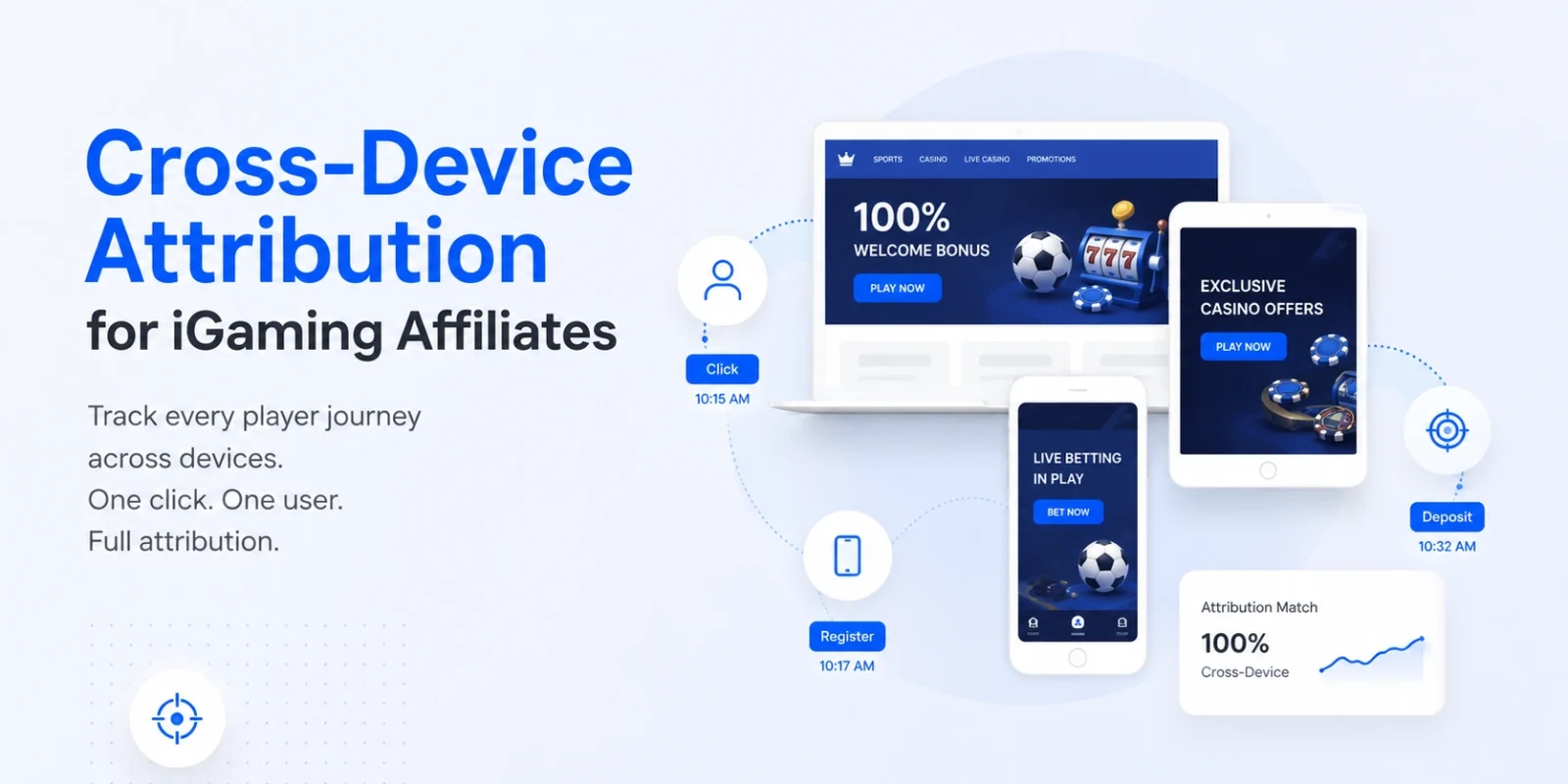
A player sees a streamer’s affiliate link on their smart TV app on a Tuesday evening. They visit your casino’s site on their phone the next morning. They register on their desktop at lunchtime and make their first deposit from the same desktop three days later. Four devices. Four sessions. One player. One referral. Most affiliate tracking systems attribute this player to nobody — or to the last click they can identify, which may be a direct navigation event with no affiliate in the chain at all. The affiliate who introduced the player receives zero credit. The commission they earned is never paid. The dispute arrives on the 15th of the following month, if it arrives at all.
⚡ DIRECT ANSWER
Cross-device attribution in iGaming affiliate programs is the technical capability to maintain a continuous referral chain when a player interacts with an affiliate’s promotional content on one device and completes the conversion (registration and first deposit) on a different device. Two methods exist: deterministic attribution, which uses a known, shared identifier (player account ID, verified email, or phone number) to link device sessions with certainty, and probabilistic attribution, which uses statistical matching of device fingerprint signals to infer a connection where no shared identifier is available. In 2026, the baseline expectation for multi-channel iGaming affiliate programs is deterministic attribution wherever a logged-in player identity is available, with probabilistic methods filling the gaps where it is not.
Why Cross-Device Attribution Breaks — and How Often
The player journey in iGaming has never been primarily single-device. But the tracking infrastructure most operators run was designed around a single-device assumption: a player clicks an affiliate link in a browser, the click ID is stored in a browser cookie, the player registers and deposits in the same browser session, the cookie is present at conversion, the postback fires, the commission is attributed. Clean, simple, and increasingly fictional.
In 2026, the average player conversion journey in a regulated European market touches 2.3 devices between first affiliate touchpoint and first deposit. The breakdown, based on Scaleo operator data across multi-channel programs: 41% of players first encounter an affiliate’s promotional content on mobile (social content, streaming, in-app banner) and complete registration on desktop; 18% encounter content on OTT or connected TV environments and convert on any other device; 27% stay within the same device type but switch browsers or clear cookies between click and conversion; and only 14% complete the full journey in the same browser session on the same device where the affiliate click was recorded.
That 14% is the only segment reliably attributed by cookie-based tracking. The remaining 86% require cross-device attribution methodology to be correctly assigned to the affiliate who generated the initial touchpoint. In programs without cross-device attribution, that 86% either goes unattributed or is misattributed to a last-click that occurred in a different browser or device context — often a branded search click or a direct navigation event that carries no affiliate tracking at all.
⚠️ The silent cost of attribution gaps: Operators who do not have cross-device attribution often believe their affiliate program is performing worse than it is — because a significant share of genuinely affiliate-sourced players are appearing in the direct/unattributed segment of their acquisition reports. This creates two compounding problems: affiliates are underpaid for real traffic they generated (generating disputes and program exit risk), and the operator’s direct acquisition metrics are overstated (creating misleading ROI calculations for direct marketing spend). Before diagnosing an affiliate program as underperforming, audit the attribution gap — the percentage of FTDs with no affiliate click ID attached. In programs without cross-device attribution, this gap commonly runs 30–50% of total FTD volume.
Where the Referral Chain Breaks: The Three Transition Points
Cross-device attribution failure is not random. It occurs at specific, predictable transition points in the player journey. Understanding the break points is the prerequisite for designing the technical architecture that bridges them.
Break Point 1: The App-to-Web Handoff
A player clicks an affiliate deep link in a social media app — Instagram, TikTok, YouTube — and the link opens in the platform’s in-app browser rather than the device’s native browser. The affiliate’s click ID is stored in the in-app browser’s session context. The player, preferring their native browser, copies the URL and opens it in Safari or Chrome. The in-app browser’s session data does not transfer to the native browser. The click ID is gone.
The same break occurs when an affiliate link opens the casino’s mobile web page and the player subsequently downloads and opens the native app. The web browser click session and the app session are different environments with different storage contexts. A click ID stored in web browser localStorage is not accessible to the mobile app by default. Without an explicit bridging mechanism, the referral chain breaks at the app download.
The technical bridge for this transition: deferred deep linking. When an affiliate tracking link is clicked on mobile, the click ID is captured and stored server-side against the device’s available identifiers (IP address, device fingerprint components available from the HTTP request). When the mobile app is first opened, it sends its device identifiers to your backend, which matches against the stored click session and retrieves the click ID. The app is attributed to the correct affiliate even though it was installed through the App Store or Play Store rather than directly through the affiliate link. This deferred attribution window typically runs 30 days — a click recorded before an app install is matched to that install if the device identifiers are consistent and the install occurs within 30 days of the click.
Break Point 2: The Cross-Browser Transition
A player clicks an affiliate link on desktop Safari (iOS/macOS). Safari’s Intelligent Tracking Prevention sets an aggressive 24-hour window before cross-site cookie data is restricted and a 7-day cap on the cookie lifespan itself. If the player returns to complete registration more than 24 hours after the affiliate click, or if they switch to Chrome for the registration step, the Safari-stored click ID is no longer available at conversion time.
This is the most common attribution break in regulated European markets, where iOS device penetration among casino players is high. It is not solvable at the browser level — Apple’s ITP is not a configuration parameter operators can adjust. It is solvable at the architecture level: S2S postback stores the click ID server-side at the point of the affiliate click, not client-side in the browser. When the player registers and logs into an account, the casino backend can match the player’s account registration data against the server-side click record using deterministic identifiers — the player’s email address or account ID — to retrieve the correct affiliate attribution regardless of which browser they used for registration.
Break Point 3: The OTT and Connected TV Gap
OTT (Over-The-Top) streaming platforms — Twitch, YouTube, Amazon Prime Video, Apple TV+ — and connected TV environments present the most structurally difficult attribution challenge because they operate in environments that are fundamentally incompatible with standard web tracking mechanisms. No browser cookies. No JavaScript pixels. No standard click ID capture mechanisms. When a player watches a casino streamer on their smart TV and decides to sign up, they transition to a different device for the actual conversion — and there is no native mechanism to link their TV viewing session to their subsequent web or app registration.
Three approaches bridge this gap, in order of attribution certainty:
Exclusive bonus codes: The affiliate (streamer or OTT content creator) provides a unique code to their audience. Players who enter the code during registration are attributed to that affiliate regardless of device or channel. This is deterministic attribution through a user-initiated action rather than a technical tracking mechanism. Its limitation is code fatigue and code sharing — players may enter codes they received secondhand, attributing acquisitions to the wrong affiliate.
Landing page-to-account registration linkage: The affiliate’s promotional content directs players to a specific landing page URL that includes the affiliate’s tracking parameters. The player types this URL on their registration device, the affiliate’s tracking parameters are present in the URL string rather than a browser cookie, and the attribution is captured at registration. This approach requires players to either memorize or manually transfer a URL — a friction point that reduces conversion rates but produces clean attribution for the conversions that do complete.
Household IP matching (probabilistic): When a connected TV session shows content from an affiliate’s channel and a registration subsequently occurs from a device sharing the same home IP address within a defined attribution window, the registration can be probabilistically attributed to the affiliate based on the IP correlation. This is not deterministic — multiple household members may share an IP, and the correlation may be coincidental — but it is the most seamless user experience option and performs well in attribution accuracy at cohort scale. The window should be short (24–48 hours maximum) to limit the probability of coincidental IP matches.
Deterministic Attribution: The Gold Standard Architecture
Deterministic attribution links device sessions through a known, shared identifier — an entity that exists in both the pre-registration and post-registration data environments and can be used to connect them with certainty rather than statistical inference. In iGaming, the deterministic identifier becomes available at account registration: the player’s account ID, email address, or phone number.
The Universal Player ID (UPID) Architecture
The most reliable cross-device attribution architecture in iGaming affiliate programs is built around a Universal Player ID (UPID) — a persistent identifier assigned to a player at the point of registration and used as the primary attribution anchor across all subsequent device interactions.
The implementation sequence:
- Click capture (pre-registration): When a player clicks an affiliate tracking link on any device or channel, the affiliate platform captures the click ID and stores it server-side against the available device signals (IP, user agent, device fingerprint hash, timestamp). No cookie required — the storage is entirely server-side.
- Registration bridge: When the player creates an account, the casino backend assigns a UPID. Simultaneously, the registration event carries whatever signals were present at registration (device, IP, browser, referral URL if available) to the affiliate platform. The platform attempts to match these registration-time signals against the stored click records from the pre-registration window.
- Match and attribute: If a match is found (same IP within a tight window, same device fingerprint hash, or an explicit identifier like an email address that matches a pre-registration form submission), the click ID is linked to the UPID. All subsequent player events — deposits, withdrawals, session activity — are posted with the UPID as the primary player identifier, maintaining the attribution chain across all devices and sessions for the lifetime of the player account.
- Post-registration continuity: Once the UPID is linked to the affiliate’s click ID, cross-device attribution is automatic. The player logs into your casino app on their phone, uses the desktop web interface, plays on their tablet — every session is associated with the same UPID, and every NGR event generated by that UPID is attributed to the originating affiliate. No further browser cookies or device-specific tracking required.
The UPID architecture requires that your casino backend passes the UPID in every postback event sent to the affiliate platform. Scaleo’s postback schema accepts UPID as a configurable parameter — it can be passed as the primary player identifier in postback URL parameters, and Scaleo stores it as the persistent attribution anchor against which all subsequent player events are matched. This is the data field that makes cross-device attribution continuous rather than per-session.
Probabilistic Attribution: Filling the Gaps Determinism Cannot Reach
Deterministic attribution requires a shared identifier between the pre-click session and the post-registration session. When that identifier is not available — the player did not submit their email in a pre-registration form, the OTT environment has no cross-device identity mechanism, the registration occurred far enough from the click that IP correlation is unreliable — probabilistic attribution is the alternative.
Probabilistic attribution uses statistical matching: the question is not “do we know this is the same person?” but “what is the probability that this registration came from this click, given the signals we can observe?” The signals used and their relative weighting:
| Signal | Attribution Weight | Degradation Factor |
|---|---|---|
| Same IP address, same session | Very High | Shared IPs (office networks, carrier-grade NAT) reduce confidence |
| Same IP address, different session (within 2 hours) | High | CGNAT and mobile carrier IP rotation reduces confidence over time |
| Same IP address, different session (2–24 hours) | Medium | Dynamic IP reassignment and household sharing reduce confidence significantly |
| Device fingerprint component match (OS + browser + screen resolution + language) | Medium-High | Common configuration combinations (iPhone 15 + Safari + en-GB) produce false positives |
| Device fingerprint full match (5+ components) | High | Limited by fingerprint entropy — less unique on common device/OS combinations |
| Geographic proximity (city-level) + temporal proximity (<4 hours) | Medium | High population density areas reduce confidence (many players, same geo) |
| Referral URL containing affiliate identifier | High | Requires referral URL to be passed and not stripped by browser privacy settings |
Probabilistic attribution produces confidence scores, not certainties. In practice, a confidence threshold is set — matches above 85% confidence are attributed; matches between 60–85% are flagged for review; matches below 60% are logged but not attributed. The threshold is an operator configuration decision that trades attribution completeness (a lower threshold attributes more journeys) against attribution accuracy (a higher threshold attributes only high-confidence matches).
The financial implication of threshold choice: at 60% confidence threshold, you attribute more affiliate journeys but accept a higher false positive rate — some attributions will be wrong, paying commission on players who were not actually referred by the attributed affiliate. At 85%, you miss some genuine affiliate referrals but maintain high attribution accuracy. For CPA programs where commission fires on each attributed QFTD, accuracy matters more than completeness. For RevShare programs where commission is ongoing and errors self-correct through the NGR calculation, completeness may be more commercially important.
Configuring Cross-Device Attribution in Scaleo
Cross-device attribution is not a single toggle in an affiliate platform — it is a configuration architecture that spans the click capture layer, the player identity layer, and the postback schema. The following configuration steps are specific to Scaleo’s infrastructure but represent the general implementation pattern for any affiliate platform attempting to bridge the attribution gap.
Step 1: Server-Side Click ID Storage
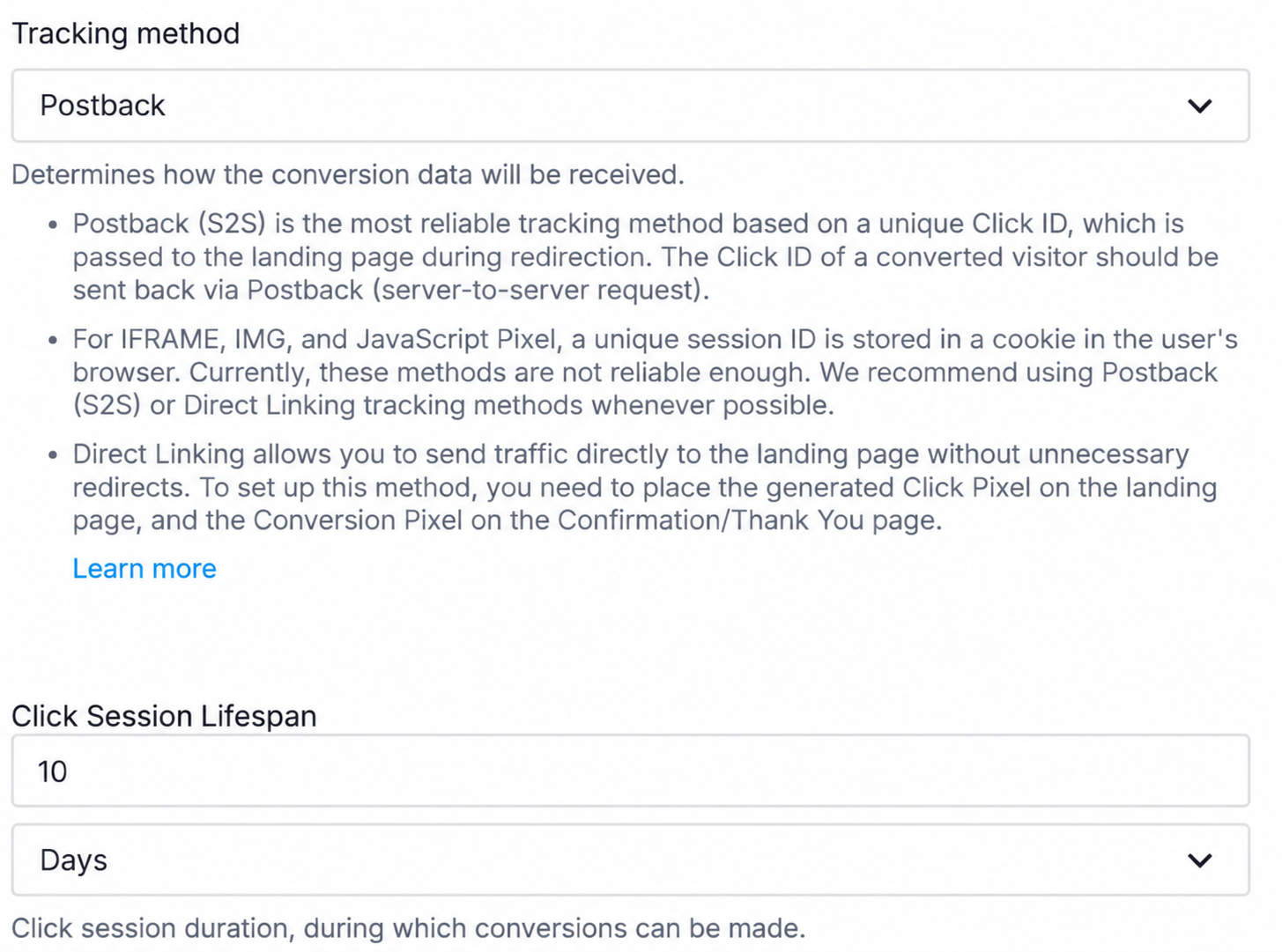
In Scaleo’s tracking configuration, ensure that click IDs are stored server-side at the point of click capture — not solely in browser cookies or client-side storage. The server-side click record should carry: the affiliate’s click ID, the timestamp, the IP address, the user agent string, the available device fingerprint hash, and any referral URL parameters. This server-side record is the persistent click attribution anchor that survives browser cookie clearing, browser switching, and the app-to-web transition.
In Scaleo’s offer tracking settings, configure the click session lifespan to match your attribution window — typically 30 days for casino programs and 14 days for sportsbook programs where player decision cycles are shorter. The click session lifespan determines how long a server-side click record is retained and remains eligible for matching against subsequent registration events. A click record that has expired cannot be matched regardless of how confident the probabilistic signals are.
Step 2: UPID Parameter in Postback Schema
Configure your casino backend to pass the player’s UPID in every postback event sent to Scaleo, using a consistent parameter name (for example, {player_id} or {upid} as a postback macro). Scaleo stores this identifier against the attributed click record, and all subsequent postback events carrying the same UPID are automatically linked to the original affiliate attribution without requiring a new click ID match for each session.
The UPID parameter must be passed from the registration event onward — it is at the registration event that the player transitions from an anonymous pre-conversion visitor to a known account holder. Every postback event before registration (click events, if you are firing them) uses the click ID as the primary identifier. Every postback event after registration (FTD, NGR events, withdrawal requests) uses the UPID as the primary identifier, with the click ID stored as a linked attribute.
Step 3: Deferred Deep Link Configuration for Mobile App Attribution
For mobile app programs, configure deferred deep link handling in your Scaleo tracking setup. When an affiliate tracking link is clicked on a mobile device and the player is directed to the App Store or Play Store rather than to a web registration page, Scaleo’s click record is stored server-side with the device’s available identifiers from the click HTTP request. Configure your mobile app to call Scaleo’s attribution API on first launch, passing the device’s current identifiers. Scaleo’s matching engine compares these against the stored click records and returns the click ID to attribute to the first-launch event if a match above the configured confidence threshold is found.
The deferred attribution window for mobile app installs should match your click session lifespan — typically 30 days. An app first launched more than 30 days after the affiliate click is not reliably attributable to that click through probabilistic matching, as too many intervening app touches may have occurred.
Step 4: OTT Channel Attribution via Exclusive Codes
For streamer and OTT affiliate programs, configure exclusive bonus codes in Scaleo’s offer settings. Each OTT affiliate receives a unique code that maps to their affiliate account. When a player enters the code during registration on any device, Scaleo’s postback chain is triggered using the code-to-affiliate mapping rather than a click ID. The commission attribution is deterministic — the code is the identifier, and its presence in the registration event unambiguously attributes the player to the correct affiliate.
Configure code expiry and code reuse limits to prevent code sharing distortion. A code that a streamer broadcasts publicly and that circulates in bonus hunting communities will generate attributions from players who were not actually influenced by that streamer’s content — inflating the affiliate’s attributed QFTD count with organically sourced players who happened to find the code secondhand. Code reuse limits (maximum one use per player account) prevent multi-claim abuse. Code expiry (typically 48–72 hours after a stream goes live) limits the window during which the code produces attributions that are reasonably connected to the streaming event.
Scaleo platform note: We, the team behind Scaleo, built the UPID and server-side click storage architecture specifically because operator programs were consistently losing attribution at the mobile/web transition point. The most common symptom: an affiliate running YouTube pre-roll ads would show strong click metrics in their own analytics but minimal attributed conversions in the affiliate platform — because players who clicked from YouTube mobile were completing registration on desktop, and the attribution chain was breaking at the device transition. The UPID-anchored postback schema closes that break. Affiliate-reported click volume and operator-attributed QFTD volume align within a few percentage points rather than diverging by 40%.
The Attribution Model Comparison: Cross-Device Scenarios
| Player Journey | Cookie-Only Attribution | S2S + UPID Attribution | Attribution Outcome |
|---|---|---|---|
| Click affiliate link on desktop Chrome → register and deposit in same session | ✅ Attributed (cookie present) | ✅ Attributed (UPID matches click ID) | Correct attribution — both methods work |
| Click affiliate link on mobile Safari → register on desktop Chrome 3 days later | ❌ Not attributed (cookie expired/ITP) | ✅ Attributed (server-side click matched to registration via UPID) | S2S + UPID recovers attribution |
| Click affiliate link in Instagram in-app browser → copy URL to native Safari → register | ❌ Not attributed (in-app browser session not transferred) | ✅ Attributed (server-side click ID stored; IP + device match at registration) | Probabilistic match via server-side signals |
| Watch streamer on connected TV → register on phone using streamer’s bonus code | ❌ Not attributed (no browser click event) | ✅ Attributed (exclusive code maps to streamer’s affiliate account) | Code-based deterministic attribution |
| Click affiliate link on mobile → download app → deposit in app 7 days later | ❌ Not attributed (web click not accessible from app environment) | ✅ Attributed (deferred deep link matches app first-launch to click record) | Deferred deep link attribution recovers the referral |
| Click affiliate link on mobile → clear cookies → register on same mobile device 14 days later | ❌ Not attributed (cookie cleared) | ✅ Attributed (server-side click record still active within 30-day window; device fingerprint match) | Server-side persistence recovers attribution |
| Multiple household members use same IP; one clicks affiliate link, different person registers | ⚠️ May misattribute | ⚠️ May misattribute (IP match without device match is medium confidence only) | Both methods risk false positive — device fingerprint must confirm the match |
The final row is the important caveat. Cross-device attribution methods — both cookie-based and server-side probabilistic — can produce false positive attributions when multiple people share a network environment. The shared household IP scenario is the most common. Shared office or campus networks are more extreme — potentially thousands of users sharing a single IP range. Probabilistic confidence scoring must include signal diversity requirements: an IP match alone is insufficient to attribute when the IP is consistent with a high-occupancy network. Device fingerprint match AND IP match at sufficient temporal proximity is a materially stronger signal than either alone.
Privacy Regulation and Cross-Device Attribution: What Changed in 2026
Cross-device attribution intersects with data privacy regulations in ways that affect what methods are legally available in specific jurisdictions. Three regulatory developments that directly affect attribution architecture for operators running affiliate programs in regulated European markets:
GDPR and device fingerprinting consent: Device fingerprinting for cross-device attribution purposes requires explicit user consent under GDPR in most interpretations — it constitutes processing of personal data for tracking purposes, which falls under the consent requirements of Article 6(1)(a). Operators using probabilistic attribution based on device fingerprint matching in EU markets must have an explicit, freely given consent mechanism in place before processing fingerprint data for this purpose. The consent must cover the specific purpose (affiliate attribution) and cannot be bundled into a generic privacy policy acceptance.
UPID as a personal data identifier: A UPID linked to a player’s account is personal data under GDPR — it is a unique identifier that, when combined with account registration data, identifies a specific natural person. The UPID can be used for affiliate attribution purposes under the legitimate interest basis (Article 6(1)(f)) if the attribution is necessary for the performance of an affiliate marketing contract, but this basis must be documented and must withstand a legitimate interest assessment that considers the player’s reasonable expectations.
ePrivacy Directive and first-party data priority: Server-side attribution methods that use first-party data — data the operator has collected directly from their own relationship with the player — are on significantly stronger regulatory ground than methods that use third-party tracking mechanisms. UPID-based attribution using data the operator holds from account registration is first-party. IP-based probabilistic matching using data from third-party data brokers or cross-site tracking networks is not. The regulatory direction across Europe is strongly in favor of first-party methods, and the infrastructure investment in UPID-anchored server-side attribution produces a compliance dividend alongside the attribution quality improvement.
Frequently Asked Questions
What percentage of iGaming affiliate conversions involve cross-device journeys?
Based on Scaleo’s operator data from multi-channel affiliate programs in 2025, approximately 86% of affiliate-sourced player registrations involve at least one cross-device or cross-browser transition between first affiliate touchpoint and completed registration. The remaining 14% complete the full journey — click, registration, and first deposit — within a single browser session on a single device. This means cookie-based attribution correctly identifies only about 14% of affiliate-sourced conversions without supplementary cross-device methods. The precise figure varies by traffic source mix: programs with heavy mobile social content see higher cross-device rates; programs with primarily desktop SEO traffic see lower rates.
What is deterministic attribution and how does it work in iGaming?
Deterministic attribution uses a known, shared identifier to link a player’s pre-registration click session to their post-registration account with certainty rather than statistical inference. In iGaming, deterministic attribution becomes available at account registration when the player creates an account with a verified email address, phone number, or other identifying credential. The Universal Player ID (UPID) assigned at registration is stored against the click record that preceded registration, and all subsequent player activity is linked to the originating affiliate through the UPID. Exclusive bonus codes in OTT and streaming programs are also deterministic — the code is a user-initiated identifier that explicitly links the player to the affiliate’s channel.
How do I attribute players acquired through Twitch or YouTube streaming?
Three attribution methods work for streaming acquisitions, in order of accuracy and user friction. First, exclusive bonus codes: each streamer affiliate receives a unique registration code that they promote during their stream. Players who enter the code at registration are attributed to that affiliate regardless of device. This is deterministic and requires no technical integration beyond code configuration in the affiliate platform. Second, tracked affiliate links with short-form URLs: streamers can promote a trackable URL in stream descriptions or pinned comments. Players who click this link on their registration device will be attributed through standard S2S postback. Third, household IP probabilistic matching: players who watched the stream on a connected TV device and registered on another device within the same home network within 24–48 hours can be probabilistically attributed based on IP correlation. This third method should only be used as a supplementary layer, not as a primary attribution mechanism.
Does cross-device attribution affect affiliate commission accuracy?
Yes, in both directions. Programs without cross-device attribution underpay affiliates for players they genuinely sourced (because the referral chain breaks between click and conversion), and may overpay affiliates who receive accidental last-click attribution from players who were originally referred by a different affiliate but converted in a session that carries the wrong affiliate’s tracking. Programs with accurate cross-device attribution correct both distortions: genuine affiliate referrals are attributed and paid, and accidental last-click attributions are replaced by the correct source-of-referral attribution. The net effect on total commission spend depends on the specific attribution gaps in the program, but operators consistently report that implementing cross-device attribution produces a more accurate program performance picture — some affiliates increase in attributed volume, others decrease, and the overall QFTD-to-direct-navigation split changes significantly.
What is the UPID and why does it matter for cross-device attribution?
A Universal Player ID (UPID) is a persistent, unique identifier assigned to a player at account registration and used as the primary attribution anchor across all subsequent device interactions, browser sessions, and app sessions. Before registration, a player is an anonymous visitor associated only with a temporary click session. After registration, the UPID links the player’s identity to the affiliate’s click record, and all subsequent player events — deposits, withdrawals, NGR accumulation — are associated with the originating affiliate through the UPID rather than requiring a browser cookie to be present at each event. Without a UPID or equivalent persistent identifier in the postback schema, cross-device attribution requires repeated probabilistic matching for each new device session, producing lower accuracy and higher false positive rates as the player relationship extends over time.
86% of Your Affiliate-Sourced Players Cross at Least One Device Boundary Before Converting
If your attribution infrastructure was designed around a single-device, single-session assumption, you are attributing 14% of your affiliate program’s output correctly. The other 86% is either unattributed, misattributed to the last trackable click rather than the originating referral, or generating affiliate disputes you are treating as individual anomalies rather than a systematic architecture problem. The fix is server-side click storage, UPID-anchored postback schemas, deferred deep link configuration for mobile, and exclusive code attribution for OTT channels. None of these are new concepts. Implementing them together is what makes a cross-device attribution architecture rather than a collection of individual tracking patches.
See how Scaleo’s tracking architecture handles server-side click storage, UPID-anchored attribution, and multi-channel postback configuration — or explore the Attribution Chain Audit guide for diagnosing where your current program is losing the referral chain before implementing the cross-device fix.