
Quick answer: An operator can enforce an affiliate brand-bidding rule only if the contract states exactly which search activity is restricted, the team can preserve evidence of the ad as it appeared, and tracked clicks can be tied to an approved or disputed partner campaign. An affiliate dashboard can identify traffic and commission. It cannot prove what an ad said, which keyword triggered it, or who bought the impression. Keep those evidence sources separate before withholding a payout.
A casino affiliate suddenly sends more first-time depositors from a campaign labeled “search.” The players look real. The commission rises. Meanwhile, your paid-search team sees an ad above the brand’s own result for a branded query. Is the affiliate buying your name, or is a third party using the same landing page? A conversion report alone cannot settle that question.
Affiliate brand bidding belongs in the operating design of the program. The search result, the advertiser account, the redirect path, the affiliate link and the commission decision are different records. A good investigation joins them without pretending one record proves the others.
Start with the rule you intend to enforce
“No brand bidding” sounds clear until an affiliate’s broad-match campaign appears for a brand query it did not enter as a keyword. Another partner may have written permission to buy a brand-plus-product term in one market. A third may not bid at all, but places the trademark in the ad headline. These are different policy questions.
Specify whether the restriction concerns bidding on named terms, appearing on a branded query, using a trademark in ad copy, direct linking, or presenting a domain that looks like the operator’s. State the covered brands, spelling variants, countries, languages, search engines and authorized exceptions. Record an effective date and the process for approving exceptions. If the rule changes, retain the version that applied when the campaign ran.
Do not confuse the program’s contract with the search engine’s trademark policy. Google’s current trademark policy says it generally does not restrict using trademarks as keywords. A program may impose a narrower contractual rule on its affiliates. Google’s separate gambling and games policy also makes ad eligibility depend on certification and country-specific requirements. Check the current rules for the markets and accounts involved; do not assume that a search ad visible in one location may lawfully run everywhere.
| Policy question | Decision to write down | Evidence needed later |
|---|---|---|
| Term | Exact brand, misspelling, brand-plus-bonus and competitor combinations. | Query, match behavior where available, and policy version. |
| Appearance | Whether an ad merely appearing on a brand query breaches the rule. | Search result captured with market, device and time. |
| Ad and destination | Trademark use, impersonation, direct linking and approved domains. | Ad copy, display URL, final URL and redirect chain. |
| Permission | Partner, brand, market, date range and permitted creative. | Written approval and the campaign or link issued for it. |
| Remedy | Pause, correction deadline, disputed-conversion review and contractual remedy. | Incident record, affected events, partner response and decision owner. |
A UK-licensed operator has an additional reason to make third-party oversight explicit: the Gambling Commission’s LCCP 1.1.2 places responsibility for contracted third parties on the licensee and addresses affiliate breaches of relevant advertising codes. This article does not prescribe one policy for every jurisdiction. The contract, licence conditions and ad-platform rules need review for the actual market.
Separate the search observation from the tracked click
A search ad monitor can capture a query, ad copy, visible advertiser, device, location and time. Your affiliate platform records a different chain: the partner, campaign, tracking link, click, player event and commission. They may connect through a distinctive final URL or campaign link. They may not. A copied affiliate link, redirect or shared landing page can make the match uncertain.
Build a case file with both sides. Preserve the full ad observation, including the result page context. Record the redirect sequence and exact tracking URL if it can be obtained without generating artificial ad clicks. Then look for the corresponding affiliate and campaign records. Do not assign an ad to a partner solely because its traffic spiked on the same day.
Scaleo’s offer Tracking panel shows the affiliate, selected campaign and generated link. In a controlled paid-search program, that link should map to the permission record for the campaign. The screen establishes the link configuration; it does not identify the search term or certify the ad.
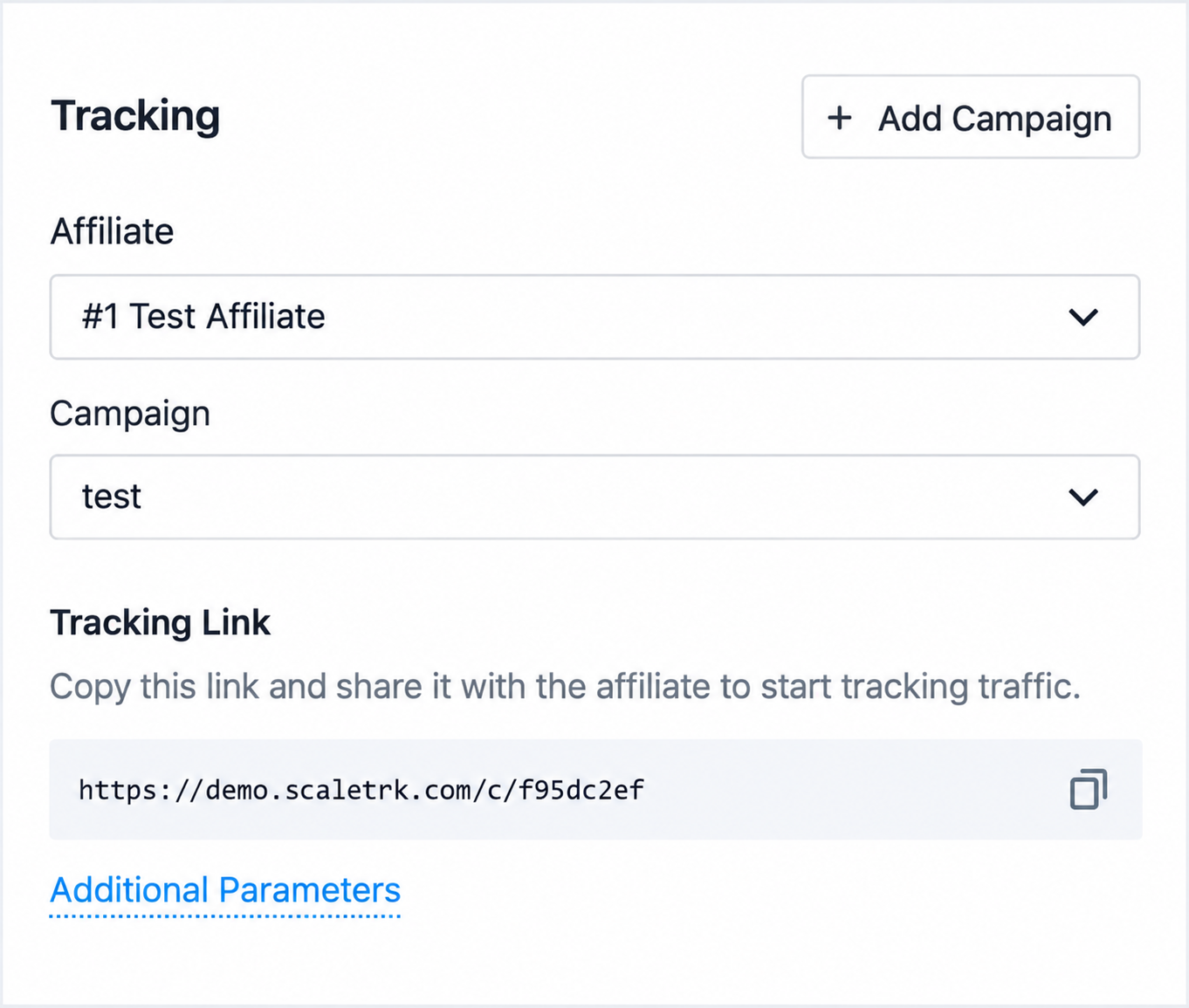
Set a convention for partner-supplied source values. For example, sub_id1=paid_search and sub_id2=brand_terms can describe the channel and intended keyword class. Those values are declarations from the partner’s link, not independent proof of where an ad served. Conversely, a blank or misleading source field is a data-quality finding. It is not, by itself, evidence of a policy breach.
What belongs in an evidence packet?
Capture the observable facts first. The record should contain the search query, search engine, country and city or region used for the observation, device type, local time and UTC time, ad copy, displayed domain, destination, and a full-page capture. Save the monitoring method and observer. If the ad disappears later, the original evidence remains interpretable.
Then add the contractual facts: the affiliate’s agreement and policy version, any paid-search exception, the permitted brand and market, and the approval owner. Finally, attach the platform facts: affiliate ID, campaign or link ID, click timestamps, SubIDs, qualifying player events and commission status for the period under review. Keep personal player data out of the shared case file unless it is necessary and access-controlled.
Why check the partner’s account settings? An authorized partner may be running a generic campaign that was matched to a brand query by the ad platform. The question is whether that violates your written rule, what steps the partner took to exclude the term, and whether the observed ad was actually theirs. An investigation that records only the screenshot and the commission total cannot answer it.
Use the report to scope exposure, not to prove the ad
Once a link is associated with a disputed campaign, reports help establish the affected window and commercial amount. Choose the same time zone, event statuses and qualification rule that finance will use. Separate click date from FTD approval date. Otherwise a manager may hold November commission for a player who clicked in an authorized October campaign, or miss a delayed FTD from the disputed period.
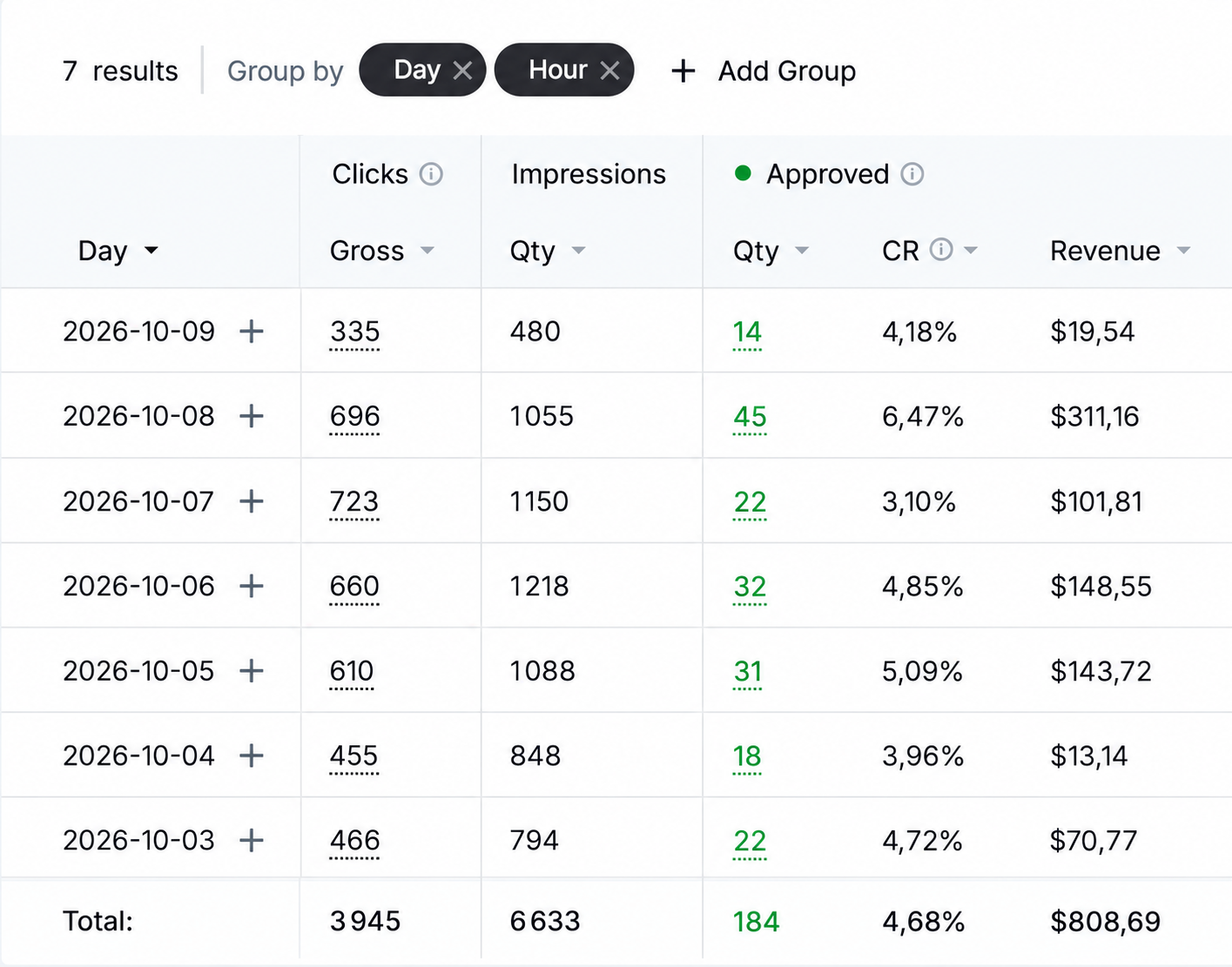
Record the disposition of each affected conversion rather than applying a blanket percentage to the partner’s balance. An approved FTD may remain payable if the event falls outside the violation window or belongs to a permitted campaign. A pending FTD may need to remain pending while the traffic source is reviewed. Any reversal or adjustment should point to the exact contract clause, event set and decision maker. The commission-correction workflow is a separate accounting step; it should not be used to manufacture missing ad evidence.
Two cases a superficial review gets wrong
Broad match creates an appearance the partner did not plan
An affiliate buys generic “sports odds” terms. Its ad appears on a query containing your brand. If the contract forbids bidding on named brand terms, the account’s keyword and negative-keyword settings matter. If it forbids appearing on brand queries, the same appearance may trigger a different obligation. Ask for the account-side evidence allowed by the agreement, and document whether a correction was made. The search screenshot alone does not tell you which keyword matched.
The ad uses a link that belongs to someone else
A copied affiliate URL may point to a legitimate partner while another advertiser controls the ad. Check who owns the ad account or displayed domain, whether redirects insert or replace tracking parameters, and whether the partner authorized syndication. A link match is a lead. It is not an identity proof. If the case cannot be attributed, preserve that uncertainty and address link governance separately.
Decide the remedy at the same grain as the evidence
Give the partner the specific observation and applicable clause, with a reasonable opportunity to respond under the agreement. The affiliate manager can verify permission; paid search can verify ad behavior; compliance can assess market rules; finance can scope commission. Those roles should not collapse into an unrecorded spreadsheet edit.
For an active risk, the operator may pause a campaign or offer access while the facts are checked. A payment hold or clawback is a separate decision governed by contract and jurisdiction. Limit it to the supported event set. Store the incident ID on the decision record so the partner statement can be explained later. If the platform cannot associate an adjustment with its cause, the next dispute will start from zero.
Brand bidding is also an incrementality question, but do not infer lost direct sales from a high FTD rate. A branded ad can capture a player already looking for the operator, or it can reach a player who would have clicked elsewhere. To estimate incremental value, compare controlled markets or periods with comparable campaigns and seasonality, and state the assumptions. The compliance decision does not need an invented incrementality estimate to be valid.
A buyer test for the next software demo
Bring one synthetic incident and the real policy language, with confidential details removed. Ask the vendor to show the record path rather than a dashboard tour.
- Create a partner campaign approved for generic paid search in one brand and market.
- Generate a tracking link with a declared source and placement code; retain the link and approval record.
- Send test clicks from that campaign and a second, unapproved campaign; locate both in the click records.
- Register and qualify one synthetic FTD from each link, then show the commission status and report filters.
- Pause or restrict the disputed campaign and confirm what happens to new clicks and historical records.
- Show how an affected commission can be held or adjusted with a reason and an auditable event reference.
- Explain which part of the search-ad observation requires a separate monitoring tool or process.
A credible answer distinguishes native tracking and access controls from external ad surveillance. Scaleo can be evaluated on the campaign, click, conversion and commission path visible in its product. The search engine’s ad impression and account settings require their own evidence. That distinction protects both the operator and the partner.
Test the disputed campaign, not a generic dashboard.
Bring your paid-search policy and a redacted case to a Scaleo demo. Ask to trace the link, affected events and commission decision while you keep the ad observation in its proper evidence file.
Frequently asked questions
Does Google Ads ban affiliates from bidding on a casino brand name?
Google’s trademark policy generally does not restrict trademarks used as keywords. A casino operator can still prohibit or limit that activity in its affiliate agreement. Gambling ad eligibility and certification are separate questions and vary by country.
Can an affiliate platform prove which keyword triggered an ad?
A tracking platform records the clicks and events it receives. The triggering search query, ad copy and advertiser account need evidence from the ad platform or search-ad monitoring. A partner-supplied SubID is not independent verification of the keyword.
What is the difference between a brand-bidding violation and an affiliate traffic spike?
A traffic spike is a signal to investigate. A violation requires an observed activity, an applicable policy clause, attribution to the partner and a decision on the supported evidence. The spike alone establishes none of those elements.
Should an operator reverse every commission from a suspected paid-search campaign?
No automatic blanket reversal follows from a suspicion. Scope the period and affected events, apply the contract and jurisdictional rules, give the partner the relevant facts, and record the reason for any hold or correction.
What should a brand-bidding software demo show?
It should show the approved partner campaign, tracking link, click and conversion records, report filters, access or pause controls, and the path from a disputed event to a commission decision. Ask the vendor to identify any search-ad monitoring that sits outside the platform.