
The audit trail: A defensible casino affiliate payout keeps the original conversion and commission record, then records each later change as a linked adjustment with a reason, effective period, approver and statement impact. Do not silently replace a paid FTD or overwrite last month’s NGR. When a partner challenges the total, the operator should be able to show the path from player event to deal rule, adjustment and final payout without rebuilding it from three spreadsheets.
The affiliate’s invoice is approved on Friday. On Tuesday, the payments team reverses one deposit and finance reduces the player’s NGR. The partner opens the portal and sees a smaller number than the statement they downloaded last week. Which number is right?
Both may have been right at different times. The problem is that the program has lost the explanation between them. That gap turns a routine correction into a commercial dispute, especially when CPA and RevShare appear on the same statement.
This is the operational layer between FTD qualification, NGR-based commission and the accounting export. It is where an affiliate platform either earns the finance team’s trust or sends everyone back to email attachments.
A correction is a new event, not a revised memory
An FTD can be valid when the casino reports it and later become ineligible under the signed deal: a deposit is returned, the player fails a required check, or the original event was duplicated. RevShare can move after a chargeback, bonus correction or late game settlement. None of those outcomes means the first record should disappear.
Preserve what was known when the original decision was made. Then append the correction and link it to the affected player, conversion, deal version and statement line. A manager can still see the current net payable amount; finance can reproduce the route to that amount.
Keep four clocks separate
- Event time: when the player action occurred in the operator’s source system.
- Received time: when the affiliate platform accepted the event or correction.
- Decision time: when a reviewer approved, rejected or held the commission.
- Statement time: when the amount entered an open or closed payout period.
A correction received in November for a September FTD belongs to the September player history. Its cash effect may belong to November’s statement if September is closed. If the system treats those dates as interchangeable, a historical report changes every time finance closes a new month.
The minimum record chain for a payout dispute
The fields below are a buyer’s acceptance test, not a claim that every platform exposes them in one screen. Ask for an export as well as a dashboard view. Screenshots are useful; a reproducible record is better.
| Record | What it must answer |
|---|---|
| Source event | Which player action, source ID and timestamp produced the conversion? |
| Attribution | Which click, affiliate, offer and brand received credit, under which rule? |
| Commercial rule | Which deal version, CPA gate or RevShare base applied on that date? |
| Adjustment | What changed, why, who approved it and which original line does it reference? |
| Statement | Was the amount pending, approved, paid or carried into a later period? |
The source IDs matter. Without them, two teams can each present a plausible row for the same player and still fail to prove they are discussing the same conversion. That is not a theoretical edge case in a multi-brand program.
How to handle a late reversal after payment
Consider an illustrative CPA deal paying €180 for a qualified FTD. The October statement is closed and paid. In November, the operator confirms that the deposit tied to source event ftd-4821 was reversed under the agreement’s eligibility rule. The commercial answer is a €180 correction, but the operational treatment depends on the contract and finance policy.
A clean ledger leaves the October €180 payment intact as history. It creates a November adjustment of −€180 linked to ftd-4821, the original commission line and the evidence for the reversal. If the agreement permits recovery from future earnings, the November statement shows that offset explicitly. If recovery requires a separate credit note or partner approval, the workflow should not disguise it as an ordinary negative conversion.
Now add RevShare. A late bonus cost can reduce the player’s NGR without invalidating the FTD. The CPA and RevShare lines need separate adjustment logic. One “reverse conversion” button cannot express both accurately.
Where teams usually lose the thread
- A closed statement is recalculated in place, so the affiliate cannot reproduce the amount they were paid.
- The reason field says only “manual adjustment,” with no source event or policy clause.
- A deposit reversal is applied to CPA and RevShare even though the agreement treats them differently.
- The affiliate sees a net negative balance but cannot see which brand, period or player cohort caused it.
The Scaleo view to test in a demo
Scaleo’s offer goals screen makes the commercial side of this question concrete: goal types, revenue, payout and approval status sit in one configuration view. The image below is an interface screenshot, not evidence that every adjustment and dispute step described here is automated. Use it as the starting point for a live test with your own deal terms.
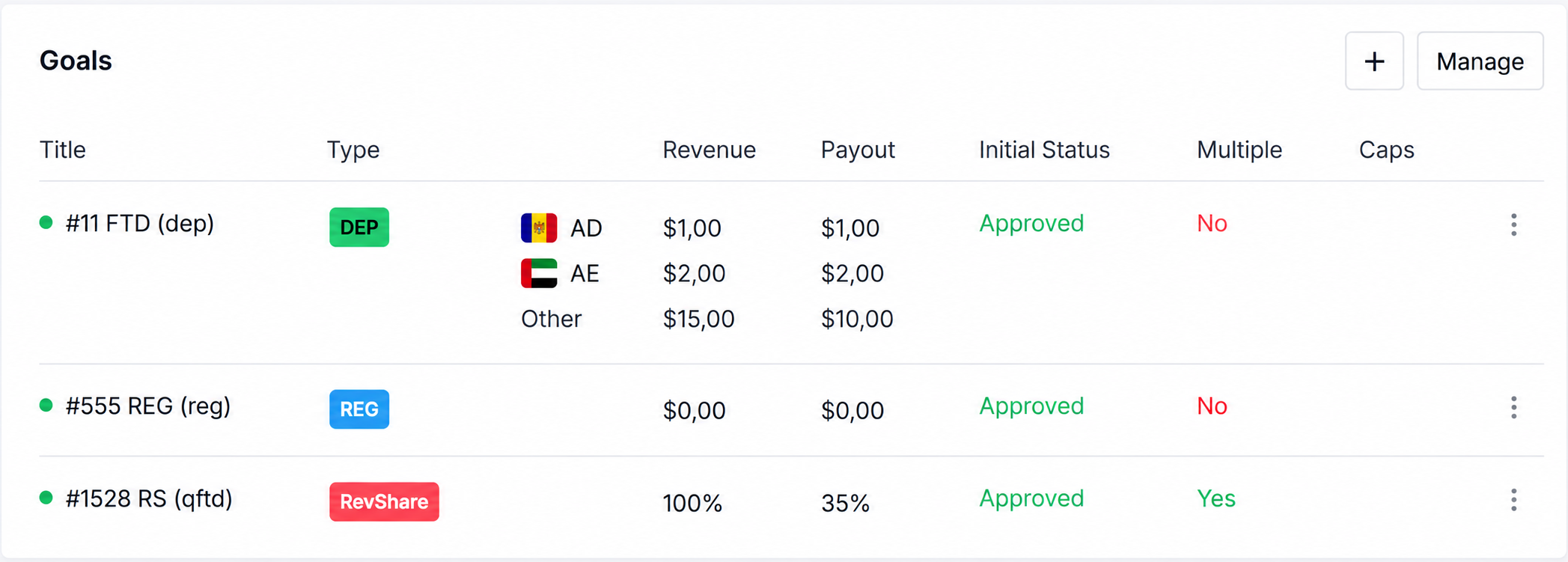
For a serious proof of concept, give the vendor one approved FTD, one duplicate, one post-payment reversal and one RevShare adjustment. Ask the same person to export the statement before and after the corrections. Can they identify every changed line without asking engineering to query the database?
The dispute packet should be ready before the dispute
A partner should not receive a raw player identifier, payment detail or risk note that the operator is not entitled to share. But they do need enough to reconcile their statement: an agreed reference, event date, affected offer and brand, reason category, rule applied, amount before and after, and the payout period carrying the change. Keep sensitive player evidence in the operator’s restricted review path.
Internal reviewers need the full packet: source event, linked conversion, deal version, adjustment history, supporting evidence, approver and export receipt. Make the packet reproducible from the platform record. If it lives only in a manager’s inbox, it will fail the first staff handover.
A buying checklist for the finance and affiliate teams
- Can an operator lock a closed period while posting a later correction against it?
- Does each adjustment reference the original source event and commission line?
- Are CPA qualification, RevShare changes and negative carryover handled as distinct rules?
- Can the affiliate see an intelligible reason without seeing restricted player data?
- Will the exported statement match the portal after filtering by brand, currency and period?
- Can a reviewer reproduce the calculation using the rate, deal version and approval history?
These are useful questions to put to Scaleo in a demo, alongside the 14-day software POC. Bring a real disputed line with identifying data removed. The most persuasive answer is the record the system produces, not a promise that disputes never happen.
Frequently asked questions
Bring your hardest payout question to the demo.
If your team is evaluating an affiliate platform, ask Scaleo to walk through a correction using your own deal rules. A traceable answer is worth more than another polished chart.
Should an operator delete an FTD after a deposit reversal?
No. Retain the original event and add a linked correction or ineligibility decision. The amount payable may become zero, but the history should still show why the FTD was credited and later changed.
What if the affiliate has already been paid?
Keep the paid statement as historical fact. Apply the correction through the mechanism allowed by the signed agreement and finance policy, such as a later offset or credit note, with the original line referenced.
Can a RevShare adjustment be handled as a CPA reversal?
Usually not without checking the deal. CPA qualification and RevShare revenue bases are separate commercial rules. A bonus cost or late settlement may change NGR while leaving the original FTD valid.
How do we test commission auditability before buying software?
Run an approved FTD, duplicate, post-payment reversal and NGR adjustment through a demo environment. Export the before-and-after statement and ask the vendor to trace every changed line to its source and approval.