There is no single LatAm compliance stack.
Quick Answer
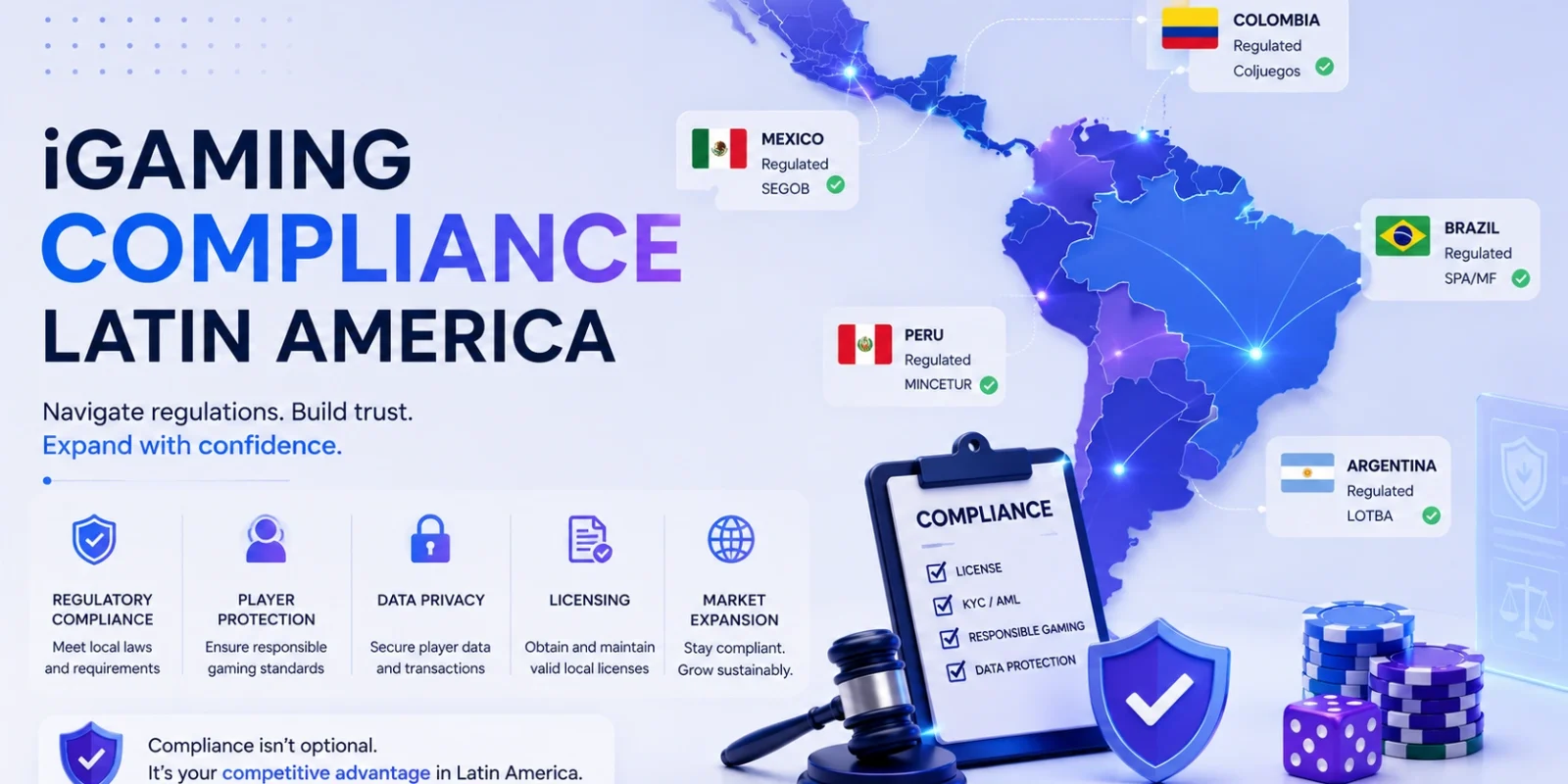
LatAm iGaming expansion in 2026 requires operators to treat each market as a separate technical build, not a regional rollout. Brazil’s SPA/SIGAP framework enforces daily-batch-plus-near-real-time transaction reporting tied to national tax ID (CPF) verification, with credit cards and crypto banned outright. Argentina’s 23 provinces plus Buenos Aires City each license and regulate independently, with national-level rules limited to AML, advertising, and RENAPER biometric identity checks — meaning a multi-province launch means multiple separate integrations, not one. Colombia’s Coljuegos offers the clearest single national framework in the region but the heaviest combined tax burden. Mexico’s outdated 1947-era legal structure means no standalone online license exists at all — an operator can only go live by partnering with an existing SEGOB land-based permit holder, and the reform bill that would modernize this has been pending since late 2025. The technical answer is a modular, decoupled compliance layer with geofencing (GeoComply is the dominant vendor) as a stack component, not the core of the compliance build.
Brazil’s SIGAP system demands near-real-time API streaming tied to CPF-based identity verification and PIX-only payments. Argentina has no national regulator at all — 23 provinces and the City of Buenos Aires each run separate licensing and reporting regimes, several still built around scheduled batch submissions.
Colombia’s Coljuegos runs one of the region’s most mature single-regulator frameworks, but layers a combined GGR-plus-VAT tax burden that pushes effective rates above 30%.
Mexico has no standalone online license at all — internet gambling is only legal as an extension of an existing SEGOB land-based permit, and the technical reporting mandate is comparatively light next to Brazil’s. Any operator planning a LatAm rollout needs a decoupled, market-specific compliance layer, not one integration copy-pasted four times.
Every one of these four markets is growing fast enough to justify the engineering investment. But “regulation” means something structurally different in each one — a different regulator, a different reporting cadence, a different identity-verification mandate, and in Mexico’s case, no dedicated online license category at all. This guide breaks down what each market actually requires at the API and infrastructure level, and where a rushed, copy-pasted compliance build tends to fail first.
Brazil: the strictest and most codified framework
Brazil’s grey-market era ended for real on January 1, 2026, when the transition period under Law 14.790/2023 expired and the Secretaria de Prêmios e Apostas (SPA) shifted from guidance to enforcement. The first wave of fines under Portaria SPA/MF No. 722 has already landed, specifically targeting operators with weak identity verification — this isn’t a theoretical risk anymore.
The technical core is SIGAP, the mandatory data pipeline connecting every licensed operator’s back end to the SPA. Every operator must transmit structured data covering wager placement, settlement, deposits, withdrawals, bonus issuance, and identity records, tagged to each player’s CPF (Brazil’s national taxpayer ID). Reporting runs on a daily batch cycle for most transaction types, but high-risk categories require near-real-time transmission, and the SPA can issue on-demand queries outside the batch schedule.
Payments are PIX-first by regulatory design — Law 14.790/2023 explicitly bans credit cards and crypto-anonymity for deposits, and as of the 2026 rule set, third-party deposits (a spouse funding an account that isn’t theirs) are strictly prohibited, which means Source of Funds verification has to confirm the PIX key belongs to the account holder, not just that a payment cleared.
Argentina: no national regulator, 24 separate rulebooks
Argentina is the market most likely to trip up a team that built its compliance layer around Brazil’s model, because there’s no equivalent centralized reporting body to integrate with. Gambling regulation sits entirely with the 23 provinces and the City of Buenos Aires under Argentina’s federal structure — the National Congress retains authority only over AML/CFT criminal law, data protection, and now biometric ID standards. As of 2026, 14 provincial jurisdictions have mature online betting regimes with defined licensing and reporting; nine more permit activity on a case-by-case basis; Santiago del Estero bans it outright.
What is national: RENAPER biometric digital identity verification is now mandatory for all online gambling platforms, required at both account opening and, in many implementations, at withdrawal. A December 2025 federal advertising law also imposed nationwide restrictions on gambling promotion regardless of province. What is not national: reporting format and cadence. Buenos Aires Province’s IPLyC and the City’s LOTBA both require ongoing data sharing with provincial and federal tax authorities, but a platform licensed only in Córdoba answers to Lotería de Córdoba under a different technical spec entirely. An operator targeting more than one province is, functionally, running parallel compliance integrations under one platform.
Colombia: the clearest framework, the heaviest tax stack
Colombia was the first country in Latin America to fully regulate online gambling, and Coljuegos remains the only single national regulator on this list handling licensing, technical certification, and enforcement end to end — no B2B license category exists, only B2C. Technical certification is mandatory for every gaming system through a Coljuegos-approved lab, covering RNG fairness, functionality, and reporting accuracy, with a minimum 83% RTP requirement on slots.
The regulatory clarity comes at a real cost: as of 2026, licensed operators pay a 15–17% GGR tax plus a 19% VAT on GGR, pushing the effective burden above 34% — and a court ruling earlier in 2026 struck down a separate presidential decree that would have added VAT directly on player deposits, which gives some short-term relief but signals the government isn’t done adjusting the tax structure. Coljuegos is also one of the most aggressive regulators globally on enforcement — it has authority to order ISPs to block unlicensed domains outright, and has used it repeatedly, including a 2026 crackdown targeting sites and social accounts offering unlicensed gambling activity.
Mexico: no standalone online license, and a reform bill that keeps slipping
Mexico is the outlier on this list technically, not because its requirements are strict, but because the legal category barely exists. The framework still runs on the Federal Law of Games and Raffles of 1947, administered by SEGOB’s Dirección General de Juegos y Sorteos (DGJS). There is no standalone online gambling license — online operation is only legal as an extension of an existing land-based permit, and a November 2023 presidential decree ended new sub-licensing arrangements, tightening how foreign operators can structure a market entry (Stake’s 2026 launch via stake.mx, for example, runs as an agent under an existing permit holder’s license).
The federal excise tax (IEPS) already sits at 30% of GGR for online activity by non-resident operators, with a proposed increase to 50% pending in Congress as part of a broader modernization bill SEGOB has been promising since September 2025 — as of mid-2026 it still hasn’t passed. Technical certification isn’t federally mandated the way it is in Colombia, but operators are still required to maintain reliable bet-registration logging, audit trails, and access controls, and advertising rules are strict: every ad must display the operator’s permit number, and a proposed 2026 rule would ban gambling advertising between 6am and 10:30pm across all media.
Regulatory comparison at a glance
| Market | Regulator(s) | Reporting model | Identity mandate | Effective tax burden |
|---|---|---|---|---|
| Brazil | SPA (single federal regulator) | Daily batch + near-real-time for high-risk transactions (SIGAP) | CPF-linked identity, PIX-verified Source of Funds | R$30M license fee (5yr) + 0.82% GGR inspection fee |
| Argentina | 23 provincial regulators + CABA (no national body) | Varies by province; provincial + federal tax data sharing | RENAPER biometric ID, national mandate | 21% national VAT + provincial GGR tax (e.g. 25% in Buenos Aires Province) |
| Colombia | Coljuegos (single national regulator) | Continuous technical certification + compliance reporting | Standard KYC/AML, no unique biometric layer | 15–17% GGR + 19% VAT (34%+ combined) |
| Mexico | SEGOB / DGJS (federal, permit-tied) | Periodic compliance reports; no real-time API mandate | Standard AML/KYC, no national biometric requirement | 30% IEPS (proposed increase to 50% pending) |
What this means for your technical architecture
The practical implication of that comparison table is that a single monolithic compliance module cannot serve all four markets — the reporting formats, identity checks, and even the definition of “real-time” are different enough that shared code becomes a liability, not an efficiency. The pattern that holds up in production is a decoupled architecture: a core platform that handles game logic, payments, and player accounts, sitting behind a modular compliance layer where each market’s reporting adapter, identity verification flow, and tax logic can be updated or replaced independently without touching the others.
- Geofencing as a separate, swappable layer — GeoComply is the dominant vendor for this specifically because it decouples location verification from the core platform. Province-level accuracy matters in Argentina in a way it simply doesn’t in Colombia or Mexico, so this needs to be configurable per market, not hardcoded to a country-level check.
- A reporting adapter per regulator, not per country — Argentina alone may need multiple adapters if you’re licensed in more than one province, since Córdoba and Buenos Aires Province don’t share a reporting spec.
- Identity verification as a pluggable module — CPF verification for Brazil and RENAPER biometric checks for Argentina are structurally different integrations against different national systems, not variations on the same KYC flow.
- Payment rail logic isolated from settlement logic — Brazil’s PIX-only, third-party-deposit-banned rule set has no equivalent in Mexico, where payment method restrictions are much looser. Hardcoding Brazil’s payment rules into the core platform breaks Mexico’s flow, and vice versa.
Where operators actually get this wrong
The most common mistake isn’t underestimating Brazil — it’s over-generalizing from it. Teams that build a rigorous, SIGAP-grade real-time reporting pipeline for Brazil often assume that level of infrastructure is the baseline for the whole region, and then either over-engineer Mexico’s comparatively lighter reporting mandate or, more dangerously, assume Argentina’s “no national regulator” status means lighter compliance overall — when in practice it means more separate integrations, not fewer, if you’re licensing in multiple provinces. Match the engineering investment to what each specific regulator actually requires, not to the strictest market in the group.
Before you scope the build
Confirm before scoping
- Which specific Argentine provinces you’re licensing in, not just “Argentina”
- Whether your Brazil reporting pipeline supports on-demand SPA queries, not just scheduled batches
- Your Mexican market-entry structure — you cannot get a standalone online license, so you need a permit-holder partnership identified early
- Colombia’s combined tax burden in your unit economics before committing capital
Don’t assume
- That a Brazil-grade compliance build transfers directly to any other market
- That “no national regulator” in Argentina means lighter compliance work
- That Mexico’s 2026 reform bill will pass on the timeline currently being floated
- That generic KYC/AML tooling covers CPF and RENAPER-specific verification out of the box
Frequently Asked Questions
Which LatAm market has the strictest real-time API reporting requirement?
Brazil, through SIGAP. Most transaction categories run on a daily batch cycle, but high-risk transactions require near-real-time transmission, and the SPA can issue on-demand queries outside the standard batch schedule — a stricter standard than Argentina, Colombia, or Mexico currently enforce.
Is there a single national gambling regulator in Argentina?
No. Gambling regulation is entirely provincial — 23 provinces plus the City of Buenos Aires each license and oversee operators independently. The national government’s role is limited to AML/CFT law, data protection, and the RENAPER biometric identity mandate.
Can a foreign operator get a standalone online gambling license in Mexico?
No. Mexico has never issued a standalone online-only license. Online gambling is only legal as an extension of an existing SEGOB land-based permit, typically accessed by foreign operators through a partnership or agent structure with an existing permit holder.
Why is geofencing treated as a separate layer instead of part of the core platform?
Because location-verification precision requirements differ by market — province-level accuracy matters in Argentina in a way it doesn’t in Colombia or Mexico. Keeping geofencing modular (the reason GeoComply is the dominant vendor in this category) lets operators adjust precision and rules per jurisdiction without re-architecting the core platform.
This guide reflects publicly available regulatory information from SPA/SIGAP, provincial Argentine regulators, Coljuegos, and SEGOB/DGJS as of mid-2026. Regulatory frameworks in this region change quickly — confirm current requirements with local counsel before committing to a market entry.
If your LatAm expansion also means managing affiliate partners across multiple currencies, tax jurisdictions, and commission structures at once, that’s a tracking problem as much as a compliance one — Scaleo’s affiliate tracking software is built for exactly this kind of multi-market iGaming operation, with per-market commission rules and reporting that scales the same way your compliance layer needs to.