Most iGaming affiliate programs die of the same disease. The traffic is fine. The architecture underneath isn’t. Operators scale affiliates until the channel is saturated, then they wonder why revenue plateaus, why margin is shrinking, why fraud is getting worse in ways their current setup can’t see.
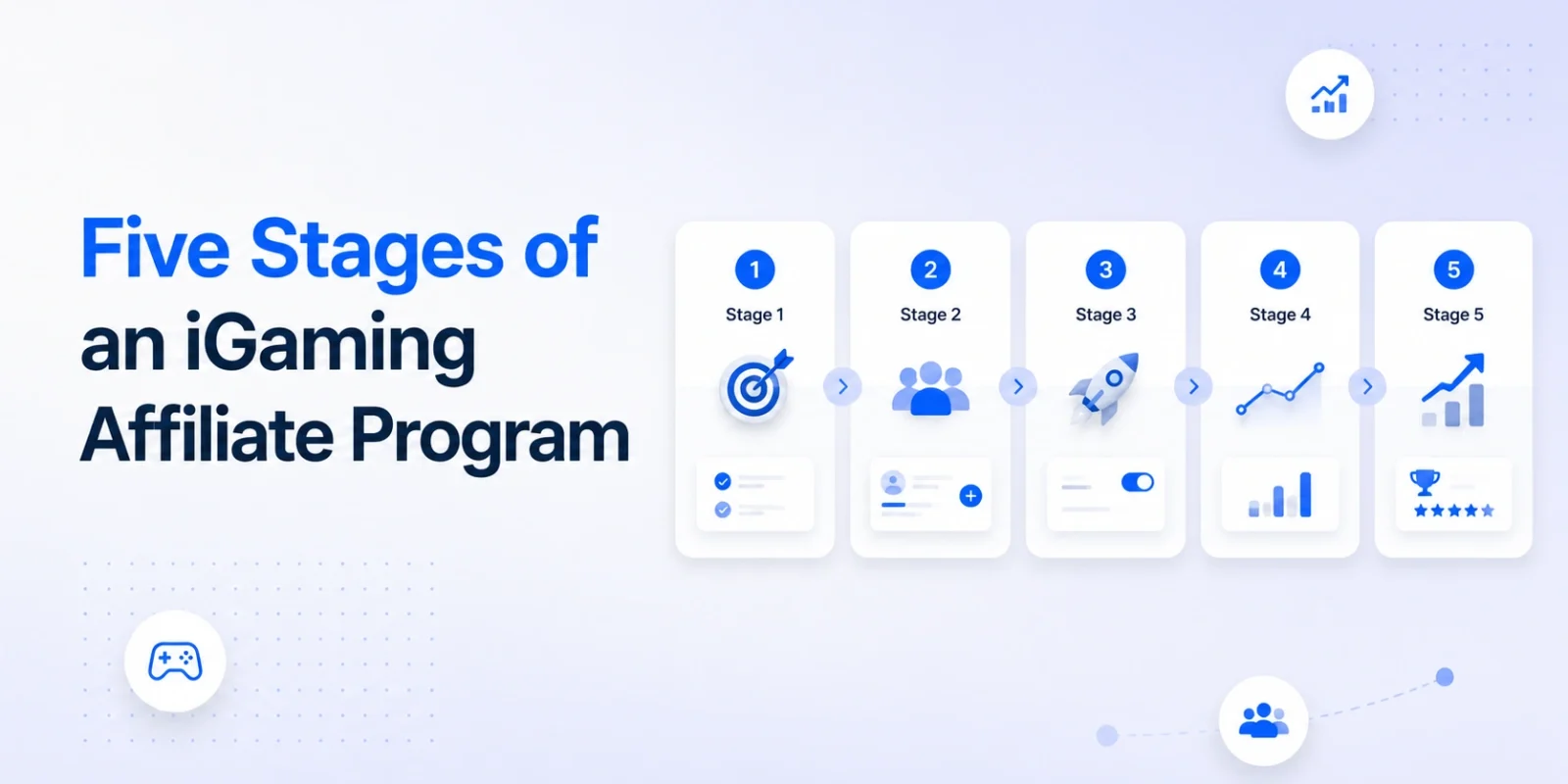
We’ve watched this happen enough times to recognize the pattern. It’s almost always the same five stages — and the same three or four decisions that move a program from one to the next. Operators who make those decisions early compound. Operators who don’t get stuck. Most get stuck at stage three.
This isn’t a vendor maturity model designed to sell you something. It’s an operator-side diagnostic. The names of the stages don’t matter much. The architectural shifts between them do.
Stage 1: Reactive (pre-launch through the first 90 days)
Stage one is the pre-launch and first 90 days. The program usually looks like a tracking pixel, a flat CPA, and one person — often a marketing lead wearing an affiliate hat — running payouts from a spreadsheet.
It works. For a while.
What you don’t see in stage one is also what defines it. There’s no observability: you know what your affiliate sent you yesterday, but you don’t know what the player did after the click. There’s no governance: payment terms live in DMs. There’s no separation between tracking and payouts, which means the same spreadsheet decides who gets paid and what got tracked. When the affiliate asks why their conversion was lower than expected, you have no answer that doesn’t sound like a guess.
Fraud in stage one is invisible. Not because it isn’t happening — it is — but because nothing is watching for it. The first sign is usually a chargeback spike two months later, or a payment processor flagging suspicious activity. By then, the money is gone.
The instinct at stage one is to keep things simple. That instinct is right, for about 90 days. After that, simplicity becomes debt.
Stage 2: Operational (months 3 to 12)
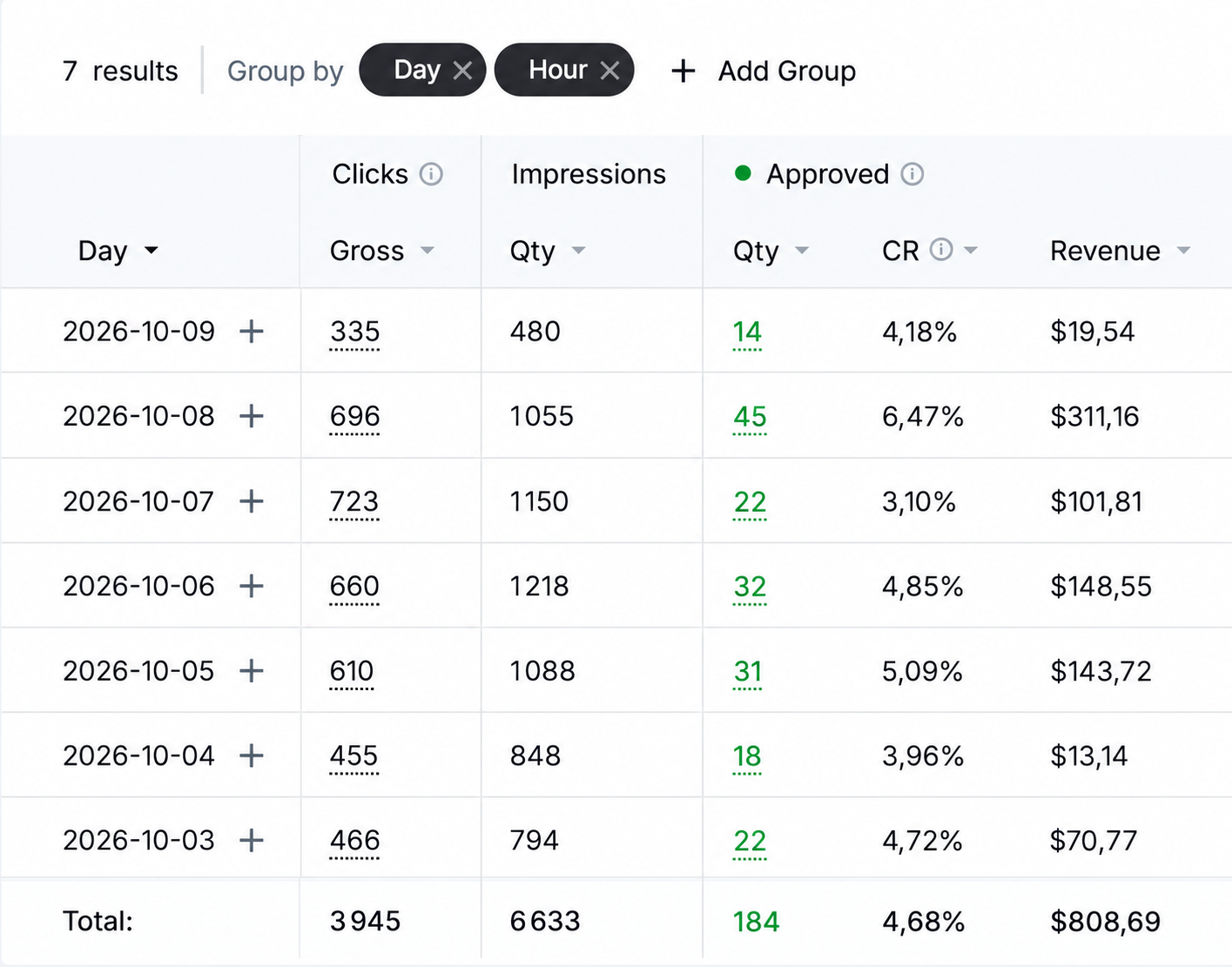
Around month three, a few things happen. The program gets a dedicated affiliate manager. RevShare gets layered on top of the CPA. Reporting goes from “the manager’s spreadsheet” to “the platform’s dashboard.” Maybe a fraud filter shows up. Maybe postbacks get configured properly instead of relying on pixel fires.
This is the stage most programs treat as the destination. It isn’t. It’s the stage that quietly creates the bottleneck you’ll fight at stage three.
The failure mode at stage two is the spreadsheet trap, except the spreadsheet is now the affiliate manager. Every decision — which affiliate gets which deal, which traffic source gets whitelisted, which sub-affiliate relationship gets formalized — routes through one human. When the AM goes on vacation, the program stops. When the AM leaves, the program loses institutional memory that was never written down.
Commission disputes show up here. The data the affiliate sees and the data the operator sees don’t quite line up, and there’s no shared source of truth to point at. Sub-affiliate relationships start emerging organically — your top affiliate recruits someone they know — and you have no formal way to track, attribute, or pay them.
The inflection point nobody warns you about: the moment you hire a second AM is the moment you need automation, not another hire. Most operators read it the other way around.
Stage 3: Scaled — the plateau (year 1 to 2)
This is where most programs live and most programs die.
Stage three looks healthy from the outside. Multiple brands under one program. Hybrid deals in play — CPA blended with RevShare, often with tiered triggers. Sub-affiliate networks forming. Traffic at six to seven figures a month. The dashboard is full. The team is busy. Revenue is growing.
Margin isn’t. Or it is, but slower than revenue. Or it isn’t, and leadership is starting to ask questions.
The plateau isn’t a traffic problem. Adding more affiliates doesn’t help — your top 20% are already doing the work, and the long tail is mostly noise. Adding more CPA doesn’t help — your best affiliates will take it and keep their current volume, your worst affiliates will over-optimize and churn out.
The plateau is an architecture problem. Specifically, it’s the collision of five gaps that all show up at the same time, and you can’t fix one without the others:
Single-touch attribution breaks at multi-brand scale. When the same player hits brand A through one affiliate, brand B through another, and brand C directly, last-touch credit is a coin flip. The affiliate who actually drove the player gets a partial credit. The affiliate who got the last click gets the rest. Both are upset. Both are right. The data model can’t adjudicate it.
Postback latency becomes revenue. A 30-second postback sounds like nothing. At scale, with fast-acquire geos, with affiliates who are testing five landing pages across three traffic sources, 30 seconds is the difference between a tracked conversion and an unattributed one. We’ve covered the mechanics in postback latency for iGaming — the short version is that pixel-based tracking loses conversions in a way most operators don’t see until they run the reconciliation.
Sub-affiliate leakage. Your top five affiliates have sub-networks. They’re not telling you about them. They don’t have to. From their perspective, you’re paying them a commission and they can do what they want with the players. The result: you have no view into 30–60% of the sub-affiliate activity that’s actually generating your conversions, and the affiliate who recruited those sub-affiliates is taking a margin you could be sharing directly.
Fraud detection is reactive. Most programs at stage three have fraud filtering — rules that catch known bad patterns. They don’t have fraud prevention — models that score a click or a signup the moment it lands and block bad traffic before it converts. The difference matters. Filtering is a refund mechanism. Prevention is a block mechanism. One loses you the conversion and gets it back. The other doesn’t lose it in the first place. We’ve written more on this in the affiliate fraud pattern library and the post-conversion bonus abuse piece.
No first-party data layer. You have all the data. Affiliates have what you show them. That asymmetry is your biggest moat and your biggest leak. Most operators at stage three are sitting on a goldmine of player-level data — first-touch source, LTV curves, device fingerprints, payment method patterns, session depth — and using maybe 5% of it to make decisions. The other 95% is sitting in a data warehouse nobody has time to query.
Stage three is the trap because each of these gaps is independently manageable. Operators usually fix one — usually the loudest, usually the attribution problem — and feel good. Then the next gap shows up. Then the next. By the time you’ve cycled through all five, your top affiliate has either left or started negotiating a deal that swallows your margin.
The programs that break through stage three do it with a single architectural decision: they stop treating the affiliate platform as a tracking system and start treating it as a decision system.
Stage 4: Compounding (year 2 to 3)
Stage four is when the architecture starts paying for itself.
What changes isn’t the dashboard. Operators at stage three usually have good dashboards. What changes is that the data layer feeds the decision layer automatically. Commission logic adjusts in real time based on player behavior. Fraud scoring happens at click, not at chargeback. Attribution is weighted and auditable — when an affiliate disputes, you can show them the model and the inputs. Sub-affiliate relationships are first-class, with their own tracking, their own commission tiers, and their own reporting.
Server-side tracking is the default, not the upgrade. The case for server-side in iGaming isn’t really about accuracy — it’s about latency and control. When your postback goes from the player’s browser to your server to the affiliate platform’s server, you can route it intelligently, you can retry on failure, and you can attribute it correctly when the player bounces between brands. Browser-side tracking can’t do any of that.
Predictive models start earning their keep. Player churn probability. LTV at signup. Fraud probability at first deposit. The most underrated use case we see is feeding these predictions back into commission logic — paying a different rate for a player whose 90-day LTV is projected at $400 versus one projected at $40. We’ve broken this down in predictive churn for iGaming and the AI traffic optimization work.
The failure mode at stage four is under-leveraging. The platform is collecting everything. The operator is still acting on last month’s report. The unlock is treating the data layer as a live system, not an archive.
This is also the stage where compliance starts to bite. LATAM expansion, Brazil’s SPA requirements, Ontario’s registration rules, the Netherlands’ cooling-off laws — each new market is a different overlay on top of the same architecture. Programs that architected for compliance from stage two handle this cleanly. Programs that bolted it on at stage three are rebuilding. We walked through this in iGaming compliance and LATAM expansion — the short version is that compliance is a data architecture problem before it’s a legal problem.
Stage 5: Defensible (year 3 and beyond)
Stage five programs don’t really feel like affiliate programs anymore. They feel like strategic assets.
What you have at stage five: owned first-party data that compounds. Affiliate relationships that have been cultivated for years. Sub-affiliate networks recruited deliberately, not accidentally. Commission structures that self-tune based on player LTV curves. Compliance that lets you enter a new market in weeks instead of months. Predictive models that re-rank your affiliate roster every week, automatically.
The failure mode here isn’t architecture. It’s complacency. Stage five operators stop paying attention because the dashboard looks fine. Then a market shifts — a regulator changes rules, a payment processor tightens, a new competitor pays an unsustainable CPA — and they discover the architecture has been running on autopilot for two years and nobody knows which levers to pull.
The other failure mode is platform lock-in. The deeper you go into stage five, the harder it is to migrate. The data moat you’ve built is partly inside the platform. We’ve written about the cost of affiliate platform migration and the custom-built to SaaS migration path for operators who get this far. The honest answer: most stage five operators don’t migrate. They renegotiate.
The four decisions that move you up a stage
If you only remember four things from this piece, make it these. They are the architectural shifts that move a program from one stage to the next.
From 1 to 2: Stop paying in spreadsheets. Move payouts to a programmatic system with audit trails. This is the cheapest move and the highest ROI at stage one. It also forces you to clean up your data model, which you’ll thank yourself for at stage three.
From 2 to 3: Model sub-affiliates as first-class relationships, not as flat referrals. If your platform treats a sub-affiliate the same as a direct affiliate, you’ll never see the activity, never pay them correctly, and never know when your top partner has built a network under your nose. We’ve covered this in sub-affiliate management for iGaming and multi-brand attribution. The platform you have either has this or it doesn’t. If it doesn’t, you’ll know by month 18.
From 3 to 4: Replace last-touch attribution with weighted multi-touch, move tracking server-side, and start feeding predictive signals into commission logic. This is the hardest jump. It requires a platform that can do weighted attribution, S2S postbacks, and predictive scoring in the same system. Most platforms at stage three can do one. Few can do all three without duct tape. The attribution chain audit piece walks through how to evaluate your current setup.
From 4 to 5: Make the data layer live. This is the shift from “the platform records what happened” to “the platform tells you what’s about to happen, and you act on it.” Predictive churn, LTV-based commission tiers, automated fraud blocking, auto-rebalancing of affiliate rosters. This is where AI agents in iGaming become operationally relevant, not just a marketing topic.
Where do you sit?
Five questions, one per stage. If more than two feel true, you’re probably between stages.
- Are your payouts still in a spreadsheet, or are they programmatic with audit trails? (1 versus 2)
- Does your team have more than one affiliate manager, and is the data they each see consistent? (2 versus 3)
- Can you tell, on a Tuesday morning, which of your top 20 affiliates is sending you the highest-LTV players — not just the most clicks? (3 versus 4)
- Does your platform block fraud at click, or does it refund it at chargeback? (3 versus 4)
- If you lost your affiliate platform tomorrow, how long would it take to rebuild the institutional knowledge inside it? (4 versus 5)
Most operators reading this will sit somewhere between stage two and stage four. That’s the operating zone where most iGaming programs live. The interesting question isn’t where you are. It’s what’s blocking the move to the next stage — and whether the platform you have today is the platform you’ll need to make that move.
The Monday-morning version
A maturity model is only useful if it changes what you do on Monday. If you’re at stage two and your blocker is sub-affiliate visibility, that’s a specific architectural decision with a specific evaluation criteria. If you’re at stage three and your blocker is attribution, that’s a different one. The platforms that take you from stage two to three aren’t always the platforms that take you from stage three to four. Knowing which transition you’re trying to make is the first move.
We’ll write more about each of the four transitions in the coming weeks. The one I’d start with, if I were you, is the 2-to-3. That’s where the most programs stall, and the architectural decisions there are the most underestimated.