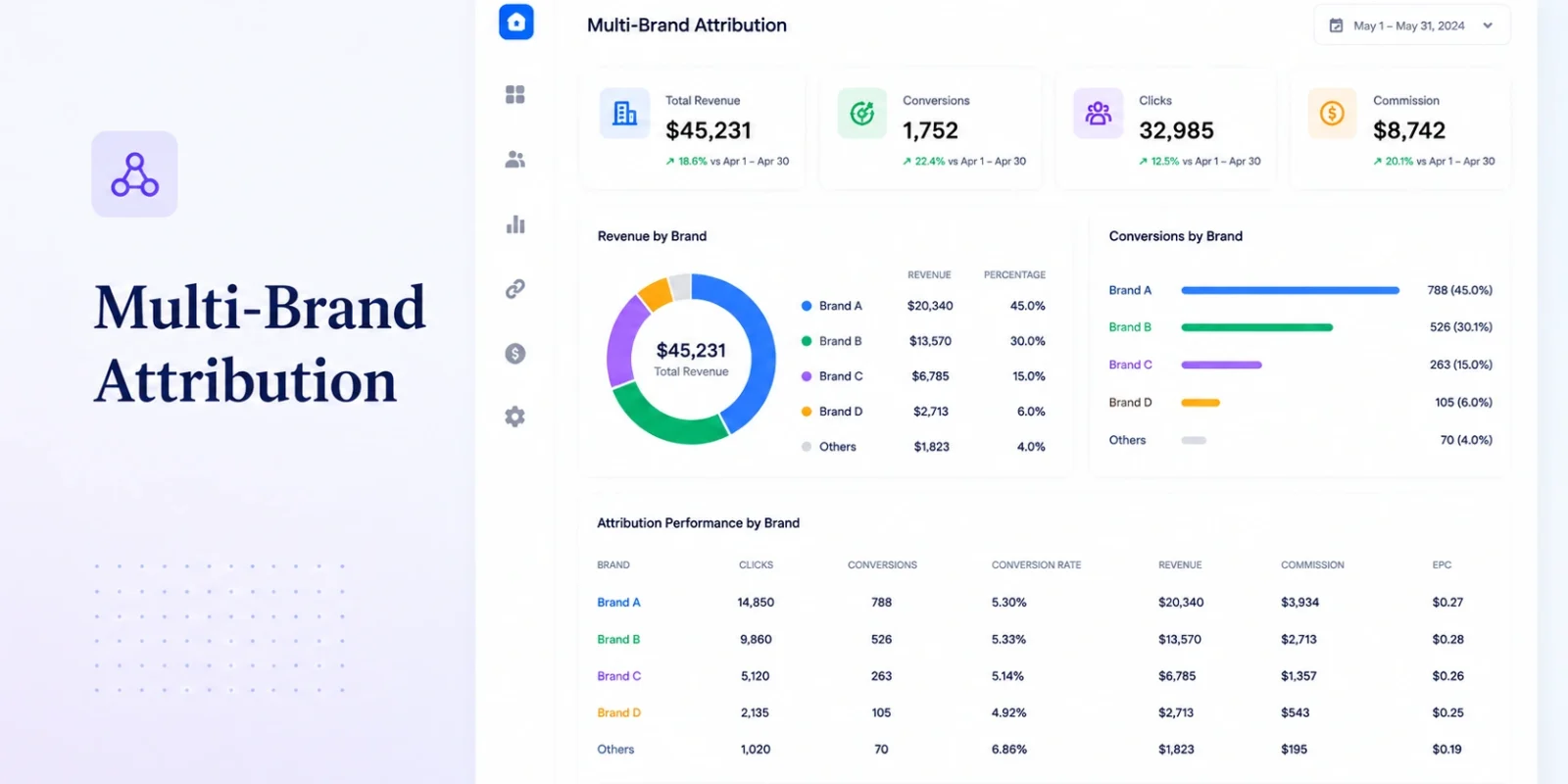
TL;DR — Multi-Brand Attribution and Cross-Property Deduplication
→ Operators running more than one casino or sportsbook brand under a shared affiliate program face a specific attribution problem that single-brand operators never encounter: the same player, the same affiliate, or the same click can register conversions across multiple properties, and without deduplication logic, the operator pays commission on the same underlying value more than once.
→ This is not the same problem as sub-affiliate tier attribution, and it is not the same problem as postback latency. It is a cross-property identity resolution problem — the system has to recognize that “Player 4471 on Brand A” and “Player 4471 on Brand B” are the same person before commission logic runs, not after.
→ We’ve audited multi-brand operator setups where the same affiliate was earning CPA on three separate brand registrations from a single player who simply signed up for each brand’s welcome offer in sequence. The commission logic had no way to know it was paying three times for one acquisition.
→ For operators running or planning a multi-brand portfolio, the diagnostic question is not “can your platform handle multiple brands.” Nearly every platform can add a second brand instance. The question is “how does your platform deduplicate a player, an affiliate, and a conversion across brands before commission is calculated” — and most vendors have never had to answer it.
Multi-Brand Attribution and Cross-Property Deduplication for iGaming Operators
Multi-brand operators are the fastest-growing segment of iGaming right now, and they’re also the segment most likely to discover their affiliate platform was never built for them.
A platform can be excellent for a single casino brand and quietly broken the moment a second brand, a third skin, or a sportsbook-and-casino combination gets added to the same affiliate program. Not broken in an obvious way — broken in the specific way that shows up as unexplained commission overpayment three months into the multi-brand launch, when someone in finance finally asks why the affiliate payout percentage looks wrong against total portfolio revenue.
We’ve walked into that exact conversation more than once. An operator adds a second brand, points the same affiliate program at both, and assumes the platform “just handles it” because the dashboard shows two brand tabs. What actually happens underneath the dashboard is the harder question, and it’s the one this post is about.
Why Is Multi-Brand Attribution a Different Problem Than Single-Brand Attribution?
Single-brand attribution has one identity space to manage: one player database, one affiliate ledger, one conversion event stream. Multi-brand attribution has to manage identity across properties that were often built, at the infrastructure level, as if they were separate businesses — separate player databases, separate registration flows, sometimes separate domains and separate compliance jurisdictions.
The moment an operator runs a shared affiliate program across those properties, the attribution system has to answer a question single-brand platforms never had to solve: is this the same underlying player, the same underlying acquisition event, or the same underlying affiliate relationship, even though the technical footprint looks like three unrelated conversions?
Get that question wrong and one of two failure modes happens. Either the operator overpays, crediting the same acquisition value multiple times across brands, or the operator underpays, failing to credit an affiliate whose player moved across brands in a way the tracking never reconciled — which damages the affiliate relationship just as badly as overpayment damages the P&L.
Sub-affiliate attribution solves a hierarchy problem: who gets credited when a conversion flows through a network of managers and sub-affiliates. Postback timing solves a latency problem: how fast does a conversion event register once it fires. Cross-property deduplication solves neither of those. It solves an identity resolution problem — determining whether two events that look distinct actually represent the same underlying commercial reality.
The Three Deduplication Failure Points Operators Actually Hit
We see the same three failure points recur across nearly every multi-brand migration we’ve handled, regardless of how the operator’s brands are structured.
Player-level duplication
The same individual registers across two or more brands, often deliberately — chasing separate welcome bonuses on each property — and sometimes incidentally, because the operator’s own marketing cross-promotes between brands without the player realizing they’re the same company. If the affiliate program credits each brand registration independently, and the affiliate who drove the original acquisition happens to be associated with more than one brand’s tracking link, the same player generates commission payouts that look like separate acquisitions but represent a single underlying customer relationship.
Affiliate-level duplication across brand-specific sub-accounts
Many multi-brand operators issue separate affiliate IDs per brand, on the theory that it simplifies brand-specific reporting. What it actually does, without deduplication logic, is create a scenario where a single affiliate driving traffic to multiple brands under different IDs looks like several unrelated affiliates to the commission engine — which means volume-based tier thresholds, override calculations, and cap enforcement all run on fragmented, incomplete data. An affiliate who should have hit a volume tier across their combined brand performance never registers as having hit it, because no single brand instance saw the full picture.
Conversion-event duplication from shared infrastructure
When brands share backend infrastructure — a common payment processor, a shared KYC provider, a shared game aggregator — conversion events can fire more than once for what is functionally a single underlying transaction, particularly around deposit events that touch multiple systems in sequence. Without event-level deduplication keyed to a canonical transaction ID, the affiliate platform can register the same deposit as two separate conversions if it arrives via two different postback paths from two different pieces of shared infrastructure.
A dashboard that shows two brands is not the same thing as a commission engine that understands two brands are one portfolio.
How Should Cross-Property Player Identity Actually Be Resolved?
Effective deduplication starts before commission logic runs, at the identity resolution layer. The system needs a canonical player identity that sits above brand-specific account IDs — a portfolio-level identity graph that recognizes when a KYC-verified individual holds accounts on more than one brand, regardless of whether those accounts use different emails, different usernames, or different payment methods on registration.
This is not a trivial matching problem, and it is exactly the kind of matching problem multi-brand operators discover their platform was never architected to solve, because it was built brand-by-brand rather than portfolio-first. Resolution has to work across several signal types simultaneously: identity document matching from KYC verification (the strongest signal, when available), payment instrument overlap across brand registrations, device and network fingerprint overlap, and — in jurisdictions where it’s permitted and compliant — direct database matching on verified personal details.
Once a canonical player identity exists, commission logic has somewhere to check before crediting a new conversion: has this individual, under this canonical identity, already generated a credited acquisition on another brand within the portfolio, and if so, under what affiliate attribution. That check has to happen at conversion time, not at monthly reconciliation. Reconciliation-stage deduplication means the operator has already paid the duplicate commission and is now trying to claw it back — a worse position, both financially and relationally, than catching it before payout.
Affiliate Portfolio Attribution: Solving the Fragmented-ID Problem
The affiliate-level duplication problem has a cleaner architectural answer than player-level identity resolution, but it requires a decision most multi-brand operators never explicitly make: does the affiliate program treat each brand as an independent commercial relationship with its own affiliate IDs, or does it treat the affiliate as a single portfolio-level partner whose performance is measured in aggregate across every brand they’re active on?
Both models are legitimate. Neither is automatically correct, and the choice has direct consequences for cap enforcement, tier calculation, and override structures. What’s not legitimate is defaulting into brand-siloed affiliate IDs without deciding — which is what happens on platforms where adding a brand is treated as a configuration checkbox rather than an architectural decision.
A portfolio-attribution model requires the platform to maintain a master affiliate record that aggregates performance across every brand-specific sub-account the affiliate operates under, with brand-level reporting available as a view into that master record rather than the master record being reconstructed after the fact from disconnected brand silos. This is the difference between an affiliate hitting a volume tier because the system actually summed their cross-brand performance, versus an affiliate perpetually one brand-instance short of a tier they’ve functionally already earned.
| Attribution Model | How Affiliate Performance Is Measured | Where It Breaks Down |
|---|---|---|
| Brand-siloed (default on most platforms) | Independently per brand, with separate affiliate IDs and separate caps per property | Tier thresholds and caps never reflect true cross-brand volume; affiliates perceive the program as unfairly fragmented |
| Portfolio-aggregated | Summed across all brands under one master affiliate identity, with brand-level views for reporting only | Requires the platform to maintain a master-record architecture from the start; retrofitting onto brand-siloed infrastructure is a significant migration |
| Hybrid (brand-specific base, portfolio-level overrides) | Base CPA/RevShare calculated per brand; volume tiers and override eligibility calculated at portfolio level | Requires the clearest documentation of any model, since two different aggregation rules are running simultaneously — undocumented, this becomes indistinguishable from a bug |
We default new multi-brand deployments toward the hybrid model, because it matches how most operators actually want to negotiate with affiliates — brand-specific commercial terms with portfolio-level recognition of scale. But the model chosen matters less than the requirement that it be explicit, documented, and consistently enforced. An operator who can’t state which model governs their program can’t audit whether it’s working.
Event-Level Deduplication: The Infrastructure Question Nobody Asks Until It’s Too Late
Shared-infrastructure duplicate conversions are the failure mode operators are least prepared for, because it has nothing to do with affiliate behavior or player behavior — it’s a pure data-plumbing problem between the operator’s own systems and the affiliate platform. When a deposit event routes through a shared payment processor that fires a webhook to the operator’s core platform and, separately, a postback fires from a shared game aggregator or bonus engine, the affiliate platform can receive what looks like two independent conversion signals for a single deposit.
Resolving this requires a canonical transaction ID that persists across every system touching a given deposit event, with the affiliate platform deduplicating on that ID before crediting a conversion — not deduplicating on looser criteria like “same player, same amount, same approximate timestamp,” which produces false negatives (rejecting genuinely separate deposits that happen to match on amount) as often as it catches true duplicates.
Operators evaluating a platform for a multi-brand launch rarely ask about this specifically, because it doesn’t show up in a sales demo — a demo environment doesn’t have the shared-infrastructure conditions that produce duplicate postback paths in the first place. It shows up three or six months into a live multi-brand deployment, usually discovered by finance rather than by the affiliate management team, because the symptom is a P&L line that doesn’t reconcile rather than an obvious tracking error.
What Should Operators Ask When Evaluating Multi-Brand Attribution Capability?
- Does the platform maintain a canonical, portfolio-level player identity, or does each brand maintain an entirely independent player database with no cross-brand resolution?
- What signals does cross-brand identity matching use — KYC document matching, payment instrument overlap, device fingerprinting — and how is match confidence handled when signals conflict?
- Is affiliate performance measured per brand, at the portfolio level, or under a documented hybrid model — and can the operator actually see which model governs their program today?
- Is deduplication enforced at conversion time, or discovered at reconciliation? The financial and relational cost of the two approaches is not comparable.
- What canonical identifier persists across shared infrastructure (payment processors, game aggregators, KYC providers) to prevent duplicate conversion events from separate postback paths?
A vendor that answers these five questions with architectural specificity has built for multi-brand operators as a first-class use case. A vendor that answers with “yes, we support multiple brands” and stops there has built brand-instance duplication, not brand-portfolio attribution — and the difference is exactly the gap that shows up in an unreconciled P&L a few months after launch.
The Structural Gap This Points To
Cross-property deduplication is, underneath the technical mechanics, a symptom of a broader visibility problem in how operators and affiliates relate to each other across a growing, increasingly multi-brand industry. Affiliates managing partnerships across several operators — and increasingly across several brands within a single operator’s portfolio — have limited standardized ways to demonstrate a consolidated track record. Operators building multi-brand programs have limited infrastructure for verifying, at onboarding, whether a new affiliate’s traffic quality is what their single-brand history suggests it will be once spread across a broader portfolio. The deduplication problem this post addresses is solvable with better identity resolution architecture. The deeper problem — a lack of shared, verifiable infrastructure for operator-affiliate trust across an increasingly multi-brand, multi-property industry — is one the current generation of affiliate platforms hasn’t meaningfully addressed yet.
Multi-brand portfolios are not slowing down. Operators consolidating multiple skins under shared ownership, or launching sportsbook-and-casino combinations under one affiliate program, are becoming the default rather than the exception. The platforms that treated multi-brand as a checkbox feature will keep generating the same reconciliation surprises they’re generating now. The ones built around portfolio-level identity from the start won’t.
FAQ
What is cross-property deduplication in iGaming affiliate attribution?
Cross-property deduplication is the process of recognizing when the same player, affiliate, or conversion event appears across multiple brands within a multi-brand operator’s portfolio, so that commission is calculated once against the true underlying acquisition rather than multiple times against what looks like separate brand-level conversions.
Why does multi-brand attribution cause commission overpayment?
Overpayment happens when the same player registers across multiple brands and each brand’s affiliate tracking credits the acquisition independently, without a canonical player identity that spans the portfolio. The commission engine has no way to recognize the two registrations represent one underlying customer, so it pays for the same acquisition value more than once.
Should affiliate performance be measured per brand or across a full multi-brand portfolio?
There are three viable models: brand-siloed, portfolio-aggregated, and hybrid, where base commission is calculated per brand but volume tiers and override eligibility are calculated at the portfolio level. The hybrid model tends to match how most operators structure commercial terms with affiliates, but any model requires explicit documentation so it can be audited rather than defaulting silently into brand-siloed fragmentation.
Why do duplicate conversions happen even without any player or affiliate fraud involved?
When multiple brands share backend infrastructure — a payment processor, game aggregator, or KYC provider — a single deposit event can generate more than one postback signal through different infrastructure paths. Without deduplication keyed to a canonical transaction ID that persists across every system touching the deposit, the affiliate platform can register the same transaction as two separate conversions.
Running or planning a multi-brand affiliate program?
We audit cross-property identity resolution and deduplication logic as part of every multi-brand migration assessment — before the reconciliation gap becomes a finance-team escalation.
Book a multi-brand attribution audit →
As of Q3 2026. Attribution architecture patterns referenced reflect deployments observed across multi-brand iGaming operators generally; specific platform capabilities should be confirmed directly during evaluation.