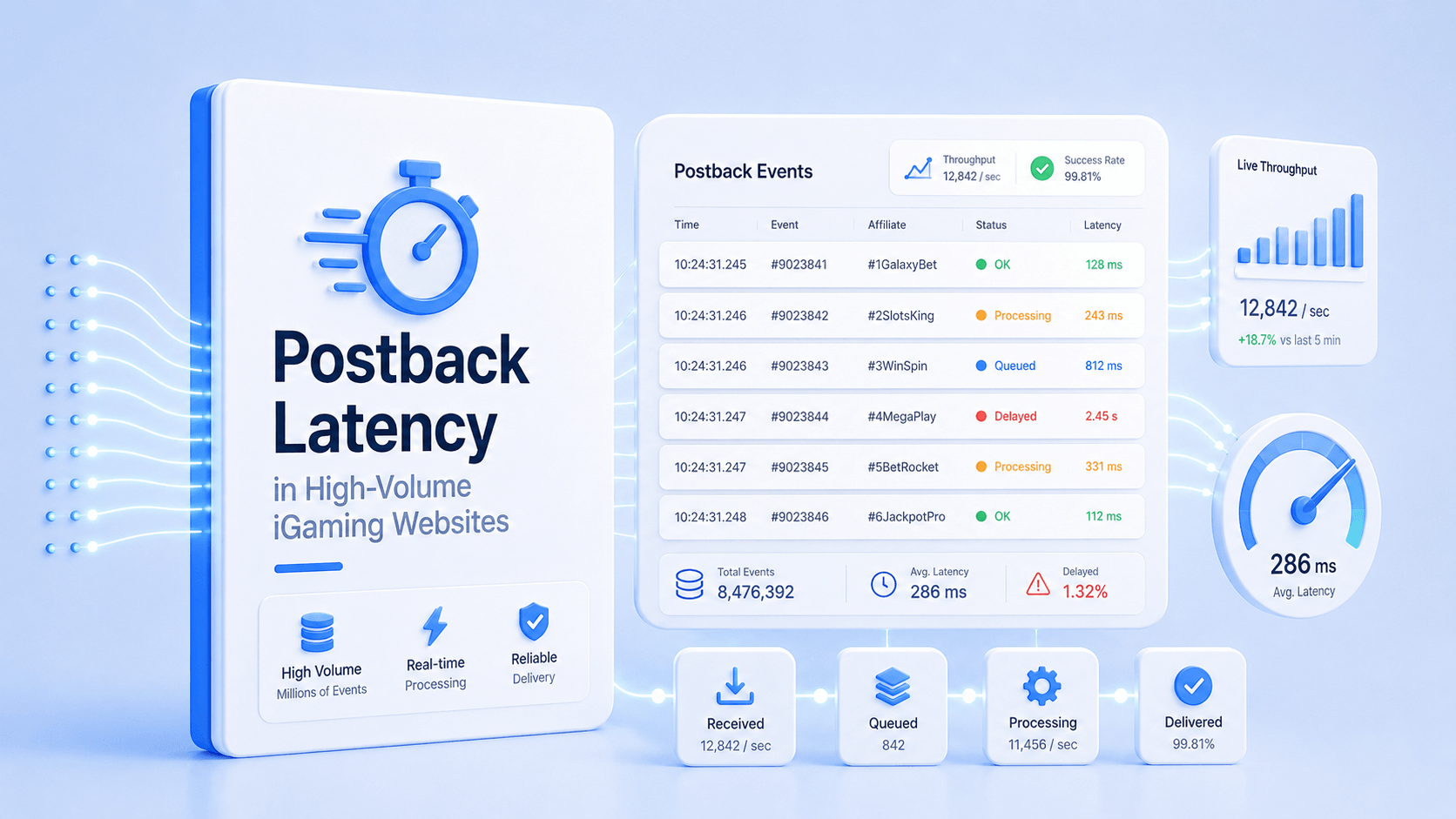
A postback is a single HTTP request. It carries a click ID, a player identifier, a revenue value, and a timestamp. It fires, it lands, it records. The entire transaction should take under 400 milliseconds. When it takes 3–5 seconds — or silently fails entirely — the consequences are not technical abstractions. They are affiliate disputes, missed CPA credits, commission reconciliation calls, and, at scale, measurable revenue leakage that compounds across every billing cycle it goes unaddressed.
This post is for the operator whose postback logs show latency spikes they cannot explain, whose affiliates are reporting missing FTD credits during peak traffic windows, or whose compliance team is getting dispute requests that trace back to postback timing rather than fraud. The technical breakdown below maps the problem from the infrastructure layer to the commercial impact, with specific benchmarks and a diagnostic framework for finding where your bottleneck actually lives.
What Postback Latency Actually Means?
Why 300ms vs 3 Seconds Is Not a Minor Difference?
In low-volume environments, postback latency is invisible. A tracker receiving 50 conversions per hour can absorb a 3-second postback delivery time without any observable downstream effect. The conversion is logged, the commission is recorded, the affiliate sees the FTD in their dashboard within seconds. Nobody notices the latency because nobody is waiting for it.
At 10,000 conversions per hour, a system receives about 2.8 events per second. If processing takes 3 seconds per event, roughly eight or nine requests can be in flight at once when work runs in parallel; latency alone does not imply a queue. A pipeline that can process 1,000 events per second would have ample capacity at that arrival rate. Monitor arrival rate, processing capacity, queue age, and failed acknowledgments during peak traffic rather than inferring backlog from latency alone.
Scaleo’s internal operator data shows a measurable dispute impact: every 1-second increase in postback confirmation latency above the 500ms baseline increases affiliate dispute rates in CPA programs by 8–12%. At a program running 500 CPAs per month, a sustained 3-second latency event during a peak traffic window generates 40–60 additional disputes per month — each requiring affiliate manager time to resolve, each carrying a risk of commission double-payment if the dispute resolution is handled manually rather than through the postback audit log.
Scaleo infrastructure benchmarks, 2025:
Median postback confirmation time across Scaleo’s production infrastructure: 287ms. 95th percentile latency: 890ms. Peak throughput tested: 18,400 postback events/hour with no queue saturation above the 95th percentile threshold. These figures represent server-to-server postback delivery from the point of casino backend firing to the point of Scaleo acknowledgment — not the round-trip time including affiliate notification.S2S vs Pixel Tracking: The Latency Gap Is Not Comparable
Before the infrastructure deep-dive, the comparison that should be settled definitively for any operator still running pixel-based tracking on any portion of their affiliate program.
| Metric | Pixel / Client-Side Tracking | S2S Postback Tracking |
|---|---|---|
| Typical delivery latency | 800ms – 4,200ms (browser render + network round trip) | 150ms – 950ms (server-to-server direct) |
| Failure rate at peak load | 15–25% (browser tab closes, ad blockers, ITP stripping) | Under 2% (with retry logic; under 0.3% with exponential backoff queue) |
| iOS 17+ attribution | 30–45% cookie loss due to ITP | Unaffected — server-side, no browser dependency |
| Attribution under mobile app handoff | Cookie chain breaks at app/browser context switch | Player ID persists across context; attribution maintained |
| Queue saturation behavior at 10,000+ events/hr | Pixel fires abandoned by browser on tab close; no retry mechanism | Queue depth managed server-side; retry logic prevents permanent loss |
| Audit trail | No server-side log; only client-side impression record | Full HTTP request/response log with timestamp, status code, retry history |
| Dispute resolution capability | None — no server-side evidence of delivery | Complete — postback delivery log is admissible evidence in affiliate dispute |
Pixel tracking’s latency disadvantage at peak load is not the most important number in this table. The failure rate is. A 15–25% pixel failure rate at peak load means that during the highest-conversion windows in your affiliate program — the windows that drive the most commission spend — a quarter of your conversions are not being tracked. Those players exist in your back-office. They do not exist in your affiliate platform. The affiliate did not get a CPA postback for them. The dispute conversation happens on the 15th of the following month.
Infrastructure Requirements for Sub-Second Latency at Scale
Sub-second postback latency at 10,000+ events per hour is not achievable with a single-threaded postback processor running on a shared-hosting infrastructure. It requires a specific architectural stack. Here is what that stack looks like and where the bottlenecks most commonly appear.
Asynchronous Queue Processing
The foundational requirement is that postback receipt and postback processing are decoupled. When the casino backend fires a postback to the affiliate platform’s endpoint, that endpoint must acknowledge receipt (HTTP 200) immediately — within 50ms — and place the postback in a processing queue rather than processing it synchronously before responding. Synchronous processing means the response time equals the processing time. At 500ms processing time and 10,000 events per hour, the endpoint is blocking for 500ms on every request. Queue-based processing means the response time equals acknowledgment time (sub-50ms), and processing happens asynchronously at whatever rate the processing layer can sustain.
The practical consequence: a casino backend that fires a postback and does not receive an HTTP 200 within its own timeout threshold (typically 2–5 seconds) assumes the postback failed and either retries or abandons it. If the affiliate platform is processing synchronously and the queue has backed up, the casino backend’s timeout fires before the platform finishes processing — the platform is still working on the request, but the casino backend has already marked it as failed and potentially fired a retry.
The retry generates a duplicate postback. Without deduplication at the platform level, the duplicate generates a duplicate commission. The original postback, when it finally finishes processing, generates a third record. The operator has paid three commissions for one player.
Geographic Distribution and Edge Processing
Network latency between the casino backend server and the affiliate platform’s postback endpoint is a physical constraint — it is bounded by the speed of light through fiber and the number of network hops between the two endpoints.
A casino backend hosted in Frankfurt firing postbacks to an affiliate platform endpoint hosted in Singapore adds 160–200ms of round-trip network latency that no amount of software optimization can eliminate. For operators whose casino backend and affiliate platform are geographically mismatched, the latency floor is set by physics before any application-level processing begins.
The solution is edge-distributed postback endpoints — receiving nodes geographically co-located with, or near, the casino backend. The postback fires to the nearest edge endpoint (sub-20ms network latency), the edge node acknowledges immediately and forwards to the central processing queue, and the casino backend’s timeout never comes close to being reached. Scaleo operates postback receiving endpoints across multiple geographic regions specifically to eliminate the geographic latency floor for operators whose backends are not hosted in a single central European location.
Exponential Backoff Retry Logic
Even with asynchronous queue processing and geographic distribution, postback delivery failures occur. Network interruptions, destination endpoint downtime, casino backend misconfiguration — all generate postback failures that need to be retried without generating the duplicate commission problem described above.
Exponential backoff retry logic handles this: a failed postback is retried after a defined initial interval (typically 30 seconds), then after 2x that interval if the retry fails, then 4x, then 8x — up to a maximum retry count and maximum retry window. The exponential spacing prevents retry storms (all failed postbacks retrying simultaneously and creating a new load spike) while ensuring that transient failures are eventually resolved.
The retry logic must be combined with player-ID-level deduplication to prevent the scenario where a postback is retried after the original delivery was actually successful but the acknowledgment was lost. Without deduplication, a postback that delivered successfully but whose HTTP 200 response was dropped by a network issue gets retried, and the retry generates a second commission for the same player.
Deduplication ensures that any postback carrying a player ID for which a commission has already been recorded in the current billing cycle is logged as a duplicate and not processed as a new commission event regardless of retry origin.
The Revenue Impact: Quantifying What Latency Costs
Latency cost falls into three categories that most operators track separately but that share a common root cause:
Missed CPA attributions. When a postback fails entirely — not delayed, failed — the player’s FTD is not attributed to any affiliate. If the player arrived through a paid affiliate channel, the operator has acquired a player at a cost (the affiliate generated the traffic) without recording that cost as a commission obligation.
The player exists in the back-office. The affiliate has no record of a conversion.
Two billing cycles later, the affiliate audits their own click logs, finds a player whose registration timestamp matches a click they generated, and disputes the missing CPA. The dispute resolution requires matching the affiliate’s click record against the operator’s registration record — possible, but time-consuming, and the outcome depends entirely on whether the operator’s platform stored the click event with enough detail to confirm the match.
Duplicate commission payouts from retry storms. The scenario described in the queue saturation section above — where synchronous processing causes timeouts that generate retries that generate duplicates — is not hypothetical. In programs without asynchronous queue processing and player-ID deduplication, a major traffic event (a European football final, a World Series game, a major poker tournament final table) generates a measurable duplicate commission rate that appears in the post-event payment run. Operators who have experienced this recognize it immediately: the commission run for the week of the big event is 15–20% higher than the FTD count would predict. The excess is duplicate postback commissions.
Affiliate relationship erosion from dashboard latency. The affiliate-side consequence of postback latency is dashboard staleness. An affiliate whose postback confirmation takes 3–5 seconds sees their conversion events appear in their portal dashboard with a corresponding delay. During a live sports event — when the affiliate is actively monitoring their performance to decide whether to push harder on a specific promotion — a 5-second dashboard lag means they are making optimization decisions against data that is 5 seconds, 30 seconds, or several minutes old depending on queue depth. At the level of a major affiliate managing multiple programs simultaneously, a platform whose data is reliably fresh gets more attention and more traffic than one whose dashboard runs cold during peak events.
The quantified relationship: Based on Scaleo’s operator data, every 1-second increase in postback confirmation latency above the 500ms baseline correlates with an 8–12% increase in affiliate CPA dispute rates in the following billing cycle. At a median CPA of €85 and a dispute resolution cost (affiliate manager time + risk of double-payment) of approximately €35 per dispute, a program experiencing 3-second postback latency during peak events is generating €1,400–€2,100 in additional monthly dispute overhead per 500 attributed CPAs. This figure excludes the cost of any duplicate commissions paid before the dispute is identified.
How Scaleo’s Postback Queue Architecture Works
—scenariosWe, the team behind Scaleo, designed the postback infrastructure specifically around the peak-traffic scenarios that iGaming operators face — scenarios that general-purpose performance marketing trackers are not architected to handle because their original use cases did not include simultaneous postback storms from 50,000 concurrent live sports bettors.
The Four-Layer Processing Stack
Layer 1 — Edge receipt (target: sub-20ms). Incoming postbacks arrive at geographically distributed edge endpoints. The edge node’s sole function is receipt acknowledgment — it returns an HTTP 200 immediately and forwards the raw postback payload to the central queue. No processing, no database writes, no commission calculation happens at this layer. The casino backend gets its acknowledgment and considers the postback delivered. Everything that follows happens asynchronously.
Layer 2 — Deduplication gate (target: sub-50ms). The forwarded payload enters the deduplication gate — a high-speed in-memory check against a rolling window of recently processed player IDs. If the player ID has already generated a commission event in the current billing cycle, the payload is flagged as a duplicate and routed to the duplicate log rather than the processing queue. This verification happens in memory, not in the database, which is why it operates at sub-50ms even under load. The database write for confirmed duplicates happens asynchronously — the gate itself does not wait for it.
Layer 3 — Commission processing queue (target: sub-300ms under normal load). Postbacks that clear the deduplication gate enter the commission processing queue. This is where the click ID is matched against the affiliate attribution record, the commission formula is applied, and the NGR balance is updated. At Scaleo’s median throughput, this processing completes in 210–290ms. At 95th percentile load — the traffic levels seen during major sports fixtures — it completes in 820–890ms. Above the 95th percentile, queue depth increases and processing time extends, but the asynchronous architecture means the casino backend has already received its acknowledgment and the latency extension is invisible to the triggering system.
Layer 4 — Affiliate notification (target: sub-500ms from queue entry). Once processing completes, the affiliate’s dashboard data is updated and, for platforms with real-time notification enabled, a push event fires to the affiliate’s portal session. This is the layer that determines whether the affiliate sees a fresh conversion in their dashboard in under a second or after a multi-second delay. Scaleo’s affiliate portal uses WebSocket connections for real-time conversion events — the notification pushes to the affiliate’s open session rather than waiting for the next dashboard refresh cycle.
Troubleshooting Postback Latency: A Step-by-Step Diagnostic
Latency problems have three possible root locations: operator-side (your casino backend is firing postbacks slowly or not at all), platform-side (the affiliate platform’s processing pipeline is the bottleneck), or network-side (the path between your backend and the platform’s endpoint has a routing problem). The diagnostic below isolates which one you are dealing with, in the order that wastes the least time.
Diagnostic Step 1: Establish Your Baseline Latency
Before investigating a latency problem, you need a baseline to compare against. If you have never measured your postback delivery times, you do not know whether what you are experiencing is a degradation from a previous state or your normal operating condition.
Pull 30 days of postback delivery logs from your affiliate platform. For each postback event, extract the timestamp at which the casino backend fired the postback (this should be logged in your back-office event log) and the timestamp at which the affiliate platform acknowledged receipt (this is in the platform’s postback delivery log). The difference is your end-to-end postback latency.
Calculate the median, the 95th percentile, and the maximum for the period. If your platform does not expose delivery timestamps with millisecond precision, that is itself a diagnostic finding — you cannot troubleshoot what you cannot measure.
Diagnostic Step 2: Isolate the Operator-Side Firing Lag
Postback latency is not always the platform’s problem. The casino backend’s postback firing logic introduces its own latency before the postback ever reaches the affiliate platform. Common casino backend bottlenecks: postback firing logic that waits for a database transaction to fully commit before firing (adds 200–800ms depending on database load), postback firing that happens synchronously within the player registration event handler rather than in a background job (blocks the registration response while the postback fires), and postback batching configurations that accumulate events over a defined interval before firing (introduces a fixed delay equal to the batch interval — typically 30–60 seconds for poorly configured backends).fires);
To isolate operator-side lag: configure a test postback endpoint at a service that logs incoming requests with precise timestamps (a simple HTTP logging service works). Fire a test player event from your casino backend and compare the timestamp in your back-office event log (when the event was generated) against the timestamp in the logging service (when the postback arrived). The difference is operator-side firing lag, independent of any platform processing time. If this gap exceeds 500ms, the fix is in your casino backend’s postback firing configuration, not in the affiliate platform.
Diagnostic Step 3: Check Platform Processing Time
Once you have isolated operator-side firing lag, the remaining latency between postback arrival at the platform endpoint and commission record creation is platform processing time. In Scaleo, the full postback delivery log shows: the timestamp the postback arrived at the receiving endpoint, the timestamp it cleared the deduplication gate, the timestamp commission processing completed, and the timestamp the affiliate dashboard was updated. Each interval is independently measurable.
If platform processing time under normal load exceeds 500ms, the specific layer where the delay occurs indicates the fix: deduplication gate delays suggest an in-memory cache miss rate that needs cache warming configuration; commission processing delays suggest an inefficient commission plan query (complex tiered RevShare plans with many condition checks are computationally heavier than simple flat-rate plans); affiliate notification delays suggest a WebSocket connection pool exhaustion under load.
Diagnostic Step 4: Identify Network Routing Issues
Network routing problems produce a specific latency signature: they are geographically consistent and traffic-independent. A routing issue between your casino backend’s datacenter and the affiliate platform’s endpoint adds a fixed latency floor that does not change with traffic volume. If your postback latency is consistently high (above 1 second) but does not correlate with traffic spikes, and your operator-side firing lag is under 100ms, the bottleneck is network routing.
Diagnosis: run a traceroute from your casino backend’s server to the affiliate platform’s postback endpoint IP. Count the hops and identify any anomalous latency at a specific hop. A hop with 200ms+ latency in the middle of the route indicates either geographic misrouting (your traffic is taking a suboptimal path through a distant exchange point) or a congested peering point between your transit provider and the platform’s hosting provider. Reporting the traceroute output to both your hosting provider and the platform support team is the fastest path to resolution — both parties need the data to investigate from their respective sides.
Diagnostic Step 5: Investigate Peak-Specific Saturation
If latency is acceptable under normal load but degrades during peak events, queue saturation is the cause. The diagnostic: compare your postback event rate (events per hour from your casino back-office log) against your postback processing rate (events per hour from your affiliate platform’s delivery log) for the period containing the latency spike. If the event rate exceeds the processing rate, queue depth is growing — and the gap between those two numbers at peak is the throughput shortfall that needs to be addressed.
The resolution depends on whether the saturation is at the platform layer or the operator layer. Platform-layer saturation — where Scaleo’s processing queue is the bottleneck — should be reported to Scaleo’s technical team with the specific peak event rate and time window. Operator-layer saturation — where your casino backend is generating postback events faster than your network connection can transmit them — requires evaluating your backend’s outbound connection configuration and potentially moving to a connection pool that handles concurrent postback transmission rather than serializing requests.
Legacy System Comparison: Where the Latency Gap Comes From
The latency difference between modern purpose-built affiliate platforms and legacy PHP-based trackers is not primarily a hardware difference. The servers running legacy systems are often provisioned with adequate hardware. The difference is architectural — specifically, whether the postback processing pipeline was designed for asynchronous queue-based processing or for the synchronous, request-response model that was standard in web application development before message queue infrastructure became commodity technology.
A legacy PHP tracker handling a postback request typically: receives the request, opens a database connection, writes the postback data to a transactions table, queries the affiliate attribution table to match the click ID, calculates the commission, writes the commission record, closes the database connection, and returns an HTTP 200. Each of those steps happens synchronously in sequence. On a well-tuned server under low load, this sequence completes in 400–600ms. Under high load — when the database connection pool is saturated and new requests are waiting for a connection to become available — the sequence takes 2–8 seconds. The casino backend times out. The postback is retried. The race condition described earlier begins.
The architectural fix — decoupling receipt acknowledgment from processing through an asynchronous queue — has been standard practice in high-volume web infrastructure since approximately 2015. Legacy affiliate trackers that have not been re-architected around this pattern are running synchronous postback pipelines on faster hardware, which mitigates the problem under normal load and fails identically under peak load. The hardware is not the constraint. The processing model is.
⚠️ The test you should run before your next major event: Fire 100 test postbacks at your affiliate platform’s receiving endpoint simultaneously from a load testing tool. Measure the time between the first request firing and the last HTTP 200 acknowledgment being received. In a properly asynchronous architecture, all 100 acknowledgments should arrive within 200ms of the first request — because the edge receipt layer processes each request independently at sub-20ms. In a synchronous architecture, the acknowledgments arrive sequentially — the 100th request does not receive its acknowledgment until the first 99 have been fully processed. If your test shows sequential acknowledgment patterns, your platform is processing synchronously and will queue-saturate at volume. Run this test before a major sports fixture, not during one.
Frequently Asked Questions
What is postback latency and why does it matter in iGaming affiliate programs?
Postback latency is the time elapsed between a qualifying player event firing a server-to-server postback from the casino backend and the affiliate platform acknowledging and processing that event. In low-volume environments, latency above 500ms is operationally invisible. In high-volume environments — major sports events, jackpot promotions, coordinated affiliate campaigns — latency above 500ms causes queue saturation that delays conversion recording, generates affiliate disputes about missing FTD credits, and produces duplicate commission payouts when casino backends retry postbacks they believe have failed. The revenue impact scales with traffic volume: a program running 10,000+ events per hour is significantly more exposed to latency-driven losses than one running 500 events per hour.
What is the acceptable postback latency threshold for CPA programs?
Sub-500ms end-to-end (from casino backend firing to affiliate platform commission record creation) is the operational target for programs running high-volume CPA traffic. The specific breakdown: under 20ms for edge receipt acknowledgment (this is what the casino backend measures as delivery confirmation), under 300ms for commission processing under normal load, and under 900ms at the 95th percentile under peak load. These are the benchmarks Scaleo’s infrastructure is designed and monitored against. Programs that cannot measure their latency at these granular levels are operating without visibility into a risk that can manifest during their highest-value traffic windows.
How does exponential backoff retry logic work in postback delivery?
Exponential backoff is a retry scheduling algorithm that spaces retry attempts at increasing intervals to prevent retry storms — situations where all failed postbacks retry simultaneously and generate a new load spike that causes further failures. A failed postback is retried after an initial interval (typically 30 seconds), then after 60 seconds if that retry fails, then 120, 240, 480 — doubling the interval on each failure up to a defined maximum (typically 4–6 retry attempts over several hours). The exponential spacing ensures that transient network interruptions are recovered without the retry queue becoming a load amplifier. Combined with player-ID deduplication, exponential backoff retry logic allows a platform to recover from partial delivery failures without generating duplicate commission events for postbacks that were actually delivered successfully but whose acknowledgments were lost.
How do I know if my postback latency problem is on my side or the platform’s side?
Run the five-step diagnostic in this post in order. The quickest isolation method: configure a simple HTTP logging endpoint and fire a test postback from your casino backend. Compare the timestamp in your casino back-office event log (when the event was generated server-side) against the timestamp in the logging service (when the request arrived). If the gap exceeds 500ms, the bottleneck is on your casino backend — the postback firing logic is introducing delay before the request ever reaches the affiliate platform. If the gap is under 100ms, the issue is in the platform processing pipeline or in network routing between your backend and the platform’s endpoint. These two diagnoses lead to completely different remediation paths, and conflating them wastes the time of both your technical team and the platform’s support team.
Does postback latency affect RevShare commission accuracy as well as CPA?
Yes, but differently. CPA latency issues are acute — a missed or delayed postback immediately creates an attribution gap or a dispute. RevShare latency issues are cumulative — delayed NGR update events cause the affiliate’s running balance to be stale relative to actual player activity, which produces inaccurate mid-month commission estimates and, occasionally, incorrect NCO balance calculations at period end if a large negative event fires late and is processed in the wrong billing cycle. For RevShare programs with complex NGR formulas and NCO policies, postback timing precision matters at the period boundary specifically: a jackpot payout event that fires late and is processed one second after midnight on the first of the new month creates a fundamentally different commission outcome than one processed one second before midnight. Billing period boundary handling — ensuring events are processed in the period they occurred rather than the period they were received — is a platform-level configuration requirement that should be explicitly verified for any RevShare program running at meaningful volume.
Latency Is Invisible Until the Moment It Is Very Expensive
Postback infrastructure performs acceptably under average load for years. The failure reveals itself at peak — during the exact events where your affiliate program is generating the most CPA commissions and where the financial impact of missed attributions and duplicate payouts is highest. The operators who discover their platform’s synchronous processing model during a World Cup final are the ones funding the anecdotes in this post. The operators who run the load test beforehand are not.
See how Scaleo’s four-layer postback architecture handles queue saturation, deduplication, and geographic edge processing — or bring your current latency data to a technical conversation with the team to identify where your specific bottleneck sits.