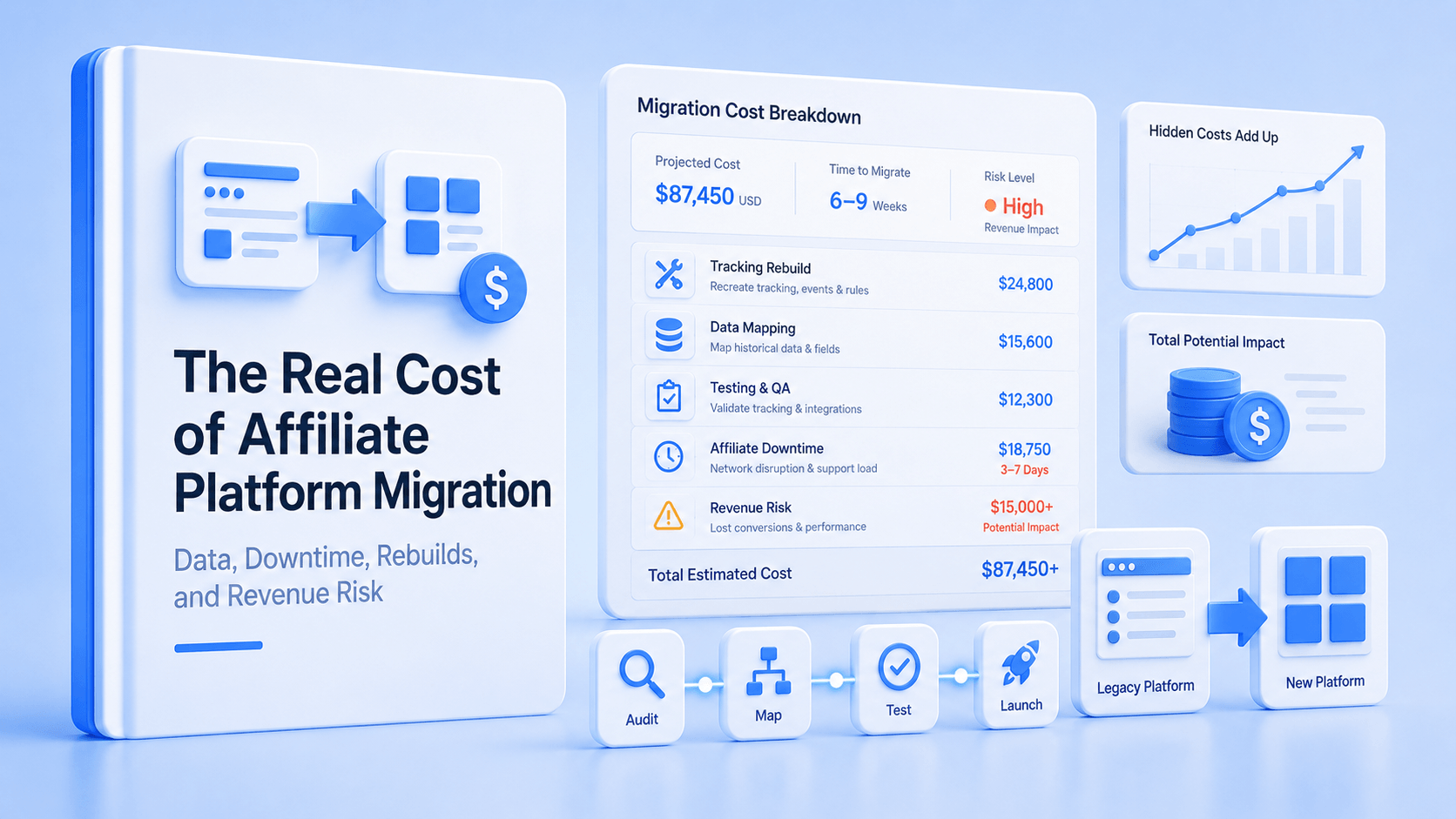
The business case for switching affiliate platforms is almost always built on what the new platform costs. The decision gets made — or killed — by what nobody budgeted for: the migration itself. This post puts actual numbers on every line item, drawn from 50+ operator migrations handled by Scaleo, so you can build a TCO model that reflects what migration actually costs rather than what the platform sales deck implies it costs.
If you are still choosing a destination platform, use our iGaming affiliate software decision matrix to compare tracking, commission, fraud and integration requirements before modelling migration cost.
⚡ DIRECT ANSWER
Total cost of ownership (TCO) for affiliate platform migration in iGaming covers five cost categories that most operators undercount: platform setup and configuration, migration labor (internal and vendor-side), downtime and attribution gap risk during the transition window, staff training overhead, and ongoing support tier differences between the old and new platform. For a mid-sized casino operator with 50–150 active affiliates, the all-in migration TCO typically runs €18,000–€42,000 over the first 12 months — of which the platform license accounts for less than 40%. The remainder is migration labor, affiliate relationship management, and the compounding cost of any commission reconciliation errors that occur during the transition period.
The TCO Framework: Every Cost Category Quantified
The table below is built from anonymized data across 50+ operator migrations completed through Scaleo’s onboarding process between 2023 and 2025. Figures are expressed as ranges because operator complexity — number of active affiliates, commission plan variety, number of casino brands, multi-currency requirements — drives significant variance within each category.
| Cost Category | Startup Casino (<50 affiliates) | Mid-Market (<50–150 affiliates) | Established Multi-Brand (150+ affiliates) | What Drives Variance |
|---|---|---|---|---|
| Platform setup & configuration | €800 – €1,500 | €1,500 – €3,500 | €3,500 – €8,000 | Number of commission plan templates, multi-brand configuration, custom postback schema complexity |
| Migration labor (internal) | €1,200 – €2,400 | €3,600 – €7,200 | €8,400 – €16,800 | Affiliate manager hours × billing cycle count during transition; data mapping and QA time |
| Migration labor (vendor/technical) | €600 – €1,200 | €1,500 – €3,000 | €3,000 – €6,000 | Back-office postback reconfiguration complexity; PAM integration documentation quality |
| Attribution gap risk (quantified) | €500 – €2,000 | €2,000 – €6,000 | €5,000 – €15,000 | Length of continuity window; affiliate link update compliance rate; traffic volume during transition |
| Staff training overhead | €400 – €800 | €800 – €1,600 | €1,600 – €3,200 | Team size; complexity of new platform reporting; commission plan admin changes |
| Affiliate communication & relationship management | €600 – €1,200 | €1,800 – €3,600 | €4,200 – €8,400 | Number of active affiliates requiring direct outreach; VIP affiliate relationship sensitivity |
| Commission reconciliation (transition period) | €400 – €1,200 | €1,200 – €3,600 | €3,600 – €9,600 | Data transfer completeness from prior platform; NCO balance accuracy; historical attribution matching |
| Total first-12-month migration TCO | €4,500 – €10,300 | €12,400 – €28,500 | €29,300 – €67,000 | Excludes new platform license cost; includes all transition overhead |
One line in this table surprises most operators: affiliate communication and relationship management. It is a real, quantifiable cost — staff hours spent on direct affiliate outreach, handling questions about the new portal, managing the small percentage of affiliates who respond to a platform change by evaluating whether to stay in the program at all. At a €60–€80/hour blended affiliate manager cost, the hours involved in a 150-affiliate migration add up to a material budget line. Budget for it before the migration, not after.
Migration Timeline Benchmarks: What the Data Actually Shows
Timeline estimates in platform sales conversations are almost always optimistic. The figures below are derived from actual migration completion data — time from signed contract to first full commission cycle completed entirely on the new platform, with zero residual postback traffic on the old platform.
| Operator Type | Median Migration Duration | Primary Timeline Driver | Most Common Delay Factor |
|---|---|---|---|
| Startup casino, single brand, <30 active affiliates, CPA-only | 3–5 weeks | Postback reconfiguration and test validation | Casino backend documentation incomplete; postback parameter format undocumented |
| Mid-market casino, single brand, 50–100 affiliates, mixed CPA + RevShare | 6–8 weeks | Affiliate link update compliance during continuity window | Top 10 affiliates by volume slow to update tracking links; manual outreach required |
| Established casino, single brand, 100–200 affiliates, RevShare-heavy with NCO | 9–12 weeks | Historical commission data reconciliation and NCO balance migration | Prior platform provides incomplete NCO balance export; manual reconstruction from payment records required |
| High-volume sportsbook, 200+ active affiliates, multi-currency, in-play settlement postbacks | 10–14 weeks | Multi-event postback schema reconfiguration and settlement event mapping | In-play settlement event types not previously mapped; requires casino backend engineering time |
| Multi-brand operator, 2–4 casino/sportsbook brands, 150+ total affiliates | 12–16 weeks | Per-brand tracking domain setup and cross-brand commission plan segregation | Affiliate portfolio overlap between brands creates attribution policy conflicts requiring explicit resolution |
The single variable that most affects timeline is affiliate link update velocity — how quickly your active affiliates replace old platform tracking links with new ones during the continuity window. This is not a technical variable. It is a relationship variable. Affiliates who have a close working relationship with your affiliate manager update their links promptly. Affiliates who are passive or disengaged may take weeks to respond. The timeline impact of slow link updates is direct: every week an active affiliate is still sending traffic through old platform links is a week of potential attribution gap at cutover.
Scaleo migration data, 2025: Across 50+ operator migrations we have handled, the costliest failure mode is not technical. It is affiliate relationship damage when historical commission data does not transfer cleanly from the old platform. The specific scenario: an affiliate’s NGR balance from the prior platform was not exported completely, their opening balance on the new platform is incorrect, and the first commission statement they receive under the new system shows a figure they cannot reconcile against their own records. That one commission statement — wrong by €400 on a €4,200 month — generates a support ticket, a trust conversation, and occasionally a program exit. For the affiliates generating your top 20% of NGR, this conversation is worth preventing at essentially any reasonable data migration cost.
The Data Transfer Risk Matrix: What Moves Cleanly and What Doesn’t
Not all affiliate program data migrates with equal fidelity. The matrix below maps the typical data transfer outcomes from a range of source platforms — based on export quality, standardization, and the degree to which the data model is compatible with a destination platform’s schema.
| Data Type | Transfer Quality | Typical Issue | Mitigation |
|---|---|---|---|
| Affiliate account records (IDs, contact details, commission plan assignments) | Clean | Custom field formats vary by source platform | Field mapping document prepared pre-import; validate against active affiliate list |
| Historical FTD records (player ID, click ID, date, amount) | Mostly clean | Click ID format incompatibility between platforms; player ID hash format differences | ID translation layer built during data mapping phase; validate sample of 50 records before full import |
| Commission payment history (amounts paid, dates, affiliate ID) | Mostly clean | Currency formatting differences; multi-currency programs may have inconsistent base currency records | Normalize to single base currency during import; validate totals against payment processor records |
| NCO balance history (running balance per affiliate per period) | Problematic | Many platforms do not export NCO balance history; only current period balance available | Manual reconstruction from payment records for top 20 affiliates by volume; accept approximate opening balance for remainder with affiliate disclosure |
| Sub-affiliate attribution records | Problematic | Sub-affiliate IDs may not be exportable; SubID data may be aggregated rather than per-event | Re-establish sub-affiliate tracking from cutover date; treat historical sub-affiliate data as reference only |
| Historical click event logs (pre-conversion click data) | Rarely available | Most platforms do not export raw click logs; only attributed conversions are available | Accept that pre-migration attribution history is unavailable; document this in affiliate communication |
| Fraud event records (flagged affiliates, blocked sources) | Highly variable | Fraud records are rarely in exportable format; often exist only as internal notes or manual flags | Document fraud history in Scaleo’s custom affiliate fields during onboarding; rebuild blacklist from records |
| Active tracking links | Not transferable | Tracking links are platform-specific; they cannot be redirected from one platform to another without a domain-level redirect | New links issued from new platform; continuity window gives affiliates time to update |
The two data types that cause the most operational pain post-migration are NCO balance history and fraud records — and notably, both are categories where the source platform’s export quality is the primary limiting factor, not the destination platform’s import capability. Before initiating any migration, request a sample data export from your current platform in the format they provide. Review it against the data types in this matrix. The gaps you find in the sample export are the gaps you will be manually reconciling after migration. Budget for them before you start.
When Migration Makes Sense — and When It Doesn’t
This section is the one that platform vendors typically do not write because it acknowledges that migration is sometimes the wrong decision. We are writing it because operators who migrate for the wrong reasons at the wrong time are more expensive to support and less satisfied with the outcome — and because building an accurate decision framework is more useful than closing deals that should not be closed.
Migration Makes Commercial Sense When:
Your manual reconciliation overhead exceeds 15 hours per billing cycle. At a €70/hour blended affiliate team cost, 15 hours of monthly reconciliation is €1,050/month — €12,600/year — in staff time spent compensating for platform limitations. Against a mid-market platform license of €400–€800/month, the migration ROI timeline is 6–12 months to positive. If reconciliation overhead is 30+ hours, the ROI case is immediate.
You are adding RevShare or hybrid commission models to a CPA-only program. CPA-only programs can function on general-purpose trackers. The moment you add RevShare — with NGR calculation, NCO policy management, and per-affiliate balance tracking — the gap between a generalist platform and an iGaming-native one becomes structural rather than cosmetic. Migration at the point of RevShare adoption is significantly less expensive than migrating after two years of manual NGR management.
Your affiliate program is about to expand into a second license jurisdiction. Multi-jurisdiction programs require per-jurisdiction tracking configuration, currency isolation in commission calculations, and license-aware traffic routing. These are native capabilities in iGaming-specific platforms and engineering projects in generalist ones. Migrating before multi-jurisdiction expansion is dramatically cheaper than migrating after it — because you are migrating one program structure rather than two or three.
Your current platform is bundled with a casino backend you are evaluating leaving. As covered in prior analysis of standalone versus bundled affiliate software, an affiliate program built on a bundled platform does not survive a casino platform migration intact. If there is any realistic probability of a casino backend change in the next 18 months, migrating the affiliate program to a PAM-agnostic standalone platform now costs less than migrating it during or after a casino platform change.
Migration Does Not Make Sense When:
Your program has fewer than 20 active affiliates, all on CPA, with no expansion plans. At this scale, the migration TCO (€4,500–€10,300) against the annual operating cost difference between platforms may not produce positive ROI within a 24-month horizon. Consolidate your affiliate program infrastructure and then migrate at the point of meaningful scale.
You are within 60 days of a major affiliate payout cycle or a significant product launch. Migration requires affiliate team bandwidth that a payout cycle or product launch will consume simultaneously. A failed migration during a high-stakes period generates affiliate relationship damage that a well-timed migration avoids entirely. Plan migrations in low-traffic periods — after a major sports season, between product launch cycles.
Your top three affiliates by NGR contribution are in active contract negotiation. A platform migration is additional uncertainty in an already-sensitive relationship moment. Complete the contract negotiations first, establish the new deal terms in the existing platform, then migrate. Asking an affiliate to accept new commission terms and a new platform simultaneously is asking for two trust commitments at once. Ask for one at a time.
Your casino backend API is undocumented or not maintained by current staff. The most common source of unexpected migration cost is a casino backend integration that requires reverse-engineering because the original developer is no longer available and there is no API documentation. Resolve backend documentation before initiating a platform migration. The migration is blocked by the documentation gap regardless of how capable the destination platform is.
The Affiliate Communication Framework: Three Templates for Migration Notification
We, the team behind Scaleo, have watched operators handle affiliate migration communication in every possible way — from a single bulk email sent 48 hours before cutover to a structured six-week communication sequence with individual outreach to top-tier partners. The outcomes are not equivalent. Affiliates who are surprised by a platform change respond differently from affiliates who were informed four weeks in advance, given a timeline, given new tracking links before they needed to update them, and given a contact person for questions. Here are the three communications that make the difference.
Communication 1 — Initial Migration Announcement (4–6 Weeks Before Continuity Window Opens)
SUBJECT: Important update to [Brand] Affiliate Program — platform upgrade on [date]
Hi [Name],
We’re upgrading our affiliate tracking platform to [Scaleo / new platform name] on [cutover date]. Here is what this means for you and what you need to do.
What changes: Your affiliate portal URL will change to [new URL]. Your tracking links will need to be updated to new links (we’ll send these directly to you on [date]). Your commission calculation will remain the same — same rates, same NGR formula, same NCO policy.
What stays exactly the same: Your commission rates, your payment schedule, your contact at [Brand] (still [Name], same email). All historical commission records will be accessible in the new portal.
What you need to do: Nothing until [new link date], when we will send you your new tracking links. Between [new link date] and [cutover date], please update any active placements to use the new links. Your old links will continue working until [cutover date + 30 days] — we’ve built in a 30-day overlap so there’s no rush and no attribution gap.
Questions? Reply here or message me directly at [contact]. I’ll respond within 24 hours.
[Your name], [Title]
Communication 2 — New Tracking Links Delivery (At Continuity Window Open)
SUBJECT: Your new [Brand] tracking links — please update before [cutover date]
Hi [Name],
Your new tracking links for the [Scaleo / new platform name] portal are below. Your current links remain live until [cutover date + 30 days], so you have time — but updating sooner means you’ll start seeing your stats in the new portal dashboard, which has [specific feature relevant to this affiliate, e.g., “real-time NGR breakdown by player” or “same-day postback confirmation”].
Your new tracking link(s):
[Link 1: description — e.g., Main casino landing page]
[Link 2: description — e.g., Sports betting landing page]
Your new portal login:
URL: [portal URL]
Username: [email]
Temporary password: [password] (you’ll be prompted to change this at first login)
Your commission history and current balance are already loaded in the portal. If anything looks incorrect, reply to this email and I will sort it within 24 hours — before your next payment run.
[Your name], [Title]
Communication 3 — Cutover Confirmation (At Old Platform Deprecation)
SUBJECT: [Brand] affiliate platform migration complete — old links now inactive
Hi [Name],
The migration to [new platform] is complete. Old tracking links are now inactive — if you haven’t updated to your new links yet, any traffic sent to old links from today will not be attributed.
If you have not yet updated your links and need help doing so urgently, reply to this email and I will prioritize your setup within the hour.
Your [Month] commission will be calculated entirely in the new platform. Your statement will show [specific improvement relevant to this affiliate — e.g., “itemized NGR breakdown” or “per-campaign performance split”]. Payment will go out on [date] as normal.
Thank you for your patience through this transition. If anything is not working as expected in the new portal, I’m your first call.
[Your name], [Title]
The Migration Risk Mitigation Checklist
This checklist is organized by migration phase. Each item carries a risk level indicating the financial exposure if that item is skipped or deferred.
| Phase | Checklist Item | Risk If Skipped | Owner |
|---|---|---|---|
| Pre-Migration | Request and review sample data export from current platform before signing migration contract | High — data gaps discovered post-contract cannot be addressed retroactively | Affiliate Manager |
| Document current NCO balances for all RevShare affiliates; reconcile against payment records | High — incorrect opening balances generate first-statement disputes | Finance + Affiliate Manager | |
| Obtain and review casino backend API documentation; confirm postback parameter support | High — undocumented parameters extend migration timeline by 2–4 weeks minimum | Technical Lead | |
| Identify top 20 affiliates by NGR volume; schedule direct phone/call outreach for migration notification | Medium — VIP affiliates notified via bulk email respond 40% more slowly than those contacted directly | Affiliate Manager | |
| Setup & Testing | Configure commission plans in new platform and validate against last completed billing cycle output | High — commission plan errors not caught in test produce incorrect statements in first live cycle | Affiliate Manager + Platform |
| Run parallel postback test: fire test events to both old and new platform simultaneously; verify new platform receives and logs correctly | High — silent postback failures in new platform not detectable without parallel test | Technical Lead | |
| Verify deduplication is enabled at player-ID level in new platform before continuity window opens | High — dual postback endpoints during continuity window will generate double commissions if deduplication is not active | Technical Lead | |
| Import historical affiliate data and validate sample of 50 affiliate accounts against source records | Medium — import errors in a sample catch systematic field mapping errors before they affect all accounts | Affiliate Manager | |
| Continuity Window | Send Communication 1 (announcement) 4–6 weeks before window opens; track open rate | Medium — affiliates without advance notice update links significantly more slowly | Affiliate Manager |
| Send new tracking links (Communication 2) at window open; log delivery and track link update rate weekly | High — unupdated links at cutover produce attribution gaps that cannot be retroactively reconciled | Affiliate Manager | |
| Monitor new platform postback delivery log daily during continuity window; flag any postback failures within 24 hours | High — postback failures during continuity window are invisible without daily monitoring | Technical Lead | |
| Cutover & First Cycle | Send Communication 3 (cutover confirmation) on deprecation date; follow up individually with any affiliate whose links were not updated | Medium — affiliates with unupdated links generate attribution loss that affects their commission and your data quality | Affiliate Manager |
| Run first commission cycle reconciliation manually: compare new platform output against expected figures from commission plan configuration | High — errors in first cycle create trust damage that echoes across multiple subsequent cycles | Finance + Affiliate Manager | |
| Conduct 30-day post-migration review: compare attribution rates, unattributed conversion rate, and affiliate portal login frequency against pre-migration baseline | Medium — post-migration review catches residual configuration issues before they compound | Affiliate Manager |
Frequently Asked Questions
What does it cost to migrate an iGaming affiliate platform?
The all-in migration TCO — covering setup and configuration, migration labor (internal and vendor-side), attribution gap risk during transition, staff training, affiliate communication overhead, and commission reconciliation — ranges from approximately €4,500–€10,300 for startup operators with fewer than 50 affiliates, to €12,400–€28,500 for mid-market operators with 50–150 affiliates, to €29,300–€67,000 for established multi-brand operators with 150+ affiliates. These figures exclude the new platform license cost. The platform license typically represents less than 40% of total first-year migration cost. The majority of migration expenditure is labor and risk management — not software.
How long does an iGaming affiliate platform migration take?
Migration duration ranges from 3–5 weeks for a startup casino with fewer than 30 affiliates on CPA-only deals, to 12–16 weeks for a multi-brand operator with 150+ affiliates across mixed commission models. The most common timeline driver is affiliate link update compliance during the continuity window — how quickly active affiliates replace old tracking links with new ones. This is a relationship management variable, not a technical one. Operators with strong affiliate manager relationships and proactive communication sequences complete migrations at the low end of the timeline range. Operators relying on bulk email notification consistently hit the high end.
What data typically does not transfer cleanly during a migration?
Four data types consistently cause reconciliation problems: NCO balance history (most platforms export only the current balance, not the history of how it was reached), sub-affiliate attribution records (SubID data is frequently aggregated rather than per-event in platform exports), historical click event logs (most platforms do not export raw click data — only attributed conversions), and fraud event records (manual flags and blacklists are rarely in exportable format). These gaps should be identified in a sample export review before migration begins, with manual reconstruction budgeted for the highest-impact items — specifically NCO balances for top RevShare affiliates.
When should an operator not migrate affiliate platforms?
Migration is not the right decision in four specific situations: fewer than 20 active affiliates all on CPA with no expansion plans (TCO may not produce positive ROI within 24 months), within 60 days of a major payout cycle or product launch (team bandwidth conflict), top NGR affiliates in active contract negotiation (avoid two simultaneous trust asks), or when the casino backend API is undocumented (migration is blocked until documentation exists regardless of destination platform capability). The decision framework question is not “is the new platform better?” — it almost certainly is — but “is the migration cost and timing appropriate given current program complexity and team capacity?”
How do I prevent affiliate relationship damage during a platform migration?
Three actions prevent the majority of relationship damage: advance notice (four to six weeks before the continuity window opens, not days before cutover), accurate historical data transfer (reconcile NCO balances and commission history before migration so the first statement affiliates receive in the new portal matches their own records), and direct personal outreach to top affiliates (the 10–20 affiliates who drive 80% of your NGR should receive a phone call or direct message from their affiliate manager, not a bulk email). The affiliates who churn during a platform migration almost always do so because their first experience of the new platform was a commission statement they could not verify against their own records. Fix the data transfer before the migration. Relationship damage from a wrong first statement is significantly more expensive to repair than the cost of the reconciliation work that prevents it.
The Migration Business Case Is Only Half the Model
Most operators build a migration business case by comparing platform license costs. The complete model compares platform license costs against migration TCO against the ongoing cost of staying on a platform that does not support your program’s requirements. For operators running RevShare with NCO, adding jurisdictions, or managing more than 50 affiliates on a generalist tracker, the “stay put” cost — manual reconciliation hours, attribution errors, fraud exposure, affiliate churn from commission opacity — compounds every month. The migration TCO is a one-time expense. The status quo cost is recurring.
See how Scaleo’s onboarding and migration support handles the data transfer, postback reconfiguration, and affiliate communication sequence that determines whether a migration goes cleanly — or generates the affiliate relationship damage that makes operators wish they had stayed put.