TL;DR
AI agents are autonomous software systems that perceive data, reason through multi-step goals, and take action across connected tools without waiting for a human prompt at each step. For iGaming operators, this means real workflows can run without human bottlenecks: affiliate fraud flagged and held before payout, player churn predicted and intervened at 3am, KYC queues cleared automatically, bonus abuse blocked in real time. The ceiling of what AI agents can automate in 2026 is genuinely high. The floor — what happens when you deploy them without governance, auditability, and human override controls — is where operators get into regulatory trouble. This post maps both.
The language around AI in iGaming has been imprecise for three years. “AI-powered” appears on everything from a basic rules engine to a genuine large language model orchestrating multi-step workflows.
The distinction matters now, because the category of AI that is actually changing how operators run their businesses in 2026 is not the AI that generates marketing copy or recommends games. It is agentic AI — systems that can plan, decide, and execute across multiple tools and data sources with minimal human intervention at each step.
The numbers are not speculative.
MIT Sloan’s research confirmed that 35% of large enterprises had already deployed AI agents in production by 2023 — before the current generation of models made them dramatically more capable. By 2026, 51% of enterprises have agents running in production, with 85% having either implemented or actively planning to.
The iGaming sector, which has always adopted automation tools faster than most regulated industries because its margins depend on operational efficiency at scale, is not an exception. It is an accelerant.
What follows is a practitioner’s map of what AI agents can actually do in an iGaming operation, where they break down, and what governance looks like in a licensed environment. Not theory. What is shipping in 2026.
What an AI Agent Actually Is — and How It Differs From the Automation You Already Have
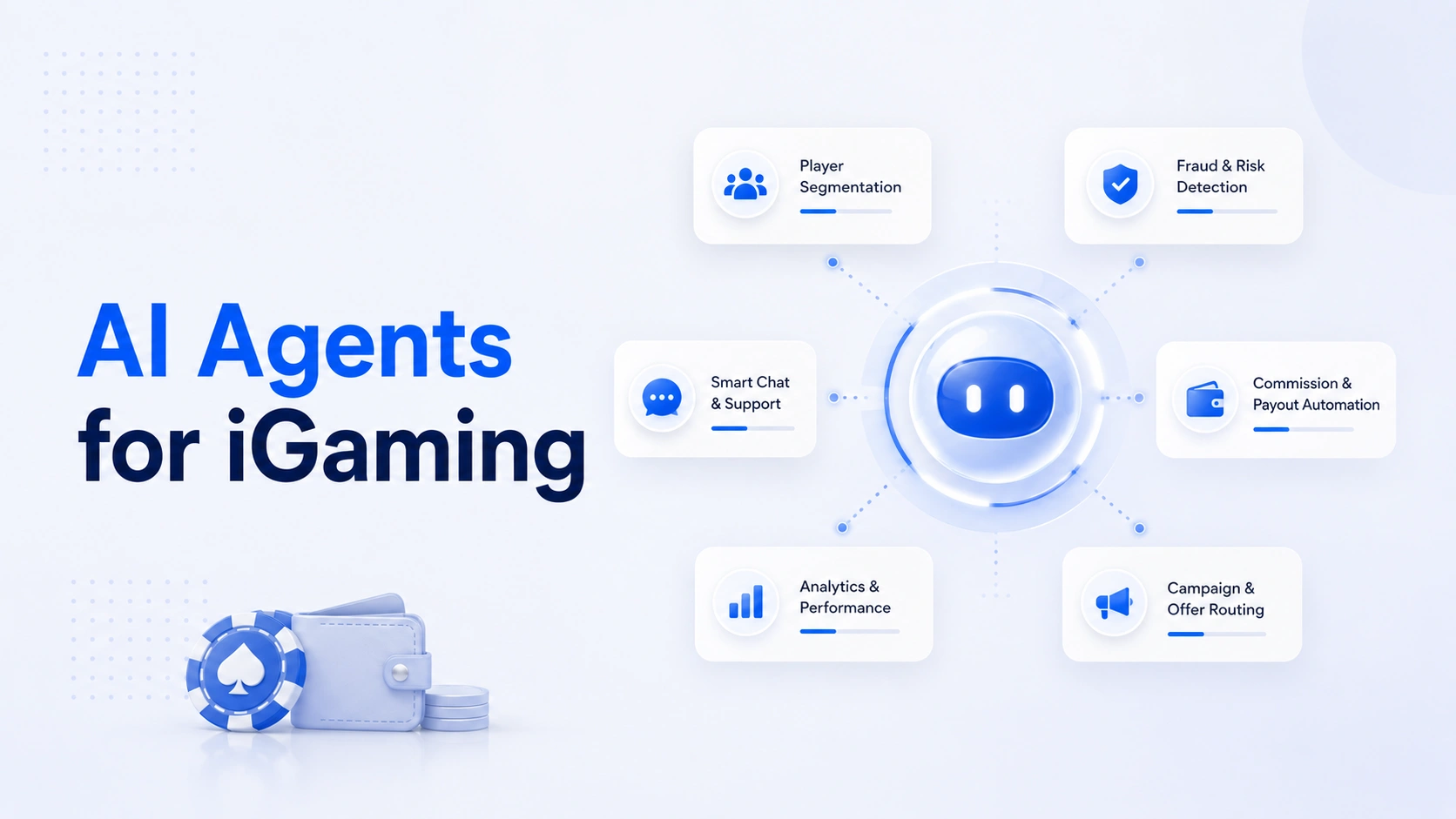
Most iGaming operators already use automation. Bonus triggers that fire when a player deposits above a threshold. CRM sequences that send an email when a player has not logged in for 14 days. Fraud rules that block registrations from flagged IP ranges. These are conditional automations — if X, then Y, with a human having defined both the condition and the response in advance.
An AI agent is structurally different. It receives a goal — “reduce bonus abuse rates in the new player cohort from Affiliate A by 30% this month” — and determines its own plan for achieving it. It identifies relevant data sources, queries them, reasons about what the data shows, decides on an action, executes that action through connected tools (your CRM, affiliate platform, back-office), monitors the result, and adjusts based on outcomes. A human defines the goal and reviews results. The agent designs and executes the path between them.
Rule-based automation handles the situations its rules were written for. An AI agent handles situations you did not anticipate because it reasons about new data patterns and takes actions that were not pre-programmed. That is not a marginal upgrade. It is a different category of tool.
| Capability | Rule-Based Automation | AI Agent |
|---|---|---|
| Handles novel situations | No — only pre-defined conditions | Yes — reasons from data and context |
| Multi-step decision chains | Limited — each rule is independent | Yes — plans and executes sequences |
| Adapts based on outcome | No — static until reprogrammed | Yes — adjusts approach based on results |
| Connects across multiple systems | Typically single-system | Multi-system via API orchestration |
| Requires upfront rule specification | Yes — exhaustively | No — goal specification is sufficient |
| Auditability of decisions | High — logic is explicit | Variable — depends on platform logging |
| Risk of unexpected behavior | Low — bounded by defined rules | Higher — agent may find unintended paths |
The auditability and unexpected behavior rows matter most for operators in regulated markets. Come back to them in the limitations section.
The Automation Map: What AI Agents Can Run in an iGaming Operation
Not every operational function is equally suited to agentic automation. The functions where AI agents produce the most measurable ROI share four characteristics: high data volume, repetitive decision patterns with variable inputs, time-sensitivity that exceeds human response capacity, and tolerance for automated action without case-by-case review. Here is the breakdown across the major operational areas.
Affiliate Program Management
This is where AI agents produce the most immediate, quantifiable returns for operators managing large affiliate portfolios.
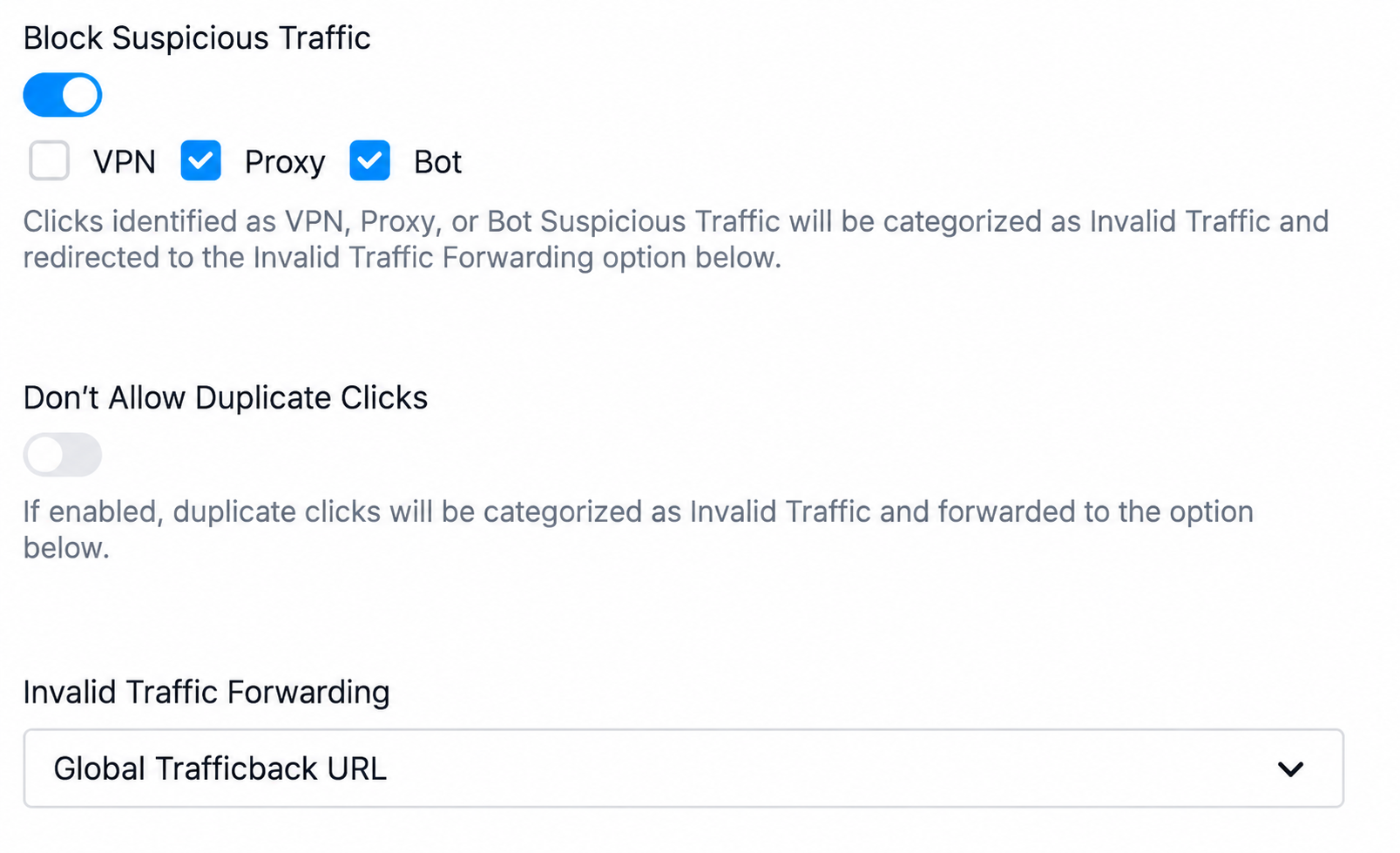
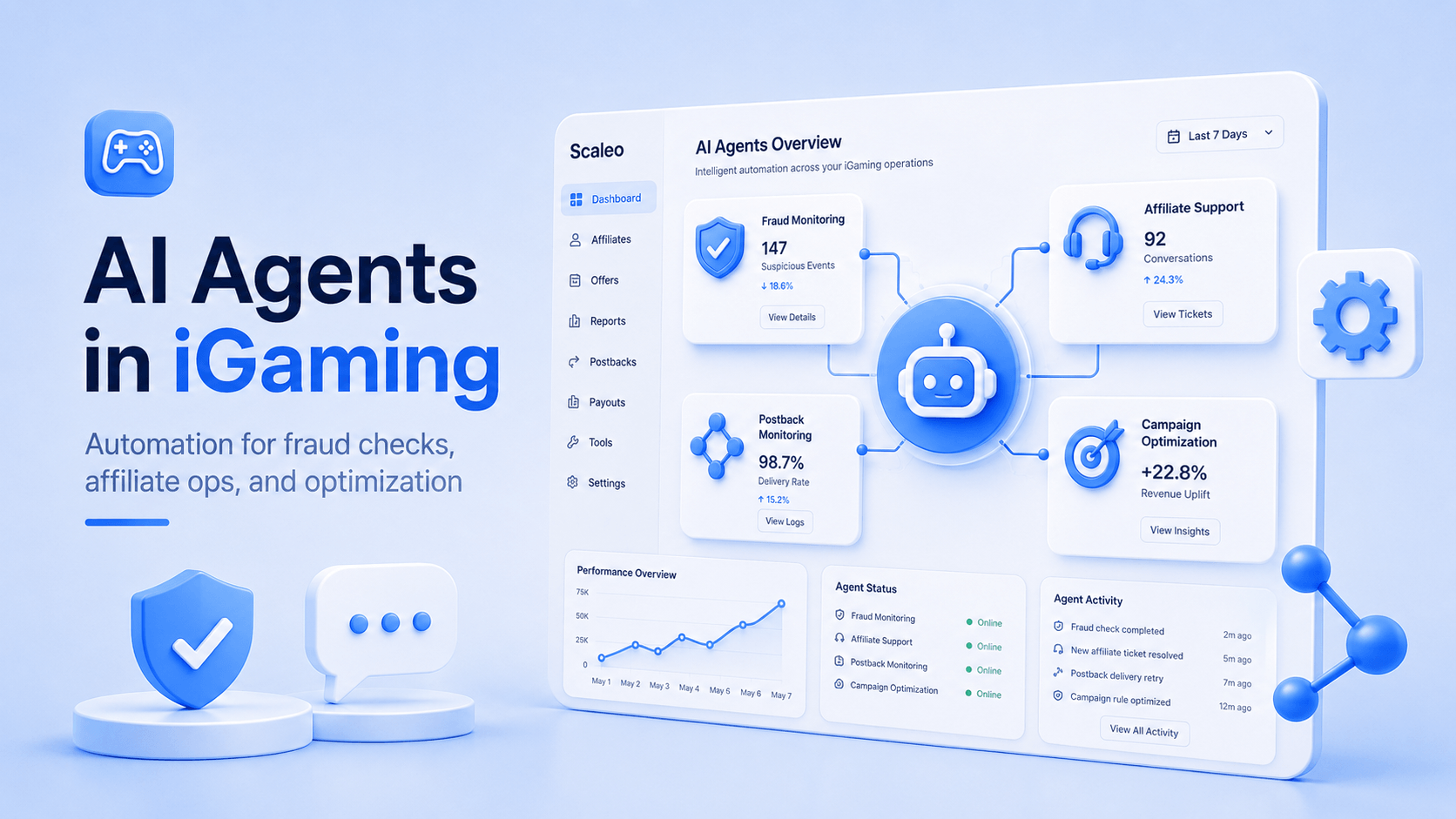
Fraud detection and commission hold automation. An AI agent monitoring affiliate traffic in real time can identify behavioral anomaly patterns — device fingerprint clustering, deposit-to-withdrawal velocity, bonus claim rate spikes — and automatically trigger a commission hold flag before a payout run, without a human reviewing each case. The agent does not make the final termination decision. It escalates, holds, and documents.
Scaleo-backed programs configure the threshold rules that govern when the agent holds automatically versus when it alerts for human review, with a full audit trail of each automated decision.
The Anti-Fraud Logic™ is the detection engine; agentic workflow orchestration is the layer that acts on its output without requiring an affiliate manager to be at their desk.
Commission plan optimization. An agent with access to affiliate NGR data, deal tier parameters, and traffic quality benchmarks can identify affiliates whose current deal structure produces below-benchmark NGR per FTD and flag them for renegotiation — with the specific metrics laid out and the suggested renegotiation position calculated based on comparable affiliate performance. The affiliate manager has the conversation. The agent did the three hours of analysis that preceded it.
Affiliate communication sequencing. New affiliate onboarding, compliance update distribution, platform migration notification — each involves conditional multi-step communication workflows that AI agents handle reliably.
Affiliate has not acknowledged a T&C update within 48 hours?
Agent fires a follow-up.
Still unacknowledged at 96 hours?
It escalates to the affiliate manager with the account flagged. No human required at each step. Scaleo’s compliance and communication architecture is the data layer; workflow tools like n8n or Make orchestrate the sequence.
Player Lifecycle and Retention
Churn prediction and intervention. Multi-agent architectures are in production at several major operators: a monitoring agent tracks player session frequency, deposit velocity, and game selection diversity against a churn probability model. When a player’s score crosses a threshold, an intervention agent fires — selecting from a retention offer library based on the player’s preference profile, issuing through the appropriate channel, and logging the outcome for model refinement.
A human defined the churn threshold and the offer library. The agents run the intervention workflow at 3am on a Tuesday when no retention specialist is available.
Responsible gambling monitoring. This is the highest-stakes application and requires the most careful governance architecture. An agent monitoring session data for problem gambling indicators — session duration escalation, loss-chasing betting patterns, deposit frequency increases — can issue automated responsible gambling interventions (cooling-off prompts, deposit limit suggestions, mandatory break triggers) in real time.
The intervention quality exceeds what a human CRM team can achieve at volume — humans cannot monitor 50,000 active sessions simultaneously. The governance requirement: the operator has documented the intervention rules, the agent is not making new policy decisions, and every automated intervention is logged for regulatory audit.
VIP player management. An agent monitoring a VIP segment can track session behavior, win/loss trajectory, and service request patterns to flag players at risk of churning or approaching VIP thresholds ready for a proactive upgrade conversation. The agent identifies the moment and the context. The VIP manager makes the call.
Compliance and Regulatory Operations
KYC queue management. Document verification bottlenecks are a direct conversion killer — a player who waits four hours for verification has a materially lower FTD rate than one verified in 20 minutes. AI agents handle the first-pass document review — checking document validity, matching identity fields, flagging anomalies for human review — and route clear-pass cases to automatic approval while escalating edge cases to a compliance officer. The compliance officer reviews complexity. The agent clears volume.
AML transaction monitoring. An agent connected to transaction data monitors deposits, withdrawals, and wagering patterns against AML indicators in real time — flagging suspicious patterns (structuring, velocity anomalies, source-of-funds inconsistencies) for compliance review without requiring a human to review every transaction.
Both the UKGC and MGA expect systematic transaction monitoring — an AI agent running 24/7 is a more defensible implementation than a human team working business hours.
Regulatory report generation. In jurisdictions with automated reporting requirements, an agent can monitor the relevant data, format required reports, and submit them within the required window without manual intervention. Human responsibility is configuration, audit, and exception handling. The agent handles the repetitive compliance workflow.
Marketing and Content Operations
Bonus offer personalization at scale. Leading operators are deploying AI agents that generate personalized promotional offers for individual player segments — not “here is the offer for the high-value cohort” but “here is the specific offer for this player, at this time, through this channel, based on their session history from the last 72 hours.”
The agent calculates which offer has the highest probability of driving a qualifying deposit, generates the copy, and fires it through the CRM. The marketing team defines the offer parameters and creative guidelines. The agent handles personalization and timing.
Odds compilation assistance. For operators running their own sportsbook rather than a turnkey odds feed, AI agents assist odds compilers by synthesizing market data, team statistics, and historical settlement patterns to generate initial probability estimates that human traders then review and adjust. The agent does not set the odds. It provides the analytical foundation that dramatically reduces preparation time per market.
The Honest Limitations: Where AI Agents Break Down in iGaming
The bullish case for AI agents is real. So are the failure modes. The operators getting the best results from agentic AI in 2026 spent as much time designing governance and human override architecture as they did selecting AI tools.
The Governance Gap — The Most Expensive Problem
Raconteur’s 2026 enterprise AI governance research identifies the governance gap as the defining risk of fast AI adoption: autonomous systems making hundreds of decisions per second in environments where the reasoning behind those decisions is not easily auditable by the humans nominally responsible for them. In iGaming, this is not abstract. It is a licensing risk.
If an AI agent automatically declines a player’s withdrawal request based on an AML flag that a compliance officer cannot reconstruct, the operator has a problem. The regulator does not accept “the AI decided” as an explanation for a compliance action. The operator is responsible for every decision made within their infrastructure, whether a human or an agent made it.
⚠️ The regulatory audit test: Before deploying any AI agent that takes autonomous action affecting players or affiliates — a commission hold, a withdrawal flag, a responsible gambling intervention, an account restriction — ask: if a regulator requested a complete explanation of why this specific action was taken on this specific account at this specific time, could your team produce it within 48 hours from the agent’s decision log? If the answer is no, the agent is not ready for production in a licensed environment.
Data Quality Is the Agent’s Ceiling
An AI agent is only as good as the data it reasons from. In iGaming operations where player data, affiliate performance data, and transaction data live in separate systems with inconsistent schemas and delayed synchronization, an agent operating across those sources will make decisions based on an incomplete picture — at machine speed, with machine confidence, in situations where a human would have paused to verify the data first.
Data integration quality is a prerequisite for AI agent deployment, not a parallel workstream. An operator who deploys a churn prediction agent against a CRM with 40% of player records missing session frequency data will get a model with systematically biased outputs — and the agent will act on those at scale before the bias is identified. Investment in data quality typically needs to precede AI agent deployment by at least one operational quarter.
Compliance Decisions Require Human Judgment
AI agents excel at high-volume, pattern-consistent decisions. They are significantly weaker — and in regulated environments should not be deployed — on decisions requiring contextual human judgment about intent, proportionality, or ethical weight. A player who exceeds a deposit limit by €12 on Christmas Day in their first year on the platform, with no prior problem gambling indicators, is in a different category from a player exceeding the same limit as part of a systematic loss-chasing pattern. A rule sees the same trigger.
A human sees the difference. An agent may or may not, depending on what contextual signals it has access to.
The safest deployment model for high-stakes compliance decisions: agent flags and prepares the case, human makes the decision. The agent’s value is speed and completeness of preparation — not autonomy of decision.
Hallucination Risk in High-Stakes Contexts
Large language model-based agents occasionally generate confident outputs that are factually incorrect. In a creative writing context, this is an inconvenience. In an iGaming context where an agent is summarizing a player’s account history to inform a compliance decision, or calculating an affiliate’s commission balance, a confident incorrect output is a compliance event.
Output validation layers are mandatory for any agent that generates numerical outputs — commission calculations, reporting figures, statistical summaries — and LLM-based agents should never serve as the sole or final authority on a financial calculation.
Integration Complexity and Write-API Scope
Multi-agent orchestration requires your operational systems — PAM, CRM, affiliate platform, payment processor — to have APIs that agents can write to, not just read from. Many legacy iGaming systems have read-capable APIs but limited or no write capability. An agent that can query your player database but cannot update a player’s status, issue a bonus, or hold a commission without human back-office intervention loses a significant portion of its automation value.
Before evaluating AI agent vendors, map which of your operational systems support write API access. That map defines your actual automation ceiling — regardless of what any agent vendor promises.
The Capability and Maturity Matrix: What Is Production-Ready in 2026
| Operational Function | Automation Maturity | ROI Profile | Human Oversight Required |
|---|---|---|---|
| Affiliate fraud detection & commission hold | Production-ready | High — direct cost reduction | Review before termination; not required before hold |
| Player churn prediction & intervention | Production-ready | High — measurable retention lift | Offer library and rules defined by humans |
| KYC first-pass document review | Production-ready | High — conversion rate improvement at registration | Edge cases escalated; human makes final decision |
| Bonus personalization and delivery | Production-ready | Medium-High — player engagement and retention | Offer parameters human-defined; agent executes |
| AML transaction monitoring and flagging | Production-ready | High — compliance risk reduction | Compliance officer reviews all flags before action |
| Responsible gambling real-time intervention | Early production | High — regulatory and reputational risk reduction | Intervention rules human-defined; all actions logged |
| Commission plan renegotiation recommendations | Early production | Medium — margin optimization | Human conducts all affiliate negotiations |
| Regulatory report generation and submission | Early production | Medium — compliance overhead reduction | Human reviews before submission |
| Odds compilation assistance | Experimental | Medium — analyst efficiency | Trader reviews all agent estimates before use |
| Autonomous final compliance decisions | Not recommended | High regulatory exposure | Agents should never make final compliance decisions without human review in licensed environments |
The Implementation Framework: Phase by Phase
The operators extracting real ROI from AI agents in 2026 did not start with the most ambitious use case. They started with the highest-volume, lowest-risk, most-measurable workflow in their operation.
Phase 1 — Agent-assisted, human-decided (weeks 1–8). Deploy agents that gather, analyze, and present — but do not act autonomously. Affiliate fraud analysis, churn risk reporting, compliance case preparation. The agent does the analytical work. A human makes the call. This phase builds team familiarity with agent-generated outputs, establishes baseline accuracy metrics, and surfaces data quality issues before they affect autonomous decisions.
Phase 2 — Autonomous action on low-stakes, reversible workflows (weeks 8–16). Affiliate compliance acknowledgment follow-ups. Player bonus offer personalization. KYC first-pass routing. Communication sequencing. High-volume, low-individual-stakes, easily reversible. Define the human override mechanism before you turn on autonomy — not after.
Phase 3 — Autonomous action on high-stakes workflows with audit infrastructure (week 16+). Commission hold automation. AML flag generation. Responsible gambling intervention triggering. These require a complete agent decision log, a clearly defined and tested human override path, and regulatory documentation of the agent’s decision logic before deployment. Not optional.
Where Scaleo fits in the agent architecture: Scaleo functions as the affiliate and commission data layer that AI agents connect to via API. The platform’s event-level storage — player events, postback logs, commission calculations, fraud scores — gives agents the structured, real-time data they need to reason about affiliate program performance and trigger actions. Operators building AI automation workflows for fraud prevention, commission anomaly detection, or compliance acknowledgment tracking connect their agent orchestration layer to Scaleo’s API for the underlying data and action capabilities. The affiliate platform is not the agent. It is the system of record the agent operates against.
Frequently Asked Questions
What is an AI agent and how is it different from regular automation in iGaming?
Regular iGaming automation follows predefined conditional logic — if a player deposits above X, trigger bonus Y. An AI agent receives a goal, determines what data it needs, queries connected systems, reasons about the data, decides on an action, executes it, and adjusts based on outcomes. It handles novel situations by reasoning from data rather than only the situations its rules were written for. This structural difference is why agentic AI requires a governance architecture that rule-based automation does not — and why it can do things that rule-based automation categorically cannot.
Which iGaming operations are most suitable for AI agent automation?
The highest ROI-to-risk functions in 2026 are affiliate fraud detection and commission hold automation, player churn prediction with intervention triggering, KYC first-pass document routing, personalized bonus delivery, and AML transaction monitoring and flag generation. These share high data volume, repetitive decision patterns with variable inputs, and time-sensitivity that exceeds human response capacity. Functions that should not be fully automated without mandatory human review at the decision step include final compliance actions, player account restrictions requiring contextual judgment about intent, and any outputs that feed directly into regulatory submissions.
What are the main risks of deploying AI agents in a licensed iGaming operation?
Four risks dominate. Regulatory auditability failure: operators must be able to explain every agent compliance decision to a regulator — “the AI decided” is not an acceptable answer in any licensed market. Data quality bias: agents operating on incomplete or inconsistent data make wrong decisions at machine speed. Hallucination in financial outputs: LLM-based agents occasionally produce confident but incorrect numerical outputs, which means commission calculations and regulatory figures need human validation layers. Integration scope creep: agents with write API access to multiple systems can take unintended actions if scope boundaries are not enforced at the API permission level rather than relying on agent instructions alone.
Do AI agents replace affiliate managers and compliance staff?
No — and operators who have deployed them at scale are unanimous on this. What AI agents replace is the repetitive, high-volume analytical work that occupies affiliate managers and compliance staff at the expense of judgment-intensive work. An affiliate manager whose agent handles fraud monitoring, compliance follow-ups, and performance data preparation has more time for strategic deal negotiation, relationship building, and program design. The ratio of staff required per affiliate in the program changes. The requirement for human judgment does not.
How does an AI agent connect to an affiliate platform like Scaleo?
AI agents connect via API — querying data endpoints for performance metrics, fraud scores, postback logs, and commission records, and using write APIs to trigger commission holds, account status changes, and compliance notifications. An agent orchestration layer (n8n, Make, or custom-built) manages the connection between the agent’s reasoning output and the platform’s action endpoints. Scaleo’s event-level data granularity — player-level NGR, SubID-level fraud scores, per-affiliate postback logs — provides the signal depth that agents need to detect patterns that aggregate reporting obscures.
What governance framework does an iGaming operator need before deploying AI agents?
Four components are non-negotiable in a licensed environment: a decision log recording every agent action with the full data inputs that produced it (the reasoning context, not just the output); a human override mechanism allowing any automated decision to be reviewed and reversed within a defined time window; a defined scope boundary specifying exactly which systems the agent can read from and write to, enforced at the API permission level; and a named human accountable for reviewing agent performance metrics and the exception log on a defined cadence. MIT Sloan’s governance research is explicit: monitoring must be a permanent operational expense, not a one-time deployment cost.
The Automation Ceiling Is High. The Governance Floor Is Non-Negotiable.
The operators who will look back at 2026 as the year they pulled ahead operationally are the ones who treated AI agent deployment as an infrastructure project with governance requirements — not as a feature to switch on. The capability is real: affiliate fraud held before payout without a human reviewer present, churn interventions firing at 3am; KYC queues clearing in minutes. These outcomes are achievable with current technology. They require the data quality, the API integration depth, and the audit architecture to be in place before the agent is trusted to act on its own.
If the affiliate program data layer is where your automation starts, Scaleo’s event-level tracking architecture and fraud scoring engine are the data foundation that agent orchestration layers connect to. The agent reasons. Scaleo provides the facts it reasons from.