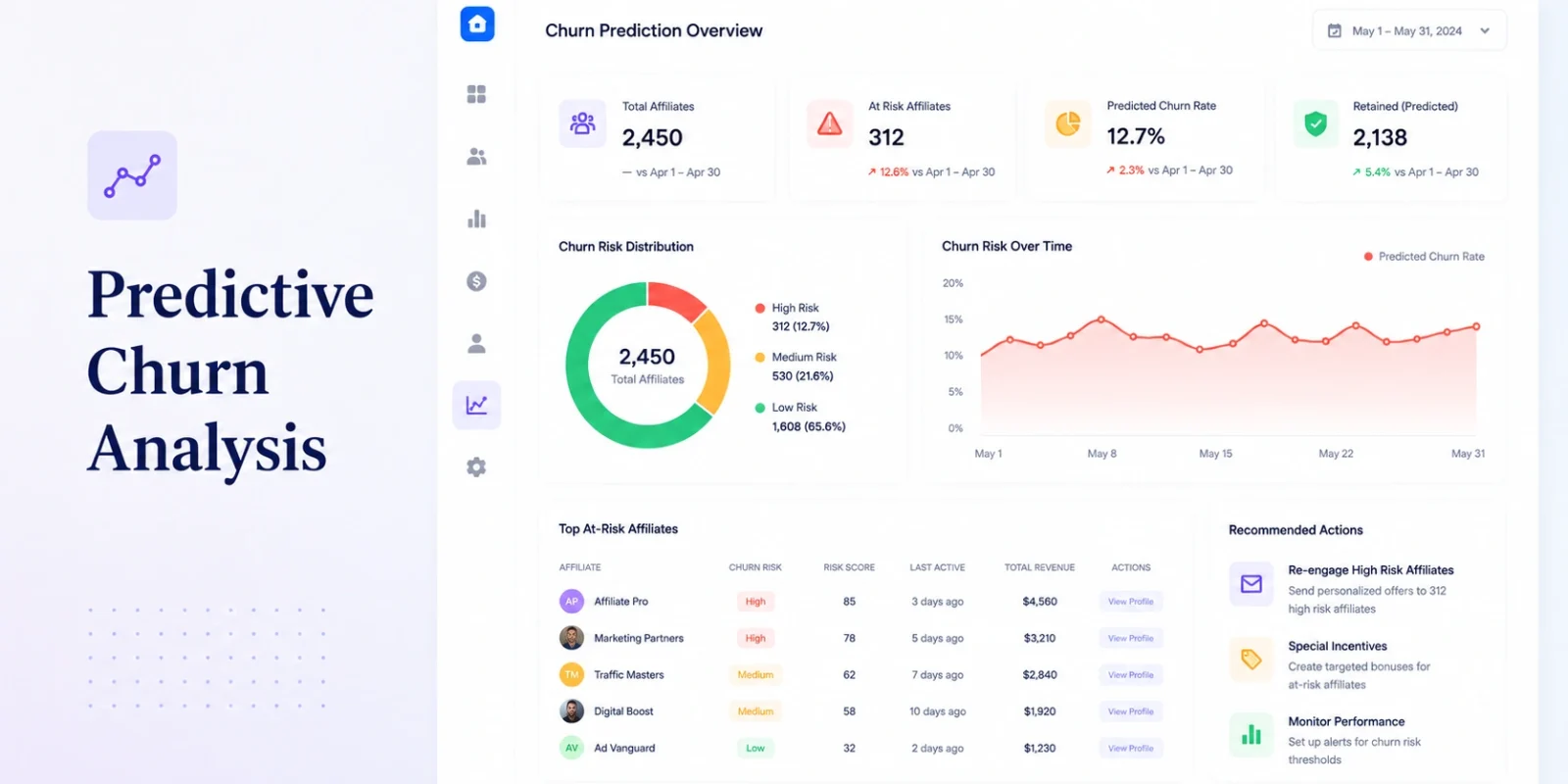
Predictive churn analysis in iGaming helps casino and sportsbook operators detect which players are likely to reduce activity, stop depositing, lose value or leave — before the revenue drop becomes visible in monthly reports.
Direct answer: Predictive churn analysis in iGaming uses player behavior, deposit activity, wagering patterns, bonus engagement, support tickets, KYC status, payment events and acquisition-source data to predict which casino or sportsbook players are likely to become inactive or lose value. The best systems do not only produce a churn score; they also explain the likely churn driver and trigger the right workflow, such as CRM outreach, VIP review, support escalation, payment assistance, responsible gambling review or affiliate-source quality investigation.
But prediction alone is not enough. A churn score only tells the operator that risk is rising. A churn reason explains what to fix. That distinction matters because iGaming churn is rarely caused by one clean event. A player may disengage after payment friction, a delayed withdrawal, failed verification, confusing bonus terms, poor onboarding, weak affiliate traffic, responsible gambling limits, or a product experience that does not match the promise made before registration.
TL;DR: Predictive Churn Analysis in iGaming
- A churn score tells you who may leave. A churn reason tells you what to fix.
- iGaming churn is not only a CRM issue. It can come from payments, KYC, product friction, bonus design, support, fraud controls, affiliate source quality or responsible gambling interventions.
- Affiliate data belongs in churn analysis. Some sources produce fewer FTDs but stronger retention; others generate high FTD volume and weak day-30 value.
- Not every at-risk player should receive a bonus. Some churn signals require support, payment help, VIP review, compliance escalation or responsible gambling review.
- Scaleo supports the acquisition-source layer. It helps operators connect partner, campaign, sub-ID, conversion, fraud, commission and performance data with downstream player value.
For casino and sportsbook operators, churn is not just a revenue symptom. It is a data-quality problem, a product problem, an acquisition problem and sometimes a trust problem. A strong predictive churn system connects player behavior with the full commercial context around that player: where they came from, which affiliate referred them, which campaign or sub-ID generated the click, whether they deposited, how they interacted with bonuses, whether they passed KYC, how their wagering changed and whether support or payment issues appeared before the decline.
This is where affiliate software becomes part of the retention stack. If an operator cannot connect acquisition source, player value, fraud indicators, commission cost and downstream activity, churn prediction becomes shallow. It may identify risk, but it cannot explain whether the risk came from the player, the product or the traffic source.
What Is Predictive Churn Analysis in iGaming?
Predictive churn analysis is the process of using historical and real-time player data to estimate which users are likely to become inactive, reduce spending, stop depositing or leave an operator’s platform entirely.
In subscription SaaS, churn often means cancellation. In iGaming, the definition is more complicated. A player may not formally cancel anything. They may simply stop depositing, stop wagering, move to another brand, reduce activity, ignore promotions, fail verification, withdraw funds or become active only when incentives are aggressive enough.
That means operators must define churn carefully before building models, dashboards or CRM workflows.
Common iGaming churn definitions
- No deposit activity for a defined number of days.
- No wagering activity after first deposit.
- Sharp reduction in stake size.
- Drop in session frequency.
- Bonus engagement followed by inactivity.
- Wallet withdrawal followed by no return.
- VIP activity decline.
- Sportsbook inactivity after key events.
- Casino inactivity after bonus completion.
- Failed reactivation after CRM outreach.
The correct definition depends on product, player segment, GEO and business model. A sportsbook may define early churn differently from a casino brand. A VIP player should not be measured with the same threshold as a low-frequency recreational player. A new depositor should not be evaluated like a mature player with six months of history.
The first rule is simple: one operator should not have five different churn definitions floating between BI, CRM, affiliate, finance and product teams. If the target is inconsistent, the prediction will be inconsistent too.
How Do You Calculate Churn in iGaming?
iGaming operators should not rely on one churn formula. Player churn, deposit churn, value churn and cohort churn answer different business questions. A player-count metric may show inactivity, while a value metric shows whether the operator is losing meaningful NGR.
| Metric | Formula | What it tells you |
|---|---|---|
| Basic player churn rate | Lost active players during period ÷ Active players at start of period × 100 | How many previously active players became inactive. |
| Deposit churn | Players who stopped depositing ÷ Previously depositing players × 100 | Whether players stopped funding accounts. |
| Wagering churn | Players who stopped wagering ÷ Previously wagering players × 100 | Whether product engagement declined. |
| Value churn | Lost NGR from declining players ÷ Starting NGR from active players × 100 | How much revenue value is at risk. |
| Cohort churn | Players inactive by day X ÷ Players acquired in the same cohort × 100 | How retention differs by acquisition date, source, campaign or GEO. |
| FTD-to-repeat-deposit churn | FTD players with no second deposit ÷ Total FTD players × 100 | Whether first-time depositors are becoming real repeat players. |
For affiliate-led operators, cohort churn is especially important. A partner may produce strong FTD volume but weak day-7 or day-30 retention. Another partner may produce fewer depositors but much better NGR quality. Without cohort and source-level churn, the operator may reward volume while losing margin.
Why Is iGaming Churn Harder Than Normal Customer Churn?
Player behavior in iGaming is volatile. The data changes quickly, and the reason behind churn can appear in minutes rather than months. A player may be active in the morning and gone by evening because a deposit failed three times. Another player may disappear after reading wagering terms. A third may come from an affiliate source that looks good at FTD level but produces weak retention after day seven.
This makes iGaming churn harder than churn in slower customer environments.
| Factor | Why it matters |
|---|---|
| Deposit and withdrawal friction | Payment issues can instantly damage trust. |
| KYC and verification | Failed or delayed verification can stop activity. |
| Bonus mechanics | Confusing terms can create disappointment, abuse patterns or inactivity. |
| Affiliate source quality | Some sources produce high FTD volume but poor long-term value. |
| Fraud controls | Aggressive checks may protect margin but interrupt good users. |
| Product volatility | Sports events, odds, game mix and jackpot behavior affect activity. |
| Responsible gambling rules | Player limits, cooling-off and exclusions must be handled correctly. |
| Multi-brand journeys | A player may move between brands inside the same operator group. |
A generic churn model may miss these factors because it treats inactivity as the primary signal. In iGaming, inactivity is often the symptom. The cause may sit somewhere else in the journey. That is why operators need more than a score. They need a reason layer.
Churn Reporting vs Predictive Churn Analysis
Churn reporting tells the operator what already happened. Predictive churn analysis tells the operator what is likely to happen next. Explainable churn analysis goes one step further by identifying the likely driver behind the risk.
| Approach | What it tells you | Main limitation |
|---|---|---|
| Churn reporting | Which players already became inactive. | Too late to prevent the loss. |
| Predictive churn scoring | Which players are likely to churn soon. | Still needs an action plan. |
| Explainable churn analysis | Why churn risk is rising. | Requires connected data across systems. |
| Retention-control workflow | Which team should act next and how success is measured. | Requires CRM, support, affiliate, BI and compliance alignment. |
The strongest operators move from churn reporting to retention control. They do not only ask, “Who is likely to leave?” They ask, “Why is this player likely to leave, who owns the fix, and how do we know whether the intervention worked?”
What Is the Difference Between a Churn Score and a Churn Reason?
A churn score tells the operator that a player is at risk. A churn reason tells the operator what kind of intervention might work. That difference changes the entire value of the system.
If the model says “high churn risk,” CRM may send a bonus. But if the real problem was a failed withdrawal, the bonus is irrelevant. If the problem was KYC friction, a generic offer may make the player more annoyed. If the problem was low-intent affiliate traffic, no retention message may fix the underlying economics.
Useful churn reasons in iGaming
- Payment friction.
- Withdrawal delay.
- Failed KYC or document upload.
- Bonus confusion.
- Poor campaign fit.
- Low-quality affiliate source.
- Product inactivity after onboarding.
- Support complaint.
- VIP value decline.
- Repeated failed login.
- High fraud or duplicate-account probability.
- Responsible gambling intervention.
- Lack of relevant promotions.
| Churn driver | Wrong response | Better response |
|---|---|---|
| Failed deposits | Send a generic bonus. | Trigger payment support or alternate payment routing. |
| Bonus abandonment | Send another bonus without explanation. | Send clear bonus-term guidance or improve the bonus page. |
| KYC failure | Send promotional reactivation. | Escalate verification support. |
| Low activity after FTD | Assume the player is lost. | Send onboarding or product discovery flow. |
| High-value decline | Treat like a normal inactive user. | Alert VIP team. |
| Weak affiliate cohort | Increase CRM spend. | Review source quality and partner payout terms. |
| Fraud-linked risk | Send stronger promotion. | Hold promotional outreach and review account integrity. |
A churn program that cannot explain risk creates more work for humans. A churn program that identifies the driver gives teams options.
A Simple Worked Example: Four Players, Four Different Actions
A useful churn model does not treat all inactive players the same. The same “high risk” label can hide completely different commercial situations.
| Player | Last deposit | Failed deposits | Bonus status | Support ticket | Affiliate source | Churn risk | Likely reason | Next action |
|---|---|---|---|---|---|---|---|---|
| A | 2 days ago | 0 | Active | None | SEO affiliate | 22% | Normal activity rhythm | No intervention |
| B | 9 days ago | 3 | Not claimed | Payment complaint | PPC affiliate | 81% | Payment friction | Payment support escalation |
| C | 5 days ago | 0 | Claimed, no wagering | None | Bonus traffic | 74% | Bonus mismatch | Bonus-term education or onboarding |
| D | 18 days ago | 0 | None | VIP complaint | Direct | 88% | High-value decline | VIP team review |
The model is useful only if the operator knows what to do next. Player B needs payment help, not another free spin. Player C may need clearer bonus terms or a better onboarding journey. Player D needs VIP escalation. Player A may not need intervention at all. Good churn analysis prevents both underreaction and stupid automation.
Why Affiliate Source Data Belongs in Churn Analysis
Affiliate acquisition and player retention are often managed separately. That is a mistake. The affiliate source can strongly influence churn behavior.
One partner may send fewer FTDs but higher-value players. Another may send a surge of depositors who vanish after a bonus. A third may produce traffic that looks profitable before fraud, chargebacks, bonus cost and retention are considered.
If churn analysis ignores source quality, the operator may misread the problem. A player who disappears after one deposit may be treated as a retention failure. But if the same pattern appears across hundreds of players from one sub-affiliate, the real issue is acquisition quality. The operator does not need a better reactivation email. It needs better partner controls, traffic review or commission rules.
Affiliate source data helps operators answer:
- Which partners produce players with strong day-30 retention?
- Which sources generate high FTD volume but weak NGR?
- Which affiliates produce high bonus usage and low repeat deposits?
- Which campaigns show high KYC failure rates?
- Which sub-IDs produce suspiciously similar behavior?
- Which partners produce players who churn after the same friction point?
- Which acquisition sources justify higher CPA or RevShare terms?
This is where Scaleo’s role becomes important. By tracking partner, campaign, sub-ID, conversion, commission and performance data, Scaleo gives operators cleaner acquisition context. That context can then be used alongside CRM, wallet, product, fraud and support data to make churn analysis more precise.
Without this layer, the operator may see that players are leaving but not understand whether the problem is retention, product, fraud, bonus economics or affiliate traffic quality.
What Data Do Operators Need for Predictive Churn?
A useful churn model depends on clean, connected data. More data is not automatically better. The right data has to describe both player behavior and the commercial context behind it.
| Data category | Example signals | Why it matters |
|---|---|---|
| Player profile | Registration date, GEO, device, language, verification status. | Defines segment, lifecycle stage and market context. |
| Wallet activity | Deposits, withdrawals, failed payments, payment methods. | Detects trust and payment friction. |
| Gameplay behavior | Wagers, game type, session frequency, stake size, product mix. | Shows engagement and value change. |
| Bonus behavior | Bonus claims, wagering progress, abandonment, bonus-to-GGR ratio. | Separates useful incentives from weak or abusive bonus behavior. |
| Affiliate source | Partner ID, campaign, sub-ID, click path, traffic source. | Connects churn to acquisition quality. |
| Fraud and risk | Duplicate checks, bot signals, suspicious patterns, chargebacks. | Prevents unsafe or wasteful reactivation. |
| Support activity | Tickets, complaints, unresolved issues, response delays. | Identifies trust and service friction. |
| CRM engagement | Email opens, offer clicks, reactivation response. | Measures whether outreach works. |
| Revenue value | GGR, NGR, lifetime value, payout cost, margin contribution. | Prioritizes value at risk, not only player count. |
These categories should not live in disconnected reports. Predictive churn becomes more useful when the operator can analyze them together. A player has not deposited for seven days. That alone may not mean much. But if the same player had two failed deposits, opened a support ticket about withdrawals, abandoned a bonus page and came from a source with poor day-30 retention, the risk becomes much clearer.
The value is not in one signal. It is in the pattern.
What Does the Data Architecture Look Like?
Predictive churn analysis needs a connected pipeline. The goal is to move from scattered operational data to a workflow that can score risk, explain the driver and route the correct action.
Data sources:
Affiliate platform + CRM + wallet + gameplay + KYC + support + payments + fraud tools

↓

Feature layer:
Player features + source features + payment features + support features + bonus features

↓

Prediction layer:
Churn score + churn reason + value at risk

↓

Workflow layer:
CRM, VIP, support, payments, affiliate review, fraud, responsible gambling/compliance

↓

Measurement:
Retention, NGR saved, reactivation rate, source quality, model drift
Scaleo supports the acquisition-source layer of this architecture. It does not replace the CRM, wallet, BI stack or player-risk systems. Its value is in giving the operator clean partner, campaign, sub-ID, conversion, fraud, commission and performance context, which can then feed a broader retention and churn workflow.
How Do You Build an iGaming Churn Prediction Workflow?
A practical churn workflow should move through six stages: define the churn event, create time-based snapshots, engineer iGaming-specific features, train models, add driver-level explanations and push outputs into operational workflows.
1. Define the churn event
The operator must decide what counts as churn for each player segment. For a new depositor, seven days without activity may matter. For a casual sportsbook player, activity may follow event cycles. For a VIP, reduced stake size may be more important than complete inactivity.
- Player segment.
- Product type.
- Activity threshold.
- Time window.
- Value threshold.
- Exclusion rules.
2. Create time-based player snapshots
The model should not learn from future behavior. Each player record needs to represent what was known at the time the prediction would have been made.
- Activity in the last 24 hours.
- Activity in the last 7 days.
- Deposit changes over 14 days.
- Wagering change over 30 days.
- Support issues before the prediction date.
- Affiliate source and campaign at acquisition.
This prevents a common mistake: building a model that looks accurate in testing because it accidentally learned from information that would not have existed in production.
3. Engineer iGaming-specific features
Generic engagement metrics are not enough. Operators should create features that reflect iGaming behavior.
- Days since last deposit.
- Failed deposit count.
- Withdrawal-to-deposit ratio.
- Bonus abandonment count.
- Change in stake size.
- Drop in game variety.
- Session frequency decline.
- Failed KYC attempts.
- Unresolved support ticket age.
- Affiliate source retention rate.
- Campaign-level NGR quality.
- Chargeback or fraud proximity.
- Day-7 and day-30 value by acquisition source.
These features help the system distinguish between normal player rhythm and real churn risk.
4. Train baseline and advanced models
Operators do not need to start with a black-box system. A baseline model can help validate whether the data has predictive value. More advanced models can then capture complex patterns between payments, product use, source quality and retention.
| Model type | Best use | Pros | Cons |
|---|---|---|---|
| Rules-based scoring | Early churn alerts and simple triggers. | Easy to explain and fast to launch. | Too rigid for complex behavior. |
| Logistic regression | Baseline prediction and interpretability. | Transparent and useful for validation. | Misses complex non-linear patterns. |
| Random forest / gradient boosting | Strong tabular prediction. | Handles non-linear behavior and interactions. | Needs explainability layer. |
| Survival analysis | Time-to-churn prediction. | Useful for lifecycle timing. | More complex to explain to business teams. |
| Cohort analysis | Affiliate source and campaign comparison. | Easy for commercial teams to understand. | Not individual-level prediction. |
| LTV + churn model | Value protection and prioritization. | Focuses action on high-impact players. | Requires clean revenue and cost data. |
The model should not override responsible gambling, compliance or fraud rules. Churn prediction must operate inside the operator’s risk and regulatory framework.
5. Add driver-level explanations
The model output should include both score and reason. Instead of saying “Player 84291: 87% churn risk,” a better output says: “Player 84291: high churn risk. Primary drivers: two failed deposits, unresolved payment ticket, 80% drop in session frequency and high-value cohort.”
This is the difference between data and action.
6. Push outputs into workflows
A churn model has little value if it stays inside a BI dashboard. The score and reason should feed into operational systems.
- CRM segmentation.
- VIP alerts.
- Support queues.
- Affiliate quality reviews.
- Fraud review.
- Product analytics.
- Payment optimization.
- Partner commission decisions.
For affiliate-led operators, partner teams should see churn patterns by source. If one affiliate repeatedly generates players who fail KYC, abandon bonuses or disappear after one deposit, that insight should affect campaign review and commission strategy.
Which Churn Signals Should Operators Watch Closely?
The strongest churn signals are often early signs of friction. A failed deposit, unresolved ticket or bonus abandonment can matter more than a simple inactivity counter.
| Signal | What it may suggest | Likely owner |
|---|---|---|
| Multiple failed deposits | Payment issue, trust issue or payment method mismatch. | Payments / support |
| Withdrawal attempt followed by inactivity | Possible trust or processing concern. | Payments / support |
| Bonus page visits without claim | Confusing or unattractive offer terms. | CRM / product |
| Bonus claim without wagering continuation | Poor bonus fit or difficult requirements. | CRM / product |
| KYC upload failure | Verification friction. | KYC / support |
| Reduced session frequency | Lower engagement or product fatigue. | CRM / product |
| Reduced stake size | Value decline before full inactivity. | CRM / VIP |
| Game/category narrowing | Product fatigue or limited interest. | Product / CRM |
| Repeated support contact | Unresolved frustration. | Support |
| Affiliate cohort drop-off | Poor source quality or campaign mismatch. | Affiliate team |
The best systems monitor these signals in context. A failed deposit from a brand-new player means something different from a failed deposit by a six-month high-value player. A week of inactivity means something different during off-season sportsbook periods than during major event windows.
Context is not decoration. It is how the operator avoids stupid automation.
When Should Operators Not Reactivate a Churning Player?
Not every at-risk player should receive a promotional message. Some churn signals may overlap with responsible gambling, compliance, fraud or payment concerns. In those cases, the correct action is not “send a bonus.” It may be responsible gambling review, support intervention, payment assistance, fraud review or no marketing contact at all.
Operators should create suppression rules so churn models do not trigger unsafe outreach.
Do not send promotional reactivation when the churn driver includes:
- Self-exclusion or cooling-off.
- Deposit-limit activity.
- Responsible gambling flags.
- Distress language in support chat.
- Chasing-loss behavior.
- Affordability or vulnerability concerns.
- Unresolved withdrawal complaint.
- Fraud, KYC or AML review.
In these cases, the correct next action may be support, responsible gambling review or compliance escalation. Retention should never override player protection. If the churn model cannot distinguish commercial risk from protection risk, it is not ready for automated CRM activation.
What Should an iGaming Churn Dashboard Include?
A churn dashboard should show more than a player list. It should expose risk by segment, value, reason, source and workflow outcome. The operator should be able to see whether churn is caused by product, payments, KYC, support, bonuses, affiliate traffic or compliance suppression.
| Dashboard widget | Why it matters |
|---|---|
| Churn risk by segment | Shows which player groups need attention. |
| Churn risk by affiliate | Reveals acquisition quality problems. |
| Churn reason distribution | Separates payment, KYC, bonus, product and source issues. |
| NGR at risk | Prioritizes value, not just player count. |
| Day-7 / day-30 retention by source | Shows partner quality after acquisition. |
| Failed-deposit churn | Highlights payment friction. |
| Bonus churn cohort | Shows whether bonus users return. |
| Reactivation success rate | Measures CRM effectiveness. |
| Suppressed due to RG/compliance | Prevents unsafe outreach. |
| Model drift indicator | Shows when predictions are becoming stale. |
This dashboard should be shared across CRM, BI, product, payments, support, affiliate and compliance teams. Churn is cross-functional, so the dashboard should be cross-functional too.
How Do Operators Measure Whether Churn Prediction Works?
A churn model can be statistically accurate and commercially weak. Operators should measure whether interventions reduce churn, protect NGR, improve retention or reveal source-quality problems. Accuracy is not the business outcome. Retained value is.
| Success metric | What it proves |
|---|---|
| Reduction in day-7 churn | Early lifecycle intervention is working. |
| Reduction in day-30 churn | Players are retaining beyond the first deposit period. |
| Increase in repeat deposit rate | First-time depositors are becoming repeat players. |
| Increase in NGR retained | The model is protecting value, not only activity. |
| Improved reactivation conversion rate | CRM actions are more relevant. |
| Lower bonus waste | Offers are not being sent to the wrong players. |
| Lower failed-deposit churn | Payment routing or support is improving. |
| Lower support-related churn | Ticket resolution is protecting retention. |
| Improved retention by affiliate cohort | Partner quality is being managed better. |
| Reduced spend on low-quality traffic | Affiliate investment is being reallocated intelligently. |
| More unsafe messages suppressed | Responsible gambling and compliance controls are working. |
Every churn intervention should have a measurable outcome. If the operator cannot tell whether the action changed retention, it is not a churn-control system. It is just a nervous dashboard.
Who Owns Churn in an iGaming Operation?
Churn is often handed to CRM, but CRM is only one part of the retention system. The actual cause may sit in payments, product, KYC, affiliate acquisition, support, fraud or responsible gambling.
| Team | Ownership in churn workflow |
|---|---|
| CRM | Lifecycle campaigns, reactivation and personalized communication. |
| BI/data | Model design, feature engineering, scoring, validation and drift monitoring. |
| Product | Onboarding, UX, game discovery, sportsbook engagement and product friction. |
| Payments | Deposit failure, withdrawal friction, payment method fit and routing. |
| Support | Complaints, ticket resolution, response delays and service recovery. |
| Affiliate team | Source quality, partner review, campaign traffic and commission strategy. |
| Fraud/risk | Suspicious patterns, duplicate accounts, abuse and chargebacks. |
| Compliance/RG | Suppression rules, safer gambling review and safe intervention standards. |
The best operators assign action owners by churn reason. Payment friction goes to payments or support. Weak affiliate cohort goes to the affiliate team. High-value decline goes to VIP. Responsible gambling flags go to trained RG staff. CRM should not be the dumping ground for every risk score.
How Should Operators Govern Churn Models?
A churn model is not “set and forget.” It needs ownership, monitoring, explainability and controls around automated actions. Player behavior changes after new markets, new payment methods, bonus changes, product updates, sports calendars and affiliate campaign shifts.
Model governance checklist
- Define the model owner.
- Define allowed and forbidden actions.
- Monitor false positives and false negatives.
- Track drift by GEO, source and product.
- Review bias across player segments.
- Log model version and prediction date.
- Explain top churn drivers.
- Prevent promotions to responsible gambling or compliance-suppressed players.
- Review the model after bonus, payment or product changes.
- Retrain on a fixed schedule or when performance drops.
Model governance matters because churn prediction can easily become unsafe automation. A model that is allowed to trigger bonuses without suppression rules may target players who should receive support, not incentives. A model that is not monitored may continue using patterns that stopped being valid after a market, payment or affiliate change.
Common Mistakes in Predictive Churn Analysis
Many churn programs fail because the business treats prediction as the final product. It is not. Prediction is only useful when it improves decisions.
Using unclear churn definitions
If BI defines churn as 14 days of inactivity, CRM defines it as 30 days without deposit and finance defines it as value loss, the model will train on confusion.
Ignoring acquisition source
Player behavior after registration is shaped by the promise, context and quality of the traffic that brought the player in. Ignoring affiliate source hides one of the most important churn drivers.
Sending generic offers to every at-risk player
A bonus will not fix failed KYC. A free spin offer will not repair a withdrawal complaint. A VIP call will not solve bad campaign targeting. The intervention should match the churn driver.
Measuring model accuracy but not business impact
A model can be statistically accurate and commercially weak. Operators should measure whether interventions reduce churn, protect NGR, improve retention or reveal source-quality problems.
Failing to monitor drift
Player behavior changes after new markets, new payment methods, bonus changes, product updates or affiliate campaign shifts. A churn model that is not monitored will decay.
Treating churn as only a CRM issue
Retention is connected to acquisition, payment experience, product usability, compliance, support and trust. CRM is often the messenger, not the root cause.
How Does Scaleo Support Better Churn Intelligence?
Scaleo is not a churn prediction model by itself. Its value sits in the data foundation that makes churn analysis more accurate for affiliate-led iGaming operators.
Scaleo helps operators connect the acquisition and partner-management side of the business with downstream player performance. That matters because player churn cannot be understood properly without knowing where the player came from, which campaign influenced the registration, which affiliate generated the activity and whether the traffic source produced sustainable value.
With Scaleo, operators can manage:
- Affiliate tracking.
- Partner and campaign attribution.
- Sub-ID visibility.
- Conversion tracking.
- Fraud and traffic-quality controls.
- Commission logic.
- Partner performance reporting.
- Payout workflows.
- Data exports and integrations.
For churn analysis, these capabilities help answer one of the most important questions: are we losing players because our retention is weak, or because the acquisition source was poor from the start?
That answer changes everything. If the issue is retention, the operator can improve CRM, product experience, support, payments or VIP workflows. If the issue is traffic quality, the operator can review affiliates, adjust commission plans, tighten validation rules or stop scaling weak sources.
From Churn Prediction to Retention Control
Predictive churn analysis is most valuable when it becomes part of a retention-control system. That system should connect player behavior, affiliate source quality, payment and wallet events, bonus engagement, KYC and compliance status, support issues, fraud signals, commission cost, NGR and lifetime value.
When these signals are connected, operators can stop treating churn as a mysterious drop in activity. They can identify the likely cause, route the right action and measure whether the intervention worked.
The future of iGaming retention is not just predictive. It is explainable and operational.
A score tells you who may leave. A reason tells you what to fix. A connected platform tells you whether the problem started with the player journey, the product, the payment flow or the affiliate source.
For iGaming operators running affiliate-led growth, that distinction is where margin is protected. Scaleo gives operators the tracking, attribution, fraud-control, commission and reporting infrastructure needed to understand acquisition quality and connect partner performance with downstream player value. That makes it a stronger foundation for retention analytics, churn investigation and smarter affiliate program decisions.
Predictive Churn Analysis FAQ
What is predictive churn analysis in iGaming?
Predictive churn analysis in iGaming uses player behavior, wallet activity, product engagement, support signals and acquisition data to estimate which players are likely to become inactive or reduce value. A useful system also explains the likely reason behind the churn risk.
What is a churn score?
A churn score is a probability or risk rating that estimates how likely a player is to become inactive, stop depositing or lose value within a defined time window. The score is useful only when paired with a reason and next action.
What is churn reason analysis?
Churn reason analysis identifies the likely driver behind churn risk, such as payment friction, KYC failure, bonus confusion, support complaint, affiliate source quality, product fatigue or responsible gambling intervention. It helps the operator choose the correct action.
Why is churn prediction harder for casino and sportsbook operators?
Churn prediction is harder in iGaming because player behavior changes quickly. Deposit friction, withdrawal delays, KYC issues, bonus terms, sports calendars, fraud controls and affiliate traffic quality can all affect player activity.
Why should affiliate source data be included in churn analysis?
Affiliate source data helps operators understand whether churn is caused by retention problems or poor acquisition quality. Some affiliates may generate many FTDs but weak long-term value, high bonus abuse or low day-30 retention.
What is the difference between player churn and value churn?
Player churn measures how many users became inactive. Value churn measures how much revenue or NGR was lost from declining players. A low-value player and a high-value VIP should not be treated the same just because both became inactive.
Should at-risk players always receive bonuses?
No. At-risk players should not automatically receive bonuses. If the churn driver involves responsible gambling signals, withdrawal complaints, payment friction, KYC review or fraud concerns, the correct action may be support, compliance review or responsible gambling escalation rather than promotion.
What data is needed for iGaming churn prediction?
Operators need player activity, deposits, withdrawals, wagering behavior, bonus engagement, KYC status, support history, CRM response, fraud signals, affiliate source, campaign data and revenue metrics such as GGR, NGR and lifetime value.
What is model drift in churn prediction?
Model drift happens when player behavior changes and the model’s predictions become less accurate. Drift can occur after new GEO launches, payment method changes, bonus updates, product changes, sports calendar shifts or affiliate campaign changes.
How does Scaleo help with predictive churn analysis?
Scaleo provides tracking, attribution, affiliate source visibility, fraud controls, commission reporting and partner-performance data. This helps operators connect acquisition quality with downstream player behavior, which makes churn analysis more accurate and actionable.
Useful References
- NIST AI Risk Management Framework
- UK Gambling Commission: Customer interaction guidance for remote gambling licensees
- Google Search Central: Creating helpful, reliable, people-first content
- Google Search Central: Structured data introduction