
⚡ DIRECT ANSWER
An FTD (First Time Deposit) is the primary conversion event in iGaming affiliate marketing, occurring when a newly referred player makes their initial monetary deposit into a casino or sportsbook account. In CPA models, the FTD serves as the payout trigger — provided the deposit meets specific Qualification Logic such as a minimum deposit amount (Baseline), a required wagering turnover, or a defined activity window. A “raw FTD” that satisfies none of these conditions does not obligate the operator to pay commission. A Qualified FTD (QFTD) does.
The FTD is the most commercially significant event in any iGaming affiliate program — and the most commonly misunderstood. Operators who pay CPA commissions on raw deposit events rather than qualified ones are systematically funding bonus hunters, incentivized traffic, and in the worst cases, coordinated fraud operations that exist solely to trigger payout thresholds. The qualification logic around the FTD is not a technical footnote. It is the mechanism that determines whether your affiliate program is generating real player value or real payout leakage.
This post defines the FTD precisely, explains the qualification logic that separates a valuable QFTD from a worthless raw deposit event, covers the technical tracking mechanics that make reliable FTD attribution possible, and maps the fraud patterns that specifically target FTD-triggered CPA payouts.
FTD Qualification Logic: Why a Raw Deposit Is Not Enough
A raw FTD is simply a first deposit — any amount, from any player, at any time after registration. Raw FTDs are the metric that appears in your acquisition dashboard. They are not the metric that should determine whether a CPA commission fires.
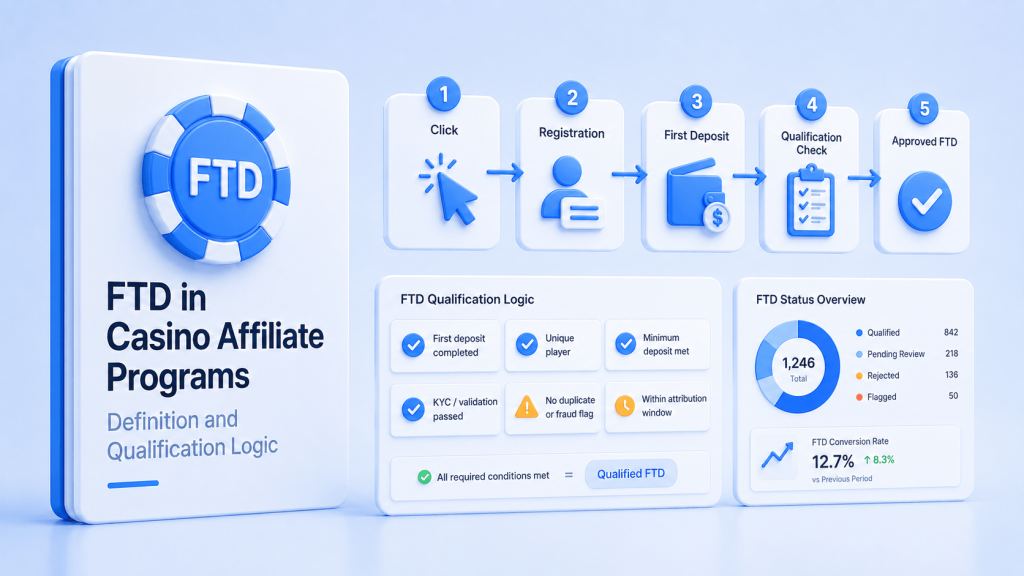
The gap between a raw FTD and a Qualified FTD is the gap between “a player deposited” and “a player deposited in a way that suggests they have genuine intent to play.” That gap is where the economic value of an affiliate program lives — and where it gets destroyed when operators skip the qualification layer.
The Baseline: Minimum Deposit Threshold
The Baseline is the minimum deposit amount that must be satisfied before an FTD triggers a CPA commission. It is the most fundamental qualification gate and the easiest to configure.
The Baseline logic is straightforward: a €10 first deposit should not trigger a €150 CPA. A player who deposits the minimum amount available, claims a welcome bonus, satisfies the minimum wagering requirement on the lowest house-edge game available, and withdraws has generated a net negative NGR event. Paying a €150 CPA on that event is not acquiring a player — it is paying a levy to a bonus abuse pipeline.
Baseline figures vary by market and product vertical. Standard ranges in 2026:
- Casino CPA programs (regulated Tier 1 markets): €20–€30 minimum deposit Baseline. Below this threshold, the probability of genuine long-term player intent is insufficient to justify the commission cost.
- Sportsbook CPA programs: €10–€25 minimum qualifying deposit, typically combined with a minimum stake of the same amount on odds above a defined floor (e.g., 1.5 or above). The odds requirement eliminates matched-betting arbitrage registrations.
- Casino CPA programs (emerging markets): Lower nominal Baselines but calibrated to local payment method minimums and player demographic income profiles. A €5 Baseline in a market where the average monthly wage is €400 represents a more meaningful commitment than a €20 Baseline in a market where the average monthly wage is €3,000.
Activity Windows: The Time Dimension of Qualification
The activity window defines how quickly a player must complete qualifying wagering activity after their initial deposit for the FTD to count as qualified. It is the second qualification gate and the one most often omitted from CPA agreements — creating a systematic vulnerability that experienced fraud operators exploit.
Without an activity window, a player who registers on Monday, deposits €25 on Tuesday, and makes their first wager three weeks later is counted as an FTD in the standard model. In practice, a three-week gap between deposit and first wager is consistent with a player who deposited to claim a sign-up bonus and has no genuine intent to play. The activity window closes this gap: if the qualifying wager does not occur within X days of the deposit, the FTD does not qualify and the CPA does not fire.
Standard activity window configurations:
- 7-day window: Tight qualification, low fraud surface area. Appropriate for high-competition markets where the CPA rate is high and the cost of paying on unqualified deposits is material.
- 14-day window: Standard for most mid-market casino programs. Sufficient time for genuine players who registered speculatively but take time to decide to play.
- 30-day window: Appropriate for programs targeting markets with longer player decision cycles — typically older demographics or high-stakes verticals where players research more before depositing.
The QFTD: What Separates a Qualified from a Raw FTD
A Qualified FTD (QFTD) is an FTD that has satisfied all defined qualification conditions — Baseline deposit amount, activity window compliance, and any additional operator-defined requirements such as minimum wagering rounds, minimum number of games played, or minimum active session duration.
The distinction between a raw FTD and a QFTD is not just semantic. It is the difference between a metric that measures traffic conversion and a metric that measures value delivery. An affiliate program that optimizes for raw FTD volume is optimizing for the wrong output. An affiliate program that pays CPA exclusively on QFTDs is optimizing for player acquisition that has demonstrated a minimum threshold of intent.
Scaleo internal data, 2025: Across operator programs on the Scaleo platform, programs that implement a minimum deposit Baseline plus a 14-day wagering activity window see an average 31% reduction in raw FTD-to-QFTD conversion gap compared to programs with deposit-only qualification. The gap reduction reflects not a decrease in genuine player acquisition — QFTD counts remain stable — but an elimination of the incent traffic and bonus-abuse pipeline that was inflating raw FTD counts without delivering player value.
FTD Across Commission Models: How the Event Changes Meaning
The FTD event does not mean the same thing in every commission model. Its role — and the tracking requirements it creates — differ materially across CPA, RevShare, and hybrid structures.
| Metric | CPA Model | RevShare Model | Hybrid Model |
|---|---|---|---|
| Role of FTD | Primary payout trigger — commission fires on QFTD event | Account activation event — marks the start of NGR accumulation, not a commission trigger | Trigger (CPA component) + ongoing baseline (RevShare component) |
| Qualification logic required | Critical — without it, every raw deposit triggers a commission | Moderate — low-quality FTDs are self-penalizing through zero NGR | Critical for CPA component — RevShare component self-corrects |
| Operator fraud risk | High — payout before NGR is realized; fraud profit confirmed at FTD | Low — affiliate only earns on genuine player NGR | Moderate — CPA component carries fraud exposure; RevShare self-corrects |
| Tracking requirement | Real-time S2S postback with qualification gate validation | Ongoing NGR sync — multi-event postback chain (deposit, wager, withdrawal) | Multi-event tracking for both CPA trigger and ongoing NGR accumulation |
| Dispute frequency | High — qualification gate failures generate affiliate disputes | Lower — disputes typically around NGR deduction transparency, not event attribution | Medium — CPA component disputes plus RevShare reconciliation |
| Value to affiliate | Immediate — paid on qualifying event regardless of subsequent player activity | Long-term — depends entirely on player retention and ongoing play | Balanced — immediate income floor plus long-term upside on retained players |
The RevShare row reveals an important structural property: in a pure RevShare model, unqualified FTDs are largely self-penalizing. A bonus-abusing player who deposits, claims the welcome offer, and immediately withdraws generates negative NGR. The affiliate earns nothing or carries a negative balance. The operator still absorbs the bonus cost, but at least the commission is not also paid. This is one of the fundamental arguments for RevShare over CPA in high-fraud-risk traffic environments — the incentive alignment is stronger because the affiliate only earns when genuine player value is delivered.
Technical Tracking: The Mechanics of a Reliable FTD Attribution
Why S2S Postback Is Mandatory for FTD Tracking
The FTD event is generated inside your casino backend — in your PAM or back-office system — when a player’s first deposit is confirmed and processed. For the affiliate platform to receive that event, it must be transmitted from your backend to the affiliate platform’s endpoint. Two transmission methods exist: S2S postback (server-to-server) and pixel tracking (client-side).
Pixel tracking fires a JavaScript tag in the player’s browser when they complete the deposit confirmation page. The fundamental problem: pixels depend on the browser completing the page load. If the player closes the tab, moves away, or the page fails to load before the pixel fires, the FTD event is never transmitted to the affiliate platform. The player deposited. The affiliate platform never received the conversion. The affiliate does not get credit. The dispute happens on the 15th of the following month.
S2S postback fires from your casino backend directly to the affiliate platform’s endpoint — no browser dependency, no page load requirement. The event fires when the deposit is confirmed in your database. It fires at the server level. It fires regardless of what the player’s browser does after the deposit is processed. S2S postback failure rates under load run under 2% with retry logic. Pixel failure rates during peak traffic (major sports events, jackpot drops) run 15–25%. That gap is the difference between a reliable FTD attribution record and an affiliate dispute queue.
The Qualification Gate in the Postback Chain
In a properly configured S2S postback architecture, the qualification gate is enforced before the postback fires — not after. Your casino backend evaluates whether the deposit event satisfies the Baseline and activity window conditions before transmitting the postback to the affiliate platform. A deposit that does not meet the Baseline does not fire a postback. A player who has not completed the required wagering within the activity window does not fire a postback until they do — or the window expires and they are logged as a non-qualifying deposit.
This architecture — qualification enforced at the postback layer — is significantly more reliable than qualification enforced at the commission calculation layer. If a raw deposit postback fires and the affiliate platform attempts to apply qualification logic retroactively, you have created a record of the raw event that the affiliate can see in their dashboard. They see an FTD. You see a non-qualifying event. The dispute is structural.
Scaleo’s postback schema supports both models: operators can configure the casino backend to fire qualification-gated postbacks (only QFTDs reach the platform), or they can configure Scaleo to receive raw deposit events and apply qualification logic internally, with non-qualifying events logged separately from commission-triggering events. The second model provides better visibility into the gap between raw FTDs and QFTDs — a useful data signal for detecting fraud patterns and optimizing qualification gate parameters.
The API Handshake: How the Deposit Verification Chain Works
The technical sequence from player deposit to affiliate commission credit in a Scaleo-backed program with S2S architecture:
- Player completes deposit on casino platform. The casino PAM records the transaction and evaluates qualification conditions (Baseline amount met, player verification status).
- If qualification conditions are met, the PAM fires an S2S postback to Scaleo’s receiving endpoint. The postback carries: click ID (the tracking identifier from the affiliate’s link), player ID, deposit amount, event type (FTD), timestamp, and any operator-defined parameters (market, product, promotion code).
- Scaleo’s deduplication gate checks whether a CPA commission for this player ID has already been recorded in the current billing cycle. If yes, the postback is logged as a duplicate and no commission fires.
- If the deduplication gate clears, the commission processing queue calculates the applicable CPA amount against the affiliate’s current commission plan, creates the commission record, and updates the affiliate’s dashboard.
- For activity window-gated QFTDs, the process holds at step 1 until the qualifying wagering event fires a second postback (wager event) and the platform confirms the activity window condition has been satisfied before triggering the CPA.
The full sequence from deposit event to commission record creation runs in under 400 milliseconds under normal load on Scaleo’s infrastructure — below any threshold the affiliate’s reporting system would register as a latency issue.
Protecting Your Margins: FTD Fraud Detection and CPA Chasing
FTD-triggered CPA payouts are the highest-fraud-risk element in any iGaming affiliate program. The economic structure is explicit: a defined payout fires on a specific, achievable event. Anyone who can reliably trigger that event at scale — whether through genuine player referral or through fraudulent means — can generate commission income. The qualification gate is the primary defense. Behavioral fraud scoring is the second layer for the fraud that passes the gate.
CPA Chasing: The Core Behavioral Pattern
“CPA chasing” describes affiliates — or coordinated networks operating under affiliate accounts — who refer players that satisfy the CPA qualification conditions and nothing more. The player deposits the minimum qualifying amount, satisfies the minimum wagering requirement, claims the welcome bonus, and withdraws. The affiliate earns the CPA. The operator has paid the bonus cost, the processing fee, and the CPA against a player who generated zero or negative NGR.
The detection signal for CPA chasing is not any single player behavior — it is a cohort-level pattern. A legitimate affiliate’s referred player cohort shows a distribution of deposit amounts above the Baseline, a range of session lengths, diverse game selection, and a deposit-to-withdrawal curve that includes players who stay well beyond the qualification window. A CPA-chasing cohort shows deposit amounts clustering exactly at the Baseline minimum, game selection concentrated in the 1–2 lowest-variance titles available, session lengths matching exactly the minimum wagering requirement, and deposit-to-withdrawal intervals clustering at 48–96 hours.
When 40%+ of an affiliate’s QFTDs show deposit amounts within 10% of the Baseline minimum, and those same players show game selection concentrated in ≤2 titles and deposit-to-withdrawal intervals under 96 hours, the CPA chasing pattern is confirmed at the cohort level. Scaleo’s Anti-Fraud Logic™ flags this composite signal automatically — the commission hold triggers before the payout run, not after a manual quarterly review.
Incent Traffic: The Invisible Qualification Gate Bypass
Incentivized traffic — players who are recruited externally with a cash payment, a gift, or a share of the welcome bonus in exchange for registering and depositing — passes qualification gates reliably because incentivized players are specifically instructed to meet the qualification conditions. They deposit the exact Baseline amount. They complete the required wagering. They qualify as QFTDs. The affiliate earns the CPA. The players churn immediately because they had no intrinsic interest in casino gaming.
Incent traffic detection requires looking past the qualification event to long-term cohort behavior. A cohort of 50 QFTDs with a 60-day deposit-to-second-deposit retention rate of 3% — compared to a program baseline of 35% — is almost certainly incent traffic. The QFTD count is clean. The retention data tells the real story. Programs that track QFTD count without tracking 30-day and 60-day retention by affiliate are paying for incent traffic without knowing it.
⚠️ The retention metric your CPA program must track: QFTD count is a leading indicator. 30-day second-deposit rate is the lagging indicator that tells you whether your QFTDs are genuine players or qualified non-players. Operators who monitor only QFTD count are flying blind on traffic quality. Operators who monitor QFTD count alongside 30-day second-deposit rate, by affiliate, can identify incent traffic and CPA chasing patterns within a single billing cycle rather than after six months of payout drain.
FTD Qualification Logic by Commission Model: Configuration Examples
The specific configuration of FTD qualification logic differs by operator context, market, and commission model. The examples below represent standard configurations used in Scaleo-backed programs across different operator profiles.
| Operator Profile | Baseline | Activity Window | Additional Gate | Rationale |
|---|---|---|---|---|
| UK casino, UKGC licensed, CPA program | €20 minimum deposit | 14-day wagering requirement | Minimum 3 wager rounds on eligible games | Eliminates minimum-deposit bonus chasers; 3 wager rounds confirms genuine game interaction |
| Sportsbook, multi-market, CPA program | €15 qualifying bet on odds ≥ 1.5 | 7 days from registration | Qualifying bet must be single, not accumulator | Odds floor eliminates matched-betting; single bet requirement removes accumulator arb |
| Casino, emerging market, hybrid program | €10 first deposit | 30 days | RevShare component: none (self-correcting) | Lower Baseline reflects market demographics; extended window reflects longer player decision cycles |
| Casino, high-roller focus, CPA + RevShare | €100 first deposit | 7 days | High-roller NCO exclusion applies to RevShare component | High Baseline pre-qualifies serious intent; tight window ensures immediate engagement from high-value segment |
| Casino, fraud-risk market, CPA program | €25 minimum deposit | 7 days | KYC must be fully verified before QFTD fires; VPN flag check | Full KYC gate ensures identity verification before commission triggers; VPN flag prevents geo-arbitrage |
Frequently Asked Questions
What is the difference between an FTD and a QFTD in iGaming?
An FTD (First Time Deposit) is any initial deposit made by a newly referred player, regardless of amount or subsequent activity. A QFTD (Qualified First Time Deposit) is an FTD that has satisfied the operator’s defined qualification conditions — typically a minimum deposit amount (Baseline), a wagering activity requirement completed within a defined time window, and any additional gates such as KYC verification status or minimum game rounds played. In CPA programs, only QFTDs trigger commission payouts. Paying CPA on raw FTDs without qualification logic is the primary mechanism by which bonus abuse and incent traffic operations drain affiliate program budgets.
What is a “Late FTD” in casino affiliate programs?
A Late FTD refers to a player who registered through an affiliate’s tracking link but did not make their first deposit until 30 or more days after registration. Late FTDs create two distinct challenges. First, the affiliate’s tracking cookie may have expired before the deposit occurs, creating an attribution gap if cookie-based tracking is used — this is one of several reasons S2S postback with a server-side click ID stored against the player’s account at registration is essential for accurate late FTD attribution. Second, late FTDs show significantly lower long-term retention rates than same-day or within-7-day FTDs in most program data — players who delay depositing have lower intent signals and are more likely to deposit once and churn. Whether late FTDs qualify for CPA depends entirely on the affiliate agreement’s activity window definition: if the agreement specifies a 30-day registration-to-deposit window, a Day 31 first deposit does not qualify.
How do bonuses affect FTD qualification?
Bonuses interact with FTD qualification at two layers. First, the presence of a welcome bonus affects the fraud risk profile of the FTD — players who know a welcome bonus is available have a stronger incentive to deposit exactly the minimum qualifying amount and no more, increasing the probability of bonus-abuse intent. Operators in high-bonus markets should set their Baseline above the minimum bonus trigger amount, not at it. Second, wagering requirements on the welcome bonus can serve as a proxy activity window — a player who has completed the bonus wagering requirement has demonstrated a level of game engagement that is difficult to fake at scale. Some operators structure QFTD logic to fire when either the explicit activity window is satisfied OR the bonus wagering requirement is completed, whichever comes first, to avoid penalizing genuine players who engaged heavily with the bonus.
What is the average FTD-to-active player ratio in iGaming?
Based on Scaleo’s program data across operator verticals, the ratio of QFTDs to active players at 60 days (defined as players who have made at least one additional deposit beyond their first) typically runs 25–40% in programs with well-configured qualification gates. Poorly configured programs — either no activity window, a Baseline at the bonus minimum, or insufficient wagering gate — show 60-day retention ratios below 15%, indicating that a significant share of QFTDs are bonus-abuse or incent traffic that satisfies qualification conditions but churns immediately. The gap between a well-configured program’s 35% 60-day retention and a poorly configured program’s 12% 60-day retention, measured across 200 QFTDs per month at €120 CPA, represents approximately €5,500 per month in commission paid on players who will never generate positive NGR.
How does KYC status affect FTD qualification?
In regulated markets, KYC (Know Your Customer) verification is a prerequisite for a player to make a qualifying deposit — unverified players cannot legally deposit above a provisional limit in most UKGC and MGA jurisdictions. The interaction with FTD qualification: some operators configure the CPA postback to fire only after KYC is fully completed, not at the point of first deposit. This is the most fraud-resistant configuration — a fully KYC-verified player represents a real identity with a verified payment instrument, which eliminates synthetic identity registrations from the QFTD count entirely. The trade-off is a delay between the player’s first deposit and the commission trigger, during which the affiliate’s dashboard shows a registration and deposit without a corresponding conversion record. Managing affiliate expectations around KYC-gated QFTD timing is an affiliate communication requirement, not a technical problem.
What is the best FTD qualification strategy for reducing CPA fraud?
The most fraud-resistant CPA qualification stack combines four layers: a Baseline at least 2.5x the minimum available deposit amount in your market; a 14-day activity window requiring at least one wagering session beyond the bonus wagering requirement; full KYC verification before the QFTD fires; and a 30-day probationary period before the first CPA payout is released for new affiliates, during which behavioral fraud scoring runs on all referred players. None of these layers individually eliminates CPA fraud. All four together reduce the fraud-per-QFTD rate to a level where the remaining fraud is detectable through cohort-level behavioral analysis before it becomes material in payout terms. The probationary hold on new affiliate payouts is the single highest-impact individual control — it allows one full billing cycle of behavioral data to accumulate before any commission is paid, and it self-selects out a meaningful percentage of fraudulent affiliate applications who require fast payouts to maintain their operation.
Your CPA Program Is Only as Good as Its Qualification Gate
Every operator who has run a CPA program for more than six months has paid for QFTDs that were not genuine player acquisitions. The qualification logic did not catch them because it was set too loosely, or because the behavioral scoring layer was not in place to catch what the gate missed, or because the retention metric was not being tracked by affiliate. The fix is not complex. The Baseline, the activity window, and the behavioral scoring layer are configuration decisions — not engineering projects. They require fifteen minutes to set correctly and save a meaningful percentage of monthly commission spend on every billing cycle they run.
See how Scaleo’s commission plan configuration handles QFTD qualification gates, postback-layer enforcement, and 30-day retention tracking by affiliate — or explore the Anti-Fraud Logic™ that catches CPA chasing and incent traffic patterns before the payout run.