Summary: Hybrid CPA and RevShare models in iGaming are essential, automated commission-control systems, not just simple contract terms, and they require precise tracking of player events, fraud, and net gaming revenue to ensure profitability. Mature affiliate software, such as Scaleo, is necessary to manage the execution layer, balancing predictable acquisition costs with the need for verified, high-value player acquisition.
Hybrid CPA and RevShare models are not just affiliate deal types. For iGaming operators, they are commission-control systems that sit across attribution, fraud prevention, KYC status, first deposit validation, bonus accounting, net gaming revenue, and payout operations.
A hybrid model works when the operator can answer five questions with audit-level precision:
- Which player event qualifies the CPA?
- When does RevShare activate?
- Which NGR formula applies?
- How are chargebacks, fraud, bonus abuse, and negative carryover handled?
- Can the operator, affiliate manager, finance team, and affiliate see the same payout logic from the same event log?
That is where mature affiliate software becomes essential. A hybrid deal is not “€80 CPA plus 25% RevShare” written into a contract. It is a set of rules that must be enforced by the platform every time a player clicks, registers, deposits, wagers, fails KYC, triggers fraud checks, generates NGR, or becomes eligible for payout.
In iGaming, margin is rarely lost on the headline commission offer. It is lost in the execution layer: an FTD fires too early, RevShare starts before validation closes, a bonus-heavy player is treated as profitable, or an affiliate team cannot reconcile source-level acquisition cost with downstream player value.
Scaleo helps operators manage that execution layer by connecting tracking, partner attribution, commission rules, fraud controls, reporting, and payout workflows in one system.
Why Pure CPA and Pure RevShare Break Down in iGaming
Pure CPA is simple to sell and easy to forecast. The operator pays a fixed amount when a qualified player action occurs, usually a first deposit. That gives finance a predictable acquisition cost and gives affiliates fast cash flow.
The problem is that an FTD is not the same as a profitable player.
A player can deposit once, claim a bonus, fail KYC, trigger duplicate-account checks, request a chargeback, self-exclude, or never generate meaningful wagering activity. If the CPA trigger is too shallow, the operator pays for event completion rather than player value.
Pure RevShare solves part of that problem because the affiliate earns only when the player produces revenue. It aligns the affiliate with long-term value, but it also creates friction. Many affiliates need predictable cash flow to buy traffic, pay media costs, or scale content production. Waiting months for meaningful revenue share can make the deal unattractive, even when the long-term economics are better.
Hybrid models exist because iGaming traffic does not behave uniformly. SEO affiliates, PPC buyers, streamers, Telegram communities, tipsters, paid media teams, and sub-affiliate networks produce different player patterns. Their users convert differently, pass KYC at different rates, respond differently to bonuses, and retain differently after day 30.
A single commission model usually overpays one source and under-incentivizes another. Hybrid gives the operator two levers:
- a reduced upfront CPA to reward verified acquisition;
- a RevShare component to reward long-term player contribution.
The result is not automatically better. It is only better when the rules are specific enough to prevent overpayment and transparent enough to avoid disputes.
What a Hybrid Commission Model Actually Means
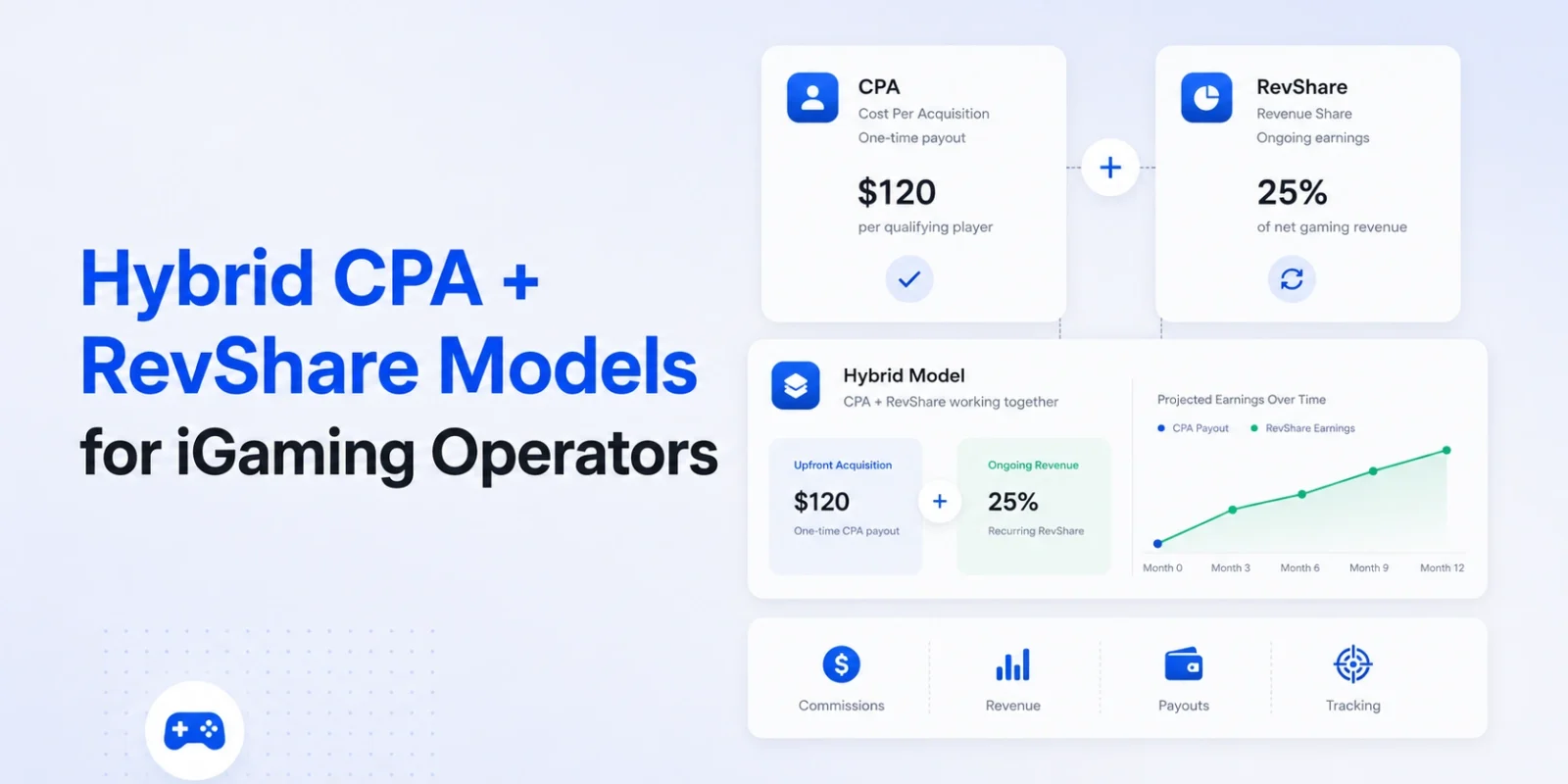
A proper hybrid model contains two persistent payout components attached to the same player, partner, source, or cohort.
The first component is a fixed CPA, usually lower than the CPA that would be offered in a pure CPA deal. The second component is a RevShare percentage applied to the player’s future NGR after the activation conditions are met.
A weak hybrid structure looks like this:
- CPA paid immediately on first deposit;
- RevShare active from day one;
- NGR defined vaguely;
- chargebacks handled manually;
- negative carryover explained only in contract language.
A strong hybrid structure looks like this:
- CPA paid only after first deposit, approved KYC, and minimum activity;
- validation window before payout release;
- RevShare activated only after a minimum NGR threshold;
- NGR formula attached directly to the commission plan;
- clawbacks and reversals processed automatically;
- affiliate-facing reports match finance-facing reports.
This distinction matters because hybrid models increase the number of moving parts. Operators are no longer managing one payout condition. They are managing acquisition cost, revenue participation, validation timing, risk controls, and reporting alignment at once.
The Scaleo Hybrid Commission Control Framework
A practical hybrid model should be designed around five control layers.
| Control Layer | What It Defines | Why It Matters |
|---|---|---|
| Attribution layer | Which click, source, partner, and sub-ID owns the player | Prevents commission disputes and source leakage |
| Qualification layer | Which events make CPA payable | Stops payment for low-quality or invalid acquisition |
| Revenue layer | Which NGR formula applies | Prevents RevShare ambiguity |
| Risk layer | Which fraud, chargeback, KYC, or bonus signals hold or reverse payout | Protects operator margin |
| Reporting layer | Which numbers affiliates, finance, and managers see | Keeps the program auditable |
In Scaleo, this logic can be managed through commission plans, tracking rules, partner-level conditions, custom parameters, fraud controls, and reporting views. The point is not simply to “support CPA and RevShare.” The point is to make the relationship between acquisition event and payout decision deterministic.
A simplified hybrid policy might read:
{
  "model": "hybrid",
  "cpa": {
    "amount": 80,
    "currency": "EUR",
    "trigger": "first_deposit",
    "conditions": {
      "minimum_deposit": 20,
      "kyc_status": "approved",
      "first_wager_required": true,
      "duplicate_account": false
    },
    "validation_window_days": 21
  },
  "revshare": {
    "percentage": 25,
    "activation": {
      "event": "minimum_ngr_reached",
      "threshold": 50
    },
    "ngr_formula": "GGR - bonuses - taxes - payment_fees - chargebacks - jackpot_contributions"
  },
  "risk_rules": {
    "chargeback": "reverse_cpa",
    "fraud_confirmed": "reject",
    "self_exclusion_within_7_days": "hold_for_review"
  }
}
This is how operators should think about hybrid deals: not as a sales promise, but as a ruleset that can be tested, reported, and audited.
Choosing the Right CPA Trigger
The CPA trigger is where most hybrid margin is won or lost.
If CPA is paid on bare registration, the operator is paying before any commercial value exists. If CPA is paid on first deposit without validation, the operator may still pay for players who never become usable, compliant, or profitable.
For iGaming operators, stronger CPA qualification usually includes a small stack of meaningful events:
- first deposit recorded;
- minimum deposit amount reached;
- KYC completed or approved;
- first wager or first settled bet recorded;
- no duplicate account match;
- no fraud flag above threshold;
- player remains valid through a short validation window.
The goal is not to make the affiliate jump through ten hoops. That creates friction and damages trust. The goal is to attach CPA payment to a player state that has real commercial meaning.
A useful rule: every gate should remove a specific economic risk.
| Gate | Risk Removed |
|---|---|
| KYC approved | Paying for users who cannot legally play |
| Minimum deposit | Paying for symbolic or bonus-led deposits |
| First wager | Paying for inactive depositors |
| Fraud check passed | Paying for duplicate or manipulated activity |
| Validation window | Paying before reversals, chargebacks, or self-exclusion events appear |
A good hybrid plan is not strict for the sake of being strict. It is strict exactly where the operator has measurable risk.
Defining RevShare Without Creating Disputes
RevShare disputes usually begin with one vague word: NGR.
If a contract says “25% RevShare on net gaming revenue” but the platform does not define the exact formula, the operator has created a future argument. Affiliates may assume one deduction model. Finance may apply another. Product teams may treat casino, sportsbook, jackpot, and bonus costs differently.
A RevShare layer should define exactly what is included and excluded:
- gross gaming revenue;
- bonus cost;
- taxes;
- payment processing fees;
- chargebacks;
- jackpot contributions;
- admin fees, if applicable;
- product-specific deductions;
- currency conversion logic;
- negative carryover rules.
The NGR formula should be machine-readable and attached to the commission plan. It should not live only in a PDF contract or email thread.
For example:
ngr = ggr - bonuses - taxes - payment_fees - chargebacks - jackpot_contributions
revshare = ngr * revshare_percentage
That looks simple, but it prevents a lot of pain. Once NGR is defined at rule level, affiliate dashboards, finance reports, accruals, and payout exports can all use the same calculation.
This is especially important for multi-brand operators. If one brand deducts bonuses before RevShare and another deducts bonuses after a threshold, the platform must reflect that difference clearly. Otherwise, the affiliate program becomes a spreadsheet circus with nicer lighting.
Handling Negative Carryover in Hybrid Deals
Negative carryover can change the real economics of a RevShare deal more than the RevShare percentage itself.
If negative carryover applies, a player’s negative monthly revenue can roll into the next period and reduce future affiliate earnings. If it is waived, the affiliate gets a cleaner upside, but the operator absorbs more volatility.
Neither option is universally right. The correct policy depends on product mix, player volatility, partner quality, and how much risk the operator is willing to carry.
What matters is clarity.
A hybrid plan should define:
- whether negative carryover applies;
- whether it applies at player, product, brand, or partner level;
- whether it resets monthly;
- whether it differs by casino and sportsbook;
- whether VIP or high-roller segments use separate logic;
- whether the affiliate can see carryover status in reporting.
For casino-heavy programs, negative carryover can materially affect affiliate trust. For sportsbook-heavy programs, settlement timing and bet resettlements may be a bigger source of volatility. Either way, the policy belongs inside the commission engine, not in someone’s memory.
The Metrics Operators Need to Monitor
Hybrid programs cannot be managed with FTD count and total commission alone. Those numbers show activity, not quality.
Operators need a dashboard that connects acquisition, validation, revenue, and payout.
The most important hybrid KPIs are:
| KPI | What It Shows |
|---|---|
| Qualified FTDs | Players who passed the actual CPA rules |
| Effective CPA | Real cost per qualified player after reversals |
| KYC pass rate | Source-level compliance quality |
| Day-7 and Day-30 retention | Whether players stay active after qualification |
| Bonus-to-GGR ratio | Whether traffic is bonus-dependent |
| Average NGR by cohort | Revenue quality by partner, GEO, and product |
| Payout-to-NGR ratio | Whether commission cost is sustainable |
| RevShare activation rate | How many CPA-qualified players become revenue contributors |
| Clawback rate | How often payouts are reversed after validation |
| Carryover exposure | How much negative revenue is rolling forward |
The operator should be able to answer one question quickly:
“Which partners are producing players whose value justifies both the upfront CPA and the long-term RevShare?”
If that answer requires exports from three systems, the hybrid model is not really under control.
How to Price a Hybrid Model
A practical starting point is to compare the hybrid deal against the pure CPA alternative.
The simplified payback formula is:
Break-even months = (Pure CPA - Hybrid CPA) / (Monthly NGR × RevShare %)
Example:
- Pure CPA offer: €200
- Hybrid CPA offer: €80
- Difference: €120
- Expected monthly NGR: €40
- RevShare: 25%
- Monthly RevShare value: €10
- Break-even period: 12 months
That means the hybrid deal becomes cheaper than the pure CPA deal only if the player remains active long enough to produce the required revenue. If the average player churns after month two, the hybrid may be under-incentivizing affiliates. If the player cohort retains strongly for 12+ months, the hybrid may protect the operator from overpaying upfront.
The mistake is pricing hybrid deals from negotiation pressure alone. Operators should price them from cohort evidence:
- source type;
- GEO;
- product;
- KYC pass rate;
- bonus usage;
- average month-1, month-3, and month-6 NGR;
- fraud and chargeback rates;
- affiliate transparency at sub-source level.
The better the data, the more confidently the operator can decide whether to raise RevShare, lower CPA, add validation rules, or promote a partner into a higher tier.
When Hybrid Models Work Best
Hybrid models work best when both sides have something to protect.
They work for operators because upfront exposure is lower than pure CPA and long-term payout is tied to revenue. They work for affiliates because there is still a near-term payment component, plus upside if the traffic performs.
Hybrid is especially useful for:
- new affiliate partnerships where quality is unproven;
- SEO and content affiliates with long-term player value;
- paid media partners who need upfront cash flow;
- high-potential affiliates entering a new GEO;
- operators expanding across multiple brands;
- programs trying to reduce pure CPA fraud risk;
- partners moving from test budgets to scaled traffic.
Hybrid is less useful when the operator has no reliable tracking, no clear NGR definition, no validation workflow, or no way to show affiliates how payouts were calculated. In that case, hybrid simply adds complexity to an already fragile program.
Implementation Roadmap for iGaming Operators
Operators do not need to rebuild every commission plan at once. A cleaner approach is to migrate into hybrid logic in phases.
Phase 1: Audit current commission rules
List every active partner and document:
- current model;
- CPA trigger;
- RevShare percentage;
- NGR definition;
- validation window;
- clawback rules;
- negative carryover policy;
- reporting visibility;
- dispute history.
The gap between contract language and platform behavior is usually where margin leakage hides.
Phase 2: Create partner archetypes
Group affiliates by traffic pattern rather than negotiating every deal from scratch.
Useful archetypes include:
- SEO/content affiliates;
- streamers and influencers;
- PPC and media buying partners;
- tipster communities;
- sub-affiliate networks;
- brand-to-brand partnerships;
- high-risk experimental sources.
Each archetype should have a default hybrid template with clear rules.
Phase 3: Launch controlled hybrid templates
Start with a small number of rule sets:
- one conservative hybrid plan for unproven sources;
- one growth hybrid plan for trusted affiliates;
- one premium hybrid plan for partners with strong retention and transparent source data.
Keep the first version simple. Too many exceptions make the model harder to explain and harder to audit.
Phase 4: Reprice from evidence
After cohorts mature, adjust based on actual performance.
Lower CPA where qualification is easy but value is weak. Increase RevShare where retention is strong. Tighten validation where fraud, bonus abuse, or KYC failure is high. Promote partners only when data supports better terms.
Hybrid commission management should feel less like guesswork and more like portfolio management.
How Scaleo Helps Operators Run Hybrid Commission Logic?
Scaleo gives iGaming operators one platform to manage affiliate tracking, partner attribution, commission plans, fraud controls, reports, and payouts. For hybrid CPA and RevShare models, that matters because the commission decision depends on multiple events, not one isolated conversion.
With Scaleo, operators can structure commission logic around partner rules, traffic sources, GEOs, player events, validation states, and payout conditions. Affiliate managers can monitor performance without waiting for manual spreadsheet reconciliation. Finance teams can review payout logic from the same underlying data. Affiliates can see clearer reporting, which reduces disputes and improves trust.
That is the real advantage of hybrid commission software. It does not just calculate a payout. It gives the operator control over when that payout becomes valid, why it was approved, and how it connects to player value.
FAQ
What is a hybrid CPA and RevShare model in iGaming?
A hybrid CPA and RevShare model pays affiliates a fixed amount for a qualified player action, usually a first deposit, plus a percentage of that player’s future net gaming revenue. It combines upfront acquisition reward with long-term revenue participation.
Why do iGaming operators use hybrid commission models?
Operators use hybrid models to reduce upfront CPA exposure while still giving affiliates enough early cash flow to scale traffic. The model works best when CPA qualification, RevShare activation, NGR definition, and validation rules are clearly controlled inside the affiliate platform.
What is the biggest risk in hybrid affiliate deals?
The biggest risk is paying CPA too early or calculating RevShare from an unclear NGR formula. If the platform does not enforce validation rules, fraud checks, chargeback handling, and negative carryover logic, the operator may overpay or create affiliate disputes.
Should RevShare start immediately after first deposit?
Not always. Many operators delay RevShare activation until the player reaches a minimum NGR threshold or passes validation. This prevents RevShare from applying to players who technically deposit but never create meaningful value.
How can Scaleo support hybrid commission management?
Scaleo supports iGaming operators by connecting tracking, attribution, commission rules, fraud controls, partner reporting, and payout workflows in one platform. This makes hybrid CPA and RevShare logic easier to manage, audit, and scale across partners, brands, GEOs, and products.
Final Takeaway
Hybrid CPA and RevShare models are not just a middle ground between two commission types. They are a way for iGaming operators to balance affiliate motivation, acquisition cost, player quality, and long-term revenue.
The model only works when the software can enforce the rules behind the deal.
For operators, the goal is not to offer the highest CPA or the biggest RevShare percentage. The goal is to build a commission structure where every payout reflects verified acquisition, measurable player value, and transparent revenue logic.
Scaleo helps operators turn hybrid commission agreements into controlled, trackable, and auditable affiliate operations.