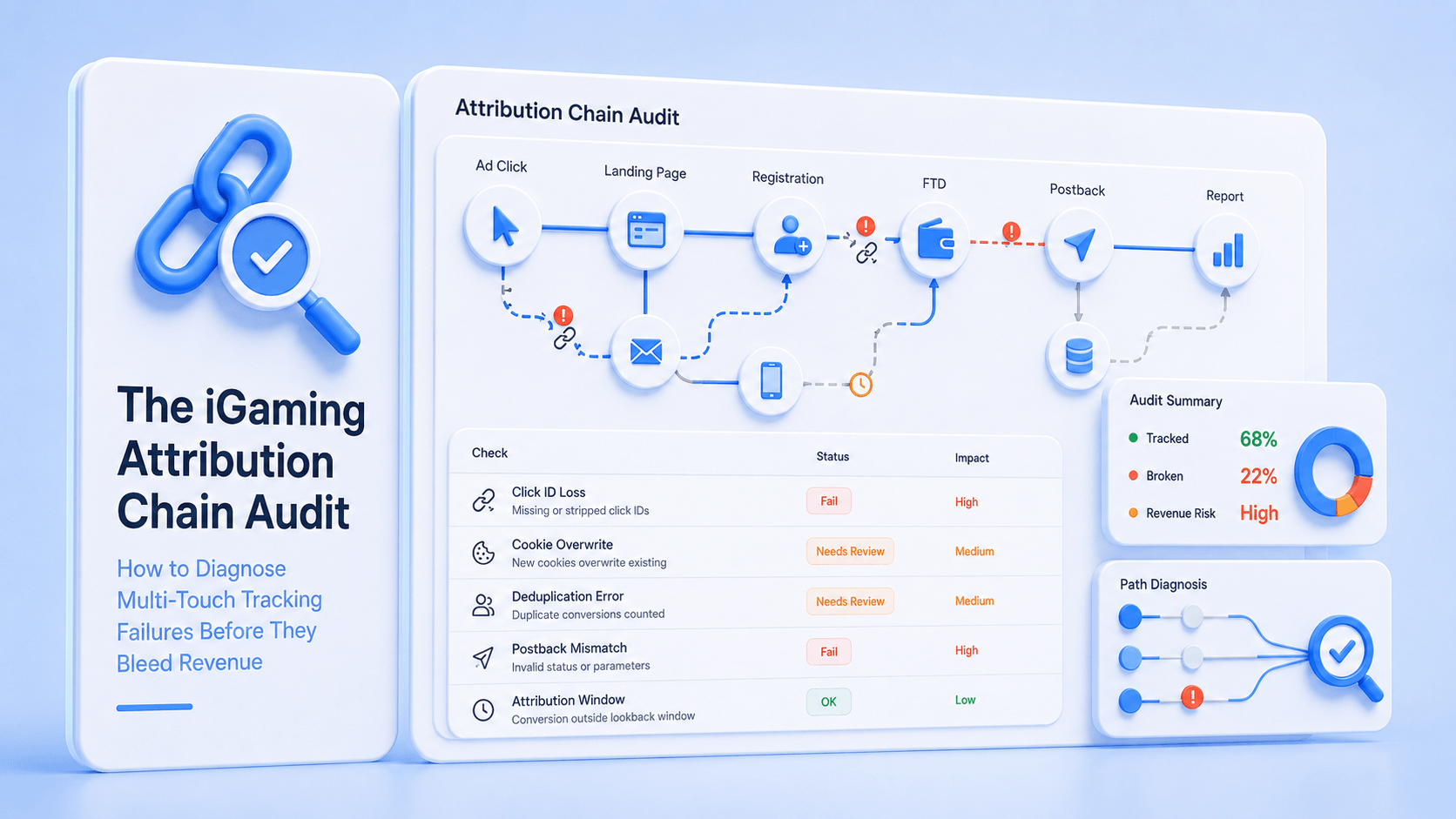
You may already be paying two affiliates for the same player without seeing it clearly in your reports. By the time the anomaly shows up in NGR or commission reconciliation, the overpayment has usually already flowed through a full billing cycle.
⚡ DIRECT ANSWER
An iGaming attribution chain audit is a structured diagnostic process that traces a player’s journey from the first affiliate touchpoint through registration and FTD to find where click IDs are overwritten, where postback deduplication fails, and where commission ends up assigned to the wrong partner. In programs that combine content affiliates, media buyers, streamers, or comparison portals, attribution conflicts are not unusual edge cases. The audit helps operators find and correct them before they distort payouts, reporting, and partner relationships.
The Diagnostic Scenario: You’re Paying Two Affiliates for the Same Player
Here is a typical multi-touch sequence that creates double-attribution risk in a real iGaming program.
A player searching for a weekend football betting offer clicks a bonus comparison listing on an SEO content site — Affiliate A, on a 35% NGR RevShare deal. They browse the operator’s site, do not register, and close the tab. Three days later, they watch a casino streamer on YouTube who mentions the same operator and uses a trackable link — Affiliate B, on a €90 CPA hybrid deal. The player clicks again but still does not register. Two days after that, they see a retargeting display ad from a media buyer — Affiliate C, on a pure CPA deal — and this time they register and deposit.
Three affiliates influenced the same player journey. One player registered. One CPA fired. One player will now generate NGR. In a last-click model, Affiliate C collects the CPA. In a first-click model, Affiliate A does. In a system without clear deduplication and attribution rules, the postback may end up rewarding more than one affiliate depending on which identifier survives to the point of conversion.
This is not rare in programs that run more than one affiliate type at the same time. Across operator audits and migration reviews, these conflicts tend to surface quickly whenever content affiliates and paid traffic partners operate under overlapping attribution logic. The cost is not just duplicate or questionable CPA payouts. It is polluted performance data that makes it harder to know which channels actually produce high-value players.
⚠️ Why this is structurally worse in iGaming than in e-commerce: In e-commerce, double attribution usually means paying twice on one sale. In iGaming, the mistake also contaminates long-term player value analysis. If the wrong partner gets credited for a high-LTV player, the operator is not just overpaying commission. They are making future deal, channel, and retention decisions on corrupted acquisition data.
The Multi-Touch Attribution Problem: How Click IDs Get Overwritten
Before auditing the chain, it helps to understand the mechanism behind most multi-touch failures in affiliate programs. In many cases, the issue is not a dramatic technical error. It is silent cookie overwriting.
How Cookie Overwriting Works in a Multi-Affiliate Journey
When a player clicks Affiliate A’s tracking link, the platform stores Affiliate A’s click ID in the browser. When the same player later clicks Affiliate B’s tracking link, that identifier may be replaced. If the player eventually registers after clicking Affiliate C’s link, the final stored click ID may now belong to Affiliate C, and the conversion is attributed accordingly.
Affiliate A and Affiliate B both influenced the player journey, but neither receives credit. Affiliate C — who may have delivered only the final prompt — receives the full CPA. Whether that is commercially fair depends on the operator’s policy. Whether it matches the operator’s stated policy depends on whether the platform is actually configured to enforce it.
The Three Overwrite Scenarios
Last-click wins: The latest click ID replaces earlier ones, so the affiliate responsible for the final pre-registration click receives the commission. This tends to favor retargeting affiliates and media buyers operating at the bottom of the funnel.
First-click wins: The first tracked click is preserved and later affiliate interactions do not replace it. This tends to favor discovery channels such as SEO content affiliates, but it can also reward very early touchpoints that did little to drive the final conversion.
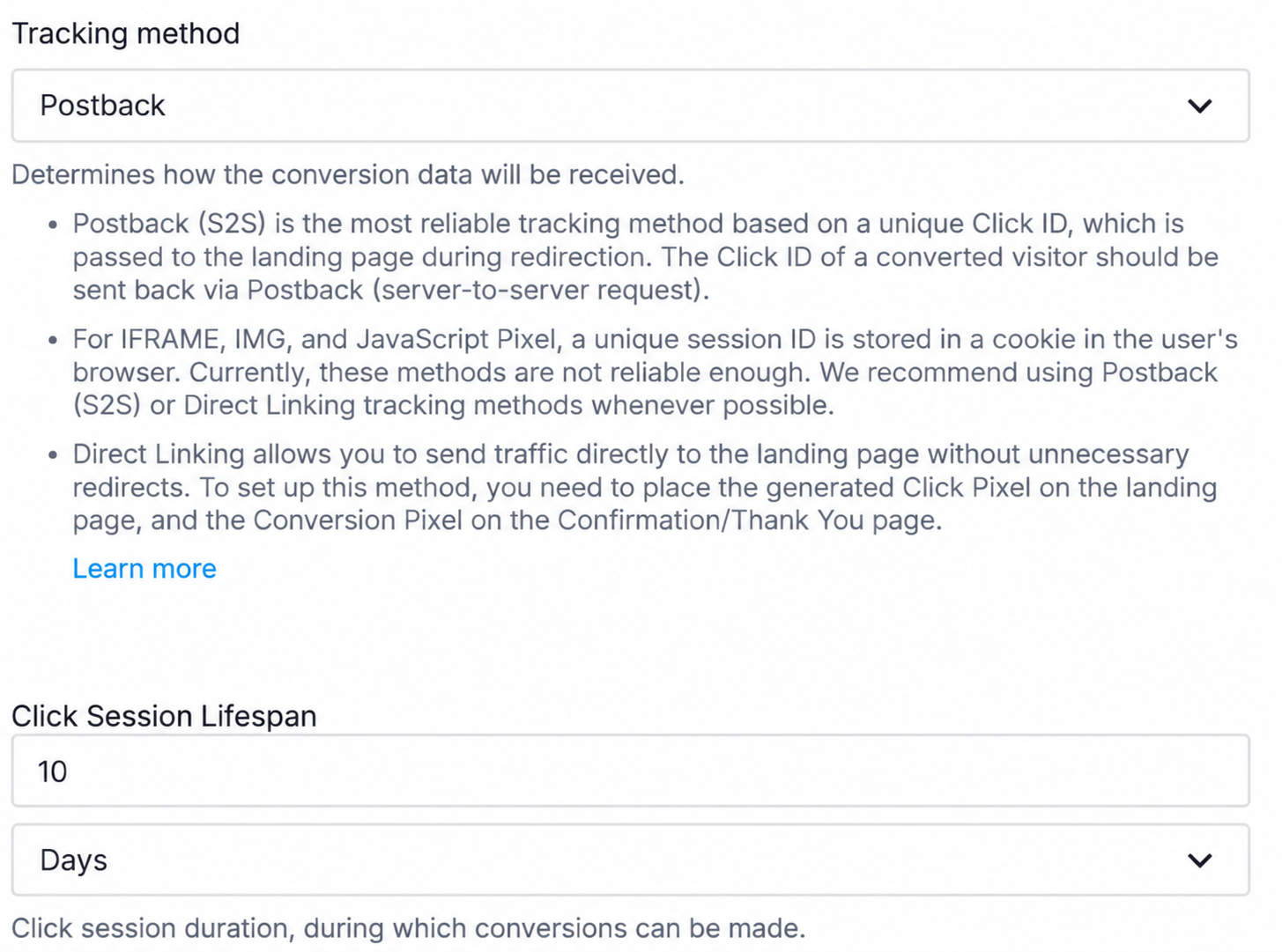
Hybrid with a lookback window: A defined window — often 30 days, though it varies by operator — determines how long attribution is preserved before a later click can take over. This is often the most balanced model, but only if it is explicitly configured and clearly written into program terms.
The important point is simple: the best model is not universally first-click or last-click. It is the one your affiliate terms describe and your platform actually enforces. Most attribution problems appear when policy and configuration drift apart.
The Attribution Chain Audit: A Step-by-Step Diagnostic
This audit can usually be run by an affiliate manager with access to postback logs and click event data. It does not necessarily require a developer, but it does require click-level visibility. If your platform stores only conversion events, part of this work may need help from the back office or product team.
Step 1: Map Your Attribution Policy Against Your Platform Configuration
Pull your affiliate agreement template and locate the attribution clause. It should define which click takes precedence, how long the attribution window lasts, and what happens when a player converts without a matchable affiliate identifier.
Then open your platform settings and verify the same logic is actually active. Check cookie duration, overwrite behavior, and deduplication rules. In particular, confirm whether deduplication works at the click ID level, player ID level, or transaction ID level.
Any mismatch between the written policy and the live configuration is a risk point. Operators often discover that the agreement says one thing while the platform has been enforcing something else for months.
Step 2: The Player Journey Trace
Pull the conversion log for the last completed billing cycle. For each FTD, identify the click ID that received attribution. Then trace backwards through the click event log using the same player identifier, such as player ID or a registration email hash.
Where a player shows more than one affiliate touchpoint before registration, record which affiliates were involved and which one received the commission. Then compare that outcome with the policy you say you use. If they do not match, you likely have a configuration problem rather than an affiliate dispute.
You do not need to audit every conversion to spot the pattern. A sample of 200 conversions from a billing cycle that includes both content affiliates and paid traffic partners is usually enough to reveal whether the issue is isolated or systemic.
Step 3: The Postback Duplication Check
Postback duplication is different from click overwriting. In this case, the system is not choosing the wrong affiliate from multiple touches. It is firing a qualifying commission event more than once for the same player.
Pull the postback delivery log for the same period, filter for FTD events, and group the data by player ID. If the same player ID appears in commission postbacks sent to more than one affiliate account, you have a duplicate payout problem.
This usually happens for one of three reasons: deduplication is disabled, the casino backend is firing to multiple endpoints without a gate, or an old and new platform were both still active during migration.
Step 4: The Unattributed Conversion Audit
Unattributed conversions are FTDs where no affiliate click ID can be matched to the registration event. These players may have arrived through direct traffic, dark social, blocked cookies, or channels your tracking setup never captured correctly.
Measure unattributed FTDs as a percentage of total FTDs in the same billing period. Below 10% is usually manageable. Above 20% suggests a broader tracking gap that needs attention.
For programs with heavy mobile traffic, a high unattributed rate often points to browser privacy controls such as iOS Intelligent Tracking Prevention. That is one of the clearest signs that cookie-only attribution is not enough.
Step 5: Check Attribution Outcomes by Affiliate Type
Break attribution outcomes down by affiliate type — for example, SEO content affiliates, media buyers, and streamers — and compare the share of credited conversions with each group’s share of pre-registration touchpoints or click volume.
In a pure last-click system, retargeting-heavy partners often capture conversions that discovery channels introduced earlier. That is not automatically fraud. It is often the predictable result of the chosen model. But it matters commercially, especially when one partner type is paid on CPA and another on RevShare.
This step may lead to a policy decision rather than a technical fix. You may decide to keep last-click, move to a hybrid model, or introduce channel-specific exclusions so one partner type does not continuously overwrite another.
The Attribution Audit Checklist
Here is a condensed version of the five-step audit for quarterly review.
| Audit Check | What to Pull | What You’re Looking For | Acceptable Threshold |
|---|---|---|---|
| Policy vs configuration match | Affiliate agreement attribution clause + platform cookie/deduplication settings | Discrepancies between stated lookback window, overwrite behavior, and actual platform config | Zero discrepancies |
| Multi-touch player journey traces | Click event log + conversion log, matched by player identifier, sample of 200 conversions | % of conversions with >1 affiliate touchpoint where attribution outcome contradicts stated policy | Under 5% policy violations |
| Postback duplication rate | Postback delivery log, grouped by player ID | Any player ID appearing in commission postbacks to >1 affiliate in same billing cycle | Zero duplications |
| Unattributed conversion rate | FTD count vs attributed FTD count for same period | % of FTDs with no matching affiliate click ID | Under 10%; investigate if above 20% |
| Attribution skew by affiliate type | Attribution outcomes broken down by affiliate category | Systematic over- or under-attribution to one affiliate type relative to their share of referred traffic | No single type capturing >60% of attributions if they represent <30% of click volume |
How Scaleo Handles Deduplication at the Postback Level
Platform-level deduplication is what prevents a qualifying event from triggering multiple commissions and helps operators enforce the attribution policy they actually intend to run.
Player-Level Deduplication
Each click tracked through Scaleo is recorded with its own identifier and timestamp. When a qualifying FTD postback arrives, the system checks whether a commission has already been recorded for that player within the relevant ruleset. If it has, the later event is logged as a duplicate rather than paid again.
That matters during backend misconfigurations and migrations. If two endpoints receive the same qualifying event, the operator still gets a visible record of the duplicate attempt, but the commission does not fire twice.
Configurable Attribution Windows and Overwrite Rules
Scaleo’s tracking configuration allows operators to define attribution windows and overwrite logic in line with commercial policy. That makes it possible to run different commission structures and attribution rules without leaving decisions to default browser behavior.
For example, an operator may want discovery-focused affiliates to keep attribution longer than retargeting-heavy paid traffic partners. The important part is not the exact model. It is that the model is intentional, documented, and enforced at platform level rather than improvised by cookie survival.
Click History for Attribution Disputes
Affiliate disputes are much easier to resolve when the platform stores the full click history rather than only the final converting event. With a full event timeline, the operator can see every tracked touchpoint leading to the conversion and explain why the credited partner received attribution under the current rules.
That reduces ambiguity, shortens reconciliation conversations, and makes the program easier to defend when a partner challenges a payout decision.
Why S2S Postback Matters
Cookie-based attribution is fragile because the operator does not control the browser environment. Players switch devices, clear cookies, or browse in privacy-restricted environments. When that happens, the original affiliate identifier may disappear before deposit.
S2S postback tracking ties the attribution chain to server-side player records instead of whatever cookie survives in the browser. That makes the chain far more durable and substantially reduces the kind of silent loss or overwrite that causes unattributed or misattributed conversions.
What operators usually find in a first attribution audit: the core problem is often not fraud. It is configuration drift. A program launches with one affiliate mix, then adds new partner types months later without revisiting attribution rules. The result is a system that still technically works, but no longer reflects how the operator wants credit and commission to flow.
Frequently Asked Questions
What is multi-touch attribution in iGaming affiliate programs?
Multi-touch attribution refers to the problem of assigning commission when a player interacts with more than one affiliate before registering and depositing. A player may click a comparison site, watch a streamer, and later convert through a retargeting campaign. The platform still needs to decide which touchpoint gets credit for one conversion event.
How do I know if I’m double-paying commission to affiliates?
Review your postback delivery log for a completed billing cycle and group FTD commission events by player ID. If the same player ID appears in commission events credited to more than one affiliate account, you likely have a duplicate payout issue. Even a small sample from the last cycle is enough to show whether the problem exists.
What is the difference between click ID deduplication and postback deduplication?
Click ID deduplication prevents one tracked click from generating multiple commission events because of retries, duplicate deliveries, or backend errors. Postback deduplication works at the player or conversion level, preventing the same underlying event from being paid more than once even when multiple identifiers or endpoints are involved.
Should I use first-click or last-click attribution for my iGaming affiliate program?
Neither model is always correct. Last-click usually favors retargeting and bottom-funnel traffic. First-click usually favors discovery channels such as SEO and content affiliates. For mixed-channel programs, many operators end up with a hybrid model and a defined attribution window, because it better reflects how different partner types contribute.
How often should I audit my attribution chain?
Quarterly is a sensible baseline, with an extra review whenever you add a new affiliate type, change commission logic, or migrate tracking infrastructure. The sooner you catch attribution conflicts, the easier they are to fix without clawbacks, disputes, or reporting distortion.
Attribution Drift Is Silent, Cumulative, and Usually Cheaper to Fix Early
Most mature affiliate programs experience attribution drift at some point. The setup that made sense at launch often stops matching the actual channel mix as new partner types, new traffic sources, and new payout structures are added. An audit takes hours. Letting the drift sit for three billing cycles usually costs more.
See how Scaleo’s attribution configuration and deduplication architecture supports multi-touch programs with mixed affiliate types — or run the five-step audit against your current setup and use the findings to tighten your policy before the next payout cycle.