Affiliate tracking software is one of those categories where the gap between platforms that look similar and perform differently is enormous. On the surface, most tools promise click tracking, commission management, and fraud protection.
Dig into the actual architecture and you’ll find some that flag fraud after they’ve already calculated the commission, use browser-dependent tracking that breaks with ad blockers, and produce reports that tell you clicks happened but not what drove them.
This post covers what modern affiliate tracking software actually needs to do — function by function — and how Scaleo handles each one. Not at the marketing level, but at the technical level: how the tracking works, how the fraud detection fires, and what the reporting actually shows.
What Affiliate Tracking Software Is For?
At its simplest, affiliate tracking software connects a click to a conversion and tells you who to pay.
In practice, it needs to do much more: attribute conversions accurately across browsers, devices, and user journeys; calculate the right commission for the right partner; detect low-quality or fraudulent traffic before a payout runs; give both the program manager and the affiliate a clear view of performance; and integrate with the rest of the marketing stack without becoming a bottleneck.
The stakes are real. A tracking gap of 15–30% in conversion attribution — common with cookie-only setups blocked by Safari’s ITP or ad blockers — means partners don’t get credited and managers can’t trust the data they’re optimizing against. Fraud that gets detected after commission is calculated means reversals, disputes, and partner relationship problems. Reports that stop at clicks and conversions without showing quality by source make it impossible to know which partners are worth scaling.
Most affiliate platforms are built to solve the easy problem — link → click → conversion → pay. The better ones are built to handle everything that goes wrong around that chain.
The 8 Core Functions Every Affiliate Tracking Platform Needs
1. Server-to-Server (S2S) Tracking
Cookie-based tracking was the default for affiliate programs for years. It still works well for certain setups, but it has a structural problem: the browser is in the middle of the data path. Ad blockers, Intelligent Tracking Prevention (ITP) in Safari and Firefox, and browser permission changes all interrupt the signal. The result is that a meaningful share of real conversions go unattributed.
Server-to-server (S2S) tracking — sometimes called postback tracking — removes the browser from the conversion step. When a user converts, the advertiser’s server fires an HTTP request directly to the affiliate platform’s server, passing the click ID and conversion data. No browser storage, no JavaScript dependency, no cookie that can be blocked or expired.
This is particularly important for any program running significant volume on mobile browsers, targeting privacy-conscious audiences, or buying media on platforms that restrict third-party cookies.
How Scaleo handles it:
Scaleo supports S2S postback tracking as a core tracking method, not an add-on. Conversion events fire server-to-server, passing the click ID from Scaleo’s tracking link back through the advertiser’s backend. The platform also supports cookie-based tracking via Google Tag Manager integration for setups where browser-based tracking is appropriate, mobile attribution tracking, UTM tracking, promo code tracking, QR code tracking, and impression tracking. The combination means programs can run the right method for each channel rather than forcing everything through one approach that doesn’t fit.
For programs where cookie attribution isn’t reliable, Scaleo also uses device fingerprinting as an additional attribution signal. The platform accepts conversion events from any source that can fire an HTTP postback — no proprietary format required from the sending system.
2. Fraud Detection That Fires Before the Commission
There are two architecturally different approaches to affiliate fraud detection.
The first is batch detection: the platform logs conversions, and a fraud review runs at the end of a period — nightly, weekly, or before payout approval. You find out about bad traffic after it’s already been credited as a conversion.
The second is real-time detection: every conversion is scored for fraud risk at the moment it fires, before it’s approved and before commission is calculated. This is architecturally harder to build, but it’s the only approach that avoids the operational problem of reversing already-calculated commissions and managing partner disputes after the fact.
What exactly qualifies as fraud in affiliate programs varies by vertical and traffic type, but the core categories are consistent: bot traffic from click farms or residential proxy networks; VPN and proxy users masking their true location to game geo-targeted offers; duplicate conversions from the same device or IP; and incentivized or self-referral conversions.
How Scaleo handles it:
Scaleo’s Anti-Fraud Logic™ runs in real-time on every transaction. For each event, the system aggregates data across a range of parameters: IP address, ISP, user device, browser, operating system, traffic source, HTTP referrer, and cookie state. That data is checked against approximately 40 internal and global blacklists covering known bad IPs, VPN exit nodes, proxy services, bot fingerprints, and other fraud signals.
The output is a fraud-risk score expressed as a percentage from 0% (minimal risk) to 100% (very high risk), displayed directly in all reports for Admin and Manager accounts. Program managers can configure rules — such as auto-rejecting conversions from duplicate IPs or blocking specific geos and devices — while retaining manual control over final approval decisions.
Critically, this detection happens before commission is logged. Catching bad traffic after the commission fires is operationally painful; catching it before means the number in the reports is already clean.
Scaleo also auto-flags multiple accounts associated with the same affiliate — a pattern that can indicate sub-affiliate fraud or self-referral abuse.
3. Flexible Commission Structures
The simplest affiliate programs run on a single CPA (cost per action) rate: a partner drives a conversion, they earn a fixed payout. That works until the program gets more complex — different rates for different partners, tiered payouts based on volume, RevShare commissions that change based on customer value, or hybrid models that combine an upfront payment with an ongoing percentage.
A tracking platform that can only handle flat CPA rates becomes a constraint on how the program is structured. Partners who bring high-volume or high-quality traffic often need different terms than smaller or newer partners, and programs with longer customer lifecycles need to attribute ongoing value back to the partner who first drove the conversion.
How Scaleo handles it:
Scaleo supports CPA, CPL (cost per lead), RevShare, hybrid models, flat-rate commissions, and multi-tier commission structures from a single platform. Within those types, commission rules can be differentiated by traffic type, device, geography, and partner group.
Commission tiers — where payout rates change based on monthly or total conversion volume — are available for programs that want to reward top partners without manually renegotiating rates. Goal-based commissions let programs configure different payouts for different conversion events within a single offer.
The sub-affiliate system supports multi-level commission structures, where a parent affiliate earns an override on conversions driven by affiliates they’ve recruited into the program. Both the parent-child relationship and the override calculation are tracked and reported within the platform.
For programs with complex payout logic, Scaleo’s API allows custom commission rules and event-based payouts to be built on top of the core platform.
4. Real-Time Reporting With Enough Depth to Be Useful
Most affiliate platforms produce reports. The meaningful difference between platforms is what those reports actually show and how quickly the data is available.
Surface-level reporting — clicks, conversions, commission by affiliate — tells you that activity happened but not what drove it. Understanding which traffic sources within an affiliate’s inventory are performing well, which devices or geos convert at different rates, or which offer variants are outperforming requires dimensional reporting: the ability to break down performance by multiple parameters simultaneously.
Speed matters too. Real-time data means managers can respond to a traffic quality drop on the same day rather than discovering it at the end of the billing period.
How Scaleo handles it:
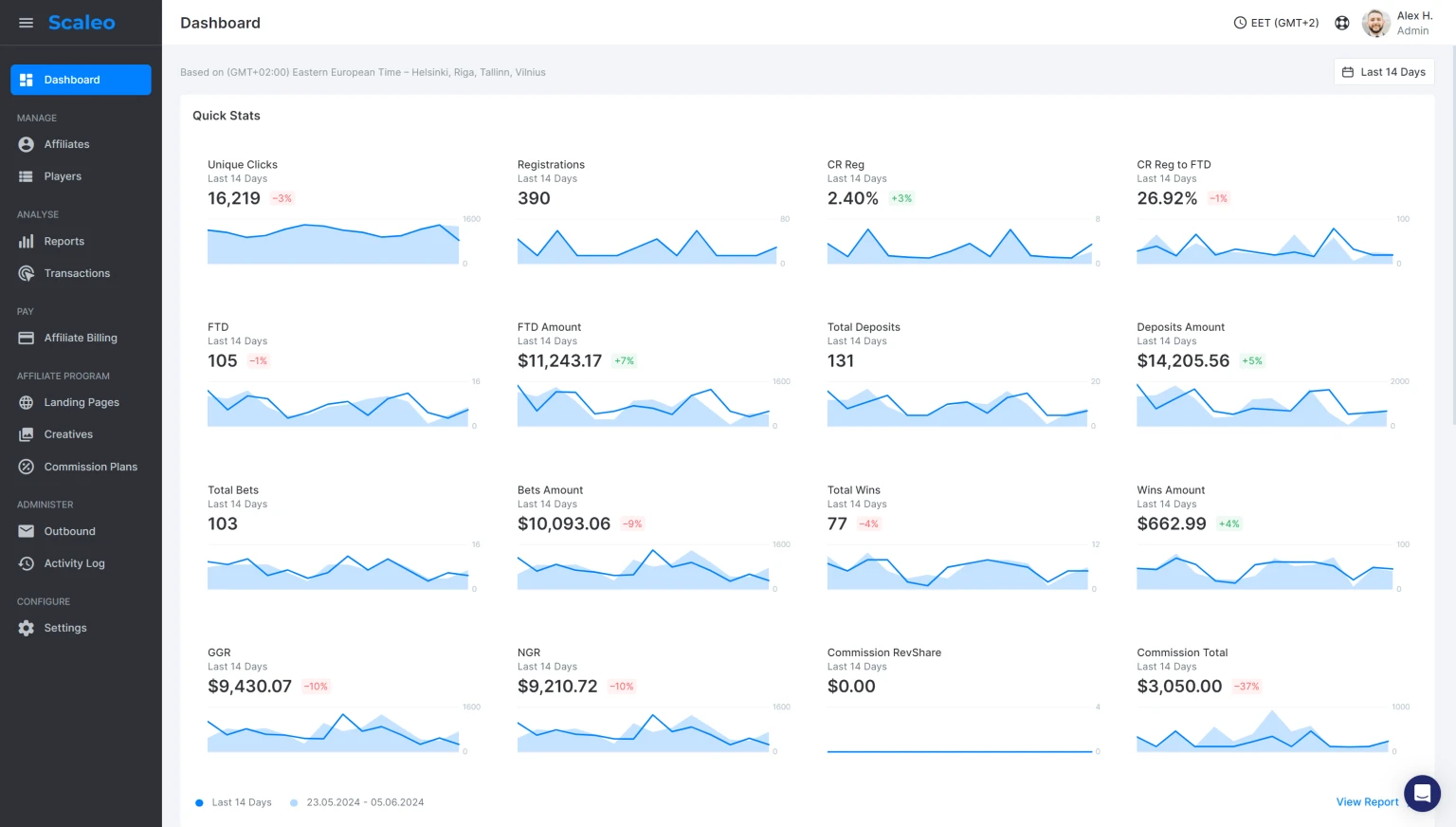
Scaleo’s reports pull from 30+ data points and update in real-time. The dashboard includes customizable widgets that surface the metrics most relevant to a given program, and reports can be filtered, sorted, and segmented across multiple dimensions.
Scaleo describes itself as the only affiliate platform with full data visualization built in — performance data rendered graphically rather than as raw tables. This is less about aesthetics and more about speed: patterns visible in a chart are slower to spot in a raw CSV.
Fraud scores appear inline with conversion data in all report views, so managers don’t have to run a separate fraud report to understand traffic quality. SubID reporting lets managers drill into an affiliate’s performance by traffic source, placement, or any custom parameter passed through the tracking link.
Automated reporting can be configured to send reports to team members on a set schedule, reducing the manual overhead of weekly performance reviews.
5. Smart Links and Traffic Distribution
When a program runs multiple offers across different geos, devices, or verticals, a standard tracking link routes traffic to a single destination. An affiliate promoting in three countries needs three links, and the manager needs to create and maintain offer configurations for each. At scale, this creates administrative overhead and introduces the risk of traffic going to the wrong offer when targeting conditions aren’t perfectly matched.
Smart link technology solves this by routing traffic automatically based on configured rules — sending a user to the best-matching offer based on their location, device, OS, browser, or other parameters — without the affiliate needing to manage multiple links.
How Scaleo handles it:
Scaleo’s SmartLinks handle automatic traffic routing to the best-performing offer. The routing logic can factor in geo-targeting, device type, and offer availability. If an offer’s budget is exhausted or it’s unavailable for a given geo, the SmartLink redirects to the next available match rather than sending traffic to a dead end.
Scaleo also supports landing page A/B testing and traffic distribution across multiple landing pages for the same offer, letting managers optimize conversion rates on the offer side without requiring affiliates to change their links.
Direct linking — sending traffic to an advertiser’s landing page without an intermediate redirect — is supported for programs that want to avoid the extra latency of a redirect hop.
6. White-Label and Custom Branding
For companies running in-house affiliate programs, brand consistency matters. Affiliates interacting with a portal that carries a third-party SaaS name aren’t experiencing a seamless extension of the company’s brand — they’re being reminded they’re using someone else’s software.
For agencies or networks managing affiliate programs on behalf of multiple clients, full white-labeling is a baseline requirement: the platform needs to appear as the client’s product, not as a branded reseller of the underlying SaaS.
How Scaleo handles it:
Scaleo is a white-label SaaS platform that supports custom application domains with SSL, custom logos, color schemes, and multi-language interface configuration. On all plans, the platform can be presented under the company’s brand with a custom tracking domain.
Full white-labeling — including removal of “Powered by Scaleo” attribution from the affiliate-facing interface — is available on the Custom plan. The affiliate dashboard, the advertiser portal, and all tracking links operate under the client’s domain.
The white-label configuration extends to the affiliate registration flow and communications, meaning the end-to-end experience an affiliate has with the program is branded to the operator, not to Scaleo.
7. API-First Architecture and Third-Party Integrations
No affiliate program runs in isolation. The tracking platform needs to communicate with the e-commerce platform that records sales, the CRM that holds customer data, the ad platforms that run paid campaigns alongside the affiliate channel, and potentially the payment infrastructure that handles partner payouts.
A platform without a complete, documented API or without pre-built connectors to common platforms forces teams to build manual reconciliation processes — exporting from one system, importing into another, managing the data lag between them.
How Scaleo handles it:
Scaleo is built with a complete REST API and webhook support. The API allows external systems to push or pull any data element in the platform — conversion events, affiliate records, commission calculations, payout statuses — enabling custom integrations with proprietary systems without requiring format-specific adapters.
Pre-built integrations cover the major e-commerce platforms: Shopify, WooCommerce, Tilda, Wix, BigCommerce, Magento, CS-Cart, OpenCart, and Squarespace. Google Tag Manager integration handles cookie-based tracking setups for web platforms that use GTM for tag management.
For mobile programs, Scaleo integrates with major mobile measurement partners including AppsFlyer, Adjust, and TUNE. Conversion data from these sources flows into Scaleo’s reporting alongside web conversion data.
Webhook support means downstream systems — payout processors, CRMs, business intelligence tools — can receive real-time notifications of conversion events without polling the API.
8. Affiliate and Advertiser Management
Tracking and reporting are the technical foundation, but an affiliate program is also a relationship infrastructure. Partners need a place to access their tracking links, review their performance, download creative assets, and check their commission status. Advertisers running offers within a network need their own view of how their campaigns are performing, without accessing data from other advertisers on the platform.
How Scaleo handles it:
Each affiliate in Scaleo has their own private dashboard with access to their tracking links, offer details, creative assets, promotional news, and performance reports. The affiliate-facing interface is separate from the admin dashboard and configurable to show only what’s relevant to each partner.
For multi-advertiser programs or networks, Scaleo maintains data isolation between advertiser accounts. Each advertiser can see their own campaign performance and commission data without visibility into other advertisers on the same platform.
Role and permission management lets program operators create different access levels for internal team members — managers who can approve conversions, team members with reporting access only, and account managers with access limited to specific partner groups.
The Mailroom feature handles direct communication with affiliates from within the platform, and Scaleo’s mobile app (available for iOS and Android) lets managers and affiliates check performance data without desktop access.
What Separates Best-in-Class from the Rest
The features above are table stakes for any serious affiliate program. Where platforms actually diverge is in the details of implementation.
Fraud detection that runs post-approval is functionally different from detection that runs at conversion time, even if both are described as “real-time.” Server-to-server tracking that requires a proprietary event format from the sending system is less flexible than one that accepts standard HTTP postbacks. Commission management that handles flat CPA well but breaks down on hybrid or tiered structures forces programs to maintain external spreadsheets to track what the software can’t.
The questions worth asking before choosing an affiliate tracking platform aren’t about feature checklists. They’re about architecture: does the fraud detection fire before or after commission is logged? Does the S2S integration require a connector for every backend, or does it accept any postback? Is the API complete enough to push and pull any data element, or limited to pre-defined exports?
Scaleo’s approach on each of these is covered above, pulled from their actual help documentation and platform specifications. The Anti-Fraud Logic™ fires in real-time before commission calculation. The S2S postback API accepts events from any source without requiring a pre-built connector. The REST API is documented as complete with access to all data elements. The commission engine handles CPA, CPL, RevShare, hybrid, tiered, and goal-based structures with device- and geo-level differentiation.
For programs at the stage where tracking gaps, fraud exposure, and manual reconciliation are measurable problems — rather than theoretical ones — those architectural differences matter.
Getting Started with Scaleo
Scaleo offers a 14-day free trial with full platform access, no credit card required. The setup process includes out-of-the-box integrations for the major e-commerce and CMS platforms, and Scaleo’s team handles migrations from other affiliate platforms, including transfer of affiliate accounts, historical data, and tracking links where possible.
Plans start at the Professional tier for growing programs and scale to Enterprise and Custom tiers for higher conversion volumes, additional tracking domains, and full white-label configurations.
Scaleo is an award-winning partner marketing software used by affiliate networks, advertisers, and agencies across e-commerce, SaaS, performance marketing, and financial services verticals. The platform is trusted by 1,000+ companies globally and is recognized across multiple industry software review platforms for its fraud detection capabilities, interface design, and support responsiveness.