Customer acquisition costs have climbed roughly 60% over the past five years. Paid search keeps getting more expensive. Social ad performance has flattened for most verticals. Meanwhile, referral-acquired customers convert at 3–5x higher rates, carry 16% higher lifetime value, and churn 37% less frequently than customers from paid channels.
That math is why referral marketing is no longer a “nice to have” channel. For brands serious about sustainable growth, it has become the anchor.
But here’s what most guides don’t tell you: the mechanics of referral marketing in 2026 are meaningfully more complex than putting a “refer a friend” button on your homepage. Cookie restrictions, ad blockers, cross-device journeys, fraud, multi-partner attribution — the tracking layer underneath a referral program has to handle all of it reliably, or the whole model breaks down.
This post covers how referral marketing actually works at a technical level in 2026, what your tracking software needs to do, and how Scaleo is built to handle each piece.
What Referral Marketing Actually Is in 2026
Referral marketing is a performance-based growth channel where existing customers, partners, affiliates, or influencers send new customers to your business — and get rewarded when those referrals convert.
The structure varies by business model:
- Customer referral programs: Existing customers share a unique link; they get rewarded when a friend signs up or buys.
- Affiliate programs: Publishers, creators, or comparison sites drive traffic to your brand on a CPA (cost per acquisition) or revenue share basis.
- Partner programs: B2B referral arrangements, often with agencies, resellers, or ecosystem partners.
In 2026, these three models have started blending into each other. A brand might run customer referrals, a formal affiliate network, and a partner portal simultaneously — all needing the same conversion events tracked, with different commission logic applied to each.
The channel is growing fast. The referral marketing software market was valued at under $230 million in 2019 and is projected to exceed $7 billion by 2031. That trajectory tells you where marketing budgets are heading.
How a Referral Gets Tracked: The Actual Mechanics
Before evaluating any platform, it helps to understand what has to happen technically for a referral to get attributed correctly.
- The click happens. A user clicks a unique referral link tied to a specific partner or customer ID.
- A tracking ID gets set. The platform either drops a cookie in the user’s browser (client-side) or logs a server-side click ID.
- The user converts. They sign up, buy something, install an app, fill out a form — whatever the advertiser defined as a conversion event.
- The conversion fires. The platform receives a signal. For cookie-based tracking, this comes from a pixel on the confirmation page. For server-to-server (S2S) tracking, it comes from a postback from the advertiser’s backend.
- Attribution happens. The platform matches the conversion to the correct partner and applies commission rules.
- Payout flows. At the agreed schedule, the partner gets paid.
That process sounds simple. The part where things break is steps 2 and 4.
Why Basic Referral Tracking Breaks in 2026
Safari has blocked third-party cookies since 2017 through Intelligent Tracking Prevention (ITP). Firefox followed. On mobile, cookies behave differently depending on whether the user is in-app or in-browser. Ad blockers are now installed on roughly 35–40% of desktop browsers — and they don’t just block ads, they block tracking pixels too.
The result: a referral tracking system built entirely on browser cookies and JavaScript pixels will miss a meaningful percentage of conversions. Studies have found miss-rates of 10–20% in some verticals. You end up paying partners for some referrals and failing to credit them for others, which creates disputes and erodes trust in the program.
That’s why server-to-server tracking isn’t optional anymore. It’s the baseline.
The 7 Things Modern Referral Tracking Software Must Handle
1. Server-to-Server (S2S) Tracking
S2S tracking bypasses the browser entirely. When a conversion happens, the advertiser’s server sends a postback — a direct HTTP request — to the tracking platform’s server. No pixel, no cookie dependency, no ad blocker vulnerability.
The accuracy advantage is significant. S2S postbacks are tied to a unique click ID generated when the user first clicked the referral link. That ID travels server-to-server, so the attribution chain stays clean regardless of browser behavior or device changes.
How Scaleo handles it: Scaleo supports S2S postback tracking natively on all plans. You configure a postback URL on Scaleo’s end and fire it from your backend when a qualifying conversion event occurs. Scaleo receives the event, looks up the click ID, attributes the conversion to the correct partner, and applies your commission rules — entirely server-side. It also supports cookie-based tracking, UTM tracking, QR code tracking, promo code tracking, impression tracking, and mobile app tracking. You can use the method that fits each channel without switching platforms.
2. Multi-Method Attribution
No single tracking method covers every user journey. A customer might click a referral link on mobile, browse your site on desktop, and convert three days later through a direct visit. Cookie-based tracking loses that attribution. S2S tracking needs to be fired from your backend to capture it.
Best-in-class referral platforms let you layer multiple tracking methods and apply attribution logic that reflects how your customers actually behave — not just who clicked last.
How Scaleo handles it: Beyond S2S and cookies, Scaleo supports device fingerprint tracking (which generates a unique device signature without relying on browser storage), UTM parameter-based attribution, and promo code tracking. Multiple methods can run in parallel. The platform also supports SubIDs, letting partners add custom parameters to their links to track which specific ad placement, content piece, or channel drove each click — useful for any affiliate managing multiple traffic sources.
3. Fraud Detection That Runs Before Payout
Referral fraud is a genuine problem at scale. Bot traffic, click farms, fake registrations, cookie stuffing, proxy sales — these patterns eat into commissions that should never have been paid. A program that relies on manually reviewing suspicious conversions after the fact will always be one step behind.
The standard for 2026: fraud detection that flags suspicious activity in real time, before any payout is approved.
How Scaleo handles it: Scaleo’s Anti-Fraud Logic is the feature that shows up most consistently in independent reviews on G2 and Capterra. The algorithm runs automatically on every click and conversion. It flags known bot traffic, multiple accounts from the same device or IP, suspicious velocity patterns, and other signals that correlate with fraudulent activity. One reviewer described it plainly: “It gives you an insight into which conversions could be fraud and the percentage chance of them being fraud, which really allows you to tackle any issues early on in your campaigns.” The system assigns a fraud probability score to each conversion before it reaches payout status — not after.
4. Real-Time Reporting and Data Visualization
If you can’t see what’s happening until 24 hours after it happens, you can’t optimize. Partner programs running on delayed reporting operate blind. By the time you notice a traffic quality issue, you’ve already paid commissions on questionable conversions. By the time you see a top performer emerging, the window to act has passed.
Real-time reporting is what separates running a program from actually managing one.
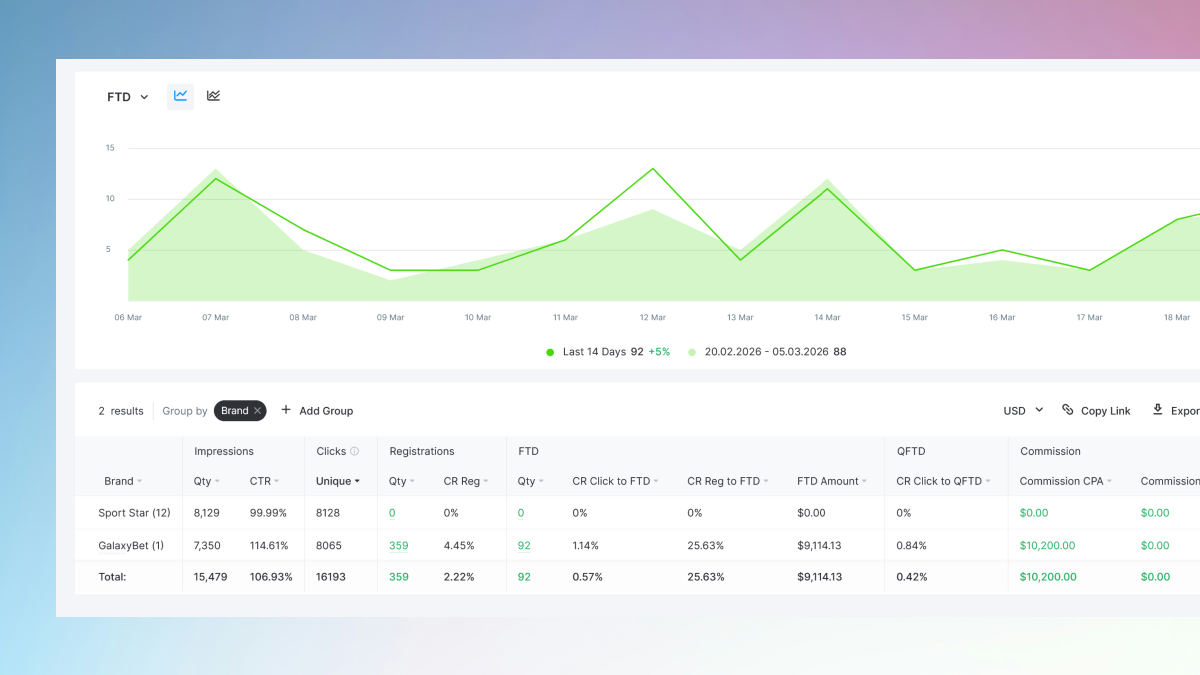
How Scaleo handles it: Scaleo bills itself as “the only affiliate software on the market with full data visualization,” and that framing reflects a real product difference. The dashboard shows clicks, conversions, commissions, and traffic quality metrics as they happen. You can filter by affiliate, date range, device type, geographic source, and campaign — all live. The interface is built around making those metrics visually understandable rather than just tabular. For teams managing dozens of partners or running landing page tests, that visibility is what makes optimization practical instead of retrospective.
5. Flexible Commission Structures
Not every referral program pays the same way. Some brands pay a flat CPA per signup. Others pay a percentage of revenue, with different rates for different partner tiers. Some run hybrid structures where a partner earns a smaller CPA upfront and a revenue share on retained customers.
If your tracking platform only supports one commission model, you’ll either oversimplify your program or spend time manually reconciling payouts in spreadsheets.
How Scaleo handles it: Scaleo supports CPA, revenue share, flat fee, and hybrid commission plans within the same account. Commission tiers let you pay top-performing partners at higher rates without creating separate campaigns for each. Sub-affiliate tracking supports multi-level partner structures — useful if your affiliates recruit other affiliates beneath them. The invoicing system sits inside the platform, so payout reconciliation doesn’t require jumping to a separate tool.
6. Partner Experience and Dashboards
Partners — whether they’re affiliates, influencers, or customer advocates — need visibility into their own performance. If they have to email your team to find out their click count or pending commission, they’ll lose confidence in the program. Partner experience directly affects both recruitment and retention.
How Scaleo handles it: Every partner in Scaleo gets a dedicated dashboard where they can access their unique links, check performance metrics in real time, download creative assets, view commission history, and track payout status. The interface is white-labeled, so partners see your brand, not Scaleo’s. Smart links allow dynamic redirection based on rules you set. Landing page A/B testing lets you test which destinations convert best. There’s also a mobile app so partners can check their stats without logging into a desktop browser.
7. API Access and Integrations
A referral program doesn’t operate in isolation. It needs to connect with your CRM, payment processor, email platform, and often custom backend systems. The more manual the data transfer between tools, the more errors accumulate and the more time your team spends on reconciliation.
How Scaleo handles it: Scaleo provides a full REST API that supports automation of virtually any data element — affiliate creation, campaign management, conversion data export, commission status updates, and more. Native integrations cover major e-commerce platforms including Shopify, WooCommerce, Magento, BigCommerce, Wix, and Tilda, as well as mobile attribution tools like AppsFlyer, Tune, and Adjust. Webhooks let you trigger real-time actions in external systems when specific events occur in Scaleo, without polling the API.
What the Full Stack Looks Like
When those seven capabilities work together, here’s what the workflow actually looks like:
A partner joins your program through Scaleo’s affiliate portal. They receive a unique tracking link under your custom domain. When a user clicks that link, Scaleo logs a click ID server-side. The user reaches your site. When they convert, your backend fires a postback to Scaleo’s S2S endpoint. Scaleo receives the postback, matches it to the click ID, runs fraud analysis in real time, records the commission, and updates the partner’s dashboard within seconds.
The full journey — click to attribution to fraud check to commission credit — runs inside one platform without manual steps at any stage.
Feature Comparison: Scaleo vs. Basic Referral Tools
| Feature | Basic Tools | Scaleo |
|---|---|---|
| Cookie-based tracking | Yes | Yes |
| S2S / Postback tracking | Rarely included | Yes, on all plans |
| Device fingerprinting | No | Yes |
| Real-time fraud detection | No | Yes — Anti-Fraud Logic |
| Real-time reporting | Partial | Full, with data visualization |
| Flexible commission models | Limited (usually CPA only) | CPA, RevShare, Hybrid, Tiered |
| Sub-affiliate / multi-level | No | Yes |
| White-label partner portal | Rarely | Yes |
| Full REST API | Limited | Yes |
| Mobile app tracking | No | Yes |
| Promo code tracking | Sometimes | Yes |
| QR code tracking | No | Yes |
Frequently Asked Questions
What is the difference between referral marketing and affiliate marketing?
Referral marketing typically refers to programs where existing customers refer new customers, often in exchange for a discount or credit. Affiliate marketing usually involves third-party publishers, creators, or media buyers promoting a brand for a commission. In practice, the tracking infrastructure needed for both is nearly identical: unique links, conversion attribution, fraud detection, and commission calculation. Scaleo supports both models on the same platform.
What is S2S tracking and why does it matter for referral programs?
Server-to-server (S2S) tracking reports conversion events directly between servers, without relying on a browser cookie or JavaScript pixel. Because it operates outside the browser, it’s unaffected by ad blockers, Safari’s ITP restrictions, or cookie opt-outs. For any referral program with meaningful volume, S2S is the most reliable way to ensure conversions are attributed correctly.
How does fraud detection work in affiliate tracking software?
Fraud detection systems analyze signals associated with each click and conversion — IP addresses, device fingerprints, click velocity, account duplication, and traffic source behavior — to identify patterns inconsistent with legitimate users. Scaleo’s Anti-Fraud Logic runs this analysis automatically in real time, scoring each conversion for fraud risk before it reaches payout status.
Can Scaleo run both affiliate programs and customer referral programs?
Yes. Scaleo’s platform supports affiliate networks, standalone partner programs, and customer referral programs within the same account. Different commission structures can be applied to different partner groups, and the dashboard experience can be customized for each.
How quickly can you set up a referral program in Scaleo?
Cookie-based tracking can be running within a day using tag managers like Google Tag Manager. S2S postback integration requires configuring your backend to fire conversion events to Scaleo’s endpoint — a standard API task. Scaleo includes setup support across all plans and a 14-day free trial.
What does Scaleo cost?
Scaleo’s pricing starts at $240/month for e-commerce brands (Starter plan) and $500/month for the Professional plan, which covers most affiliate network and partner program use cases. Enterprise plans start at $750/month. Annual billing reduces pricing by 20%.
The Bottom Line
Referral marketing in 2026 is a performance channel with real technical requirements. The difference between a program that runs smoothly and one that creates constant disputes is almost entirely in the tracking layer: whether conversions are captured reliably, whether fraud is caught before payout, and whether partners have the visibility they need to stay engaged.
Platforms that don’t handle those requirements will leave attribution gaps, pay commissions on fraudulent conversions, and generate the kind of payout disputes that kill partner relationships.
Scaleo is built to handle the full stack — S2S tracking, multi-method attribution, real-time fraud detection, data visualization, flexible commissions, white-label partner portals, and a complete API. If you’re running or planning a referral or affiliate program, the infrastructure matters as much as the incentives.