Anti-Fraud Operations · Bonus Integrity · Advanced Detection
The hardest affiliate fraud to catch is not the fraud that looks like fraud. It is the fraud that looks exactly like your best acquisition month. Real players. Real KYC documents. Real deposits. Real wagering activity. The affiliate is sending you genuine human beings who have been carefully instructed on how to extract maximum value from your bonus structure and leave. By the time the NGR report tells you what happened, you have paid the CPA, absorbed the bonus cost, and the players are halfway through doing the same thing at your competitor’s program.
This post is specifically about that fraud type — coordinated bonus gaming by real players who are being directed, recruited, and sometimes compensated by the affiliate sending them. It is the most operationally sophisticated category of iGaming affiliate fraud, the hardest to detect without behavioral analysis, and the most expensive to absorb once it is running at scale.
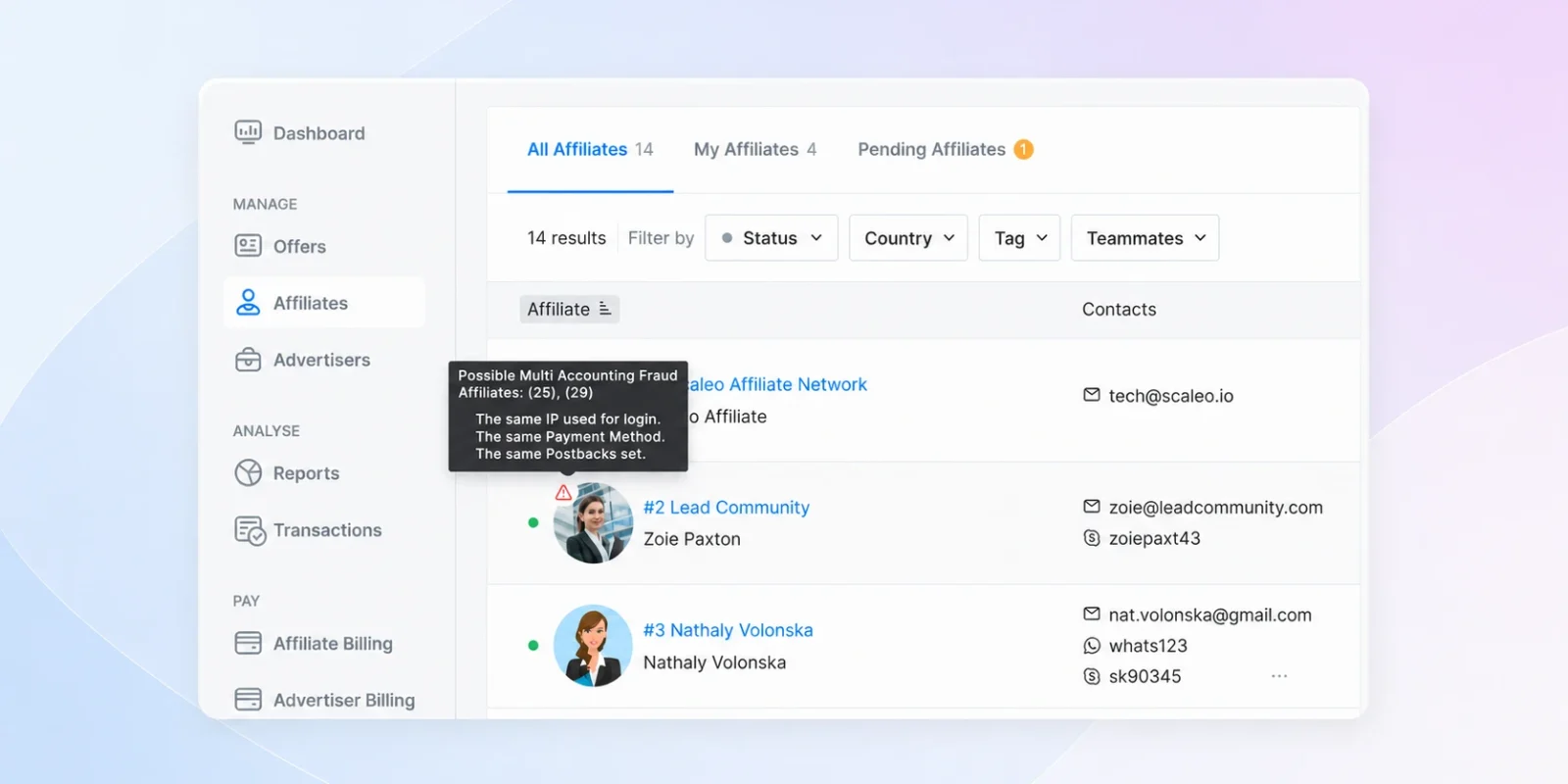
It also has a specific detection signature that Scaleo’s Anti-Fraud Logic™ is designed to surface — but only if the operator understands what they are looking for and how the platform is configured to find it.
The Mechanics: How Affiliates Teach Players to Game Your Bonus Structure
To detect coordinated bonus gaming, you need to understand exactly how it is organized at the affiliate level. Most operators imagine bonus abusers as unsophisticated opportunists making individual decisions. At the level of fraud that actually moves the needle on monthly NGR, the operation is considerably more structured.
The affiliate — or a coordinated network operating through a single affiliate account — maintains a communication channel with recruited players. This is typically a private Telegram group, a Discord server, a closed WhatsApp channel, or, in sophisticated operations, a dedicated “bonus guide” website that ranks in search results for terms like “casino welcome bonus how to clear” or “low-risk bonus wagering strategy.”
The channel serves three functions: player recruitment, instruction distribution, and coordination timing.
The instruction content is the critical element.
These are not naive players who happen to choose low-variance games — they are players who have received step-by-step guidance specifying: the exact deposit amount that minimizes exposure while maximizing bonus value (usually the minimum qualifying deposit that triggers the maximum matching percentage), the exact game or game type that offers the highest return-to-player against the wagering requirement (classic blackjack with basic strategy, or specific slot configurations with RTP above 98% and low variance), the exact session timing that clears the wagering requirement in the minimum number of spins or hands, and the withdrawal window to target once the requirement is satisfied.
A player following this instruction set is not making random decisions. They are executing a mathematically optimized extraction sequence. The wagering they complete is real — it fires real postbacks, generates real session data, clears your qualification gates. The economic outcome for the operator is structurally negative regardless of how the wagering requirement is set, because the player is making the statistically optimal choice at every decision point in the sequence.
The affiliate earns the CPA when the player completes the qualifying deposit. By the time the player follows the withdrawal instructions, the commission has been paid and the affiliate has no further stake in what happens. The entire cost — bonus, processing fee, CPA — sits with the operator.
The player keeps their winnings minus the expected value loss from completing the wagering on a high-RTP game. The affiliate keeps the CPA minus whatever share they passed back to the recruited player.
⚠️ Why traditional fraud detection fails here: IP blacklists, device fingerprint blocking, and VPN detection are designed to catch non-human or identity-fabricated traffic. Coordinated real-player bonus gaming produces genuine human behavioral signals at every surface-level detection layer. The player’s IP address is residential. Their device fingerprint is unique. Their KYC documents are real. Their deposit is genuine. The only layer where the fraud is visible is the behavioral analysis of what they do after the deposit — and most operators either are not running that analysis, or are running it at the aggregate level where the statistical signal is too diluted to detect until the damage is already done.
The Detection Signature: What Coordinated Bonus Gaming Looks Like in Data
Coordinated bonus gaming by real players produces a distinctive data signature at the cohort level. Individual players following the same instruction set converge on similar behavioral patterns — not because of any technical coordination between their devices, but because they are executing the same mathematical strategy. That convergence is the detection signal.
Signal 1: Game Selection Concentration on High-RTP, Low-Variance Titles
A normal player cohort depositing through a content affiliate’s traffic channel shows game selection diversity — slots across different providers, some table games, occasional live casino play, varying RTP profiles.
A coached bonus-gaming cohort shows game selection concentrated in one to three specific titles that have the highest RTP and lowest variance combination available for wagering requirement clearance. The titles they converge on are not random — they are specifically listed in the guide the affiliate distributed.
The detection metric: when more than 45% of an affiliate cohort’s wagering activity in the first 96 hours concentrates on fewer than three game titles, and those titles share high RTP profiles (above 96%) and low variance characteristics, the game selection pattern is consistent with coordinated instruction rather than organic preference.
Scaleo’s event-level game activity data — received via the postback chain from the casino backend — allows this concentration metric to be calculated at the affiliate and SubID level within a single billing cycle.
Signal 2: Wagering Efficiency Far Above Cohort Baseline
The “wagering efficiency” metric measures how precisely a player’s actual wager volume tracks the wagering requirement multiplier — with no excess wagering beyond the minimum needed to clear the requirement. A genuine casual player deposits, plays their favorite games, and may wager 2x or 3x the requirement before noticing their bonus has cleared.
A coached player wagers to almost exactly the requirement threshold and stops. They know the number. They were given it in the guide.
When a cohort’s median wagering total clusters within 5–10% of the exact wagering requirement multiplied by the deposit amount — across 20 or more players — the precision is statistically implausible for organic play. Players do not independently and consistently wager to exactly 30x their deposit by coincidence. They do it because they were told to stop at that point.
Signal 3: Withdrawal Timing Clustering After Wagering Completion
The withdrawal request timing after bonus clearance is the behavioral signal most unique to coordinated bonus gaming. Organic players who clear a wagering requirement and have a positive balance tend to continue playing — they are engaged. Coached extraction players submit a withdrawal request within hours of clearing the requirement, because the guide told them that is what they should do.
The detection metric: median time between wagering requirement completion event and withdrawal request submission. In a coached cohort, this interval clusters tightly — many players submitting within the same 2–6 hour window after clearing the requirement. In an organic cohort, the distribution is broad and irregular.
Scaleo’s postback schema captures both the bonus clearance event and the withdrawal request as distinct typed events, making this interval measurable at the affiliate source level without manual data extraction.
Signal 4: Correlated Timing Across Players — The Coordination Fingerprint
This is the most diagnostically powerful signal, and the one that requires event-level timestamp data to detect. When an affiliate’s referred players complete wagering and submit withdrawals in correlated time clusters — multiple players completing the same sequence within the same short window, on the same days of the week, or at the same times of day — the correlation is the coordination fingerprint.
Players who independently discovered your bonus and independently decided to game it would not independently choose the same Tuesday evening session window across six consecutive weeks.
The coordination timing often reflects when the affiliate posts to their Telegram group or Discord channel. A post goes out at 7pm with the deposit instructions and the code. Twenty players deposit between 7pm and 9pm. Twenty withdrawal requests arrive 96 hours later. The next post goes out the following Tuesday at 7pm. The pattern repeats.
At the affiliate level in Scaleo’s reporting, this appears as registration and QFTD spikes on specific days followed by withdrawal spikes 72–96 hours later — a rhythm that a random organic cohort does not produce.
The Evasion vs. Detection Arms Race
Sophisticated bonus gaming affiliates are aware that operators run fraud detection. The more advanced operations deliberately attempt to break the detection signals above by introducing variance — instructing players to wager a random amount beyond the requirement (say, 1.1x to 1.3x rather than exactly 1.0x), to play one or two non-optimal game rounds before switching to the optimal title, and to delay the withdrawal request by a random interval of one to three days.
This evasion layer is specifically designed to push the cohort-level behavioral signals below the threshold that triggers automated fraud flags.
| Evasion Technique | What It Mimics | Why It Still Fails Detection |
|---|---|---|
| Wagering 10–30% above the requirement before withdrawing | Casual player who “played a bit extra” | Wagering still clusters in a narrow band above the requirement across the cohort; the clustering itself is the signal, even if the floor is higher |
| Playing 2–3 rounds on a low-RTP game before switching to the optimal title | Normal game exploration behavior | The switching pattern is consistent across the cohort — same game sequence, same session structure, same transition timing — which organic exploration does not produce |
| Delaying withdrawal by 1–3 days with a random offset | Player who “thinks about it” before withdrawing | At cohort level, the delay distribution is uniform-random rather than naturally skewed; withdrawal clustering after the random delay period is still visible in the timing data |
| Using different deposit amounts within a defined range (e.g., €25–€45) | Organic deposit amount variation | All amounts within the coached range still cluster in the highest-bonus-trigger segment; the range is narrow and consistently above the minimum threshold |
| Spreading deposits across multiple days rather than simultaneously | Organic conversion timing | Registration-to-deposit interval still clusters at a specific time post-instruction-post; the absolute timing varies but the relative interval from registration is consistent |
The fundamental limitation of evasion strategies is that they cannot randomize the economic incentive.
A player following a bonus guide is always trying to maximize their expected return from the wagering requirement. That objective function constrains their behavioral choices regardless of the random noise added around the edges.
The statistical distribution of a cohort executing an optimized strategy with random perturbations is distinguishable from the distribution of an organic cohort at sufficient sample size — and Scaleo’s behavioral baseline is built from genuine organic player data, which makes the distinguishing comparison automatic rather than manual.
How Scaleo’s Anti-Fraud Logic™ Catches Real-Player Bonus Gaming
The technical architecture matters here because Scaleo’s fraud detection for this fraud type operates differently from its detection of synthetic identity registrations or click injection attacks. Those fraud types are detectable at the click and registration layers. Coordinated real-player bonus gaming is only detectable at the post-conversion behavioral layer — which requires the platform to store and analyze player event data after the QFTD, not just at the QFTD event itself.
The Event Graph: What Scaleo Receives and Stores
For real-player bonus gaming detection to work, Scaleo’s postback schema must receive typed events for the full player lifecycle — not just the deposit event. Specifically: registration event, first deposit event, bonus claim event, wagering session events (with game title and wager amount), bonus clearance event, and withdrawal request event. Each event carries a player ID, an affiliate attribution (click ID matched at registration), a timestamp, and event-specific parameters.
The platform’s Anti-Fraud Logic™ runs cross-event behavioral analysis against each affiliate’s attributed cohort. The analysis is not run at the individual player level — a single player exhibiting any of the above signals could have an innocent explanation. It is run at the cohort level, where the statistical patterns produced by coordinated instruction become visible against the baseline established from the operator’s legitimate organic traffic.
The fraud score generated for each affiliate is a composite of multiple behavioral signal weights, not a single threshold. Game selection concentration contributes a score. Wagering efficiency clustering contributes a score. Withdrawal timing correlation contributes a score. Coordinated timing patterns across players contribute a score. The composite determines the alert tier — enhanced monitoring, commission hold for review, or automated investigation flag. The decision to act is configurable by the operator; the scoring is automated and continuous.
The Custom NGR Deduction Layer: Why Paying on Gross Events Enables This Fraud
One structural protection that significantly reduces the damage from real-player bonus gaming is calculating affiliate commissions on true NGR rather than raw deposit events or gross revenue. Scaleo’s commission architecture deducts bonus costs, processing fees, and jackpot contributions from GGR before the commission base is calculated. A player who deposits €25, claims a 100% match bonus, wagers to the minimum requirement on a 98% RTP game, and withdraws their remaining balance has generated:
- GGR: approximately €12.50 (expected value of 2% house edge on €625 wagered)
- Bonus cost deduction: €25 (the matched deposit)
- Processing fee deduction: approximately €0.75
- NGR: approximately −€13.25
If the affiliate’s commission is calculated on true NGR, this player generates a negative commission event — the operator paid the bonus and absorbed a net loss, but at least the CPA was not also paid on top of it. If the commission is calculated on the raw deposit event (€25), the operator pays a CPA of perhaps €80 in addition to absorbing the negative NGR, for a total loss per player of approximately €93.25.
The NGR deduction layer does not prevent the fraud — the bonus cost is still absorbed, the player still left, and the NGR event is still negative. What it prevents is the compounding: paying a commission on a player event that generated negative economic value. In a program running 200 coached players per month through a bonus gaming operation, the difference between CPA-on-deposit and commission-on-NGR is approximately €16,000 in avoided commission overpayment per month. The fraud is still happening. It is just not being rewarded with a commission on top of the loss.
Advertiser Security Tokens: Stopping Fabricated Postbacks
A related but distinct fraud vector operates alongside coordinated real-player gaming: affiliates who attempt to fire fabricated conversion postbacks — simulating player deposits that never occurred — to claim CPAs without any real player activity. Scaleo’s Advertiser Security Token mechanism addresses this directly.
Operators configure a unique token in their casino backend that must be present in every conversion postback for Scaleo to accept it as valid. Postbacks arriving without the correct token are rejected and logged as unauthorized conversion attempts. This ensures that conversion events can only be fired by your casino platform’s backend infrastructure — an affiliate cannot claim a CPA by guessing your postback URL format and firing it from an external source.
The security token requirement is configured in Scaleo’s offer tracking settings. Once enabled, any postback arriving on the offer’s endpoint that does not carry the correct token value is rejected, logged with the originating IP, and flagged for review. The affiliate sees no conversion credit. The operator sees an unauthorized postback attempt in their delivery log — which is itself a diagnostic signal that the affiliate is attempting technical fraud alongside or instead of real-player recruitment.
IP Whitelisting for Postback Endpoints
The postback IP whitelisting configuration in Scaleo’s tracking settings restricts conversion postback acceptance to a defined list of authorized IP addresses — specifically, the server IPs of your casino backend infrastructure.
This prevents open-network postback abuse: an affiliate who has identified your postback URL format cannot fire conversion events from their own servers or from a bot network. Only postbacks originating from your whitelisted casino backend IP ranges are processed.
For operators managing multiple casino backends or PAM providers, the whitelist supports multiple IP ranges simultaneously. Changes to the whitelist take effect immediately without requiring platform restart or a postback configuration update on the affiliate side — the restriction operates at the receiving endpoint, invisibly to affiliates.
Platform Configuration: Building the Detection Stack
The detection capabilities described above require specific platform configuration to activate. The following represents the implementation sequence that operators experiencing real-player bonus gaming fraud should deploy, ordered by the speed at which each layer stops the ongoing financial exposure.
Step 1: Secure the Conversion Postback Chain
In Scaleo’s Settings > Tracking, enable Advertiser Security Token for all iGaming offers. Configure your casino backend to append the token to every conversion postback. Enable IP whitelisting for your casino backend’s server IP range. These two controls eliminate fabricated postback fraud and ensure that every conversion event in Scaleo originated from a real casino backend event — not from an affiliate attempting to claim CPAs on non-existent player activity.
In the same settings, configure the Unique Session Span minimum delay. A conversion postback arriving within 2–5 seconds of the originating click event is mathematically impossible for a genuine player who clicked an affiliate link, read the landing page, completed registration, and made a deposit.
Scaleo’s Click Session Lifespan setting rejects postbacks with impossibly short click-to-conversion intervals, flagging them as injection attempts. For iGaming bonus gaming detection, set the minimum conversion delay to 300 seconds (5 minutes) as a floor — this eliminates click injection while being well within the normal range of genuine player onboarding time.
Step 2: Configure Anti-Fraud Logic™ for Post-Conversion Behavioral Analysis
In Offers > [Select Offer] > Anti-Fraud Settings, enable the behavioral analysis parameters and configure alert thresholds specific to bonus gaming detection:
Set the game session event postback parameters to receive game title, wager amount, and session timestamp for each wagering event — not just the deposit and withdrawal events. This requires coordination with your casino backend to fire session-level postbacks to Scaleo’s endpoint alongside the standard conversion events. Without session-level event data, game selection concentration analysis is impossible.
Configure the withdrawal event postback to fire when a player initiates a withdrawal request, carrying the player ID, withdrawal amount, and timestamp. Scaleo stores this event against the player’s attribution record and includes it in the cohort-level behavioral analysis for the referring affiliate.
In the NGR deduction settings, configure the bonus cost deduction rate for each offer. Scaleo’s commission calculation will apply this deduction to every NGR calculation for players acquired under that offer, ensuring that bonus costs are subtracted from the commission base before any RevShare or hybrid commission is calculated. Operators who have not yet configured NGR deduction rates are calculating commissions on GGR — which means every bonus-gaming player is generating a commission on the gross amount of their wagering, not the net economic value they produced.
Step 3: Set Affiliate-Level Behavioral Alert Thresholds
With post-conversion event data flowing, configure the alert thresholds in Scaleo’s Anti-Fraud Logic™ that trigger review flags for bonus gaming patterns:
- Game selection concentration alert: Flag affiliates whose cohort shows more than 40% of wagering activity concentrated in fewer than three game titles, where those titles share RTP profiles above 95%. Threshold: flag when this concentration persists across 10 or more attributed players in a single billing period.
- Withdrawal velocity alert: Flag affiliates whose cohort shows median time between bonus clearance event and withdrawal request below 12 hours. This is the most direct signal of coached extraction behavior — organic players do not consistently withdraw within hours of bonus clearance at cohort scale.
- NGR per QFTD alert: Flag affiliates whose 45-day cohort average NGR per qualifying first deposit is below a defined threshold — for most casino programs, below −€20 per QFTD over a 45-day window indicates systematic extraction rather than variance. This is the financial outcome signal that confirms the behavioral signals.
- Deposit amount clustering alert: Flag affiliates whose cohort shows more than 60% of deposits within a narrow range of the minimum bonus-triggering amount. Legitimate organic traffic produces a normal distribution of deposit amounts above the minimum. Coached traffic clusters precisely at the instruction-specified deposit amount.
Scaleo internal data, 2025: Operators who configured post-conversion behavioral alert thresholds — specifically the withdrawal velocity and NGR-per-QFTD alerts — identified coordinated bonus gaming operations within an average of 1.4 billing cycles from the point the operation began generating material volume. Operators relying on pre-conversion fraud detection alone (click-level, IP, and device checks) identified the same operations at an average of 4.8 billing cycles — by which point the affiliate had been paid three to four times and the NGR drain was in the five-figure range. The detection layer that catches real-player bonus gaming is entirely different from the one that catches bot traffic. Both are necessary. Only one of them is sufficient for this fraud type.
What to Do When You Find It: The Investigation and Response Sequence
An alert triggering is not a confirmed fraud finding. It is an investigation trigger. The investigation sequence for suspected coordinated bonus gaming differs from the sequence for suspected click fraud or synthetic identity registrations, because the evidence required to confirm it and act on it is different.
Step 1: Pull the cohort-level behavioral data for the flagged affiliate. Export the full event history for all players attributed to this affiliate in the alert window: deposit amounts, game selection sequences, wagering totals relative to requirement, withdrawal timing.
Calculate the median, standard deviation, and distribution shape for each behavioral dimension. The question you are answering is: does this distribution look like an organic player cohort, or does it look like a cohort executing a shared strategy?
Step 2: Check for timing correlation across players. Look at the registration timestamps and deposit timestamps relative to clock time and day of week. If multiple players are registering and depositing within the same narrow time windows on repeated occasions, the timing correlation is the coordination fingerprint. Map when these windows occur relative to any identifiable affiliate content output — if the affiliate runs a Telegram channel or a YouTube channel, check whether they posted bonus-related content within 6–12 hours before the registration spikes.
Step 3: Contact the affiliate directly with the data — not an accusation. Present the behavioral metrics: “We have identified a pattern in your recent traffic — 67% of wagering activity from your referred cohort is concentrated in two game titles, and the median deposit-to-withdrawal interval across 22 players is 81 hours. We would like to understand what traffic source is generating this cohort.”
A legitimate affiliate who is unaware that one of their sub-affiliate sources is running bonus gaming instructions will be able to identify and disconnect the source. A bonus gaming operation will not have a credible explanation.
Step 4: Commission hold pending resolution. While the investigation is ongoing, hold commission payments on the players exhibiting the suspicious pattern — not on the affiliate’s entire portfolio. Scaleo’s commission plan configuration supports per-player commission hold flags. The hold prevents further CPA payments on the affected cohort without disrupting the affiliate’s commission income from legitimate traffic that has already been attributed.
Step 5: Structural response — qualification gate tightening. Regardless of the affiliate investigation outcome, a bonus gaming operation that reached the alert threshold is evidence that your current qualification gate is passable by a coached player.
Review the Baseline, wagering requirement, and activity window configuration for the affected offer. Tightening any of these — or adding a game eligibility restriction that excludes high-RTP, low-variance titles from wagering requirement clearance — closes the specific route the operation was using, even if the affiliate continues sending traffic from other sources.
Frequently Asked Questions
Is coordinated bonus gaming illegal?
From the player’s perspective, completing a wagering requirement on a high-RTP game is not illegal — the casino’s terms and conditions define which games are eligible, and if the game is listed as eligible, the player is following the rules. The legal and commercial issue operates at the affiliate layer, not the player layer.
An affiliate who recruits players specifically to execute a bonus extraction strategy — particularly if they are compensating players with a share of the bonus value — is in breach of most iGaming affiliate agreement terms prohibiting incentivized traffic and bonus abuse facilitation. The affiliate’s conduct gives the operator contractual grounds for commission clawback and termination. The player’s conduct may give the operator grounds to void bonus eligibility under bonus abuse terms in the player agreement, but this is a separate and more complex question that requires legal review in your specific jurisdiction.
How do I distinguish coordinated bonus gaming from legitimate low-engagement players?
Individual low-engagement players — those who deposit, meet the wagering requirement, and withdraw — exist in every cohort and are not inherently indicators of coordination. The distinguishing factor is cohort-level statistical pattern rather than individual player behavior.
A single player completing the minimum wagering on a high-RTP game and withdrawing within 72 hours is normal variance. Fifteen players from the same affiliate source completing the same sequence with game selection concentrated in the same two titles and withdrawal timing clustering within the same 6-hour window is a coordination fingerprint.
The detection threshold requires minimum cohort sizes (typically 10+ attributed players showing the pattern) to reduce false positives from genuine variance events. Individual behavioral signals alone should trigger monitoring, not action — composite cohort signals trigger investigation.
Should I restrict which games count toward wagering requirements to prevent this fraud?
Yes — game eligibility restrictions on wagering requirements are one of the most effective structural defenses against coached bonus gaming. Excluding or reducing contribution percentages for high-RTP, low-variance games (classic blackjack with certain rule sets, specific slot configurations above 97% RTP) from wagering requirement clearance removes the specific mathematical advantage that coached players are exploiting.
The trade-off is player experience: legitimate players who prefer these games will have a less efficient wagering requirement experience. The calibration question is whether the fraud prevention value justifies the legitimate player experience cost for your specific player demographics. Most operators in competitive markets exclude games above 97% RTP from wagering requirement clearance and apply 50% contribution weighting to games in the 95–97% RTP range — a middle ground that reduces the extraction advantage while not completely penalizing players who enjoy these games.
Can Scaleo detect bonus gaming across multiple affiliate accounts from the same operation?
Yes, through two mechanisms. First, player-level cross-affiliate analysis: if Scaleo identifies a coordinated bonus gaming pattern from affiliate A’s cohort and a subsequent cohort from affiliate B shows similar behavioral signatures, the platform can cross-reference player ID, device, and payment instrument signals to identify overlap suggesting the same operation is running accounts across multiple affiliates. Second, behavioral baseline contamination detection: if the same game-selection concentration pattern and withdrawal timing signature appears simultaneously across multiple affiliate cohorts, the platform’s anomaly detection scores each cohort independently but the pattern correlation across accounts is visible in the operator dashboard. At the investigation stage, affiliate accounts showing correlated behavioral patterns from the same time period should be reviewed together, not in isolation.
What is the typical financial exposure from a coordinated bonus gaming operation before detection?
Based on Scaleo’s operator data, the median detection lag for coordinated bonus gaming using pre-conversion-only fraud controls is 4.8 billing cycles. A mid-scale operation generating 40–60 coached players per month, at a CPA of €90 and an average bonus cost of €25 per player, creates operator exposure of approximately €4,600–€6,900 per month in CPA plus bonus costs — or €22,000–€33,000 over a 4.8-cycle detection window before the pattern is identified and the commission hold is applied. Programs that add post-conversion behavioral alerts reduce the median detection lag to 1.4 cycles, limiting the same operation’s undetected exposure to approximately €6,400–€9,700. The configuration change that enables post-conversion behavioral analysis costs nothing beyond the time to set it up. The detection lag difference is worth approximately €15,000–€23,000 per incident in avoided payout exposure.
The Fraud That Passes Your Fraud Filter Is the Fraud That Costs You the Most
Click-level fraud detection — IP blacklists, bot filtering, VPN blocking — catches the fraud that looks like fraud at the traffic layer. Coordinated real-player bonus gaming does not look like fraud at the traffic layer. It looks like acquisition. The detection layer for this fraud type is entirely downstream: game selection patterns, wagering precision clustering, withdrawal timing correlation, NGR per QFTD over time. If you are not running analysis at those layers, you are not running analysis that can find this fraud. The configuration changes that enable it are not complex. The cost of not enabling them compounds every billing cycle the operation runs undetected.
See how Scaleo’s Anti-Fraud Logic™ applies post-conversion behavioral scoring to detect coordinated bonus gaming before the payout run — or explore the platform’s commission architecture and how NGR deduction configuration structurally reduces the commission exposure from bonus extraction events.