Summery: Server-side tracking helps iGaming operators protect affiliate attribution, reduce missed FTDs, improve payout accuracy, and build a cleaner audit trail across casino, sportsbook, and multi-brand affiliate programs.
For operators still relying on browser pixels, third-party cookies, and scattered client-side scripts, attribution is becoming a little like reading tea leaves in a thunderstorm: occasionally poetic, rarely reliable.
In iGaming, tracking is not a vanity metric. It decides who gets paid, which affiliates receive premium deals, which campaigns should be scaled, which traffic sources need fraud review, and whether the finance team can explain why one partner’s commission suddenly changed.
That is why server-side tracking, often called S2S tracking or server-to-server postback tracking, has become one of the most important technical foundations for modern casino and sportsbook affiliate programs.
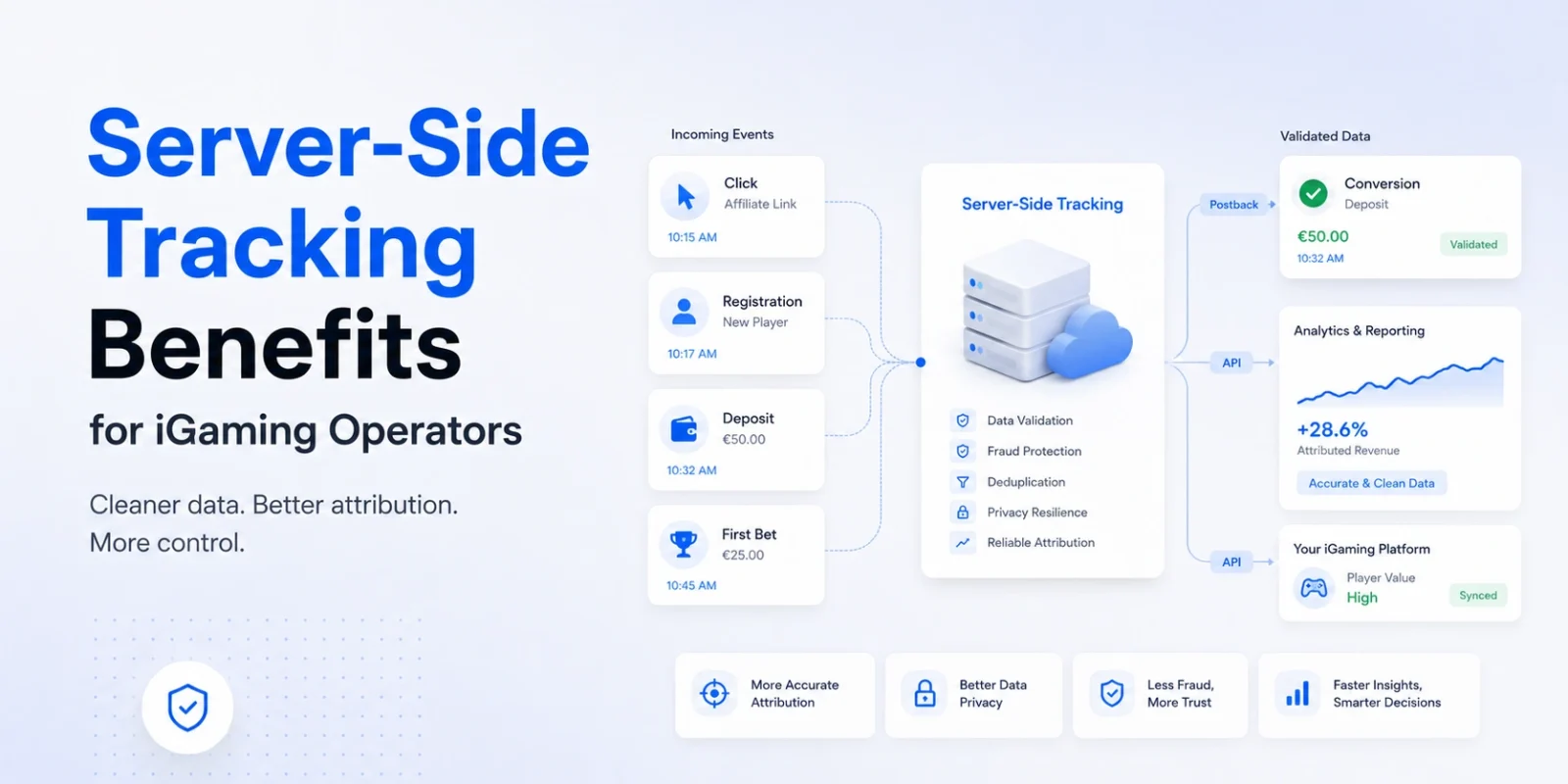
Instead of depending only on the player’s browser to fire a pixel after registration or deposit, server-side tracking sends conversion data directly from the operator’s system to the affiliate tracking platform. This creates a more stable attribution chain, especially for events like registration, first-time deposit, qualified player activity, chargebacks, bonus abuse review, and commission approval.
What is server-side tracking in iGaming?
Server-side tracking is an attribution method where conversion events are recorded and passed between backend systems instead of relying only on browser-based pixels. In an iGaming affiliate program, this usually means the operator’s platform sends a postback to the affiliate software when a tracked player completes a valuable action.

Typical iGaming server-side events include:
- player registration;
- email or KYC verification;
- first-time deposit;
- qualified deposit amount;
- wagering activity;
- net gaming revenue;
- bonus abuse flags;
- refunds, chargebacks, or rejected players;
- approved CPA, RevShare, hybrid, or custom commission events.
The Two Ways to Deploy Server-Side Tracking
Not all server-side tracking is built the same way. In iGaming, operators typically use a blend of two methods:
- Server-to-Server (S2S) Webhooks / Postbacks: Your core iGaming platform (e.g., EveryMatrix, Altenar) fires a direct backend API call to your affiliate platform (like Scaleo) the exact millisecond a player’s deposit clears the payment gateway database. This handles financial logic.
- Cloud Server Tagging (First-Party Subdomain): Using a proxy server (like Google Tag Manager on AWS/Google Cloud) mapped to a custom subdomain (e.g.,
tracking.yourcasino.com). This ensures that even frontend behavioral data (like clicking a registration button) bypasses ad blockers because the browser views the tracking script as your own website, not a third-party pixel.
In a basic setup, an affiliate sends traffic to the operator using a tracking link. The click creates a unique tracking ID. When the player later converts, the operator’s backend sends that ID back to the affiliate platform through a server-side postback. The affiliate platform then attributes the conversion to the correct partner, campaign, source, creative, or sub-affiliate.
Why browser-only tracking is weaker for casino and sportsbook programs
Browser-only tracking is weaker because it depends on scripts, cookies, browser storage, consent behavior, ad blockers, redirects, and the player’s device environment. In iGaming, where the path from click to deposit can involve several sessions, devices, verification steps, and payment redirects, that is a fragile chain.
Client-side pixels can fail when:
- the player switches from mobile to desktop before depositing;
- the browser restricts cookies or tracking scripts;
- an ad blocker blocks the pixel request;
- the thank-you page does not load properly after payment;
- the player completes KYC later, outside the original browser session;
- the operator uses several brands, funnels, or payment processors;
- the affiliate link redirects through multiple tracking layers.
The Hidden “Browser Tax” on Your GGR
Let’s look at the math of a mid-sized sportsbook generating 1,000 FTDs a month via affiliates, with a standard $250 CPA:
- Standard Browser/Pixel Loss: On average, privacy tools, ad blockers, and cross-device drops block 20% of frontend tracking scripts.
- The Data Void: 200 FTDs are untracked on the client side.
- The Real Cost: That is $50,000 in disputed commissions monthly. You either manually pay out hours of affiliate disputes based on CSV audits, or you refuse to pay, causing your top-tier traffic partners to abandon your brand for a competitor with reliable S2S tracking.
Google describes server-side tagging as a way to process activity through a server environment, giving businesses more control over data quality, privacy controls, and page performance. WebKit’s tracking prevention documentation also shows the direction browsers have taken for years: less tolerance for cross-site tracking and more restrictions on client-side identifiers.
For a normal ecommerce store, losing a few events is annoying. For an iGaming operator, losing affiliate attribution can mean angry partners, unpaid commissions, duplicated CPA claims, fraud blind spots, and a finance report that starts looking like experimental fiction.
The main benefits of server-side tracking for iGaming operators
The biggest benefit of server-side tracking is that it makes affiliate attribution more accurate and controllable. It gives operators a backend record of what happened, when it happened, which player ID was involved, which affiliate should receive credit, and which commission rule should apply.
| Benefit | Why it matters in iGaming |
|---|---|
| More reliable FTD attribution | First-time deposits can be tracked after registration, KYC, payment redirects, or delayed approval. |
| Better payout accuracy | CPA, RevShare, hybrid, tiered, and custom commission rules can be triggered from verified backend events. |
| Cleaner fraud review | Suspicious traffic, duplicate accounts, bonus abuse, and rejected players can be evaluated before commission approval. |
| Improved privacy control | The operator controls which event data is sent to vendors, partners, and analytics platforms. |
| Stronger audit trail | Finance and affiliate teams can review timestamped backend events instead of relying only on browser pixels. |
| Better multi-brand reporting | Operators can attribute one player journey across multiple brands, funnels, geos, and products. |
1. More accurate first-time deposit attribution
FTD attribution is where server-side tracking pays for itself fastest. In casino and sportsbook affiliate programs, the first deposit rarely behaves like a clean ecommerce checkout. A player may register today, verify documents tomorrow, deposit on another device, and trigger a payment confirmation through a third-party processor.
If attribution depends only on a browser pixel, each extra step creates another place where tracking can break. Server-side tracking connects the conversion to backend events, so the affiliate platform can record the FTD when the operator confirms the deposit, not merely when a browser page tries to fire a script.
For operators, this reduces disputes. For affiliates, it increases trust. For everyone else, it means fewer Slack threads titled “where did this deposit go?” — which is civilisation, really.
2. Better commission accuracy across CPA, RevShare, and hybrid deals
Server-side tracking gives operators better control over which events trigger commission rules. This is critical because iGaming payouts are rarely one-size-fits-all.
A serious affiliate program may need to support:
- CPA triggered only after a minimum deposit;
- CPA approved only after KYC completion;
- RevShare calculated from net gaming revenue;
- hybrid deals combining CPA and RevShare;
- tiered commission increases based on monthly FTD volume;
- geo-specific payout rules;
- negative carryover rules;
- manual approval workflows for suspicious traffic.
With server-side tracking, the affiliate platform can receive validated backend signals instead of guessing from page views. That gives the operator cleaner data for commission logic and gives affiliates a more transparent view of how their earnings are calculated.
3. Stronger fraud detection and bonus abuse control
Server-side tracking improves fraud control because operators can separate raw conversion events from approved commission events. A player can register or deposit, but that does not automatically mean the affiliate should be paid immediately.
In iGaming, operators often need to review signals such as:
- duplicate accounts;
- self-exclusion matches;
- bonus abuse patterns;
- suspicious payment behavior;
- chargeback risk;
- same-device or same-IP account clusters;
- traffic from restricted geos;
- low-quality incentivized traffic.
A browser pixel does not know whether a deposit will later be reversed, flagged, or rejected. A backend system can pass richer event statuses into the affiliate platform: pending, approved, rejected, adjusted, or reversed. That distinction matters when commission leakage becomes expensive.
4. Cleaner reporting for affiliate managers and finance teams
Affiliate managers need campaign-level visibility, while finance teams need payout-level accuracy. Server-side tracking supports both by creating a cleaner event trail from click to registration, deposit, revenue, commission, and invoice.
This matters because affiliate reporting is not only about marketing performance. It affects partner negotiations, commission approvals, payment schedules, fraud investigations, and month-end reconciliation.
When a top affiliate asks why 40 FTDs became 32 approved commissions, the operator needs a precise answer. “The pixel maybe didn’t fire” is not an answer. It is a cry for help wearing a spreadsheet costume.
5. Better control over data privacy and vendor exposure
Server-side tracking gives operators more control over what data is collected, transformed, and shared. Instead of letting multiple third-party scripts run in the player’s browser, the operator can decide which event fields are sent from its server environment to affiliate, analytics, or advertising platforms.
Regulatory Compliance: Protecting PII at the Server Level
Under strict GDPR and local gambling jurisdictions, sending unhashed user data to third-party ad networks (like Meta or Google) is a compliance nightmare.
Server-side tracking acts as your data firewall. Because the data passes through your server before reaching external platforms, you can programmatically scrub or hash sensitive data.
- What stays on your server: Player names, home addresses, precise geolocations, and credit card flags.
- What gets passed to the affiliate tracker: Hashed click IDs, generic currency values, and anonymous transaction IDs.
You get 100% attribution accuracy without ever exposing Personally Identifiable Information (PII) to an external network.
For iGaming brands operating across regulated markets, that control is not just a technical nice-to-have. It is part of risk management.
6. Faster pages and fewer frontend scripts
Moving tracking logic away from the browser can reduce script load and improve the frontend experience. Google’s server-side tagging documentation specifically lists page performance as one of the benefits of server-side setups.
That matters for operators because acquisition pages, affiliate landing pages, and registration flows already carry enough weight: analytics scripts, consent tools, live chat, payment scripts, personalization, compliance messages, and sometimes enough JavaScript to heat a small apartment.
Reducing browser-side dependency can support cleaner landing pages, faster interaction, and fewer opportunities for conversion scripts to fail during the player journey.
Server-side tracking vs pixel tracking
Pixel tracking is easier to set up, but server-side tracking is usually stronger for serious iGaming affiliate programs. Most mature operators use server-side postbacks for core conversion events and may still use pixels for lighter analytics or remarketing scenarios.
| Tracking method | Best for | Main weakness |
|---|---|---|
| Browser pixel tracking | Simple page views, remarketing tags, lightweight analytics | Can be affected by cookie restrictions, ad blockers, failed page loads, and device switching |
| Server-side postback tracking | Registrations, FTDs, deposits, approved commissions, revenue events | Requires proper technical integration and event mapping |
| Hybrid tracking setup | Operators that need marketing analytics plus reliable affiliate attribution | Requires governance so teams do not compare mismatched data sources |
The smartest setup is usually not “pixels or postbacks.” It is a controlled hybrid architecture: server-side tracking for business-critical affiliate events, and carefully governed client-side tags for analytics, UX, and advertising use cases.
Which iGaming events should be tracked server-side?
Any event that affects affiliate commission, player value, fraud review, or financial reporting should be tracked server-side. Browser pixels can support marketing analysis, but commission logic should rely on validated backend events wherever possible.
| Event | Why track it server-side? |
|---|---|
| Click ID capture | Connects the affiliate visit to later registration and deposit events. |
| Registration | Shows lead volume by affiliate, campaign, source, and geo. |
| KYC verification | Prevents payout on players who cannot be approved. |
| First-time deposit | Core event for CPA and hybrid commission models. |
| Qualified deposit | Supports minimum deposit thresholds and deal-specific conditions. |
| NGR or revenue update | Required for RevShare and long-term affiliate value reporting. |
| Chargeback or refund | Prevents overpayment and supports commission reversals. |
| Fraud status | Allows suspicious traffic to be rejected or held for manual review. |
| Commission approval | Creates a clean distinction between raw conversions and payable conversions. |
How server-side tracking supports multi-brand iGaming operations
Multi-brand operators need tracking that can connect one affiliate relationship to several casino or sportsbook brands without losing attribution clarity. Server-side tracking is well suited to this because backend events can include brand, product, market, currency, and player status fields.
This is especially useful when an operator manages:
- several casino brands under one affiliate program;
- casino and sportsbook products in the same player wallet;
- geo-specific brands with different commission rules;
- separate funnels for SEO affiliates, PPC affiliates, streamers, and media buyers;
- sub-affiliate structures or agency-managed partner networks.
Without strong backend attribution, multi-brand reporting can quickly turn into a swamp. Server-side tracking helps affiliate managers understand not only who delivered the player, but which brand, deal, and commission model should receive the event.
Common server-side tracking mistakes in iGaming
Server-side tracking is powerful, but only when the implementation is clean. A bad postback setup can create duplicated conversions, missing FTDs, incorrect commission triggers, and enough affiliate drama to fill a conference panel.
| Mistake | What it causes | How to avoid it |
|---|---|---|
| Not storing the click ID correctly | Registrations cannot be matched to the original affiliate click. | Capture and persist the click ID across registration, login, deposit, and backend player records. |
| Sending duplicate postbacks | Affiliates may receive duplicate conversions or inflated reports. | Use transaction IDs and deduplication logic. |
| Firing CPA before qualification | Operators pay for players who never meet deal conditions. | Trigger commission only after verified deposit, KYC, or custom qualification rules. |
| Not passing rejection reasons | Affiliates see missing commissions without explanation. | Send clear statuses such as pending, approved, rejected, reversed, or fraud review. |
| Using inconsistent event names | Reports become hard to reconcile across systems. | Define a fixed event taxonomy before launch. |
| Ignoring test mode | Live reports get polluted by QA activity. | Separate test conversions from production events. |
How Scaleo helps operators manage server-side affiliate tracking
Scaleo gives iGaming operators the affiliate tracking and partner management infrastructure needed to run postback-based attribution, commission logic, reporting, and fraud-aware workflows from one platform.
For operators, the goal is not just to “track a conversion.” The real goal is to know which partner delivered the player, which campaign influenced the journey, whether the player qualified, what commission model applies, and whether the payout should be approved, adjusted, or rejected.
Scaleo is built for affiliate programs that need operational control across CPA, RevShare, hybrid deals, custom commission rules, affiliate segmentation, performance reporting, and postback-based tracking workflows.
That makes server-side tracking especially valuable for operators that want to:
- reduce missed or disputed FTDs;
- automate commission attribution;
- manage different payout rules by affiliate, geo, product, or campaign;
- improve affiliate transparency without exposing unnecessary player data;
- support multi-brand affiliate reporting;
- detect unusual conversion patterns before payouts are finalized;
- give finance teams a clearer event trail for reconciliation.
Need cleaner affiliate tracking for your casino or sportsbook?
Scaleo helps iGaming operators manage affiliate tracking, postbacks, commission rules, partner reporting, and performance visibility from one platform.
Server-side tracking implementation checklist for operators
A successful server-side tracking setup starts with event governance, not code. Before developers touch the integration, the operator should define which events matter, which conditions trigger payouts, and how rejected or adjusted events should be handled.
- Define your conversion events. Separate registration, FTD, qualified deposit, revenue, commission approval, reversal, and fraud rejection.
- Map every event to a business rule. Decide which events are informational and which events trigger affiliate commission.
- Capture and store the click ID. The tracking ID must survive registration, login, payment, KYC, and backend player processing.
- Use unique transaction IDs. This prevents duplicate conversions from being counted twice.
- Pass useful but minimal data. Send the fields needed for attribution and commission logic, but avoid unnecessary personal data.
- Separate test and live traffic. QA events should never contaminate affiliate reports.
- Document event statuses. Affiliates and internal teams should understand pending, approved, rejected, reversed, and adjusted events.
- Monitor postback failures. Track failed requests, latency, duplicate events, missing parameters, and unexpected status codes.
- Reconcile with finance monthly. Affiliate reports, commission rules, and actual payment files should match before payouts are sent.
When should an operator move from pixel tracking to server-side tracking?
An iGaming operator should move core affiliate events to server-side tracking as soon as commissions depend on deposit quality, player value, fraud status, or multi-step approval. Pixel tracking may be acceptable for early testing, but it becomes risky once the affiliate channel starts producing meaningful volume.
Strong signs you need server-side tracking include:
- affiliates frequently dispute missing FTDs;
- finance and affiliate reports do not match;
- commission approval depends on KYC or deposit thresholds;
- you run CPA, RevShare, and hybrid deals at the same time;
- you operate multiple brands or geos;
- you need to reject conversions after fraud review;
- you want better control over what data vendors and partners receive.
In short: if affiliate payouts have become material to your acquisition strategy, server-side tracking should not be treated as a technical upgrade. It should be treated as infrastructure.
The operator’s takeaway
Server-side tracking gives iGaming operators a more reliable, auditable, and commission-ready attribution system. It reduces dependency on the browser, improves FTD attribution, supports complex commission models, strengthens fraud review, and gives affiliate managers cleaner data for partner decisions.
For small programs, pixel tracking may look convenient. For serious casino and sportsbook operators, server-side tracking is the safer long-term foundation.
The affiliate channel is too valuable to run on fragile attribution. When every FTD, commission rule, and partner relationship matters, tracking needs to happen where the business logic lives: on the server side.
What is server-side tracking in iGaming?
Server-side tracking in iGaming is an attribution method where player events such as registration, first-time deposit, qualified deposit, revenue, and commission approval are sent between backend systems instead of relying only on browser pixels. It is commonly used through server-to-server postbacks.
Why is server-side tracking better than pixel tracking for casino affiliates?
Server-side tracking is usually better for casino affiliate programs because it is less dependent on cookies, browser scripts, ad blockers, payment-page redirects, and page-load issues. It gives operators a more reliable backend record of affiliate clicks, player actions, deposits, and approved commissions.
Does server-side tracking improve FTD attribution?
Yes. Server-side tracking can improve FTD attribution because the first-time deposit event is confirmed by the operator’s backend system and then passed to the affiliate platform. This is more reliable than waiting for a browser pixel to fire after a payment or registration flow.
Can server-side tracking help prevent affiliate fraud?
Server-side tracking can support fraud prevention by allowing operators to separate raw events from approved commission events. Suspicious registrations, bonus abuse, duplicate accounts, chargebacks, and rejected players can be held, reviewed, adjusted, or rejected before affiliate payouts are finalized.
Which iGaming events should be tracked server-side?
The most important iGaming events to track server-side are click ID capture, registration, KYC verification, first-time deposit, qualified deposit, net gaming revenue, chargebacks, fraud status, and commission approval. Any event that affects affiliate payout or financial reporting should be handled server-side where possible.
Is server-side tracking privacy compliant?
Server-side tracking is not automatically privacy compliant, but it can support better privacy controls because the operator can decide which data is collected, transformed, and shared. Operators still need proper consent management, lawful processing grounds, data minimization, and jurisdiction-specific compliance procedures.
How does Scaleo support server-side affiliate tracking?
Scaleo helps iGaming operators manage affiliate tracking, postback-based attribution, commission rules, partner reporting, and performance workflows in one affiliate management platform. Operators can use Scaleo to track key events, manage CPA, RevShare, and hybrid deals, and improve affiliate payout visibility.