
The geo rule: Geo targeting for an iGaming affiliate program needs four separate decisions: whether an affiliate may promote an offer in a market, where a click is routed, whether the operator may accept the player, and whether the resulting event qualifies for commission. Put the approved market list, brand, offer, landing page and deal version in one controlled record. Log the rule used at click and conversion time, then test denied, unknown and cross-border cases before affiliates send traffic.
A partner launches a campaign approved for one market. The click lands on the right casino page, the player registers, and a first deposit appears in the affiliate report. Three weeks later, compliance says the traffic originated elsewhere. Does the operator pay the CPA?
The answer is not contained in an IP address. It depends on the approved campaign terms, the operator’s player checks, the evidence available at each step and the contract’s eligibility language. If those rules live in separate tools, everyone can be following a sensible process and still reach a different answer.
That is why geo targeting deserves its own operating design. The compliance framework describes the wider program; here we examine the offer-level controls a buyer should expect to configure, inspect and test.
One “allowed country” field cannot make every decision
At a minimum, separate promotion permission from player eligibility. The affiliate team may permit a partner to advertise in a territory. The casino still has to determine whether an individual player may register and play under its own checks. The affiliate platform should not pretend a click-location signal is a final player decision.
There are four points where the rules matter:
- Offer access: which affiliates and campaigns may use this offer and creative in a market?
- Click routing: which landing page or fallback receives an eligible, denied or uncertain click?
- Player acceptance: what does the operator’s registration and verification process decide?
- Commission eligibility: which verified player events satisfy the deal, after market and quality rules are applied?
Make those decisions visible as separate states. A denied click should not be described as a failed FTD; the player never reached the same stage. A player rejected after registration should not be counted as qualified merely because the first click was allowed.
Write the policy as a matrix before touching the platform
The table is an illustrative design exercise, not a statement about any market’s law. Replace the example market labels with the territories and decisions approved by your own legal and compliance teams.
| Input | Approved Market A | Denied Market B | Unknown location |
|---|---|---|---|
| Offer link | Active for approved partners | Do not route to the casino | Use a reviewed fallback |
| Creative | Market-approved version | Not available to partner | No market-specific claim |
| Commission | Assess verified event under deal | Hold for documented review | Hold until evidence resolves |
Notice that “denied” and “unknown” have different handling. A location lookup can fail. A campaign can also be shared outside its intended territory. If both cases disappear into one generic rejection code, the affiliate manager cannot tell an integration fault from a partner breach.
Decide which rule wins when signals disagree
A click can carry a campaign parameter, an IP-derived country, an affiliate-declared market and a destination page. The eventual player record may indicate a different country after account verification. Which of those controls commission? The signed deal and operator policy must decide; a tracking platform should record the signals rather than silently choosing the most convenient one.
Document a rule order. For example, the operator may first check brand and offer availability, then partner permission, then the click-routing rule, and later the verified player country and FTD conditions. If a later verified result conflicts with the click signal, preserve both and produce a review state. This makes the decision explainable without claiming IP geolocation is identity proof.
Two cases worth testing before launch
The travelling player. A user clicks in Market A and completes registration in Market C. The click route may have been correct when it happened, while the player’s eligibility is a separate decision. The commission record should retain the original click facts and the operator’s final acceptance result.
The shared affiliate link. A partner posts an approved Market A link in a channel with a global audience. Some clicks arrive from denied or unknown locations. The system should apply the configured route or fallback and show the affiliate manager where the unwanted traffic came from. If the destination simply returns a blank page or a 404, the campaign is hard to diagnose; the site’s broken-link troubleshooting guide covers that separate failure.
What the Scaleo interface shows
Scaleo’s offer targeting panel exposes Allowed Countries and Denied Countries selectors. That is a useful configuration surface for the click path. The screenshot below shows the actual interface; it does not show a jurisdictional legal decision, player verification or a guaranteed payout rule.
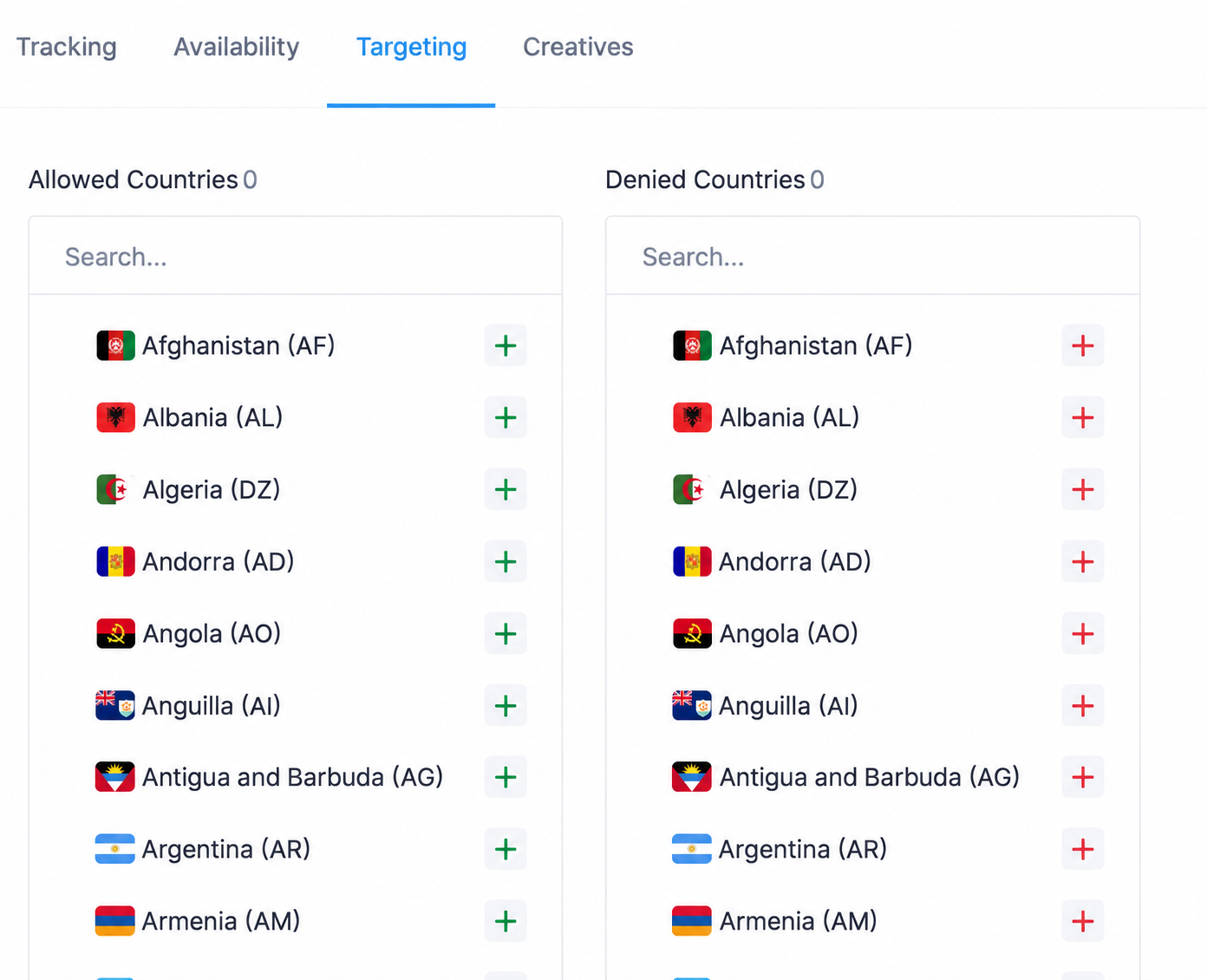
In a demo, ask the team to configure one permitted and one denied market for the same offer. Then test the actual tracking link as an affiliate would use it. The configuration screen is only the first half of the proof; the click, redirect, conversion and reporting records are the other half.
Log the rule version, not just the result
Market permissions change. An operator may pause an offer, replace a landing page or withdraw a creative while a partner still has an old link in circulation. A good audit trail answers what rule was in force when each click arrived, and what rule applied when a player event was evaluated.
- Give each material offer-policy change an owner, reason, approval and effective time.
- Keep old and new landing destinations in the change record; do not rewrite historical click destinations.
- Record which partner received the revised terms and when.
- Keep a tested fallback for denied or unknown traffic, with language approved for that audience.
- Compare conversion and rejection rates before and after the change, by brand, offer and market.
This matters commercially as much as operationally. An unannounced market pause can destroy a partner’s campaign economics. A stale landing page can make an otherwise valid campaign look as though the affiliate stopped performing. In a multi-brand program, the same affiliate may have different permissions and deals for each property. The policy key cannot be “affiliate” alone.
A seven-case acceptance test for software buyers
Bring this list to a Scaleo demonstration or any competing platform proof of concept. Use test data and your own approved destinations. For each case, ask for the click record, destination, conversion status and the explanation shown to the affiliate manager.
- Approved partner, approved market, active offer: the expected landing page and attributable test event.
- Approved partner, denied market: the configured safe fallback and no false qualified conversion.
- Unknown location: explicit handling rather than an arbitrary country guess.
- Inactive offer: a controlled route and a reason visible in reporting.
- Unapproved partner using a copied link: access blocked or reviewed under the chosen policy.
- Click in one market, verified player in another: both signals retained and eligibility resolved by the operator rule.
- Offer rule changed mid-campaign: old clicks and new clicks traceable to their respective rule versions.
Ask one more question after the test: can the vendor export the evidence? If a disputed CPA depends on a market rule that no longer exists in the current settings screen, the export must still explain the historical decision.
The control is only as good as its exception path
No targeting setup will eliminate messy traffic. VPNs, carrier routing, corporate networks and shared links can make an IP-derived country uncertain. Operators need a documented exception queue and a clear owner for decisions that depend on verified player information. Automatic rejection may be appropriate for a known denied route; an unknown signal deserves a deliberately chosen policy, not a silent assumption.
Done well, this is a trust mechanism. The affiliate knows which markets and creatives are approved. The manager can explain why traffic was routed or held. Finance can connect commission eligibility to the rule actually in force. That is a much stronger commercial position than saying the platform “has geo targeting.”
Test the rule on a real click path.
Bring your approved market matrix to a Scaleo demo. Ask the team to show the configuration, route and resulting record for both an eligible and a denied case.
Frequently asked questions
Is click geolocation enough to decide whether an iGaming player is eligible?
No. A click-location signal helps route traffic, but the operator’s registration and verification process determines player eligibility under its own approved policy. Preserve both records when they disagree.
What should happen to clicks from a denied market?
Apply the approved fallback or block rule before the casino landing page. Record the reason and destination so the affiliate manager can distinguish a denied route from a broken link or tracking failure.
How should an operator treat an unknown country?
Define an explicit unknown-location policy before launch. It may use a reviewed fallback or hold the event for investigation. Do not silently classify the click as an allowed market.
Can one affiliate have different geo permissions across brands?
Yes. In a multi-brand program, permissions should be keyed to the brand, offer, partner and applicable deal rather than the partner identity alone. Test each combination separately.
What should buyers ask to see in an affiliate software demo?
Ask for a live allowed and denied click test, the exact redirect behavior, the event record, a later conflicting player-country case and an export showing the rule version behind each decision.