Quick answer: Multi-brand iGaming affiliate management means giving an operator one reliable view of a partner relationship while preserving the commercial rules of each casino or sportsbook brand. One affiliate may promote several properties, but each brand can have different eligible markets, offers, CPA gates, RevShare bases, creatives, permissions and payout approvals. The platform must connect those records without blending them into a misleading portfolio total. Scaleo supports the operator workflow by bringing tracking, partner management, commission configuration and reporting into one affiliate environment. Start with a shared partner identity, then make every brand-level rule explicit and test a complete payout before scaling traffic.
An operator launches a second casino brand. The same affiliate who performs well for the first brand wants a new deal. Creating a second, unrelated partner account may seem fast, but it fragments the relationship: two approvals, two sets of links, two explanations for the same traffic source and two places to settle a dispute. Copying the first brand’s commission plan is equally risky. The brands may have different player economics, licensing boundaries or bonus policies.
The operational question is not simply whether software accepts multiple brands. It is whether the affiliate team can manage a portfolio relationship and explain what happened for each property. This guide is for casino and sportsbook operators who want a workable model for onboarding, offers, links, permissions, reporting and finance across brands. For the underlying player identity and cross-property credit rules, use our guides to multi-brand attribution and cross-property deduplication. Here, the focus is running the program after those attribution rules have been chosen.
What changes when one affiliate promotes several brands?
In a single-brand program, a partner account, campaign, commission plan and statement often describe the same commercial relationship. That assumption breaks when a partner promotes a casino, a sportsbook and a newly launched regional brand. The operator may want one relationship owner and one record of the partner’s identity, but each brand still owns a distinct offer and performance result.
Think of the account as a parent relationship with brand-level assignments. The parent record answers who the affiliate is, who owns the relationship, which traffic sources have been approved and which documents are current. The brand assignment answers what the affiliate may promote, where, under which terms, and how success is measured. The tracking event answers which player and product activity belongs to that assignment. Finance then approves the resulting commission under the correct brand and period.
| Management layer | Shared across the operator group | Kept distinct by brand |
|---|---|---|
| Partner relationship | Identity, contact owner, due diligence history and relationship notes | Brand invitation, approval status and local restrictions |
| Promotion | Affiliate login and a coherent asset catalog | Tracking links, landing pages, creatives, GEOs and product offers |
| Commercial terms | Version history and a consistent approval workflow | CPA, RevShare or hybrid plan, qualification gate and effective date |
| Measurement | Portfolio view of the partner and traffic source | Brand and product conversion path, player value and exceptions |
| Settlement | A traceable finance workflow | Brand liability, currency, adjustments and payable statement lines |
This division prevents a common reporting error: treating “the affiliate generated 300 FTDs” as a decision-ready fact. An operator needs to know which brand received each player, which FTDs qualified under that brand’s agreement and which commission period includes them. A portfolio total is useful for relationship strategy only after the brand-level numbers can be reconstructed.
Operator rule: Keep the partner relationship unified, but never let a portfolio summary overwrite a brand’s eligibility rule, revenue definition or approval decision. The original brand-level record is what makes the consolidated number credible.
Choose the program structure before inviting partners
There are three workable ways to organize a multi-brand affiliate program. A fully separate program for each brand gives clear boundaries but duplicates administration and can obscure the value of a partner who works across the portfolio. A single portfolio program simplifies relationship management but can conceal differences if every offer is forced into one default plan. A hybrid structure—one partner record with controlled brand assignments—is often the most practical operating model when brands share ownership but have different economics.
| Structure | Useful when | Main management burden | Test before adopting |
|---|---|---|---|
| Separate brand programs | Brands have separate teams, legal entities or strongly different approval processes | Duplicate partner records, communication and settlement | Can the group still see relationship history without merging confidential data? |
| One portfolio-wide program | Offers and rules are genuinely consistent across brands | Exceptions can become hidden manual work | Are qualification and revenue definitions actually identical? |
| Shared partner, brand-specific assignments | One team manages partners while brands retain local terms | Requires clear permissions, naming and precedence | Can one partner receive different deals and statements without ambiguity? |
The choice should follow the operator’s actual contracts and reporting responsibilities. If a brand has a separate licensed entity or payment process, that boundary may require a distinct settlement path even when the affiliate uses one portal. If all brands are managed by one finance team, a consolidated payout may be possible, but the statement should still show the component liabilities. Do not assume that a common logo or backend makes the contracts interchangeable.
The same caution applies to sportsbook and casino under one group. A shared partner can promote both products, yet a qualifying sportsbook customer may depend on a settled bet while a casino CPA depends on a qualifying deposit. The product event, review window and reversal treatment belong in the brand or product assignment. Our FTD qualification guide explains why a raw first deposit and a payable acquisition are different records.
Build one partner record with explicit brand permissions
Onboarding is where the operating model becomes real. A partner should not need to repeat the same basic identity checks for every brand if the group has already verified them, but approval for one property should not automatically authorize promotion of every property. Record the common partner identity once and attach each brand’s invitation, traffic-source approval, GEO restrictions and deal acceptance to it.
The affiliate team needs a visible owner for the overall relationship. That owner should be able to see which brand managers have approved the partner, which offers are active and what documents the partner has acknowledged. Brand managers, in turn, should see only the data and controls they need. An affiliate’s portal should show the brands and offers they are allowed to promote, not a confusing catalog of every property the group owns.
There is a practical privacy point here. A portfolio relationship does not require exposing player-level data from one brand to staff or partners of another. Give managers a group-level view where authorized, and keep individual player details inside the access boundary that matches the operator’s policies. The affiliate typically needs conversion status and commission evidence, not a player’s personal identity.
When adding a brand, run a short approval sequence: confirm the partner’s current traffic sources; check the new brand’s allowed markets and creatives; issue the correct agreement version; assign the commission plan; generate brand-specific tracking links; and test the path from click to payable event. Our affiliate onboarding guide covers the first relationship. A second brand is a new assignment within that relationship, not a silent copy of the first.
Keep offers, links and campaign names unmistakably brand-specific
An affiliate link should answer three questions without a spreadsheet: which partner sent the traffic, which brand and offer the player reached, and which campaign or placement should receive credit. Use a consistent taxonomy for partner ID, brand, product, campaign and SubID. The exact field names depend on the integration, but the meaning must stay stable from the click through the player event and report.
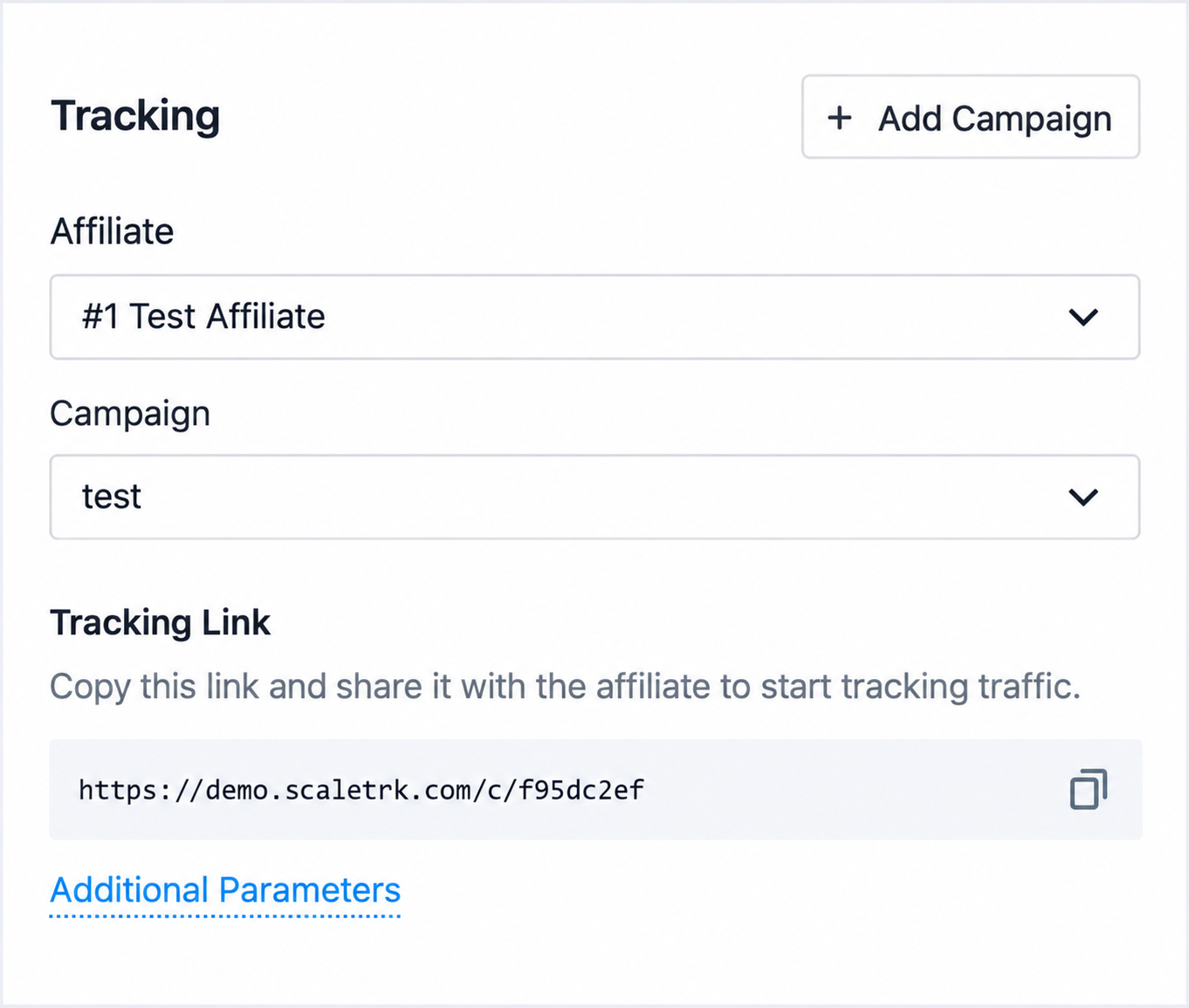
Offer catalogs need the same discipline. A creative approved for one market should not be presented as usable for every brand. Mark the brand, product, eligible GEO, active dates and destination on each offer. When a landing page changes, preserve the relationship between the old link and the resulting conversions so historical reports remain understandable. If links are redirected, test that brand and campaign parameters survive the redirect.
Different brands may have similar names or share a signup flow. That is precisely why a brand field must travel with the event rather than be guessed from a URL later. An operator should be able to inspect one disputed FTD and identify the original link, destination, brand, offer, player event and applied commission rule. The casino affiliate API integration guide describes the event contract behind that trace.
Link audit box: Before releasing a new brand’s links, run a real test click and registration for each major offer path. Check the final landing page, permitted GEO, partner and SubID, event arrival and brand label in the operator report. A valid click that lands on the wrong brand is an operational failure even if the tracking system records it.
Separate deal economics even when the partner relationship is shared
The same affiliate can have a CPA deal for one brand and RevShare for another. Even when both deals use RevShare, their NGR definitions may differ because of bonuses, payment charges, jackpot contributions, product mix or local terms. A group-wide default can provide a starting template, but the binding plan is the one accepted for the relevant brand and effective date.
Do not blend revenue first and allocate commission later unless the agreements explicitly say to do so. Calculate each brand’s commission from its own attributed activity, revenue base, deductions, qualification rules and adjustments. Then create the portfolio view as a sum of those documented components. This order matters when one brand has negative carryover, another has a CPA cap and a third settles in a different currency.
| Deal element | Why brand-level configuration matters | Evidence an operator should retain |
|---|---|---|
| Qualified acquisition | Minimum deposit, verification and product activity may differ | Event status, rule version and approval time |
| Revenue base | GGR and NGR definitions may have different deductions | Source revenue, deduction lines and agreed formula |
| Commission rate | Partner tiers and temporary overrides may be brand-specific | Plan, effective date and authorized change |
| Cap or hold | Budget and risk review may belong to one brand only | Cap consumption, reason and reviewer |
| Currency | Player revenue and affiliate payout may use different currencies | Original amount, conversion point, rate and rounding rule |
Our NGR versus GGR guide explains the revenue base, and the multi-currency commission guide covers FX and rounding. The multi-brand management requirement is to keep those definitions attached to the right brand. A partner should never have to infer why two brands with similar player volume produce different statements.
If the operator offers a portfolio-wide volume tier, state precisely which events count toward it and which commission lines it changes. Does a sportsbook qualified player increase the casino tier? Does a rejected casino FTD count toward the group’s volume target? Does a tier earned this month apply retrospectively or only prospectively? These are contract decisions. The software should implement the chosen answers, not invent them from an aggregate dashboard.
Give management, finance and partners different views of the same truth
A group-level dashboard should help the affiliate lead decide where to spend attention. Show the partner’s performance by brand, product and market, with qualified acquisitions, player value, commission cost and unresolved exceptions. A group total is useful for spotting the relationship’s overall contribution, but it should be expandable down to the brand and event that produced it.
Brand managers need a narrower operating view: their own offers, partners, campaign placements, quality signals and budget. Finance needs a period-based view that can reproduce each brand’s liability. The partner needs a portal that explains traffic, qualification and payable status without disclosing protected player details or other brands’ confidential economics. These views can share the same underlying events while applying different access rules.
Every report should distinguish received, pending, approved, rejected, adjusted and paid. The time of a player event, the time a reviewer approved it and the commission period may be different. That distinction becomes more important when a partner sends traffic to several properties and asks why a consolidated payout differs from today’s performance dashboard. Our iGaming affiliate reporting guide gives a deeper test of report lineage and payout reconciliation.
Finance box: Close commission periods by brand first. Reconcile each brand’s approved events, revenue base, reversals, currency and adjustments against the operator source. Only then build any consolidated partner statement or payment instruction. A group total that cannot be decomposed is not a reliable payable figure.
Treat compliance and brand safety as assignment controls
Multi-brand growth often means different license territories, advertising rules, offer restrictions and legal entities. The partner may be trusted, but each new brand still needs a clear list of approved markets and marketing methods. The operator should know who approved the creative, what terms the affiliate acknowledged, and when the approval became effective.
Make restrictions enforceable in the promotion workflow. If a brand cannot accept traffic from a market, do not distribute that market’s offer to the affiliate as if it were universally available. Maintain versioned terms and an audit trail for changes. When a restriction changes, update links and assets prospectively, communicate the change to the partner and retain the earlier state for disputes. The software can make the rule visible and traceable; the operator remains responsible for defining its own legal and policy requirements.
Avoid one broad “compliant affiliate” checkbox. Compliance is tied to a particular brand, market, channel, creative and period. A partner can be approved for organic search on one brand and need separate approval for paid social on another. Keeping that granularity reduces the chance that a good portfolio relationship masks a local advertising problem.
Move existing brands into one system without losing history
An operator consolidating separate affiliate systems should map partner identities before importing transactions. Some partners may have different account names or contacts across brands. Decide how those records will be matched and who can approve a merge. Do not collapse accounts merely because a name looks similar; keep the original IDs and an audit trail.
Next, inventory the active deals, effective dates, NGR definitions, caps, negative carryover balances, pending events and unpaid statements for each brand. Import or preserve them with their brand association intact. If history cannot be migrated at event level, keep a read-only reference and define the cutover date. A partner should see a clear boundary between legacy balances and newly calculated activity.
Run both systems in parallel long enough to compare known test events and a representative commission period. Test one partner who promotes only one brand, one who promotes several, and one with an exception such as a late approval or reversal. Reconcile by brand before comparing portfolio totals. The migration TCO guide covers the broader project cost; the 14-day software POC offers a compact framework for proving the tracking and calculation paths.
Migration is complete when the operating team can explain a payout from the new system without returning to a private spreadsheet or the old interface. A clean-looking partner list is only the beginning. Links, rules, event history, statements and permissions have to agree.
How to evaluate Scaleo for multi-brand affiliate management
Scaleo is an iGaming affiliate platform for operators that need to manage partners, track player events and apply configurable commissions. For a multi-brand evaluation, ask us to show the same partner across two distinct brand assignments, with different offers and commission terms. The demonstration should move from partner approval and link generation through an attributed event, qualification, commission calculation and statement. It should also show what the affiliate sees and what the group-level manager can see.
Bring your own difficult case rather than a generic feature checklist. Use a partner who promotes casino and sportsbook, or a group with different GEO permissions and payout currencies. Ask how brand and product labels remain intact in event records and exports. Ask how a plan change is versioned, how a rejected event appears to the partner, and how finance reconciles the two brands before paying the affiliate.
Scaleo’s value here is the shared operating layer: the partner team can work in one system while setting and inspecting the rules that belong to each brand. The configuration still depends on the operator’s contracts and source events. No platform can decide whether a cross-brand player deserves a second CPA without the operator defining that rule. Our multi-brand attribution guide addresses that policy choice; this guide addresses the management workflow around it.
Acceptance tests before a second brand goes live
Run these tests with affiliate operations, the brand owner, finance and integration staff. Record the expected result, the observed event ID and the resulting statement line. A test passes only when the partner and operator views agree at the right level of detail.
- Existing partner, new brand: Invite a current affiliate to a second brand without duplicating the parent relationship or granting access before approval.
- Restricted offer: Confirm a partner can see and use only the creative, landing page and GEO approved for that brand.
- Brand-labelled events: Trace a click, registration and qualifying activity to the correct brand, product, campaign and partner.
- Different commission plans: Apply each brand’s effective CPA, RevShare or hybrid terms to its own events without leaking the other brand’s rules.
- Cross-brand player: Apply the operator’s chosen attribution and duplicate-commission policy to a player who touches both properties.
- Late decision: Show a pending event that becomes approved after the source event date, with the correct commission period and both timestamps retained.
- Brand-specific adjustment: Reverse or correct one brand’s item without silently changing the other’s closed statement.
- Portfolio reconciliation: Sum brand-level approved liabilities into the group view and reproduce the total from the underlying lines.
- Role and portal boundaries: Verify the affiliate, brand manager, group manager and finance reviewer each see only the appropriate information and actions.
These tests are more useful than asking only “Does the platform support multiple brands?” The answer should be visible in the actual partner journey, event record and statement. If a vendor demonstration cannot reproduce the outcome, keep the item open before migration or launch.
Frequently asked questions
Should a multi-brand operator use one affiliate account per partner?
Often yes at the relationship level, because one record makes onboarding and communication easier. Each brand still needs its own approval, eligible offers and deal terms. Separate legal or finance requirements may require distinct settlement records even if the partner has one portal login. Choose the structure from the contracts and access boundaries, then test it in software.
Can one affiliate have different CPA and RevShare deals across brands?
Yes. Keep the commission plan, qualifying event, revenue base and effective date attached to the relevant brand assignment. A shared partner identity does not imply a shared rate. Reconcile each brand’s calculation first, then consolidate statements only where the commercial and finance process allows it.
What is the difference between multi-brand management and multi-brand attribution?
Management covers the partner relationship, offer catalog, permissions, commercial plans, reporting and payout workflow across properties. Attribution answers which partner and brand receive credit for a player or event, including cross-property journeys. Both are needed: a correct attribution event can still be paid under the wrong deal if management rules are poorly organized.
Should finance pay affiliates once or separately for each brand?
Either can work if the agreements and legal entities permit it. A single payment should still be backed by brand-level approved lines, currencies and adjustments. Separate payments may be required when brands have distinct contracting or settlement responsibilities. The operator should choose explicitly and make the partner statement match that choice.
What is the first test when moving several programs into Scaleo?
Use a partner who promotes more than one brand and a closed period with known results. Rebuild each brand’s attribution, qualification and commission before comparing the portfolio total. Then check what the affiliate sees and whether finance can reproduce the payable amount from source events. This exposes mapping and rule problems before high-volume traffic moves.
One relationship, many accountable brand decisions
The commercial advantage of a multi-brand program is a stronger relationship with affiliates who can promote more than one property. The operational advantage comes only when that relationship is easy to manage without flattening the economics of each brand. Keep shared identity and communication where they help. Keep offer eligibility, player events, commission rules and settlement evidence as specific as the contracts require.
Scaleo gives operators a place to run that workflow and inspect it. If you are evaluating a platform for a growing brand portfolio, start with our iGaming affiliate software decision matrix, then use the acceptance tests above in a live demonstration. Your partners should see a coherent program; your brand and finance teams should be able to explain every payable line.