⚡ TL;DR – RevShare vs CPA vs Hybrid Commission Models for iGaming Operators Compared
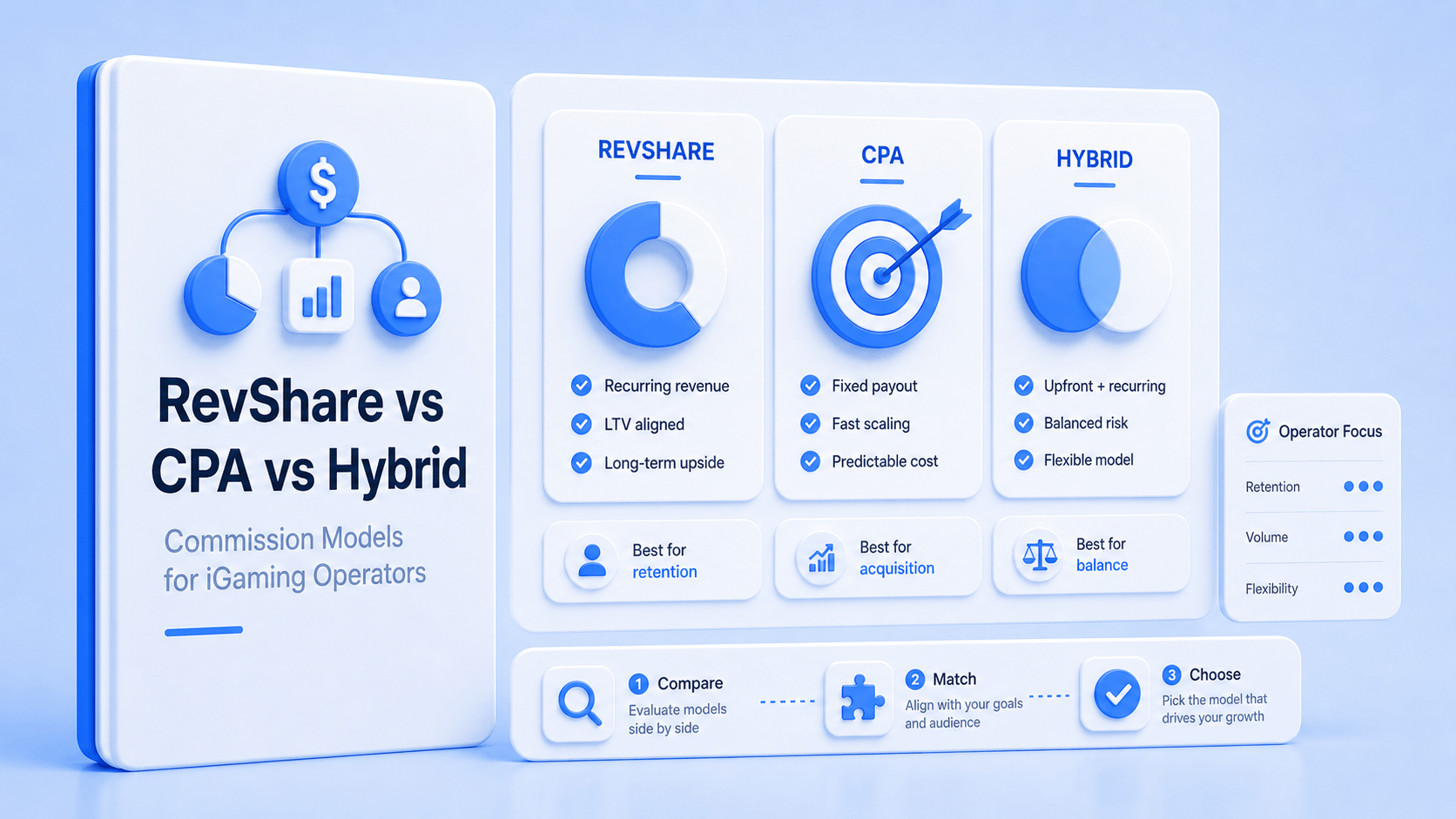
RevShare pays affiliates a percentage of the net gaming revenue their referred players generate on an ongoing basis — aligning long-term incentives but exposing the operator to high-roller variance. CPA pays a flat fee per qualifying first deposit, giving operators cost certainty at the expense of upside sharing. Hybrid combines a reduced CPA with a lower RevShare rate, splitting risk and reward between both parties. The right model depends on your traffic quality targets, your NGR margin profile, your player lifetime value, and how much variance your program budget can absorb in a single month.
The commission model you offer defines the affiliates you attract, the risk you carry, and the margin you keep.
Most operators pick a model at launch and never revisit it. That is how you end up overpaying for low-quality traffic, underselling your program to serious partners, or creating monthly payout disputes your finance team should never have had to touch.
This guide is written for casino operators, sportsbook operators, affiliate managers, finance teams, and iGaming acquisition leaders choosing how to pay affiliates without destroying margin. It compares the main iGaming affiliate commission models: RevShare, CPA, Hybrid, Tiered RevShare, and Sub-Affiliate overrides.
Quick Definitions: RevShare, CPA, Hybrid, NGR, GGR, and NCO
If you need the short version before the deeper finance logic, use this table as the baseline.
| Term | Meaning | Why operators care |
|---|---|---|
| RevShare | Affiliate earns a percentage of player revenue, usually calculated on NGR. | Best for long-term alignment, but exposed to player variance and jackpot swings. |
| CPA | Affiliate earns a fixed payment when a player completes a qualifying action, usually first deposit. | Predictable acquisition cost, but weak alignment with long-term player value. |
| Hybrid | Affiliate receives a smaller CPA plus a smaller RevShare rate. | Useful when traffic quality is unknown or affiliates need upfront cash flow. |
| GGR | Gross Gaming Revenue: wagers minus player winnings before deductions. | A larger commission base. Lower headline rates can still pay more than NGR-based deals. |
| NGR | Net Gaming Revenue: GGR after deductions such as bonuses, taxes, payment fees, chargebacks, and jackpot contributions. | The most common operator-safe commission base for RevShare. |
| NCO | Negative Carryover: a policy that carries negative affiliate RevShare balances into future periods. | Protects operator margin, but can make an affiliate program less attractive. |
Core Formulas Operators Should Use Before Choosing a Model
Do not compare commission models by headline rates alone. Compare them by the actual money that moves through your program.
GGR formula:
GGR = Total wagers − Player winnings
NGR formula:
NGR = GGR − Bonuses − Taxes − Payment processing fees − Chargebacks − Jackpot contributions
RevShare commission:
Affiliate payout = NGR × RevShare percentage
CPA ROI:
Operator margin = Player lifetime NGR − CPA payout − Bonus cost − Payment cost − Fraud/compliance cost
Hybrid commission:
Affiliate payout = Qualified CPA + (NGR × Hybrid RevShare percentage)
Which iGaming Commission Model Should You Choose?
Use the commission model as a filter for affiliate type, traffic source, cash-flow pressure, and risk exposure.
| Operator situation | Best model | Why | Risk to control |
|---|---|---|---|
| New affiliate program with limited cohort data | Hybrid | Gives affiliates upfront value while giving the operator time to measure player quality. | Set CPA qualification gates and review 60–90 day NGR data. |
| SEO affiliates with proven organic traffic and high-retention players | RevShare | Rewards long-term player value without upfront acquisition cost. | Define NGR deductions and negative carryover policy clearly. |
| Paid media affiliates with upfront ad spend | CPA | Affiliates need predictable cash flow to manage media buying margins. | Use KYC, deposit, and wagering qualification gates before CPA fires. |
| High-volume affiliate with stable monthly NGR | Tiered RevShare | Creates a visible growth path and rewards proven contribution. | Automate tier movement to avoid manual rate disputes. |
| Affiliate network or master affiliate managing sub-partners | Sub-affiliate override + controlled hybrid | Lets a parent affiliate build distribution while the operator keeps visibility over SubID quality. | Require SubID-level reporting and fraud scoring by sub-source. |
| Streamer or influencer traffic with spikes around events | Hybrid | CPA rewards campaign spikes while RevShare captures long-tail player value. | Monitor bonus abuse, multi-accounting, and low-retention spikes. |
| Regulated sportsbook with thin margin | CPA with strict qualification or low RevShare | Sportsbook hold can be volatile and lower than casino margin. | Do not set CPA from casino LTV assumptions. |
| High-volatility casino product with jackpot exposure | NGR-based RevShare with NCO | Protects operator from one-off negative player events. | Disclose jackpot contribution deductions and NCO rules before launch. |
Why Commission Model Selection Is a Risk Architecture Decision
Commission model conversations in iGaming almost always get framed as affiliate relations decisions. Which model do affiliates prefer? Which one is easiest to recruit with? These are useful questions, but they are not the right questions to lead with.
The better question is: what is the financial exposure profile of each model against your actual player base, and how does that interact with your NGR margin at different traffic quality levels?
An operator with a high-volatility slots product and a player base that skews toward bonus-seeking behavior has a fundamentally different risk calculus than an operator running a regulated sportsbook with a sticky, recurring-deposit audience. The commission model that protects the first operator’s margins may weaken the second operator’s affiliate recruitment. The model that recruits elite SEO affiliates for the second operator may damage the first one during a jackpot cycle.
Structure the decision around your financial reality first. Then fit the model to the affiliate relationship, not the other way around.
The Commission Model Comparison Matrix
Before going deep on each model, compare them at a glance. Use this as a decision anchor — the following sections explain the reasoning behind each cell.
| Model | Operator Risk | Operator Upside | Affiliate Preference | Best Traffic Type | NGR Alignment |
|---|---|---|---|---|---|
| RevShare | High — variance-exposed, jackpot events hit directly | High — low-quality months cost nothing | Strong for long-term SEO operators | Organic, high-intent, recurring depositors | Excellent — operator and affiliate share outcomes |
| CPA | Low — fixed cost per FTD, no variance exposure | Low — operator pays before player value is proven | Strong for PPC and paid media affiliates | Paid traffic, high volume, variable LTV | Poor — commission paid before NGR is realized |
| Hybrid | Medium — CPA caps affiliate cash-flow pressure, RevShare shares upside | Medium — both acquisition and retention contribute | Moderate to strong — suits versatile affiliate businesses | Mixed traffic, diversified affiliate portfolios | Good — partial alignment at both acquisition and retention |
| Tiered RevShare | High at top tiers | High — performance-driven cost structure | Very strong for volume-motivated affiliates | High-volume SEO, comparison portals | Strong — higher rates only at higher NGR |
| Sub-Affiliate / Override | Medium | High — network multiplication effect | Strong for affiliate network operators | Managed affiliate networks, media buyers | Variable — depends on sub-affiliate traffic quality |
Worked Example: Same Player Cohort, Three Commission Models
Here is the simplest way to see why headline rates alone are misleading. Assume one affiliate sends the same 100 first-time depositors under three different deal structures.
| Metric | Assumption |
|---|---|
| FTDs | 100 |
| Total month-one NGR | €18,000 |
| Standalone CPA rate | €90 per qualified FTD |
| Standalone RevShare rate | 35% of NGR |
| Hybrid rate | €45 CPA + 15% RevShare |
| Model | Affiliate payout | Operator keeps before other costs | What it tells you |
|---|---|---|---|
| CPA | 100 × €90 = €9,000 | €18,000 − €9,000 = €9,000 | Simple, but risky if player quality drops after FTD. |
| RevShare | €18,000 × 35% = €6,300 | €18,000 − €6,300 = €11,700 | Better margin in month one, but exposed to negative NGR months. |
| Hybrid | (100 × €45) + (€18,000 × 15%) = €7,200 | €18,000 − €7,200 = €10,800 | Middle ground: affiliate gets immediate income and upside, operator limits upfront risk. |
This is why many operators use Hybrid for new affiliate relationships, RevShare for proven SEO partners, and CPA for paid media affiliates with strict qualification rules. The model should follow the traffic source, not the other way around.
Revenue Share: The Long Game — Its Strengths and Its Real Costs
RevShare is the most NGR-aligned commission model in iGaming.
The affiliate earns a percentage of the net revenue their players generate — meaning when players win, the affiliate earns nothing or less. When players lose consistently over time, the affiliate earns more. The incentive structures are genuinely aligned: the affiliate is motivated to send players who actually play, not just deposit and withdraw.
The Financial Reality of RevShare Exposure
The alignment comes with a cost. RevShare exposes the operator to every variance event in the affiliate’s player cohort.
A single progressive jackpot winner can generate a five-figure negative NGR balance that either the operator absorbs under a No NCO policy or carries forward as a deferred affiliate balance under Standard NCO. Neither outcome is free.
The math on a bad RevShare month is instructive. Take an affiliate at 35% NGR RevShare with a 200-player cohort:
- Normal monthly NGR: €22,000
- Affiliate commission at 35%: €7,700
- Month with one €40,000 jackpot winner: NGR = −€18,000
- Affiliate commission at 35% on −€18,000: −€6,300
- Operator absorbs the jackpot under No NCO policy: full jackpot exposure plus the reset of the affiliate’s negative balance
This is why RevShare requires a properly configured NGR formula — with jackpot contributions deducted before the commission base is calculated — and a clearly defined NCO policy.
RevShare without these two components is not a revenue-sharing model. It is an uncapped liability with an affiliate attached.
When RevShare Is the Right Default
RevShare is the correct default for operators whose primary affiliate channel is organic SEO content. The players referred by high-ranking review sites and comparison portals are high-intent, research-driven depositors. They take longer to acquire — the affiliate invested months of content work — but they usually have better long-term retention and higher NGR per active player than many paid traffic sources.
An operator paying 35% RevShare on a player cohort that generates €400 NGR per player per year is paying €140 per player per year in commission — with no upfront cost and no payment until revenue is realized.
The same player acquired via CPA at €120 per FTD costs more in year one and generates zero commission obligation in years two and three. RevShare is often the cheaper model for high-LTV players across any time horizon beyond 10 months.
RevShare Rates: What the Market Actually Pays
Standard RevShare rates in iGaming commonly run from 25% at entry level to 45% for elite affiliate relationships.
The spread reflects three variables: traffic quality, cohort size, and competitive positioning. Organic SEO commands higher rates than incentivized traffic. Larger cohorts justify higher rates because variance is lower per affiliate. Operators recruiting from a strong competitive field often pay more to differentiate.
Rates above 45% exist, but they should be exceptional. They typically indicate either an operator with unusually high margins or one that has not run the lifetime value math.
Scaleo platform insight, 2025: Based on anonymized internal program data across iGaming programs using Scaleo, the median RevShare rate was approximately 32%, with top-tier affiliate deals clustering between 38–42%. Programs offering rates above 40% as a default — rather than as a negotiated tier — showed a higher rate of early NGR disputes, usually because the rate was extended to traffic that could not sustain it.
CPA: Cost Certainty and Its Hidden Trade-offs
Cost Per Acquisition pays the affiliate a fixed amount per qualifying first deposit. The operator knows exactly what each new player costs at the point of acquisition. No variance exposure. No multi-month commission liability. No negative balance calculations. The financial simplicity is real.
The LTV Problem with Flat CPA
The simplicity is also the limitation. A flat CPA of €100 per FTD pays the same commission for a player who deposits once and churns after 48 hours as it does for a player who deposits monthly for three years and generates €1,800 in NGR over that period.
The operator overpays massively for the first player and underpays structurally for the second.
At scale, this creates a misalignment: the affiliate has little financial incentive to optimize for player quality or retention because their commission is fixed at the point of acquisition regardless of what happens next.
This misalignment produces a specific pattern in CPA-heavy programs. Affiliates learn quickly that optimizing for FTD count rather than player quality maximizes their income. Bonus-hunting traffic, incentivized sign-ups, and paid registration schemes can all generate high FTD counts. They also generate high churn rates, negative NGR cohorts, and fraud exposure.
The operator who designed their program around CPA simplicity can end up running a fraud investigation instead.
Where CPA Works Without Apology
CPA is the right model for paid media affiliates — Google Ads buyers, programmatic networks, and compliant paid social teams — who carry upfront media cost and need predictable income to manage their own cash flow.
These affiliates are running a margin business: media spend out, CPA commission in. They cannot absorb the variance of a RevShare model where a bad jackpot month means they spent €5,000 on media and received €0 in commission.
The operator accepting CPA traffic from paid media sources is making a deliberate bet: that the fixed cost per FTD is lower than the lifetime NGR value of the average acquired player.
Running that calculation honestly — using actual cohort NGR data from comparable traffic sources, not assumed LTV figures — is the prerequisite for setting a CPA rate that is sustainable.
A CPA rate set without LTV data is a guess dressed as a commission structure.
CPA Rate Benchmarks and the Qualification Gate
Standard iGaming CPA rates may range from €50 for low-competition markets to €250+ for regulated tier-one jurisdictions. The qualification gate — the minimum deposit amount, KYC status, or minimum wagering action required before the CPA fires — is as important as the rate itself.
A €150 CPA with a €10 minimum deposit and no wagering requirement is a bonus-abuse invitation. A €150 CPA requiring a €20 minimum deposit, KYC approval, and one completed wager round eliminates much of the deposit-and-withdraw fraud at the acquisition stage.
Configure your qualification gate in your tracking platform before launching CPA campaigns. In Scaleo, the CPA trigger conditions — minimum deposit amount, wagering requirement, verification status — can be set at the commission plan level and triggered via S2S postback only when all conditions are met.
An affiliate should only be able to claim a CPA conversion that satisfied the gate. That is not a minor detail. It is the difference between a CPA program and a manual dispute queue.
Hybrid: The Model That Requires the Most Operational Discipline
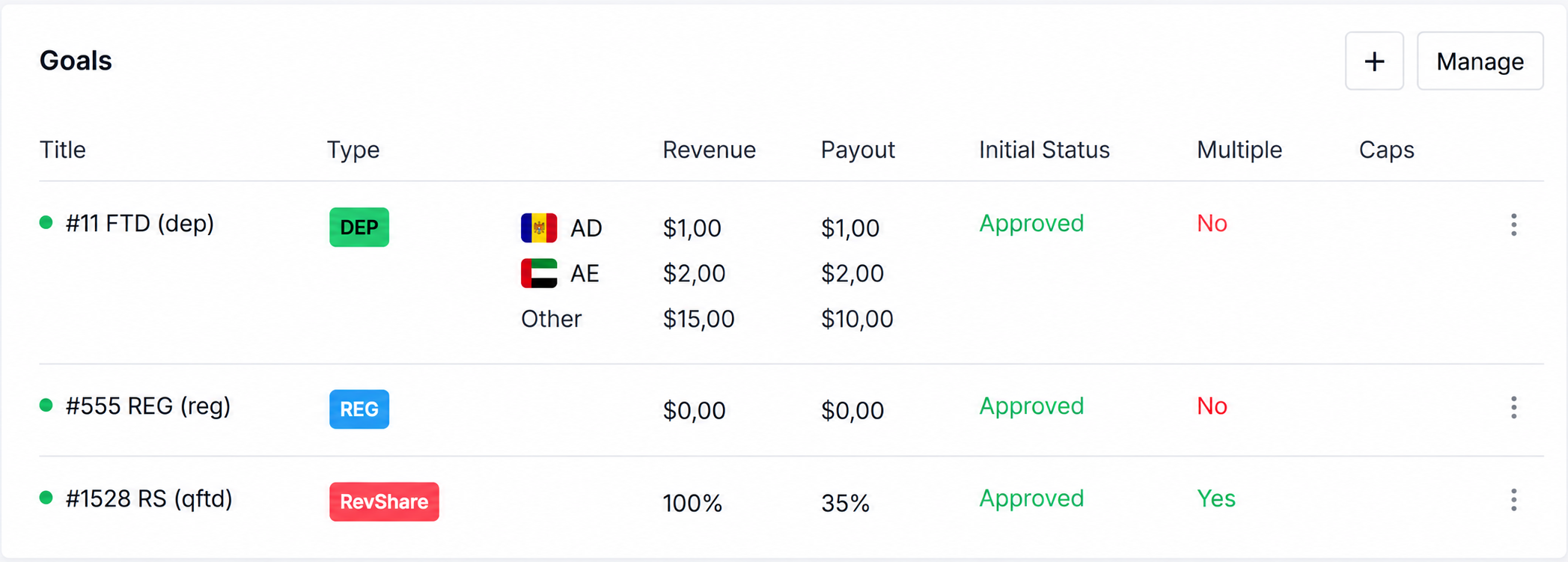
Hybrid commission combines a reduced CPA — typically 40–60% of the standalone CPA rate — with a lower RevShare percentage, often in the 10–20% range. The affiliate gets immediate income at the point of acquisition and ongoing revenue share as the cohort matures. The operator limits upfront acquisition cost while maintaining NGR alignment on long-term players.
The Operational Complexity Hybrid Adds
Hybrid deals are more complex to administer than either pure model. Every commission cycle requires two separate calculations: the CPA component and the RevShare component.
The NCO policy applies only to the RevShare component. The CPA fires on the qualifying event regardless of subsequent player performance. Affiliates on hybrid deals sometimes assume an NCO event freezes all payouts, including the CPA portion. It does not, and your agreement language needs to make that explicit.
Platform support for hybrid calculation matters. A tracker that handles pure CPA and pure RevShare separately but cannot natively combine them into a single affiliate statement forces your affiliate team to manually reconcile two commission reports into one payout. At 200 hybrid affiliates, that reconciliation overhead becomes a job nobody wanted.
Scaleo’s commission plan architecture can run both components in a single deal template — the affiliate sees one statement with both line items, and the payout is calculated from a single commission run.
When Hybrid Is the Right Offer
Hybrid works best for affiliates running diversified traffic — a mix of organic SEO content driving recurring players and paid campaigns driving FTD volume. The CPA component covers their media cost exposure. The RevShare component rewards the long-tail player retention that their SEO audience generates. The affiliate is incentivized on both acquisition and quality.
It is also the right offer for affiliate recruitment situations where the affiliate’s traffic quality is unknown.
Run a 60-day hybrid trial — reduced CPA to offset your risk, low RevShare to give the affiliate upside if their cohort performs — and use the NGR data from that period to negotiate the long-term deal structure. You will have actual cohort performance data rather than the affiliate’s self-reported traffic quality claims.
Tiered RevShare: Aligning Volume Incentives With NGR Reality
Tiered RevShare structures increase the commission percentage as the affiliate’s monthly NGR contribution crosses defined thresholds. A common structure looks like this:
| Monthly NGR Tier | RevShare Rate | Operator Logic |
|---|---|---|
| €0 – €5,000 | 25% | Entry level — operator margin protected at low volume |
| €5,001 – €15,000 | 30% | Established performer — rate reflects proven cohort quality |
| €15,001 – €40,000 | 35% | High-volume partner — competitive rate justifiable on margin |
| €40,001+ | 40% | Elite tier — negotiated, requires explicit agreement clause |
Tiered structures are powerful recruitment tools because they give affiliates a visible income growth path. An affiliate who joins at 25% and knows they can reach 40% by growing their cohort NGR has a program-specific reason to invest in your brand rather than a competitor’s.
The tier acts as a retention mechanism built into the commission structure itself.
The operational requirement is that tier calculation must be automated. An affiliate whose NGR crosses a tier threshold should not be waiting for an affiliate manager to manually update their rate. Scaleo’s tiered commission plans calculate and apply the correct rate automatically at commission cycle close, so the affiliate sees the correct rate in their portal without a support ticket.
Sub-Affiliate Overrides: Useful, but Easy to Mismanage
Sub-affiliate or override commissions pay a parent affiliate for recruiting or managing other affiliates. In iGaming, this can help operators scale partner recruitment faster, especially across GEOs where local affiliate relationships matter.
The usual structure is a small percentage override — often 5–15% of the sub-affiliate’s commission — paid to the parent affiliate. The problem is visibility. If your platform cannot show which sub-affiliate generated which traffic, what quality that traffic produced, and whether the parent affiliate is actively managing the source, the override becomes a tax on your program rather than a growth mechanism.
Use sub-affiliate structures only when you can track performance by SubID, apply fraud scoring by source, and stop overrides when the downstream traffic fails quality gates.
The NGR vs GGR Commission Base: The Decision Below the Model
Whichever model you choose, the commission base definition is a separate and equally consequential decision. RevShare calculated on GGR — gross gaming revenue before any deductions — is fundamentally different from RevShare calculated on NGR.
A 30% RevShare on GGR sounds lower than a 35% RevShare on NGR. It may not be.
If your bonus cost is 30% of GGR, your NGR is 70% of GGR. A 30% rate on a 100% base equals 30 units. A 35% rate on a 70% base equals 24.5 units. The affiliate earning 30% on GGR is earning more per player than the affiliate earning 35% on NGR — and potentially does not know it, because the rate comparison obscured the base difference.
This is a routine source of affiliate program disputes, forum complaints, and program-switching decisions. The operators who pitch their commission structure with full transparency — here is the rate, here is the base, here is the deduction formula, here is what your statement will show — close better affiliate deals and have fewer reconciliation arguments than those who lead with a headline rate and hope the affiliate does not do the math.
⚠️ Regulatory and audit note: In regulated markets, operators must be able to produce complete and auditable commission calculation records. This includes the NGR formula applied, the deductions taken, and the resulting commission figure for each affiliate in each period. A commission structure that exists as a rate without a defined base and deduction methodology is a reconciliation problem waiting to happen. Define it in the agreement. Enforce it in the platform. Log it automatically.
Common Commission Model Mistakes Operators Make
Most commission-model failures are not caused by affiliates being unreasonable. They are caused by operators launching vague, under-modeled, or manually enforced payout logic.
| Mistake | What happens | Better approach |
|---|---|---|
| Using one model for every affiliate | SEO affiliates, paid buyers, and streamers are all paid as if their traffic behaves the same. | Assign models by traffic source and cohort behavior. |
| Advertising high RevShare without defining NGR | Affiliates compare headline rates but later dispute deductions. | Show the NGR formula before agreement signature. |
| Paying CPA on deposit only | Deposit-and-withdraw traffic and bonus abuse inflate acquisition costs. | Require KYC, minimum deposit, and at least one wager condition. |
| Applying No NCO blindly | Operator absorbs negative player variance without budget planning. | Reserve No NCO for proven partners or limited trial periods. |
| Manual hybrid reconciliation | Affiliate statements become inconsistent and slow. | Use one commission plan that calculates CPA and RevShare together. |
| No fraud scoring before payout | Fraud gets paid before anyone investigates it. | Score traffic before the commission cycle closes. |
| Setting CPA from competitor rates | Program overpays because competitor economics do not match your player LTV. | Set CPA from your own cohort NGR and expected lifetime value. |
Configuring Commission Models in Your Tracking Platform
The commission model you choose on paper is only as reliable as the platform enforcing it. Three configuration requirements apply regardless of which model you run.
1. S2S Postback With Qualifying Event Gating
Every commission trigger — a qualifying FTD for CPA, an NGR calculation event for RevShare, both for Hybrid — should fire via server-to-server postback with defined qualification conditions.
If your CPA fires on a loose front-end match rather than a verified S2S event, you risk paying commissions on attributions that do not satisfy your commercial rules.
2. Per-Affiliate Model Assignment
Different affiliates need different models. Your platform needs to support per-affiliate commission plan assignment — not a global setting that forces every partner onto the same structure.
An operator running RevShare for SEO affiliates, CPA for paid media affiliates, and Hybrid for new recruits needs multiple active commission plan templates running simultaneously.
Scaleo’s commission plan architecture handles this at the deal-template level: each affiliate is assigned a plan, and the calculation logic executes correctly for each model type without manual intervention.
3. Fraud Scoring Before Commission Payment
Regardless of model, new affiliate traffic should run through a behavioral fraud screen before the first commission cycle pays out. CPA fraud — affiliates generating high FTD counts from bonus-abusing or bot-adjacent traffic — is more common in CPA programs precisely because the incentive is acquisition volume rather than player quality.
Scaleo’s Anti-Fraud Logic™ scores clicks and conversion events from onboarding, flagging patterns that indicate non-genuine player activity before a commission run turns a fraud event into a paid invoice.
Scaleo internal data, 2025: Across programs on the Scaleo platform, operators running per-affiliate commission model assignments — mixing RevShare, CPA, and Hybrid across their portfolio rather than applying a single model — showed materially stronger average NGR per active affiliate than single-model programs. The differentiation allows operators to match commission structure to traffic type, reducing systematic overpayment when high-LTV organic traffic is compensated like paid media, or vice versa.
Commission Model Governance Checklist
Before launching or revising your affiliate commission structure, make sure these questions are answered in the agreement and configured in the platform.
- What is the commission base? GGR or NGR?
- What deductions apply? Bonuses, taxes, fees, chargebacks, jackpot contributions?
- When does CPA fire? Registration, KYC, first deposit, minimum wager, or another qualified event?
- Does negative carryover apply? Full carryover, monthly reset, or threshold reset?
- Can models differ by affiliate? RevShare for SEO, CPA for paid media, Hybrid for trial partners?
- Are tiers automatic? Or does an affiliate manager manually adjust the rate?
- Can affiliates audit their statements? Do they see deductions, qualified events, and payout line items?
- Is fraud scoring applied before payment? Or only after suspicious invoices are already paid?
The Right Model Means Nothing Without the Right Platform Behind It
RevShare, CPA, Hybrid — the model you choose is a financial architecture decision. The platform that executes it determines whether that architecture actually holds up across 300 affiliates, multiple currencies, changing GEO rules, and a jackpot cycle.
Per-affiliate model assignment, S2S postback qualification gating, automated NGR calculation, tiered RevShare automation, hybrid CPA-plus-RevShare calculation, and behavioral fraud scoring are not premium extras. They are the baseline requirements for running a commission program that pays correctly, every cycle, without a reconciliation call.
Frequently Asked Questions
Which commission model is best for a new iGaming operator?
Start with a hybrid model for your first cohort of affiliates. A reduced CPA — typically 50–60% of your target standalone CPA rate — with a 15–20% RevShare gives you cost certainty at acquisition while building NGR data on each affiliate’s cohort quality. After 60–90 days, you have real performance data to negotiate long-term deals with affiliates generating positive NGR, and a natural exit from relationships that do not perform. Starting with pure RevShare as a new operator without NGR data is a variance gamble. Starting with pure CPA without LTV data is a margin gamble. Hybrid is the risk-managed entry point.
Can I offer different commission models to different affiliates simultaneously?
Yes, and you should. Running RevShare for SEO content affiliates, CPA for paid media partners, and Hybrid for new recruits is standard practice at well-managed iGaming programs. The operational requirement is a tracking platform that supports per-affiliate commission plan assignment — not a single global setting. If your current platform forces all affiliates onto the same structure, that is a platform limitation, not an industry standard. Platforms like Scaleo handle per-affiliate model assignment natively, with each plan template containing its own calculation logic, NCO policy, and payout schedule.
How do I calculate whether my CPA rate is sustainable?
Run the lifetime value calculation against your actual NGR cohort data, not assumed industry averages. Take a sample of players acquired through the same traffic channel you are planning to run CPA on. Calculate their average NGR per month across their first six months. Multiply by the expected average active lifetime in months. That figure is your expected lifetime NGR per player. Your CPA rate should generally not exceed 30–40% of that figure, leaving margin for bonus costs, processing fees, fraud/compliance costs, and operator return. If your CPA rate exceeds 50% of expected lifetime NGR, you are likely acquiring players at a loss.
What is the difference between RevShare on GGR versus RevShare on NGR?
GGR (Gross Gaming Revenue) is total player losses before operator cost deductions. NGR (Net Gaming Revenue) deducts bonus costs, payment processing fees, jackpot contributions, chargebacks, and applicable taxes from GGR before the commission base is calculated. RevShare on GGR at 30% appears lower than RevShare on NGR at 35%, but if your bonus cost is 25% of GGR, the NGR base is 75% of GGR. At that deduction rate, 35% on NGR equals a 26.25% effective rate on GGR — lower than the 30% GGR rate. Always compare commission structures on the same base.
How does negative carryover interact with hybrid commission deals?
NCO applies only to the RevShare component of a hybrid deal. The CPA portion fires on a qualifying first deposit event and is paid regardless of subsequent player performance or RevShare balance. If an affiliate’s RevShare balance goes negative due to a high-roller event, their CPA commissions for new FTDs continue to pay normally — the NCO balance does not freeze the entire account. This must be stated explicitly in your agreement, because affiliates on hybrid deals often assume an NCO event suspends all payments. It does not.
What is RevShare in iGaming affiliate marketing?
RevShare (Revenue Share) is a commission model where an operator pays affiliates an ongoing percentage of the net gaming revenue (NGR) their referred players generate. When players lose, the affiliate earns; when players win, the affiliate earns nothing or less. RevShare aligns long-term incentives between the operator and affiliate because both benefit when referred players are high-quality, high-retention depositors. Standard RevShare rates in iGaming commonly run from 25% at entry level to 45% for elite affiliate relationships.
What is the difference between CPA and RevShare for iGaming operators?
CPA (Cost Per Acquisition) pays a flat fee per qualifying first-time deposit, giving operators cost certainty because they know exactly what each new player costs at the moment of acquisition. RevShare pays an ongoing percentage of player NGR for the lifetime of those players, meaning commission continues to accumulate but is subject to variance. CPA is better for paid media affiliates who need predictable income to manage media cost. RevShare is better for SEO affiliates whose organic-traffic players have long retention and high lifetime NGR.
What is a hybrid commission model in iGaming?
A hybrid commission model combines a reduced CPA — typically 40–60% of the standalone CPA rate — with a lower RevShare percentage, usually 10–20%. The CPA component gives the affiliate immediate income at the point of player acquisition; the RevShare component provides ongoing earnings as the referred cohort generates NGR over time. Hybrid is useful for affiliates running diversified traffic, recruitment situations where traffic quality is unknown, and streamers whose event-driven traffic produces CPA-scale volume in spikes but also generates long-tail player value.
What is negative carryover (NCO) and how does it interact with RevShare?
Negative carryover is a RevShare policy where an affiliate’s negative NGR balance in one period — caused by players winning more than they lost — carries forward into the next period as a deficit. The affiliate must generate enough positive NGR commission to clear that deficit before receiving new RevShare payouts. Under a No NCO policy, the deficit is absorbed by the operator and the affiliate’s balance resets to zero at the start of each month. No NCO can help recruit affiliates, but it exposes the operator to full loss absorption during jackpot cycles.
What is the difference between NGR-based and GGR-based RevShare in iGaming?
GGR is player losses before deductions. NGR is GGR after deducting bonus costs, payment processing fees, jackpot contributions, taxes, and chargebacks. RevShare calculated on GGR appears lower than RevShare on NGR but can pay more per player depending on the deductions. For example, a 30% rate on GGR with a 30% bonus cost equals 30 units of commission on a 100-unit base. A 35% rate on NGR equals 24.5 units when NGR is 70% of GGR. Operators must disclose the commission base formula clearly to avoid disputes.