
Quick answer: iGaming affiliate reporting software should let an operator trace a partner’s traffic from click to qualified first-time deposit (FTD), player revenue, commission decision and payout. The useful dashboard is not the one with the most charts. It is the one where affiliate, finance and risk teams can explain the same number, with the same filters and the same status rules. Scaleo brings tracking, commission logic, traffic quality and partner reporting into that operating view.
An affiliate manager asks which partner deserves a better deal. Finance asks why the payable amount differs from last week’s estimate. Risk asks whether a group of FTDs came from legitimate players. Those are three views of the same program, yet many operators still answer them from separate spreadsheets. That is where apparently healthy acquisition can become an expensive reconciliation exercise.
This guide is for casino and sportsbook operators assessing the reporting layer of an affiliate platform. It covers the questions a report should answer, the data behind each number, and the acceptance tests to run before relying on a dashboard. It is narrower than a general software comparison: if you are still choosing a platform, start with our iGaming affiliate software decision matrix and use this article to inspect the reporting promises on your shortlist.
What should an iGaming affiliate dashboard actually answer?
A report is operational when it leads to a decision. “Partner A sent 200 FTDs” is incomplete if nobody can say how many qualified, which brand received them, what they cost, and whether the cohort generated value after bonuses and adjustments. Conversely, a dense export of every event is not useful if an affiliate manager cannot identify the one placement that changed performance this morning.
We separate the reporting questions into four layers. Each layer has a different owner and a different tolerance for delay or approximation.
| Reporting layer | Question it must answer | Typical owner | Evidence to inspect |
|---|---|---|---|
| Acquisition | Which partner, campaign, SubID and creative produced the visit, registration and FTD? | Affiliate manager | Click ID, event time, source parameters and attribution status |
| Player quality | Did those players qualify, remain active and produce revenue worth the acquisition cost? | Growth and risk | Qualification outcome, cohort activity, fraud status and revenue base |
| Commission | What is owed under each partner’s actual CPA, RevShare or hybrid terms? | Affiliate operations | Effective plan, calculation inputs, adjustments and approval state |
| Settlement | What was approved, invoiced, exported and paid for the period? | Finance | Statement version, currency, payment status and reconciliation record |
The first row is often available in generic tracking tools. The remaining rows are where an iGaming program becomes specific. An operator needs to see the change from a raw deposit event to a qualified FTD, and from gross gaming revenue (GGR) to the net gaming revenue (NGR) definition in the affiliate agreement. A total without that lineage cannot settle a serious partner dispute.
Operator test: Pick one real partner and one closed commission period. Ask your team to reconstruct a single payout from the underlying player events and agreed deal terms. If the result depends on someone’s private spreadsheet, the dashboard is a display, not the source of truth.
The KPI dictionary: agree on definitions before building widgets
Two teams can both report “CPA” and mean different things. One may count every first deposit; another may count only KYC-approved players who meet the deposit threshold. The dashboard cannot repair a definition that was never agreed. Write the metric dictionary before choosing chart colors or delivery schedules.
At minimum, the dictionary should define a click, registration, raw FTD, qualified FTD, rejected event, active player, deposit amount, GGR, NGR, pending commission, approved commission and paid commission. For each metric, record the event source, timestamp convention, reporting currency, attribution rule and owner of exceptions. If the same player can appear across casino and sportsbook, define whether the view is per brand, per product, or deduplicated across the operator group.
The distinction between FTD and qualified FTD deserves special attention. A payment event may arrive before KYC checks, wagering requirements or duplicate-account review finish. A dashboard that treats all incoming FTDs as payable will overstate acquisition success and may inflate CPA exposure. Our FTD qualification guide explains the gate in more detail; the reporting requirement is to preserve both the raw event and its final qualification outcome.
Revenue also needs a declared base. GGR is not NGR, and NGR is not universally defined across operators. The report should show the categories of deductions your agreement actually uses, the period in which they apply, and any later adjustments. Finance should be able to reconcile that view with the operator’s source system. See our NGR versus GGR commission guide for the deduction chain.
| KPI | Useful definition in an operator report | Common misleading shortcut |
|---|---|---|
| Qualified FTD rate | Qualified FTDs divided by attributed registrations for the same cohort and window | Raw deposits divided by clicks |
| Cost per qualified FTD | Approved acquisition cost divided by qualified FTDs | Media spend divided by all first deposits |
| NGR per acquired player | Cohort NGR divided by attributed acquired players, with the observation window shown | This month’s total NGR divided by this month’s FTDs |
| Partner contribution | Cohort NGR minus the commission and other acquisition costs included in the stated model | Revenue before bonus and fee deductions |
| Approval rate | Approved payable events divided by submitted candidate events | All postbacks treated as approved |
These are definitions for analysis, not universal accounting standards. The metric label should carry enough context that a manager cannot compare unlike cohorts by accident. A 30-day cohort and a mature cohort are different questions. A CPA program and a RevShare program also have different cost timing, even if the traffic count is identical.
Build three working views, then let teams drill deeper
The executive view should show a small set of outcomes: qualified FTDs, acquisition cost, cohort NGR, partner contribution and trend by brand or market. It should flag the share of events still pending. This view is for deciding where to investigate, not for approving individual commissions.
The affiliate manager’s view needs more detail. It should break traffic and value down by partner, campaign, SubID, placement, creative, device, GEO and product where those dimensions are collected. It should show the conversion path, quality status and effective deal. A manager must be able to compare two traffic sources within the same affiliate rather than blaming the whole relationship for a weak placement.
Finance’s view should be period based and reproducible. It needs opening balance where relevant, payable events, RevShare base, CPA triggers, reversals, carryover treatment, currency conversion, manual adjustments and final approved amount. A closed period must remain explainable after a later chargeback. Our multi-currency commission guide covers the FX and rounding decisions behind this view.
Risk needs a fourth, focused lens on exceptions: duplicate player records, anomalous velocity, restricted GEOs, rejected KYC, bonus abuse indicators and traffic sources that change abruptly. A risk flag is not automatically a fraud verdict. The report should show who reviewed the case and whether it affected commission eligibility. This prevents an unexplained “fraud” label from becoming a partner dispute.
Decision box — what to check each morning: Look for a change in qualified FTD rate, NGR per recent cohort, rejected-event share or spend per qualified FTD. Drill into partner and SubID before changing a deal. A flat total can hide one excellent source and one source that is consuming margin.
Real-time acquisition and closed-period finance are different clocks
Operators often ask for “real-time reports” without specifying which facts can be final in real time. A click can be available immediately. An FTD can arrive later from the player platform. Qualification can change after verification. Revenue can change after settlement, reversals or approved adjustments. A dashboard should update promptly and still label provisional data as provisional.
That calls for separate statuses such as received, pending qualification, approved, rejected, adjusted and paid. The reporting layer should retain the original event time and the time the status changed. If an August FTD is approved in September, the operator should be able to answer both “when did the player deposit?” and “in which commission period did it become payable?” One date field cannot serve both questions reliably.
The same principle applies to sportsbook data. Bet placement, result settlement, voids and free-bet treatment are different events. A partner’s daily report may show traffic and provisional value; the payout statement should use the contractually defined settled revenue. Report freshness is useful only when the user knows which stage the number represents.
Compare reporting tools by auditability, not dashboard polish
A polished graph can still hide weak data lineage. When vendors demonstrate reporting, give each the same scenario and require a drill-down to the event and commission decision. Ask for an affiliate-facing view as well as the operator view. Those two sides should agree on definitions, while respecting permissions and confidential player data.
| Evaluation question | Basic tracker | Operator-grade requirement |
|---|---|---|
| Can a manager segment an affiliate? | Partner total only | Partner, campaign, SubID, GEO, device, brand and product where captured |
| Can finance reproduce commission? | Payout total | Effective deal, revenue base, qualification, adjustments and statement history |
| Can risk explain exclusions? | One rejected count | Event-level status, reason, reviewer and timeline |
| Can an affiliate see enough to trust the statement? | Clicks and earnings | Agreed performance and payable status without exposing unrelated player data |
| Can teams export or schedule the same defined report? | Manual CSV with shifting filters | Saved definitions, period controls, permission boundaries and consistent export |
| Can the report support a multi-brand operator? | One combined total | Brand-specific economics plus an intentional group-level rollup |
Treat this as an acceptance matrix rather than a claim that every operator needs every field on screen at all times. A smaller single-brand program may have fewer dimensions; it still needs a reproducible path from event to payout. A group running casino and sportsbook across markets needs product and brand boundaries so that one unit’s economics do not contaminate another’s.
If you are comparing shortlisted platforms, the same scenarios belong in a hands-on trial. Our 14-day proof-of-concept checklist gives a broader test plan; add your reporting definitions and a closed-period reconciliation case to it.
Connect the dashboard to the event chain
Reporting begins upstream. A missing click ID cannot be fixed by a clever visualization. An FTD postback that fires twice will make the best-looking dashboard wrong twice. The reporting evaluation should therefore include the data contract between the operator’s player platform and the affiliate platform: player reference, click or attribution key, event type, currency, amount, timestamps, status, brand and correction mechanism.
Run a controlled path from affiliate link to registration, FTD, qualification and commission. Compare the event log, the dashboard and the exported statement. Then deliberately test a duplicate event, a late approval, a rejected player and a correction to revenue. Ask what changes on the operator side and what the affiliate sees. Our casino affiliate API integration guide describes the technical handoff, and the postback troubleshooting guide covers missing events.
When an operator also buys media directly, keep the cost categories explicit. Affiliate commission and ad spend should not silently become one “marketing cost” metric. They may be combined for a broader acquisition view, but the report must preserve source and owner so that decisions can be made accurately. Our ad spend tracking guide addresses that adjacent workflow.
What Scaleo contributes to the reporting workflow
Scaleo is built to connect affiliate tracking, commission rules, partner management and performance reporting in one operator workflow. Its reports draw on more than 30 data points, support segmentation and SubID analysis, and can be presented through configurable dashboard widgets. Managers can examine traffic quality alongside conversion and commission data; affiliates have their own portal view for the performance and payout information relevant to their account.
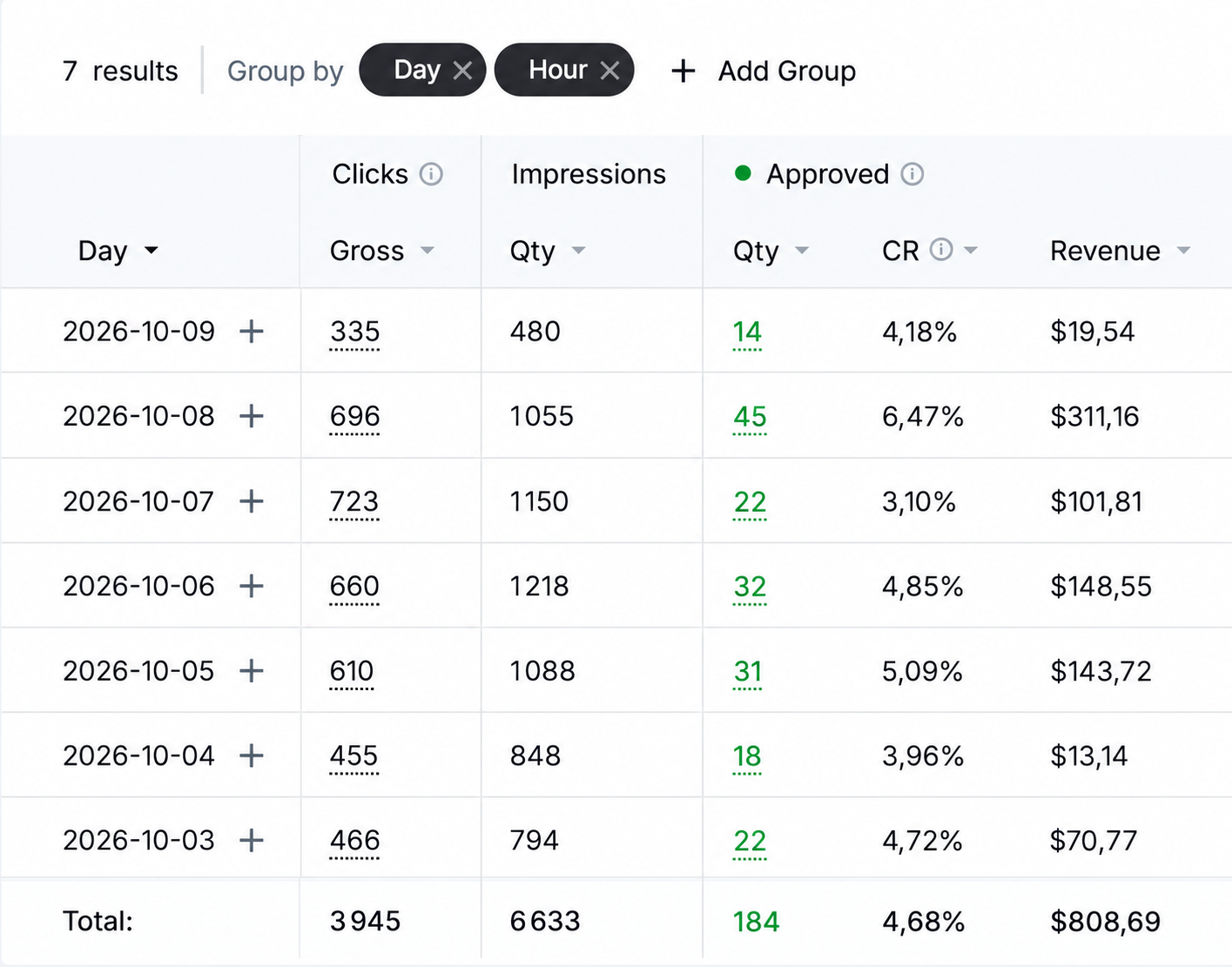
For an iGaming operator, the advantage is practical: the team can inspect the same attribution and commission chain that drives a partner statement, then focus on the placement, cohort or rule that explains a change. Scaleo also supports scheduled reporting and role-based access, so a finance reviewer and an affiliate manager can use the same underlying program data without needing identical permissions. These are capabilities to validate against your event schema and deal terms in a live demonstration. A software feature cannot compensate for missing or mislabelled events sent by the casino or sportsbook.
Our affiliate tracking software guide explains Scaleo’s broader platform functions. If you are evaluating a reporting move, show us a difficult payout case from your own program. The useful demonstration is the one that traces it from source event to partner-facing result.
A reporting acceptance checklist for operators
Before signing off, have the affiliate lead, finance owner, risk owner and integration lead agree on these checks. Save a sample report and the underlying records for each case.
- Definitions: FTD, qualified FTD, NGR, approved commission and paid commission are defined once and visible to relevant users.
- Lineage: One conversion can be traced to its click or other agreed attribution key, source event, effective deal and final commission result.
- Segmentation: A manager can isolate a partner’s campaign or SubID and compare like-for-like cohorts by brand, product and GEO.
- Status changes: Pending, rejected, adjusted and approved events show their history without silently rewriting the original event.
- Reconciliation: A closed period’s statement matches an export with the same filters, currency and rounding rules.
- Permissions: Affiliate, manager, risk and finance accounts each see the appropriate data and cannot see unrelated partner records.
- Exception handling: Duplicate postbacks, late approvals, chargebacks and missing player references have an owner and a visible resolution path.
- Freshness: Every view makes clear whether it is live, provisional or a closed-period result.
If one check fails, name the owner of the underlying data or rule. Do not solve a tracking defect with a manual reporting adjustment that cannot be repeated next month. The cost of that shortcut rises with every partner and every additional brand.
Frequently asked questions
What is iGaming affiliate reporting software?
It is the reporting layer of an affiliate platform that connects partner-sourced traffic with qualified player events, revenue, commission calculations and payout status. For operators, it should support decisions and reconciliation, not just display click and registration totals. The definition of every metric should be tied to the program’s event and commission rules.
Which KPIs should an affiliate manager check first?
Start with qualified FTDs, qualification rate, cost per qualified FTD, cohort NGR and the share of events pending or rejected. Then drill into partner, campaign and SubID. The right set depends on the deal model and observation window; a RevShare cohort cannot be judged by the same first-day cost snapshot as a CPA campaign.
Should affiliates and operators see the same dashboard?
They should see consistent definitions and the performance needed to understand their deal, but they should not have identical access. An affiliate needs transparency about attributed activity and commission status. The operator also needs risk signals, cross-partner comparisons and confidential financial detail. Role-based views protect both clarity and data boundaries.
Why does a report disagree with the finance payout file?
Common causes include different date fields, a pending-versus-approved mismatch, late FTD qualification, revenue adjustments, different NGR deductions, exchange rates and rounding. Start with one partner and one period, compare the event IDs and statement versions, and resolve the rule behind the mismatch before changing totals manually.
Is real-time reporting enough to approve commissions?
No. Live data helps a manager react quickly, but some player and revenue events remain provisional until verification or settlement. Approve commissions against the agreed eligibility and close process. A trustworthy platform shows both the current operational view and the final payable result.
The report should survive the hardest partner question
The test of affiliate reporting software is simple: when a partner asks why a conversion or payout changed, can your team answer with an event, a rule and a timeline? If so, the dashboard is doing more than illustrating performance. It is helping you manage acquisition spend, protect margin and keep credible relationships with the affiliates worth growing.
Scaleo’s reporting belongs in that decision process. Begin with the software comparison guide, then use your own event chain and commission statement to verify the view your operators and affiliates will actually rely on.